

I have sat with European mill buyers on ferrosilicon long enough to keep a producer list and a traded assessment in separate columns. On 10 November 2026 Elkem, writing from Oslo, said it will increase its ferrosilicon sales prices in the EU by a minimum of 10 percent compared with third-quarter 2026 levels, effective immediately or as contracts allow. I opened that Cision release in this session, and the figure that belongs in the headline is the list, on coal, energy and wider costs, with the euro market print left unpublished.
The quarter those prices are measured against was already on the record. On 29 October Elkem reported Elkem Silicon EBITDA down 43 percent from the third quarter of 2025, with the division still marked by weak silicon and ferrosilicon sales prices, on operating income of NOK 2,142 million, itself down 9 percent. A minimum 10 percent lift off that realised base can repair a margin on the next booking and still leave the average invoice behind the new schedule until contracts roll. The phrase that carries the timing is "as contracts allow."
Key facts
- Elkem will raise EU ferrosilicon sales prices by a minimum of 10 percent versus third-quarter 2026 levels, effective immediately or as contracts allow. Elkem via Cision, 10 November 2026.
- Elkem Silicon third-quarter operating income was NOK 2,142 million, down 9 percent, and EBITDA was down 43 percent on weak silicon and ferrosilicon sales prices. Elkem, 29 October 2026.
- Group EBITDA was NOK 554 million, down 14 percent from NOK 646 million, on total operating income of NOK 3,587 million, down 2 percent. Elkem, 29 October 2026.
- Residual anti-dumping duty stays at 31.2 percent on Chinese ferro-silicon and 22.7 percent on Russian ferro-silicon. Regulation (EU) 2026/1794, text opened 14 November 2026.
- Out-of-quota ferro-silicon faces a safeguard price threshold of EUR 2,408 a tonne. Annex II of Regulation (EU) 2025/2351, opened 14 November 2026.
- Elkem Rana produces about 80,000 tonnes of ferrosilicon a year. A NOK 260 million furnace renewal starts in the first quarter of 2027. Elkem, 30 September 2026.
- Landsvirkjun will supply the Iceland plant with 127 MW and about 1,035 GWh a year through March 2039. Elkem, 29 October 2026.
From a February shutdown to a November list
On 10 February 2026 Elkem said it would temporarily curtail Rana and Salten on a difficult market, high inventories and high power prices. As of 13 February, both Rana furnaces and the three Salten furnaces were to be shut. Inge A. Grubben-Strømnes, then senior vice president for Silicon Products at Elkem, said the adjustment was meant to optimise value and to ease a tight northern power market. Rana's product there is ferrosilicon for steel, while Salten mainly produces silicon metal, a different commodity on the same power bill.
Commission Implementing Regulation (EU) 2026/1794, done at Brussels on 27 July 2026, put definitive anti-dumping duties back on ferro-silicon from China and Russia after an expiry review. Elkem's third-quarter release called the renewal an additional five years, with residual rates of 31.2 percent for Chinese producers in general and 22.7 percent for Russian producers in general. Article 1, opened on 14 November, sets lower rates for Erdos Xijin Kuangye, Lanzhou Good Land and Bratsk, and the table keeps those names off the residual line.
On 30 September Elkem approved NOK 260 million to renew one of the two furnaces at Elkem Rana, plus off-gas equipment at the end of its life. Installation starts in the first quarter of 2027, and the second furnace keeps running. Luiz Simão, senior vice president of Elkem Silicon, said the investment would secure continued safe, low-emission and cost-competitive production, using Elkem's latest proven technology. Output in that release is about 80,000 tonnes of ferrosilicon and 15,000 tonnes of Microsilica a year.
At 07:00 CET on 29 October, group EBITDA was NOK 554 million against NOK 646 million, on total operating income of NOK 3,587 million, down 2 percent. Foundry Alloys posted operating income of NOK 1,056 million, up 5 percent, with EBITDA up 7 percent, and Carbon posted operating income of NOK 782 million and EBITDA of NOK 183 million, while Silicon carried the weak sales prices. Equity at 30 September was NOK 12,982 million, 45 percent of assets, net interest-bearing debt was NOK 6,459 million or 3.3 times EBITDA, and cash was NOK 5,459 million with about NOK 4,500 million undrawn. The outlook said silicon prices, meaning silicon metal, rose modestly in the third quarter and kept rising in the fourth, with a stable fourth-quarter result expected. The ferrosilicon list arrived twelve days later.
The same release recorded Elkem Iceland's Landsvirkjun contract through March 2039, 127 MW and about 1,035 GWh a year, tied to a strategic review announced in the second quarter.
On 10 November the sales list moved, timestamped 11:43 CET: a minimum of 10 percent versus third-quarter 2026 levels, effective immediately or as contracts allow, on coal, energy and broader inflation. Efficiency work offset only part of the cost rise. Odd-Geir Lyngstad, vice president of finance and investor relations, and Marianne Stigset, vice president of corporate communications and public affairs, are the contacts. The page gives the percentage and withholds a euro price for any dealt assessment.
Notice C/2026/5959, dated 13 November 2026, opened the first review of the ferro-alloy safeguard imposed on 18 November 2025, inside the one-year window the Commission had set. The file covers ferro-silicon together with ferro-manganese, ferro-silico-manganese and ferro-silico-magnesium. Above a product-specific tariff-rate quota, the extra duty equals the gap between a price threshold and the import price. Parties from the 19 December 2024 proceeding keep their status, new parties had 15 days to register, and written views were invited within 21 days, with hearings only if exceptional circumstances require them.
What the minimum 10 percent is tied to
A ferrosilicon price, as a buyer uses the phrase, is a delivered assessment for a stated silicon content, size and region. Elkem's sentence is a minimum change in its own EU sales prices against third-quarter realisations, and with Silicon EBITDA down 43 percent, 10 percent on that base can be a large move in the next margin beside an older peak a mill still remembers.
"Effective immediately or as contracts allow" lets a spot booking or a renewal reprice at once, while a quarterly or annual agreement keeps the old number until the clause says otherwise. The press release is the offer, and the purchase order is the price. Until someone publishes the volume still inside unexpired contracts, the 10 percent is a floor on the new list and the booked average stays a blend the release leaves uncalculated.
Elkem names coal and energy, plus wider inflation, and says efficiency work absorbed only part of the rise, without a coal index or a power tariff. Newcastle coal and API2 track seaborne thermal coal, a different commodity from a Norwegian furnace reductant. The February curtailment blamed high power prices in northern Norway, while the Iceland deal is a long contract, and the two facts can share a year.
In the third quarter Elkem received 1.3 million additional free EU ETS allowances for 2021 to 2025, after a July 2025 finding of unequal treatment versus EU producers, and it holds 1.3 million surplus allowances. For 2026 to 2030 the Norwegian plants were told to expect allowances in line with comparable EU producers. That stock changes the cash cost of compliance beside the EU carbon allowance price, so the energy bill and the cash energy bill can diverge.
Duties already on the import book
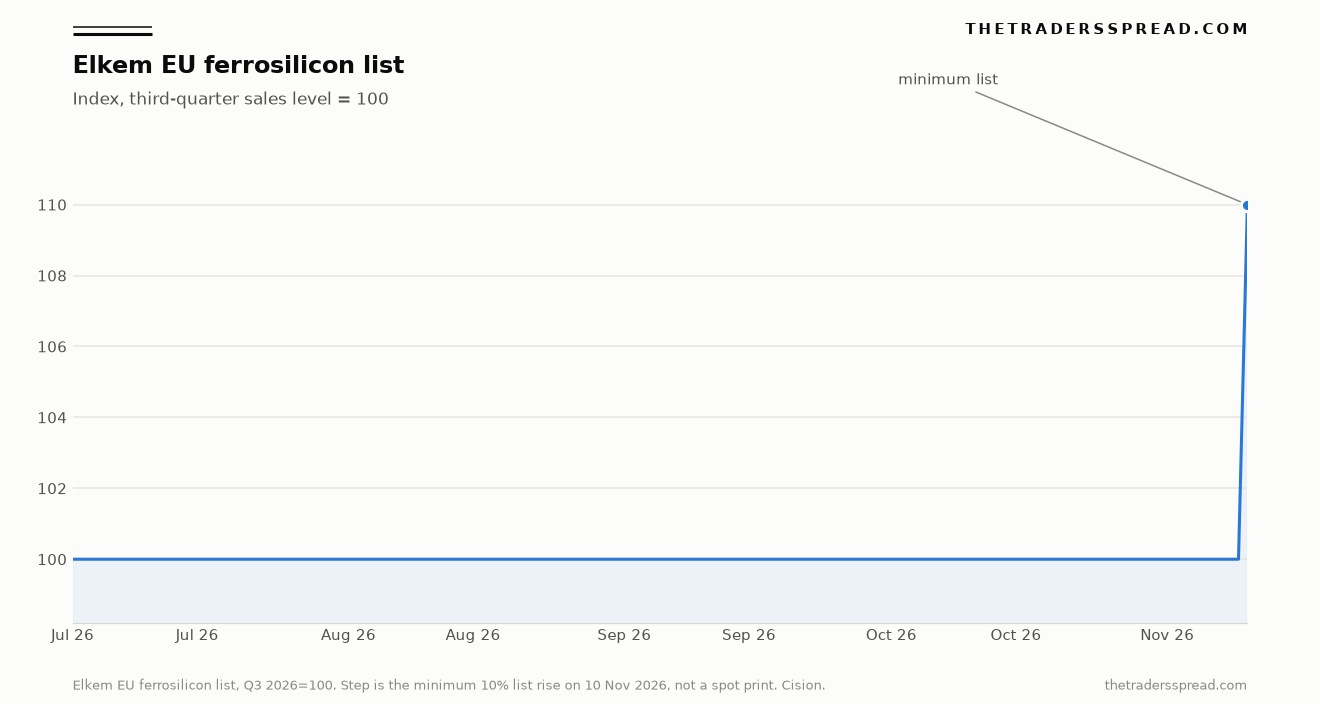
The chart is the list step alone. Third-quarter 2026 sales sit at 100, and the 10 November minimum sits at 110. The release supplied a percentage and no euro series, so the line is an index of Elkem's schedule. A later assessment, with a date and a delivery basis, would be a second line.
Article 1 of Regulation (EU) 2026/1794 duties ferro-silicon under CN codes 7202 21 00, 7202 29 10 and 7202 29 90 from China and Russia, on the net free-at-Union-frontier price before duty. Individual rates need a commercial invoice with a prescribed declaration. Missing that invoice, the residual rate applies.
| Instrument | Who it hits | Figure | Where I read it |
|---|---|---|---|
| Anti-dumping, China, Erdos Xijin Kuangye | Ferro-silicon, named plant | 15.6 percent | Art. 1, Reg. (EU) 2026/1794, opened 14 Nov 2026 |
| Anti-dumping, China, Lanzhou Good Land | Ferro-silicon, named plant | 29.0 percent | Same article |
| Anti-dumping, China, all other companies | Ferro-silicon residual | 31.2 percent | Same article; Elkem Q3 release, 29 Oct 2026 |
| Anti-dumping, Russia, Bratsk | Ferro-silicon, named plant | 17.8 percent | Art. 1, Reg. (EU) 2026/1794 |
| Anti-dumping, Russia, all other companies | Ferro-silicon residual | 22.7 percent | Same article; Elkem Q3 release, 29 Oct 2026 |
| Safeguard price threshold | Out-of-quota ferro-silicon, CN 7202 21 and 7202 29 | EUR 2,408 per tonne | Annex II, Reg. (EU) 2025/2351, opened 14 Nov 2026 |
| Elkem EU sales list | Elkem's own EU ferrosilicon sales | Minimum plus 10 percent versus Q3 2026 levels | Elkem via Cision, 10 Nov 2026 |
EUR 2,408 a tonne is the level below which an out-of-quota import pays a variable duty equal to the gap, on the 13 November notice. A cargo inside a tariff-rate quota never meets that threshold, and a cargo above the quota meets it when the declared price sits under EUR 2,408. Elkem's 10 percent is a change against its own third-quarter realisation, a commercial schedule on top of that legal structure for a Norway and Iceland producer.
Dag Teigland, chief executive of Elkem, said in the 29 October release: "Recent EU trade policy developments point to a greater willingness to deploy defensive trade measures to restore a level playing field and protect Europe's strategic industrial value chains. This is encouraging, and bolsters the market outlook for Elkem's products."
The same release noted a separate interim review of duties on silicon metal from China, currently 16.8 percent and last renewed in 2022. Silicon metal and ferrosilicon share a furnace and clear under different codes, so that duty prices a different product from the ferro-silicon bands in the table. The 13 November review can move the ferro-silicon quota and the EUR 2,408 threshold, or leave both standing, in the same week as the list.
The tonnes at Rana and the megawatts in Iceland
One Rana furnace comes out in the first quarter of 2027 for about three to four months, with the second furnace kept running, so part of the roughly 80,000 annual tonnes steps offline and then returns. Elkem framed the NOK 260 million job as competitiveness and biocarbon work, with lower dust and process emissions, after the February curtailment.
RelatedBismuth refined quote rose 5.4% off the autumn low
Elkem expects the Landsvirkjun contract to improve competitiveness and calls it an important element in a strategic review that stays open on the 29 October page. Headcount in the 30 September line, after the silicones sale, is about 3,000 people across more than 20 locations, headquarters in Oslo, listed as ELK. The 10 percent is aimed at Silicon's EU ferrosilicon sales, the book that printed the weak quarter.
Who pays, and on which clock
The buyer who feels the EU list is a melt shop, a foundry or a trader whose contract is up. A mill with tonnes still on an annual agreement pays the old price until that agreement yields. A repeatable assessment moves when deals move, and deals after 10 November show whether buyers take the schedule Elkem has set.
Shanghai steel rebar clears on its own inventories, mill margins and a Chinese delivery point, which is why an alloy list can rise while a finished-steel quote is heavy. Elkem leaves the tonne split across carbon steel, electrical steel and foundry unpublished, and mills can change silicon additions or lean on Norwegian and Icelandic quota material. Cash and undrawn lines at the third-quarter scale let Elkem hold the new list through a weak Silicon quarter, while a mill with a full book can wait out an old contract.
What to watch next
The next evidence is procedural and commercial. I would tick these before treating the list as the dealt price.
- Whether EU renewals confirm the minimum 10 percent, or unexpired contracts keep third-quarter levels on a stated volume.
- Whether a named reporter publishes a European ferrosilicon assessment after 10 November, with silicon content, delivery basis and date.
- Written views in notice C/2026/5959, due 21 days from 13 November 2026, including any move in the EUR 2,408 threshold or the ferro-silicon quota.
- Rana's renewal from the first quarter of 2027, about three to four months on one furnace, the second kept in production.
- The Iceland strategic review, still open on 29 October, beside the Landsvirkjun contract through March 2039.
- Coal, northern power and the 1.3 million surplus ETS allowances, each on its own print, since Elkem named coal and energy as the cost reason.
- Whether the fourth-quarter result stays stable, as Elkem expected on 29 October, and whether the modest silicon-price rise lands in ferrosilicon or in silicon metal.
Questions on the ferrosilicon price
Is the 10 percent a rise in the dealt European ferrosilicon price?
The 10 percent is the minimum Elkem set on its own EU ferrosilicon sales list against third-quarter 2026 realisations. The Cision text, at 11:43 CET on 10 November 2026, takes effect immediately or as contracts allow and names coal, energy and wider cost pressure. A dealt assessment needs its own grade, delivery point and date. Elkem published the percentage and left the euro print for a later assessment.
Why lift the list after Elkem Silicon's weak quarter?
On 29 October Elkem put Silicon EBITDA down 43 percent year on year, on operating income of NOK 2,142 million, and said weak silicon and ferrosilicon prices were still the drag. The 10 November list asks EU customers for at least 10 percent more than those third-quarter levels. Dag Teigland, the chief executive, had already tied renewed EU trade measures to the outlook. The new schedule reaches the booked average only when contracts let it onto the invoice.
Which clocks matter before the next EU invoice?
Contract renewals decide when the 10 percent replaces the third-quarter level on a given volume. The safeguard review opened on 13 November 2026, written submissions run for 21 days, and EUR 2,408 a tonne is still the out-of-quota reference. Rana's renewal starts in the first quarter of 2027 for about three to four months, with the second furnace kept online. The Iceland contract runs to March 2039 inside a strategic review Elkem left open on 29 October.
This is analysis for information only. Ferrosilicon list changes, mill contracts and import duties can diverge from any single percentage, and capital committed on a headline figure can be lost.