

Calling Tellurium a primary mined metal, with a pit of its own and a daily screen price, misreads the chapter the U.S. Geological Survey published in February 2026. The metal is recovered from the residues of copper anodes. The figure the Survey prints is an annual average, in dollars per kilogram, and the 2025 column is marked as an estimate.
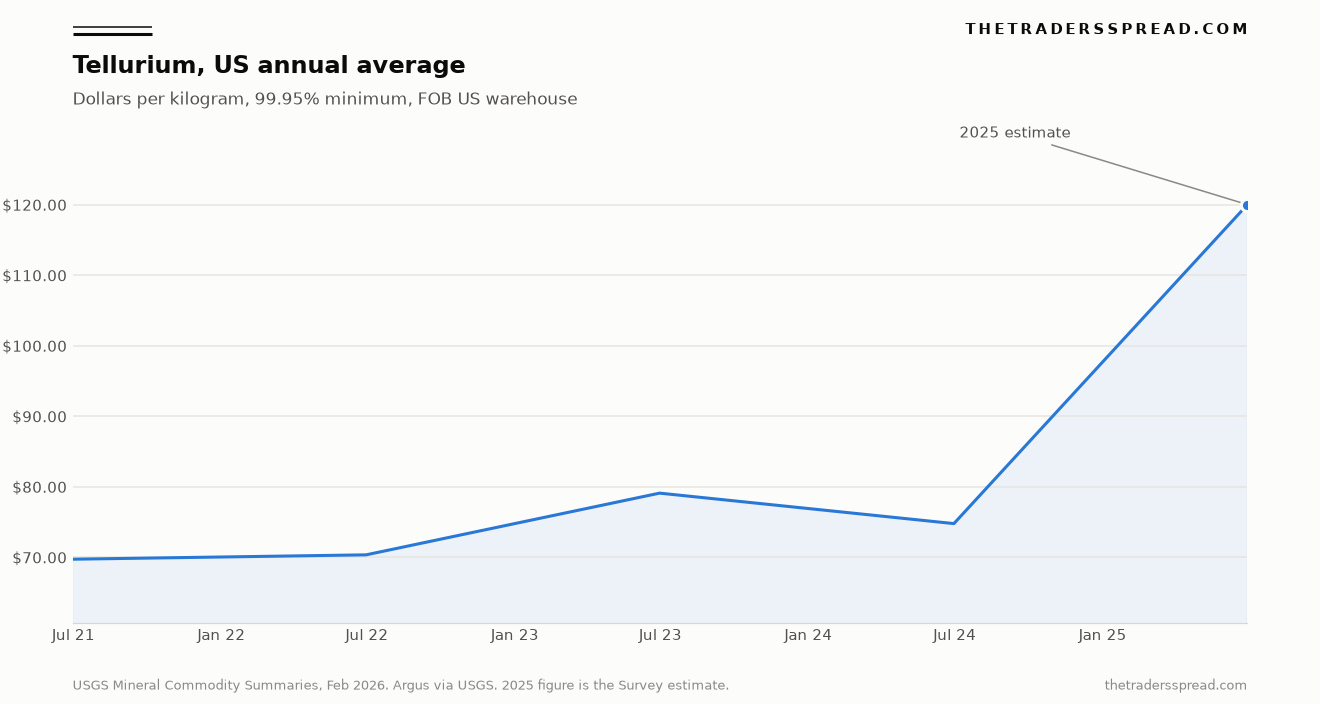
We opened that chapter, prepared by Daniel M. Flanagan, and the pages that sell or consume the metal. The US annual average for at least 99.95 percent purity, free on board a US warehouse, was $69.72 a kilogram in 2021, $70.34 in 2022, $79.09 in 2023, $74.77 in 2024 and an estimated $120 in 2025. Rotterdam, a 99.99 percent grade in warehouse, ran $67.26, $68.10, $76.74, $81.54 and an estimated $150. Argus Non-Ferrous Markets is the source named for both. The European average rose 84 percent because Chinese export controls limited availability, and the US average rose 60 percent as buyers who missed metal in Europe came into the US spot market. Solar cells are estimated at 70 percent of global end use. The 2025 print is the license window, on a supply base that copper refining sets.
Updated 17 November 2026, the figures below are reference data from the source and the date named with each one. No daily tellurium quote would open on a page we could read, so the price here is the published annual unit value.
Key facts
- Estimated global end use in 2025 was solar power cells 70 percent, thermoelectric devices 15 percent, metallurgy 10 percent and other applications 5 percent. USGS Mineral Commodity Summaries, February 2026.
- The US annual average for tellurium of at least 99.95 percent purity was an estimated $120 per kilogram in 2025, from $74.77 in 2024. USGS Mineral Commodity Summaries, February 2026, citing Argus.
- The Rotterdam annual average for tellurium of at least 99.99 percent purity was an estimated $150 per kilogram in 2025, from $81.54 in 2024. USGS Mineral Commodity Summaries, February 2026, citing Argus.
- China's estimated refined output was 800 metric tons in 2025, beside a rounded world total of 1,000 metric tons that excludes withheld US production. USGS Mineral Commodity Summaries, February 2026.
- More than 90 percent of tellurium has been produced from anode slimes at primary electrolytic copper refineries. USGS Mineral Commodity Summaries, February 2026.
- US imports for consumption were an estimated 14 metric tons in 2025, after 6 metric tons in 2024, with exports an estimated 3 metric tons in both years. USGS Mineral Commodity Summaries, February 2026.
- First Solar's Series 7 page lists cadmium-telluride modules at up to 550 watts and up to 19.7 percent efficiency, with a 0.3 percent warranted annual degradation rate. First Solar, page opened 17 November 2026.
1. Chinese licenses, and the annual average that moved
Rank the drivers by what the published price did, and the export rule comes first. As of February 2025, exporters in China had to file documents verifying the end user and the end use of tellurium shipped abroad. A license typically took 45 days, and any change of recipient or intended use required a new one. In Europe those controls limited availability. The annual average rose 84 percent, from $81.54 a kilogram in 2024 to an estimated $150 in 2025. The same paragraph says the shortage pushed spot buying into the United States, where the warehouse average rose 60 percent, from $74.77 to an estimated $120.
From 2021 to 2024 the US average stayed inside a band of about $10 a kilogram and slipped in 2024, while Europe climbed from $67.26 to $81.54 before the jump. The series are different goods, 99.95 percent free on board a US warehouse against 99.99 percent in warehouse at Rotterdam, so the columns stay separate.
China was the leading refined producer in 2025 and accounted for 80 percent of estimated global production, excluding countries too thinly reported to estimate. Output is 750 metric tons in 2024 and 800 in 2025, against capacity of 1,000. Over ten years that output rose with a near-75 percent increase in electrolytic copper-refining capacity, while copper-anode capacity more than doubled. The license sits on a refining system that grew with copper, inside one country.
Our gallium export-rules note and the indium premium piece cover sister metals under Chinese licensing, and the bismuth note is the refined-quote companion. Tellurium's chapter is the one that puts 84 percent and 60 percent on the two annual averages. A Ministry of Commerce page would not open this session, so the timing and the percents are the Survey's, dated February 2026, on rules that took effect in February 2025.
2. Copper-anode slime, the stream the metal comes from
Under that print, supply is a copper byproduct. Tellurium accumulates in the residues of copper anodes during electrolytic refining of primary copper. More than 90 percent of it has been produced from those anode slimes. The rest has come from lead-refinery skimmings and from flue dusts and gases at smelters treating bismuth, copper and lead-zinc ores. Bismuth telluride ores and gold telluride ores are named as further potential sources. Reserves are generally unreported by mine or country and cannot be reliably quantified.
The supply lever named first is the host material, primarily copper. In 2025, recovery of copper telluride from domestic anode slimes was estimated lower than in 2024, because US primary electrolytic refineries poured fewer cathodes. Our copper note is that host market. It has its own quote, and it is still the ore body this metal rides on.
A company post uses a different word for the residue. On 6 April 2026 First Solar said tellurium at Rio Tinto's Kennecott operation in Salt Lake County, Utah, is recovered from copper mining tailings and used in the photovoltaic semiconductor. The Survey's phrase is anode slime from electrolytic refining. Tailings are what a mill leaves at a mine. Anode slime settles when a copper anode is refined to cathode. Both streams can carry tellurium, at different plants and different steps. The post is the manufacturer's Utah supply line. The chapter is where commercial tellurium has been won.
Our US supply chain stretches from coast to coast — and even reaches underground. At the @RioTinto Kennecott mine in Salt Lake County, Utah, tellurium is recovered from copper mining tailings to be repurposed into our powerful photovoltaic semiconductor.
— First Solar (@FirstSolar) April 6, 2026
Supporting First… pic.twitter.com/2FTYpOHUFH
5N Plus uses the refinery-residue wording. On the high-purity metals page opened 17 November 2026, tellurium runs from 2N5 to 7N, as ingot, powder, lump, stick, shots and pellets, extracted primarily from copper and lead refining residues for cadmium-telluride cells and thermoelectric devices. The history page dates a Montreal expansion of tellurium recovery to 2022, for renewable-energy demand, with no tonnage attached. A 35 percent rise in Montreal capacity in 2023 is written as a plant-wide figure, so it stays off the tellurium line.
3. Cadmium telluride, seven tenths of estimated use
The use book is where the residue becomes a solar material. Estimated global end use in 2025 is solar cells 70 percent, thermoelectric devices 15 percent, metallurgy 10 percent and other applications 5 percent. A book that is seven tenths one application feels a factory ramp, and a pause in that ramp, more than a change in free-machining steel.
In August 2025 the leading US producer of solar modules opened a fifth domestic plant, with production expected by year-end 2026 and a ramp in the first half of 2027. The company, which predominantly made cadmium-telluride modules, projected as much as 14 gigawatts a year in the United States at full capacity. The name stays off that page. First Solar's own pages, opened 17 November 2026, are the cadmium-telluride manufacturer whose capacity figure sits next to it.
Series 7 is a thin-film cadmium-telluride module. TR1, for the US utility market, is designed in California and Ohio and made in Ohio, at up to 550 watts, up to 19.7 percent efficiency, a 30-year warranty and 0.3 percent warranted annual degradation. The same page puts FT1 at 505 to 540 watts and up to 19.3 percent for fixed-tilt work in India.
The manufacturing page says five US factories, three in Ohio, Alabama, and one then expected in Louisiana in the fourth quarter of 2025, together 14 gigawatts at full operation, while a strip on the same page says more than 14 gigawatts expected in 2026. The locations page already lists New Iberia, Trinity, Perrysburg and Walbridge. Read on 17 November 2026, the two pages disagree on whether Louisiana was still prospective. The First Solar note is the equity page.
The polysilicon explainer is the rival solar quote. Thin-film tellurium demand does not inherit it. Amorphous silicon and copper indium gallium diselenide are the two principal thin-film competitors the Survey names, usually with losses in efficiency or product characteristics.
4. Who actually refines it
Slime is a step short of the graded metal in the price table. US copper-telluride production is withheld for every year from 2021 through 2025. The two domestic electrolytic refineries, one in Texas and one in Utah, produced copper telluride and exported it for further processing. Refined tellurium, high-purity products, compounds and tellurium dioxide came from imported metal worked up downstream. Production, consumption, apparent consumption and producer stocks in the United States are withheld. A domestic consumption tonnage for 2025 is a figure the chapter withholds.
The refinery table is what the February 2026 chapter will print, in metric tons. The 2025 column is estimated except Sweden's concentrate, marked reported. World totals are rounded and exclude withheld US output. The 2024 country lines add to the printed 981. The 2025 lines add to 1,028, against a rounded world total of 1,000, and that gap stays visible. Producers who stopped at ore, blister, anodes or slime, without refined metal, are excluded. Australia, Belgium, Chile, Germany, India, Indonesia, South Korea and the Philippines may refine, on information the Survey calls inadequate.
| Country | 2024 | 2025e | Capacity |
|---|---|---|---|
| Bulgaria | 1 | 1 | 5 |
| Canada | 27 | 28 | 30 |
| China | 750 | 800 | 1,000 |
| Japan | 70 | 61 | 75 |
| Russia | 64 | 67 | 80 |
| South Africa | 5 | 5 | 10 |
| Sweden, concentrate | 46 | 48 | 50 |
| Uzbekistan | 18 | 18 | 50 |
| World total, rounded, excludes US | 981 | 1,000 | 1,300 |
On 10 June 2026 First Solar's account called Kennecott the only tellurium processing facility in the United States, and called tellurium the foundation of its cadmium-telluride technology. The February chapter says those US facilities shipped copper telluride and that graded metal was refined abroad. Copper telluride and the 99.95 percent metal in the price table are sequential products. The post is a manufacturer's claim about Utah. The chapter is the Survey's claim about where the priced metal was made.
First Solar CEO Mark Widmar met with Utah @GovCox at the Energy Imperatives Summit in Washington, D.C. this week.
— First Solar (@FirstSolar) June 10, 2026
Utah is home to @RioTinto's Kennecott mine and the only tellurium processing facility in the United States. Tellurium is the foundation of First Solar’s cadmium… pic.twitter.com/IpmLIs4qnP
5. The US trade book, and a free tariff line
Imports ran 42, 37, 8, 6 and an estimated 14 metric tons across 2021 to 2025. Exports, which may include copper telluride, ran 2, 1, 15, 3 and an estimated 3. Reliance went from above 95 percent to a net-exporter mark in 2023, when 15 tons out beat 8 tons in, then back above 25 percent in the 2025 estimate. Apparent consumption stays withheld, so that reliance line cannot be rebuilt from a consumption series.
RelatedWhy Rhenium Metal Can Fade to $4,400 or Reach $7,200
| 2021 | 2022 | 2023 | 2024 | 2025e | |
|---|---|---|---|---|---|
| Imports, t | 42 | 37 | 8 | 6 | 14 |
| Exports, t | 2 | 1 | 15 | 3 | 3 |
| US average, $/kg | 69.72 | 70.34 | 79.09 | 74.77 | 120 |
| Europe average, $/kg | 67.26 | 68.10 | 76.74 | 81.54 | 150 |
| Net import reliance | >95% | >75% | E | <25% | >25% |
Combined import sources for 2021 through 2024 were Canada 64 percent, the Philippines 14 percent, Japan 8 percent, Germany 5 percent and other origins 9 percent. Canada also shows as a refiner, at an estimated 28 tons in 2025. The tariff line is 2804.50.0020, free under normal trade relations as of 31 December 2025. The depletion allowance is 14 percent, domestic and foreign. The stockpile entry reads none, so the warehouse assessment is a commercial Argus print carried by the Survey, beside an empty official pile.
Exports of 15 tons in 2023, which may have been copper telluride, made the United States a net exporter under imports minus exports, adjusted for stocks. The sign flipped back the next year. In the 2025 estimate, imports rose from 6 tons to 14 as the US average went from $74.77 to an estimated $120, which matches the sentence on US spot buying after Europe tightened. Where those extra 8 tons went is outside the table, because consumption is withheld.
6. Thermoelectric devices and the steel addition
The other 30 percent of estimated use is still real metal. Bismuth telluride, at 15 percent, cools and makes power from heat. Metallurgy, at 10 percent, is a small addition to steel for machining, to cast iron for chill depth, to lead for fatigue, and to copper alloys for machinability. The residual 5 percent runs from blasting caps and rubber to fibre catalysts, photodetectors and pigments. The chapter never prints one world consumption total, so the shares stay shares, and the 2025 price jump stays assigned to European availability under the license. The iridium note is the other byproduct case on this desk, cleared from a larger ore body into a short industrial list. Tellurium's ore body is copper, and its published balances are metric tons with the US rows withheld.
7. Substitutes, and a recycling stream that is still young
Several materials can replace tellurium in most uses, usually with a loss of efficiency or of product character. Thin-film rivals are amorphous silicon and copper indium gallium diselenide. Some thermoelectric devices can use bismuth selenide or organic polymers. Free-machining steels can use bismuth, calcium, lead, phosphorus, selenium or sulfur. Other catalysts, or no catalyst, can run some of the reactions. Rubber can vulcanize with selenium or sulfur. Solid lubricants can use selenides and sulfides of niobium and tantalum where tellurides of those metals had been used. The chapter prints no price at which any of those switches.
Tellurium was recycled from US cadmium-telluride cells, in a quantity the Survey calls limited because most cells had yet to reach end of life. First Solar's manufacturing page, opened 17 November 2026, lists recycling beside plants in Ohio, Alabama, Louisiana, India, Malaysia and Vietnam. Designed capacity in 2024 was 112,000 metric tons, about 3 million modules, on track for 136,000 by the end of 2026, with glass reuse above 90 percent and closed-loop semiconductor recovery. A number strip puts semiconductor and glass recovery at 90 percent. Designed module tons and recovered tellurium are different units, and the tellurium grade of a spent module stays off both pages.
FAQ
What is the tellurium price?
The sourced figure is an annual average, with no live screen behind it. In the February 2026 Mineral Commodity Summaries the US warehouse average, at least 99.95 percent, was an estimated $120 a kilogram in 2025 after $74.77 in 2024. Rotterdam, at least 99.99 percent, was an estimated $150 after $81.54. Argus is the commercial source the Survey names, and both 2025 figures are estimates in that chapter.
Where does commercial tellurium come from?
Mostly from anode slime at electrolytic copper refineries. The Survey puts more than 90 percent of historical output there, with the rest from lead-refinery skimmings and smelter dusts and gases. US refineries in Texas and Utah produced copper telluride and exported it for further processing. China's estimated refined output was 800 metric tons in 2025, inside a rounded world total of 1,000 that excludes withheld US production.
What is tellurium used for, and what can replace it?
The 2025 estimate puts solar cells at 70 percent of global use, thermoelectric devices at 15 percent, metallurgy at 10 percent and other uses at 5 percent. Solar is cadmium-telluride film, thermoelectric use is bismuth telluride, and metallurgy is a small addition to steel, iron, lead and copper. Amorphous silicon and copper indium gallium diselenide compete in thin film. Bismuth, calcium, lead, phosphorus, selenium and sulfur can stand in for tellurium in many free-machining steels.
Which driver dominates
Copper-anode slime dominates physical supply, at more than 90 percent of historical output, and the Survey says tellurium supply moves with copper. Cadmium telluride dominates use, at an estimated 70 percent. The annual average is a separate question. For 2025 the chapter names Chinese export controls: Rotterdam rose 84 percent to an estimated $150 a kilogram, and US spot buying lifted the warehouse average 60 percent to an estimated $120. On that price series, the license regime dominates. Refinery recovery decides whether slime becomes the graded metal in those assessments. Smaller uses, substitutes and a young recycle stream sit outside the move in the 2025 column.
Desk research here is information for traders who need the supply chain behind a minor-metal quote. It is not a recommendation to buy or sell tellurium, a solar equity or any other security, and capital put at risk can be lost.