

The question the market is actually pricing in iron ore is not whether Simandou will drown the seaborne trade. It is when. At $97.41 a dry metric tonne for the 62% Fe CFR North China benchmark on 15 September 2026, the price sits within a few dollars of where it sat a year ago, and the Singapore forward curve out to March 2027 is a flat line a dollar and a half below spot. That is not the shape a market draws when it expects 120 million tonnes a year of new high-grade supply to land imminently. It is the shape a market draws once it has read the construction schedule. The answer embedded in today's price is that the Guinean supply event is dated 2027 and 2028, and that Chinese steel demand erodes rather than breaks.
Here is the part the consensus write-ups leave out. Rio Tinto's own quarterly filing says its equity share of the SimFer mine sold 190,000 tonnes of iron ore in the entire first half of 2026. Set that against 845.3 million tonnes of Chinese imports over January to August and it is a rounding error on a rounding error. The same filing discloses 7.6 million tonnes of uncrushed ore already stockpiled at the mine gate, stranded behind a port that will not finish commissioning until the first quarter of 2027. Simandou is not missing from the market. It is queued, and the queue has a release date.
Key facts
- 62% Fe CFR North China settled at $97.41/dmt on 15 September 2026, down 0.14% on the day, up 2.59% on the month and down 7.60% year on year — Trading Economics, cross-checked against the CNBC futures quote, retrieved 16 September 2026.
- SGX TSI 62% Fe futures settled at $96.60 (Sep-26), $95.44 (Oct-26), $95.78 (Dec-26) and $95.62 (Mar-27) on 14 September 2026 — Singapore Exchange daily settlement data.
- China produced 651.85 million tonnes of crude steel in January–August 2026, down 3.1% year on year; August alone was 74.61 Mt, down 3.7% — NBS data reported by SteelOrbis, 15 September 2026.
- China imported 845.27 million tonnes of iron ore over the same eight months, up 5.5% — GACC customs data via SteelOrbis, 8 September 2026.
- Portside stocks at China's 45 tracked ports stood at 138.5 Mt on 11 September 2026, roughly 10% below the year-ago level — Mysteel survey.
- Rio Tinto's 45% share of Simandou produced 554,000 tonnes and sold 190,000 tonnes in H1 2026, with 7.6 Mt of uncrushed ore stockpiled and SimFer port commissioning targeted for Q1 2027 — Rio Tinto second quarter operations review, 15 July 2026.
- BHP shipped a record 265 Mt in FY2026 at an average realised US$84.56/wmt and guides FY2027 to 260–272 Mt — BHP operational review filed 16 July 2026.
What the forward curve is actually saying
Forward curves are the cheapest sentiment survey in commodities, and the iron ore curve on 14 September 2026 was close to featureless. The September contract settled at $96.60, October at $95.44, November at $95.70, December at $95.78 and March 2027 at $95.62. The entire twelve-month spread is 116 cents. Open interest says these are not stale marks: 363,291 lots sat in October and 148,435 in December. Real money is expressing a view that the benchmark sits still.
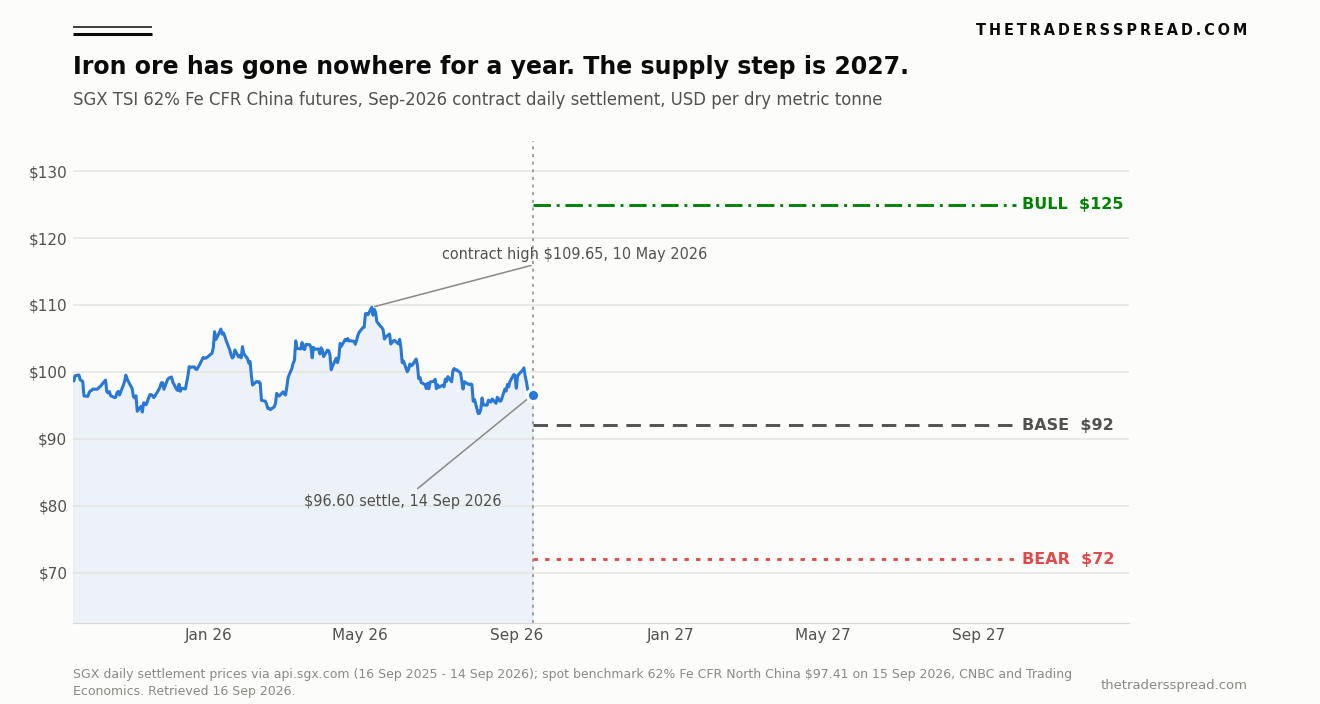
A flat curve at $95 is a specific statement. The marginal tonne is neither scarce nor desperate, nobody with size is paying up for prompt cargoes, and nobody is dumping forward paper ahead of a Guinean avalanche next quarter. The twelve months behind us say the same. The September 2026 contract traded as high as $109.65 on 10 May and as low as $93.76 on 2 August, a 17% range that never threatened the structure of the market.
Compare that with the balance sheets of the people producing the ore.
| Producer | Latest reported volume | Guidance | Realised price |
|---|---|---|---|
| Rio Tinto | Q2 2026 global sales 88.8 Mt, up 5% y/y | 2026 global sales 343–366 Mt, unchanged | Not disclosed quarterly |
| BHP | FY2026 production 265 Mt, a record | FY2027 260–272 Mt | US$84.56/wmt FOB, FY2026 |
| Vale | Q2 2026 sales 79.75 Mt, up 3.1% y/y | 2026 production 335–345 Mt | US$95/t for fines, Q2 2026 |
| SimFer (Rio Tinto 45% share) | H1 2026 sales 0.19 Mt | Full rates during H2 2028 | Not disclosed |
Three incumbents at or near record output, all reaffirming guidance, and a fourth entrant whose first-half sales would fit inside a single Capesize cargo. That is the supply picture the $95 strip is discounting.
The Simandou gap between narrative and tonnes
Simandou deserves the attention. Blocks 1 and 2 belong to the Baowu-Winning consortium, blocks 3 and 4 to SimFer, the Rio Tinto and Chinalco joint venture, and between them they are engineered to export up to 120 million tonnes a year down a 536-kilometre dual-track railway that did not exist four years ago. Rio Tinto's share of the capital bill alone is $6.2bn. The workforce across SimFer's mine, rail and port scope was 19,460 at the half-year, 76% Guinean.
The tonnes are another matter.
Ship-tracking data compiled by Kpler and reported in June 2026 put Morebaya port exports at 2.2 million tonnes in May, up from 1.3 million in April and from 0.6 million or less in each of the first three months of the year. That acceleration surprised people. "The consensus at the start of the year was for a slow, constrained first half given the rail logistics bottleneck," said Alexandre Claude, founder and CEO at DBX Commodities. "The May numbers suggest something has shifted, likely the improving loading cadence at Morebaya as port infrastructure matures."
Even at 2.2 Mt a month, though, Guinea is running at roughly a fifth of the design rate, and the split matters. Most of what has shipped is Baowu-Winning ore moving through the WCS barge port. SimFer is still borrowing that port while its own transhipment facility is finished. Rio Tinto's disclosure is unusually blunt about the consequence: ore leaves the SimFer mine gate uncrushed, final crushing happens in China, and there is a two-to-three month lag between production and recognised sales. Hence 554,000 tonnes of mine-gate production in the first half against 190,000 tonnes of sales, and 7.6 million tonnes sitting in a stockpile.
"At Simandou, we continue to advance at pace," Rio Tinto Chief Executive Simon Trott said on 15 July 2026. "SimFer mine construction and port infrastructure are both now more than three quarters complete, with full rail commissioning achieved in the first quarter." The filing puts numbers on that language: the mine 77% complete, the port and marine infrastructure 85% complete, first ore through the primary crusher expected in Q4 2026, SimFer port commissioning in Q1 2027, and the ramp toward full rates running through H2 2028. On 8 September 2026 SimFer said it had begun progressively commissioning storage-yard systems, stacker-reclaimers and shiploaders at Morebaya.
Read as a supply model rather than a press narrative, that schedule delivers its first genuinely disruptive quarter somewhere in mid-2027. The 7.6 Mt stockpile is the tell. It is deferred supply with a known release mechanism, and it lands on top of the ramp rather than instead of it.
China is importing more ore to make less steel
The demand side contains a contradiction that most iron ore commentary papers over. Chinese crude steel output in the first eight months of 2026 was 651.85 Mt, down 3.1% year on year, with August running 3.7% below August 2025 and 3.0% below July. Pig iron, which is the number that actually consumes imported ore, fell 3.1% to 563.4 Mt. Yet iron ore imports over the same period rose 5.5% to 845.27 Mt, and August imports of 108.09 Mt were 3.1% above the year-ago month.
Less steel, more ore. The gap has three explanations and they are not mutually exclusive.
Domestic Chinese mine output keeps shrinking, so every tonne lost at home is replaced at the wharf. Blast furnace operators have been substituting toward higher-grade imported fines to squeeze productivity out of fewer furnace-hours, which raises the import intensity of each tonne of hot metal. And traders have been willing to hold ore at $95 to $105 because the price has not moved in two years, the same carry logic visible across the copper and aluminium complex this year.
What that surplus has emphatically not done is pile up at the ports. Mysteel's survey of 45 Chinese ports put portside inventories at 138.5 Mt on 11 September 2026, up a negligible 241,500 tonnes on the week but around 10% below where they stood a year earlier. Daily discharge across those ports averaged 3.3 million tonnes over 4–10 September, up 4.2% week on week.
A market carrying 10% less portside cover than a year ago, with mills drawing harder, is not the picture of a glut. It is the picture of a supply chain that has quietly moved inventory from the wharf into the mill yard, which is a less visible and less liquid place to hold it.
Who is responding, and how
The incumbents are behaving as though volume, not price, is the thing to defend. BHP's operational review for the year to 30 June 2026 recorded record iron ore production of 265 Mt and guided FY2027 to 260–272 Mt. "We achieved this against a backdrop of stronger realised prices for both copper and iron ore," said Brandon Craig, BHP Chief Executive Officer, in the same document.
That realised price deserves a moment, because it is the number most retail coverage of iron ore gets wrong. BHP's average realisation was US$84.56 per wet metric tonne FOB, up 3% on FY2025's $82.13. The headline $97.41 is a dry-tonne, delivered-to-China number. Strip out moisture and freight and the gap between the two is most of what separates an index quote from a producer's revenue line. Vale, selling into the same market, realised $95 per tonne for fines in Q2 2026, up 11.6% year on year, because its Brazilian product is higher grade and priced differently.
Vale reaffirmed 2026 guidance of 335–345 Mt. Rio Tinto reaffirmed 343–366 Mt of global sales. Nobody is cutting, which is also why the Australian dollar has tracked volume rather than price this year.
The other actor worth watching is the buyer. China Mineral Resources Group, the state procurement vehicle Beijing created to centralise iron ore purchasing, has spent the past year testing how much pricing power a single counterparty can assemble against three sellers. Simandou changes that arithmetic permanently, since Chinese state entities hold large stakes on both sides of the Guinean project. The tonnes are not simply new supply. They are supply the buyer partly owns.
The precedent that rhymes
Iron ore has run this experiment before. Between 2014 and 2016 the Pilbara majors and Vale added expansion tonnes into a decelerating Chinese steel cycle, and the benchmark fell from roughly $135 to below $40. The lesson traders drew was that iron ore supply arrives in indivisible lumps and demand adjusts in slivers.
Two things are different this time, and both argue against a repeat of that severity.
The first is that the 2014 wave was incumbent expansion designed explicitly to push higher-cost supply out of the market, which meant the sellers wanted a lower price. Simandou is a new entrant part-owned by the largest buyer, ramping over three years rather than eighteen months, and its high-grade product substitutes for mid-grade fines rather than simply adding to them. The second is that China's domestic mine supply, which absorbed much of the 2014 shock by shutting down, is already far smaller. There is less marginal tonnage left to displace.
RelatedNaphtha climbed 2.90 percent alongside crude highs
Ewa Manthey, Commodities Strategist at ING, set out the bear framework in December 2025 with a simple forecast: "We see prices averaging $95/t in 2026." Nine and a half months later, with the year-to-date average hovering close to $100 and spot at $97.41, that call has aged better than almost anything else written about iron ore last winter. It is also a useful reminder that the bear case here is a slow grind, not a crash.
The call
Base case, $92 by late 2027 (about 50% probability). The forward curve, Trading Economics' own model at $94.54 on a twelve-month view, and ING's $95 average all cluster in the same place, and there is no good reason to be clever about it. SimFer's port commissions in Q1 2027, the 7.6 Mt stockpile clears through China over the following two quarters, Guinean exports move from something like 25 Mt annualised toward 45 Mt, and Chinese pig iron keeps falling 3% a year. Those two forces roughly cancel through mid-2027 and then tip mildly bearish. A drift from $97 to the low $90s is what that looks like.
Bear case, $72 (about 25% probability). This requires two things at once: Simandou hitting the upper end of its ramp while Chinese crude steel output falls faster than 3%, most plausibly through a formal capacity-cut mandate rather than the voluntary restraint mills have ignored so far. At $72 the price is through the cost support that has held since 2019 and into the part of the curve where Chinese domestic concentrate and marginal Indian and Iranian tonnes shut in. Getting there needs port inventories to rebuild above 160 Mt first, which is the signal to watch.
Bull case, $125 (about 25% probability). Less exotic than it sounds. Iron ore printed $105.14 as recently as March 2026 and $109.65 on the September futures contract in May. The path to $125 runs through a Guinean slip of two or three quarters, which the wet season, the rail commissioning schedule and one labour dispute could each deliver on their own, combined with a Chinese infrastructure impulse that stabilises pig iron. Portside stocks are already 10% below last year. A restock from that base against delayed Simandou tonnes is how this market squeezes.
What would change my mind. A single month of Guinean exports above 6 Mt before the SimFer port commissions would mean the barge-port workaround scales better than the filings imply, and the 2027 supply step arrives early. Conversely, portside stocks holding below 135 Mt into the Chinese winter restock, with imports still running above 105 Mt a month, would say the mills are tighter than the steel-output numbers suggest and the base case is too low.
FAQ
What is the iron ore price today?
The 62% Fe CFR North China benchmark settled at $97.41 per dry metric tonne on 15 September 2026, down 0.14% on the previous day. That is 2.59% higher than a month earlier and 7.60% lower than a year earlier. All prices in this piece are quoted on that benchmark and were retrieved on 16 September 2026 from Trading Economics and the CNBC futures quote service.
Why is Simandou considered such a big deal for iron ore?
The Guinean project is engineered to export up to 120 million tonnes a year of high-grade ore once both consortia reach capacity, equivalent to roughly 8% of global seaborne trade, from a country that exported none of it in 2024. It is also the first large new source of supply in decades in which Chinese state entities hold direct ownership stakes, which changes the bargaining position between the world's largest buyer and the three incumbent sellers.
How much iron ore has Simandou actually shipped?
Morebaya port exports reached 2.2 million tonnes in May 2026, up from 1.3 million in April and under 0.6 million in each month of the first quarter, according to Kpler ship-tracking data. Most of that is Baowu-Winning ore. Rio Tinto's 45% equity share of the SimFer mine recorded just 190,000 tonnes of sales across the whole first half of 2026.
Does a lower iron ore price mean the big miners lose money?
Not at these levels. BHP realised an average US$84.56 per wet metric tonne FOB across FY2026 against Pilbara unit costs well below that, and Vale realised US$95 a tonne for fines in Q2 2026. The majors sit at the bottom of the global cost curve, which is precisely why none of them has trimmed guidance. Pressure at $72 would fall first on Chinese domestic mines and marginal seaborne suppliers.
What do Chinese port inventories tell you about iron ore?
Portside stocks are the market's visible buffer. At 138.5 million tonnes across 45 ports on 11 September 2026 they were around 10% below the year-ago level, which limits how quickly buyers can absorb a supply shock without bidding for cargoes. A sustained rebuild above 160 Mt would be an early warning for the bear case; a continued draw below 135 Mt would argue the opposite.
Which other markets track iron ore most closely?
The Australian dollar is the cleanest proxy, since iron ore is Australia's largest export by value, and our AUD/USD forecast runs on the same Chinese demand inputs. Brent crude matters too, because it feeds the freight leg of every delivered cargo.
Disclaimer
This article is analysis and information, not investment advice, and nothing in it is a recommendation to buy, sell or hold any instrument. Commodity futures and contracts for difference are leveraged products that carry a high risk of loss. Prices, guidance figures and forecasts cited here were accurate at the stated retrieval dates and can change without notice. Capital is at risk. Independent research and professional advice appropriate to individual circumstances remain the responsibility of the reader.