

Iridium is discussed in the same breath as the platinum packed into a car catalyst, and Johnson Matthey's 2025 iridium balance records four industrial uses while the automotive line stays off that page.
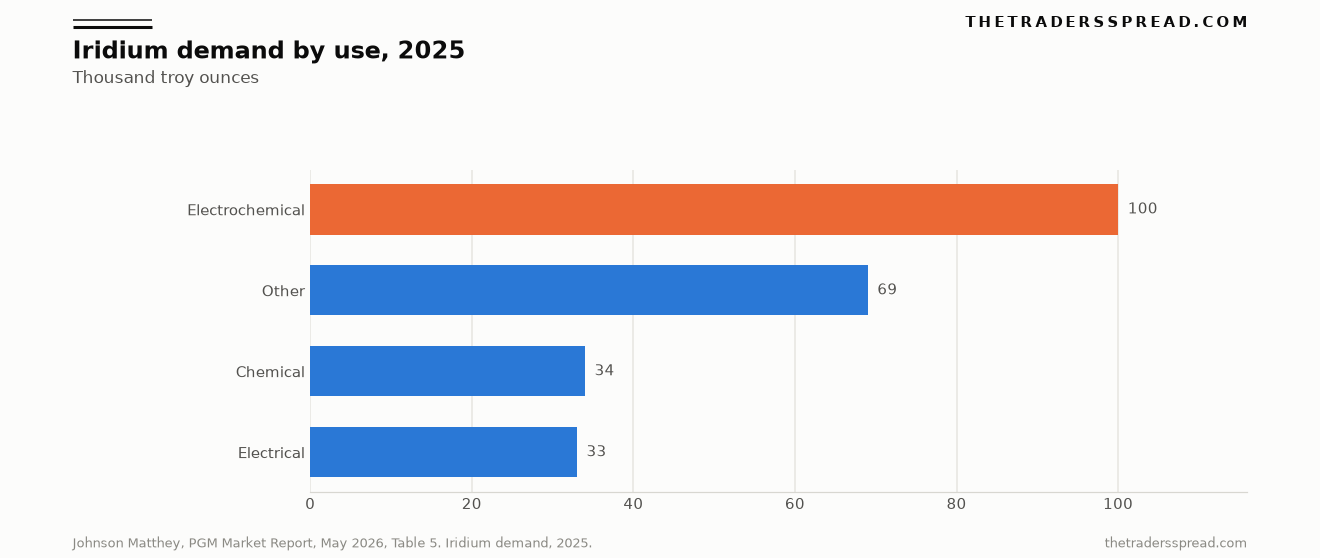
The iridium price that circulates as one headline number has to survive a harder test than family resemblance. In the PGM Market Report published in May 2026, Johnson Matthey puts primary supply at 229,000 troy ounces for 2025 and the same 229,000 ounces for 2026, against total demand of 236,000 ounces and a 2026 demand column of 240,000 ounces. Electrochemical use is the largest 2025 line at 100,000 ounces, with other uses at 69,000, chemical use at 34,000 and electrical use at 33,000. The glossary in that report defines the 4E basket as platinum, palladium, rhodium and gold, and the 6E grade as those four plus ruthenium and iridium. Valterra Platinum's financial review for the year ended 31 December 2025 then prints realised prices for platinum, palladium and rhodium, and states that all PGMs, with the exception of iridium, contributed meaningfully to the price uplift.
Updated 16 November 2026, the figures below are reference data from the source and the date named with each one.
The can is the wrong picture
A car-catalyst can is a useful object for a photograph and a poor map of this market. Johnson Matthey's Table 5, in the May 2026 report, sorts iridium demand into chemical, electrical and electronics, electrochemical, and other, and across 2021 to 2026 that page carries no automotive row and no investment row. Platinum, palladium and rhodium get the automotive chapters in the same document. Iridium's industrial cells are already net of closed-loop recycling: the footnote calls them new metal required by industrial users each year, after metal that stays inside a plant loop.
That split matters for anyone who meets iridium only as a trace inside a three-way catalyst. The can on a petrol car is a platinum, palladium and rhodium object in Johnson Matthey's own sorting. Iridium's 2025 book is an industrial book: 100,000 ounces electrochemical, 69,000 other, 34,000 chemical, 33,000 electrical. Add those four lines and you reach the 236,000 ounces of total demand. The largest slice is about two-fifths of the book. The other three slices together are still the majority.
The desk's platinum piece, the palladium strike note and the rhodium note cover those autocatalyst metals on their own, which is where the can's loadings actually sit, apart from an iridium balance that lists other buyers.
229,000 ounces, and four buyers
The byproduct claim is the one that half-survives. South African platinum supply fell by just under 5% to 3.96 million ounces in 2025, Johnson Matthey writes, and the other PGMs broadly followed, with no material change in the ore mix, after rainfall closed parts of Valterra's Amandelbult mine. Iridium primary supply moved from 237,000 ounces in 2024 to 229,000 in 2025, and the 2026 column holds 229,000 flat. The ore body ties the metals together. The published lines stay on separate scales: millions of ounces of South African platinum, and a global iridium line in the low hundreds of thousands.
Ruthenium, the other minor metal in the 6E grade, shows how far a co-product can drift from the platinum headline. Ruthenium sales fell 14% in 2025 because a large release of refined inventory in 2024 was absent the next year. Johnson Matthey's Table 4 puts the 2025 ruthenium stock movement at minus 293,000 ounces. Iridium's 2025 stock movement, on Table 5, is minus 7,000 ounces. Same mining system, same year, two stock lines that a single "byproduct of platinum" sentence cannot carry.
| Line | 2024 | 2025 | 2026 |
|---|---|---|---|
| Primary supply | 237 | 229 | 229 |
| Chemical | 37 | 34 | 28 |
| Electrical and electronics | 27 | 33 | 33 |
| Electrochemical | 94 | 100 | 109 |
| Other | 68 | 69 | 70 |
| Total demand | 226 | 236 | 240 |
| Movement in stocks | 11 | -7 | -11 |
In tonnes the same table prints primary supply of 7.1 tonnes in both 2025 and 2026, and total demand of 7.3 then 7.5 tonnes. Ounce supply from 2021 runs 235,000, 218,000, 229,000, 237,000 and then 229,000 for the last two years. Stock movements over that stretch are plus 6,000, plus 17,000, minus 17,000, plus 11,000, minus 7,000 and minus 11,000, so 2022 and 2024 were surplus years.
Most of the South African projects in that supply chapter are there to replace or extend existing mines, which fits a primary line held at 229,000 ounces more readily than a sudden new stream of metal. Nornickel guidance beside it is stated for palladium, down 10% to 11%, and platinum, down 5% to 8%, after a shift toward lower-grade ore at Norilsk-Talnakh. The iridium total on the page remains the global 229,000 ounces.
Sponge, grade by grade
Sponge is the industrial form traders name when they say the iridium price, and it is a ladder. American Elements' iridium sponge catalogue, opened on 16 November 2026, lists six codes on one page: 99% as IR-M-02-SPO, 99.5% as IR-M-025-SPO, 99.9% as IR-M-03-SPO, 99.95% as IR-M-035-SPO, 99.99% as IR-M-04-SPO, and 99.999% as IR-M-05-SPO. The page describes sponge as a high-purity powdered or granular metal, typically coarser than 200 mesh, and tells the buyer to request a quote for pricing. No public dollar figure sits on that catalogue.
A China-versus-West sponge price would be two assessments. The documents opened here print one global primary-supply line, and one supplier's purity ladder with prices on request. What Johnson Matthey does say about China is a liquidity note, not a second settlement. After the 2020-2021 spike, Chinese crucible makers adopted platinum for some formats. The report then describes a fresh wave of strategic buying, especially in China, counted as a stock movement because it is hard to pin on one industrial use, which took liquidity out while the conventional balance stayed close.
The price path printed beside that story is a range, not a ticker. Johnson Matthey puts the 2021 peak at $6,300 an ounce, then a drift through 2022 to 2024 to either side of $4,500, a relatively stable 2025, and new all-time highs in early 2026, when iridium and ruthenium hit $8,000 and $1,750. Those are the house's reference points from the May 2026 publication. A live refiner screen was not among the pages opened with them.
A bar is another product page
Investment bars are a platinum habit that gets pasted onto iridium. Table 5 has nowhere to put them. Demand is chemical, electrical, electrochemical and other. The platinum chapters of the same May 2026 report discuss investment bars and exchange-traded holdings as their own demand. Iridium's page has the industrial lines and the stock-movement line, and the stock line is where the report parks buffer buying from the hydrogen enthusiasm of 2020 and 2021.
American Elements keeps the forms apart. The sponge codes share one URL, while rings, blocks, cubes, chunk and rod each have another page, and the sponge page withholds a posted price. A cast bar and a drum of 99.95% sponge are different catalogue entries, set beside a demand table with no investment row for the bar.
Valterra's prices left iridium aside
The lockstep-with-platinum claim is the one a producer can settle for a full year. Sayurie Naidoo is named chief financial officer on Valterra Platinum's integrated-report financial review for 2025. In that review the company says revenue increased 7% to R116.3 billion, from R109.0 billion, driven primarily by a 26% improvement in the PGM dollar basket price to US$1,852. The sentence that follows is the iridium one: all PGMs, with the exception of iridium, contributed meaningfully to the price uplift, with platinum and rhodium showing particularly strong gains. The rand basket was R32,611 an ounce against R26,695, a 22% rise, at an average exchange rate of R17.84 per dollar against R18.24.
| Metal | 2025 | 2024 | Change |
|---|---|---|---|
| Platinum, US$/oz | 1,338 | 957 | 40% |
| Palladium, US$/oz | 1,157 | 1,008 | 15% |
| Rhodium, US$/oz | 6,236 | 4,636 | 35% |
| PGM basket, US$/oz | 1,852 | 1,468 | 26% |
Other PGM metals, the bucket that is wider than iridium alone, contributed R17.8 billion of revenue against R16.1 billion, an 11% rise. PGM sales volumes on a 5E-plus-gold basis were 3,454,000 ounces against 4,078,000, a 15% decline, after the Amandelbult flood, the Kroondal tolling change and smaller inventory releases. Platinum ounces sold were 1,552,000 against 1,871,000. The price uplift carried the revenue line while the ounce line fell. Inside that uplift, the realised-price table the company chose to print is platinum, palladium, rhodium, nickel and chrome. Iridium stays in the prose as the exception, and stays out of the average-price rows.
Johnson Matthey's 2025 comment lines up with that exception and then parts company with it in the next quarter. Iridium prices were relatively stable during 2025, the report says, before they rose at the year-end and set new highs in early 2026. Over that same year a typical South African 4E basket, platinum, palladium, rhodium and gold, rose from around ZAR 24,000 an ounce in January to over ZAR 40,000 by December. Iridium sits outside that 4E definition and inside the 6E grade, so a basket quoted as the PGM price can rally while this metal has a quiet year. Early 2026 is the other stretch: the May report has iridium at $8,000 in the first quarter, in a period when the 14 May release also records a platinum all-time high. A lockstep rule has to cover both stretches, and the Valterra year is where it fails.
RelatedHafnium price follows separation more than new mines
Eleven thousand ounces on the 2026 stock line
The permanent-deficit claim is the loudest one in circulation, and the stock column is the quiet answer. Johnson Matthey writes that the iridium market has been broadly balanced in recent years, that it is the smallest and least liquid of the PGMs, and that even modest extra buying can move the price because the pool is thin. The 2026 outlook in the same report says the market will edge further into deficit, with mine supply flat and demand at a three-year high. The shortfall in iridium will be modest, with supply unchanged and demand forecast to increase moderately. On the numbers, that modest shortfall is the minus 11,000 ounces of stock movement against 240,000 ounces of demand and 229,000 ounces of primary supply.
Rupen Raithatha, Market Research Director at Johnson Matthey, said in the 14 May 2026 release that accompanies the report: "This year should also see the first commercial-scale use of iridium in proton exchange membrane (PEM) electrolysis for green hydrogen." The report itself places that first significant PEM demand with large projects in Germany and Portugal nearing completion, and it adds further iridium use in electrodes for copper foil, the foil that goes into lithium batteries and circuit boards. Chemical demand is set to fall, including lower use in ruthenium-iridium catalysts for the Cativa acetic acid process, and the report says the electrochemical gains more than offset that fall. The full report sits on Johnson Matthey's PGM market reports page.
Read the 2025 electrochemical line beside that sentence. Commercial-scale PEM electrolysis is described as arriving in 2026, and electrochemical demand is already 100,000 ounces in 2025, rising to 109,000 ounces in the 2026 column. The hydrogen projects are a nine-thousand-ounce kind of step in this table, inside a line that was already the largest, beside an "other" line of 69,000 to 70,000 ounces that the hydrogen story does not replace. Closed-loop recycling is already netted out of every demand cell, so the 236,000 ounces are new metal, and they are still spread across four uses.
The 14 May note keeps the minor metal from standing in for the whole complex. All the PGMs were in deficit in 2025, it says, and in 2026 platinum, ruthenium and iridium see further shortfalls while palladium and rhodium could record small surpluses. Ruthenium is the deep deficit in the report's own wording, and the iridium chapter stays a thin market with a flat primary line and an 11,000-ounce draw.
What the record still supports
Two claims survive the documents opened here. Iridium is a co-product of the PGM ore mix Johnson Matthey describes as broadly unchanged in South Africa in 2025, so primary supply is tied to that mining system, and the life-extension bias in the project list argues for a flat line more readily than for a sudden new stream of ounces. The May 2026 balance also supports a small 2026 deficit: primary supply unchanged at 229,000 ounces, demand 240,000 ounces, stock movement minus 11,000 ounces, with the house itself calling the shortfall modest.
The other claims fall over on the same pages. Table 5 has four industrial uses and the automotive row is missing, so the catalyst can is the wrong demand picture. Sponge at American Elements, opened 16 November 2026, is six purity codes with prices on request, and the Johnson Matthey table prints one global supply line plus a China note on strategic buying and crucible substitution, which leaves a paired China-versus-West sponge settlement off the page. A cast bar and a sack of sponge are different product pages, and the demand table has no investment row for the bar. Platinum, palladium and rhodium at Valterra rose 40%, 15% and 35% in 2025 while the review named iridium as the exception, and early 2026 then lifted iridium to the $8,000 reference in the first-quarter account. The stock column shows a deficit in 2025 and 2026 and a surplus in 2022 and 2024. Raithatha dates the first commercial-scale PEM use to 2026, while electrochemical demand was already 100,000 of 236,000 ounces the year before.
What remains is a small industrial balance, a purity ladder, and a producer year in which the metal stood aside from the basket that carries its name. The primary pages behind the figures are the May 2026 Johnson Matthey report, the 14 May release, Valterra's 2025 financial review, and the American Elements sponge catalogue.
This article is for information only and is not a recommendation to buy or sell iridium, sponge, or any related security. The figures are reference data from the sources named, and they are not a price target.