

"The sharp reduction in barley area reflects the combined impact of weaker prices, lower premiums and lower demand from the malting, brewing and distilling sectors," said Helen Plant, lead analyst for cereals and oilseeds at the Agriculture and Horticulture Development Board, in the board's 9 June 2026 planting note.
The figure behind that sentence is the Great Britain barley area: 930,000 hectares, down 12 percent on the year, 17 percent under the 2021 to 2025 average, and the lowest since 2010. Scotland's barley area fell 13 percent to 258,000 hectares, the smallest since the 1960s, and the share of varieties suitable for malting, brewing and distilling slipped to 62 percent.
An area cut on that scale still leaves two prices, because feed barley and malting barley clear in separate markets. Agricultural Prices, released by the National Agricultural Statistics Service on 29 September 2026, put August malting barley at $5.86 a bushel and August feed barley at $3.86. The May 2026 prints in the marketing-year table released on 29 June 2026 were $4.41 for feed and $5.70 for malt, so across those three months feed fell 55 cents while malt rose 16 cents. Across the twelve months to August, all wheat, the other grain beside barley in this feed comparison, rose from $4.84 a bushel to $6.23 on that same September release, about $177.84 a tonne to about $228.91 using the WASDE factor of 0.027216 tonnes per bushel. Feed barley eased from $3.94 to $3.86, about $180.97 a tonne to about $177.29 on the barley factor of 0.021772, and malting barley edged from $5.83 to $5.86, about $267.78 to about $269.15. One feed-grain rally, two barley results.
The balance sheets already explain the split. WASDE-676, released on 9 October 2026, puts 2026/27 US food, seed and industrial use of barley at 110 million bushels and feed and residual at 25 million, so the price American farmers receive sits close to malt. The UK sheet, published by AHDB on 22 October 2026 and corrected the next day, runs the other way: animal feed at 4.393 million tonnes against human and industrial use of 1.407 million tonnes. A rally in a competing feed grain has more room in a British ration than in the US all-barley average.
Updated 27 October 2026.
- US all barley in August 2026 was $5.55 a bushel, unchanged from August 2025, while malting barley was $5.86 and feed barley was $3.86. Source: USDA NASS Agricultural Prices, released 29 September 2026.
- From May 2026 to August 2026, US feed barley fell from $4.41 a bushel to $3.86 and malting barley rose from $5.70 to $5.86. Source: USDA NASS Agricultural Prices, marketing-year table released 29 June 2026 and the 29 September 2026 release.
- US barley production for 2026 was estimated at 116 million bushels, down 19 percent from the revised 2025 total of 143 million, on a yield of 72.1 bushels an acre. Source: USDA NASS Small Grains Summary, released 30 September 2026.
- The October WASDE cut 2026/27 US barley production from 140 million bushels to 116 million and left the season-average farm-price reference at $5.70 a bushel in both columns. Source: USDA WASDE-676, released 9 October 2026.
- UK barley production for 2026 is estimated at 5.614 million tonnes, availability at 7.201 million tonnes, and the surplus available for export or free stock at 450,000 tonnes. Source: AHDB early balance sheet, corrected 23 October 2026.
- Great Britain barley area for harvest 2026 is estimated at 930,000 hectares, down 12 percent, and UK spring barley in the final harvest survey averaged 4.8 tonnes a hectare, about 17 percent under the five-year average. Source: AHDB, 9 June 2026 and 25 September 2026.
First the grain has to be named
A barley price starts as a decision about what the sample is allowed to become. Malting barley is sold against a specification: a variety a maltster has already accepted, a protein band a brewer or distiller can use, germination that survives the malthouse, and a sound kernel. Feed barley is grain aimed at a ration from the start, plus every lot that misses one of those tests. The two can leave the same field on the same morning and clear in different rooms.
"Each of these varieties perform well and support Canada's value proposition as a reliable supplier of high-quality malting barley and malt," said Peter Watts, managing director of the Canadian Malting Barley Technical Centre, when the centre published its 2026-27 recommended list on 24 November 2025. "As newer varieties come forward, we work with the industry to understand how they perform from field to brewhouse." A variety off that list can be sound feed and a difficult malt sale, because the premium sits on the buyer's acceptance.
CMBTC posted on 8 September 2026 that grower confidence is what builds customer acceptance for a new barley variety, which is the practical gate between a feed sale and a malt contract.
Grower confidence is key to building customer acceptance for new barley varieties.@westernproducer spoke with Chad Ferguson about what could put CDC Churchill on more acres.
— CMBTC&MaltAcademy (@canadianbarley) September 8, 2026
Check it out here: https://t.co/fdlbMAl6aL@SaskBarley
Jon White, chair of the centre, put the commercial consequence on that same page: "New varieties give our industry the chance to strengthen supply, improve quality and stay competitive. When growers, breeders and end-users move together, we set the stage for long-term success." If the end user has yet to move, the grower's extra care shows up as feed.
Britain's 2026 harvest drew the same line. In AHDB's final harvest report of 25 September 2026, winter barley averaged 6.9 tonnes a hectare, in line with the five-year average, while spring barley averaged 4.8 tonnes, about 17 percent under its average. Helen Plant said quality had been highly variable, "which will create additional challenges when storing and marketing grain over the coming months." A thin spring crop swells the feed pile while a maltster is still short of parcels that pass.
US use explains why the headline average hugs malt. Food, seed and industrial use at 110 million bushels is more than four times feed and residual at 25 million, and the August 2026 all-barley price of $5.55 sat 31 cents under malt and $1.69 over feed. The same release splits by state: Idaho all barley $6.07 and malt $6.15, Washington all barley and feed both $3.61, North Dakota feed $4.06 against malt $5.18.
Then someone prints a public number
The public US barley price is monthly. NASS describes prices received as sales from producers to first buyers, covering all grades and qualities, in Agricultural Prices released on 29 September 2026. The marketing year runs June through May, and each month's share of sales weights the season average. The series in the chart is that monthly survey. A daily close is a local bid, a different object from the national average.
The chart runs from June 2024 through August 2026. June 2024 to May 2026 comes from the marketing-year table in the 29 June 2026 issue. June, July and August 2026 come from the issues released on 31 July, 31 August and 29 September 2026. All barley opened at $7.04 a bushel in June 2024, touched $5.09 in December 2025, and stood at $5.55 in August 2026, the same figure as August 2025. Feed and malt moved apart underneath that line, which is why the chart is the public blend and the table further down is the split.
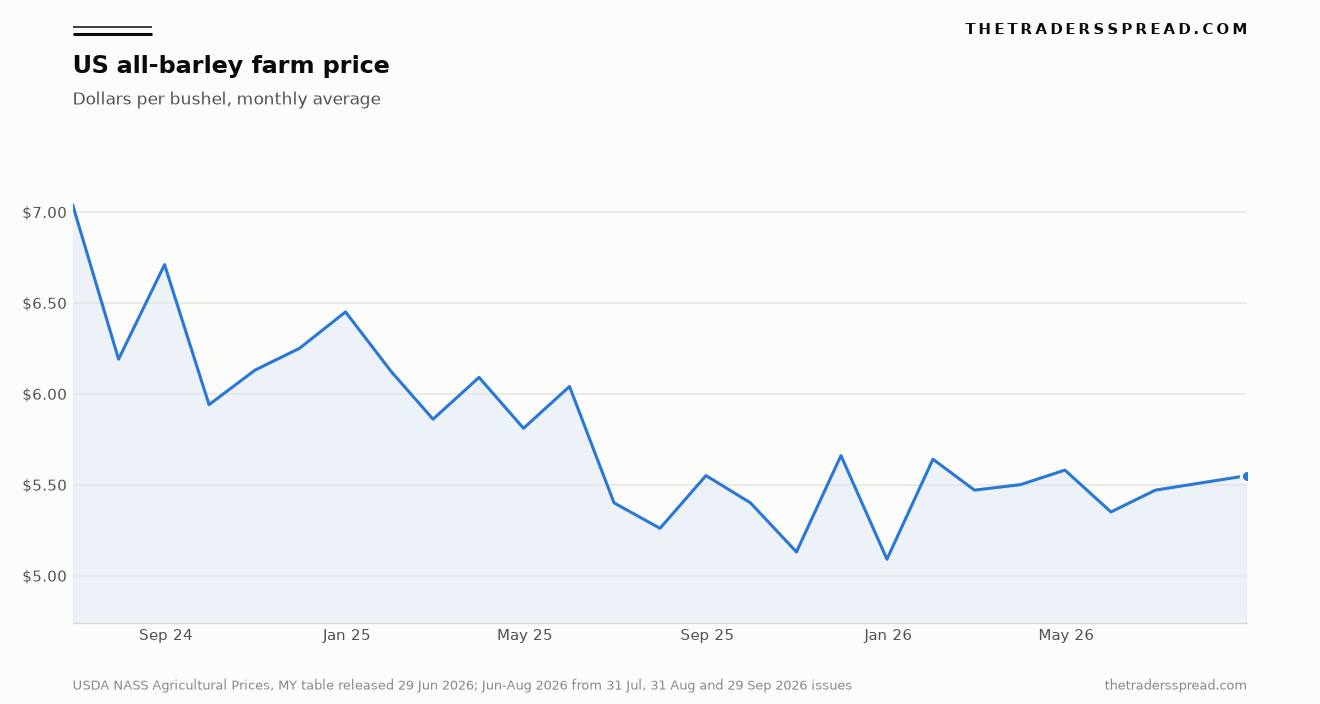
The 2025/26 marketing-year average in that June table is $5.46 a bushel for all barley, $5.79 for malting and $4.00 for feed. WASDE's 2025/26 season-average farm price is the same $5.46, and both sources put 2024/25 at $6.31. August 2025 was 19.1 percent of all-barley marketings and 20.0 percent of malt marketings, so harvest sales pull the blend toward malt. WASDE's 2026/27 reference remains $5.70, a year-long blend of the three rows.
The basis is a weight problem before it is a view
Corn is the other energy grain beside barley in many cattle rations, and NASS prints both in the same release, each in its own bushel. In August 2026 corn was $4.45 and feed barley was $3.86, a 59-cent discount for barley on the page. In August 2025 corn was $3.96 and feed barley was $3.94, which looks like parity if the reader stops at the bushel.
The bushels weigh different amounts. WASDE-676 prints the factors on its conversion page: 0.021772 tonnes per barley bushel and 0.025401 tonnes per corn bushel, and the conversion is the price divided by the factor. August 2025 feed barley at $3.94 works out to about $180.97 a tonne, and corn at $3.96 to about $155.90, so barley was about $25 a tonne richer in a month when the bushel column said the two were level. August 2026 feed barley at $3.86 is about $177.29 a tonne and corn at $4.45 is about $175.19, about $2 apart on a common weight in a month when the bushel column said barley was 59 cents cheap.
Malting barley stays off that feed comparison. August 2026 malt at $5.86 is about $269.15 a tonne against feed near $177, a gap of about $92. A year earlier the gap was about $87. The malt premium held while the feed-to-corn relationship was rewritten, so a ration that uses barley has to name which barley.
| Month | Feed barley ($/bu) | Malting barley ($/bu) | Gap ($/bu) |
|---|---|---|---|
| August 2025 | 3.94 | 5.83 | 1.89 |
| November 2025 | 3.58 | 5.89 | 2.31 |
| December 2025 | 3.86 | 5.51 | 1.65 |
| May 2026 | 4.41 | 5.70 | 1.29 |
| August 2026 | 3.86 | 5.86 | 2.00 |
These are US prices received, with August 2025 and August 2026 taken from Agricultural Prices released on 29 September 2026, and November 2025, December 2025 and May 2026 taken from the marketing-year table released on 29 June 2026. The gap is malting minus feed.
The two series part company inside a single month. From November 2025 to December 2025, feed barley rose from $3.58 to $3.86 while malting barley fell from $5.89 to $5.51, and the all-barley average fell with the malt side, from $5.66 to $5.09. From May 2026 to August 2026 the gap widened from $1.29 to $2.00 as feed fell and malt rose.
Protein in the same ration is a separate commodity. Soybean meal is the protein beside barley once the energy grain is chosen. Barley can stand in for corn on a tonne comparison. It stays out of the protein line.
A crop revision moves the spare tonne
The Small Grains Summary, released on 30 September 2026, estimated US barley production at 116 million bushels, down 19 percent from the revised 2025 total of 143 million. Yield was 72.1 bushels an acre, down 7.8. Producers seeded a record-low 2.21 million acres, down 4 percent, and harvested 1.60 million acres, down 10 percent. On 23 August, 53 percent was rated good or excellent, eleven points above the same week a year earlier, so a smaller crop and a better field rating were both on the sheet.
WASDE-676, dated 9 October 2026, still showed a September-column crop of 140 million bushels for 2026/27, with yield 78.8, imports 8 million, feed and residual 30 million, food, seed and industrial 115 million, exports 9 million and ending stocks 60 million. The October column prints production 116, yield 72.1, imports 15, feed and residual 25, food, seed and industrial 110, exports 5 and ending stocks 57. The 24 million bushel cut was absorbed as imports up 7, feed down 5, food seed and industrial down 5, exports down 4 and stocks down 3. The season-average farm-price reference stayed at $5.70 a bushel in both columns, so the unchanged blend describes the malt-heavy side of the sheet.
RelatedNaphtha climbed 2.90 percent alongside crude highs
Britain shows the version where quality fails and feed inherits the grain. AHDB's early 2026/27 balance, with production corrected on 23 October 2026, puts UK barley output at 5.614 million tonnes, down 753,000 and the smallest crop since 2012/13. Availability is 7.201 million tonnes, down 658,000, or 8 percent, with opening stocks of 1.337 million tonnes. Human and industrial use is 1.407 million tonnes, down 49,000, on sluggish brewing, malting and distilling demand. Animal feed is 4.393 million tonnes, close to last season, with farms replacing thin forage. The balance is 1.200 million tonnes, the lowest since 2007/08, and after an operating-stock requirement of 750,000 tonnes the surplus available for export or free stock is 450,000 tonnes. AHDB says feed barley is pricing competitively against other feed grains, though the tighter sheet could shift that position, and that poor-yielding crops missed malting specification while the smaller accepted pool should still cover on lower malt demand.
Helen Plant had framed that mechanism in the June planting note: "Planted area is only part of the picture. Final supply will depend heavily on yields, crop quality, particularly for bioethanol and malting barley. This, plus how demand develops through the season, will also influence prices." Anthony Hopkins, director of cereals and oilseeds at AHDB, said in the 25 September harvest report that this was "the second, or in some cases third, successive challenging harvest" and that "at a time of high input costs, arable farmers in the worst-affected areas are really feeling the financial pressure right now." A farm under that pressure decides how long to hold a lot that might still make malt, and how quickly a failed lot is offered as feed.
The June planting survey that cut the barley area also recorded a rebound in oilseed rape. Rapeseed is the other crop beside barley in that rotation. A grower leaving barley leaves a feed-or-malt option, and the next area survey shows whether the 12 percent cut is repeated after this season's thin premiums.
What gets checked before the ration is priced
Before a ration is priced, three rows are read together: feed, malt, and the all-barley blend. The August 2026 release arrived on 29 September 2026, and the NASS calendar lists the next Agricultural Prices issue for 30 October 2026. Feed barley and corn on each new release are divided by 0.021772 and 0.025401. From August 2025 to August 2026 that conversion moved a barley premium of about $25 a tonne over corn to a gap of about $2.
Quality decides which tonnes may be called malt. Variety acceptance moves slowly, the way Watts and White described it, while germination and protein move inside one harvest. A buyer then checks whether weaker malt demand still covers the accepted pool, whether the 24 million bushel production cut left the $5.70 blend in place, and whether place still splits Washington feed at $3.61 from Idaho malt at $6.15.
Why do feed barley and malting barley carry different prices?
Malting barley has to clear a variety list, a protein band, germination and a buyer who has already accepted the variety. Feed barley is grown for the ration or fails one of those tests. In August 2026 the US malting price was $5.86 a bushel and the feed price was $3.86. On a tonne the gap is about $92, and across the months tabled above it moved between $1.29 and $2.31 a bushel.
What does a smaller barley crop do to the feed price?
Between the September and October columns of WASDE-676, US barley production for 2026/27 went from 140 million bushels to 116 million, imports rose from 8 million to 15 million, and feed and residual fell from 30 million to 25 million. The season-average farm-price reference stayed at $5.70 a bushel. In Britain the smaller crop coincided with feed use held near 4.393 million tonnes, with forage short and some barley missing malt specification.
Where is a barley price printed when screen trade is thin?
The US public print is the monthly price farmers received, published by NASS in Agricultural Prices near the end of the following month. The August 2026 all-barley figure of $5.55 a bushel was released on 29 September 2026. It averages sales, qualities and end uses. A local elevator bid is fresher and tied to one place. The malting row and the feed row beside the average are the two figures a ration and a malthouse can use.
A feed buyer who splits malt from feed, converts barley and corn onto one weight, and treats the all-barley average as a blend, is pricing the grain that can enter the ration.
This page explains how a barley price is formed. It is not a recommendation to buy or sell barley, malt, feed, or any related contract.