

I have spent enough sessions on the Paris rapeseed board to stop treating the nearest price as the market. On 23 October 2026 the November 2026 MATIF rapeseed contract settled at €511.75 a tonne. The February 2027 contract, which traded 9,214 lots that session against 677 on November, settled at €549.50. The gap is €37.75 a tonne on the same exchange, the same seed and the same afternoon.
We downloaded Euronext's settlement file for both expiries in this session, and the file runs through that Friday close. The nearest number is an expiring month, while the liquid line is the next one. Customs surveillance through 18 October 2026 splits the story again: of 1,088,203 tonnes of rapeseed brought into the EU since 1 July, Ukraine supplied 44.7 percent and Canada 11.4 percent. A Canadian crop and a Paris settlement meet in the trade statistics, and they clear on different contracts.
Updated 25 October 2026
Three words do most of the damage when they stay fuzzy. MATIF is the name traders still use for the Paris commodity futures, which Euronext lists as contract ECO on Euronext Derivatives Paris. Crush is the volume of seed a processor runs through the plant to separate oil from meal. Basis is the cash price of a physical parcel minus the futures price, after the quality scale in the contract. The €37.75 between November and February is a calendar spread, a carry from one expiry to the next. Calling that gap a basis requires a named cargo set against one of those futures.
Key facts
- The November 2026 MATIF rapeseed contract settled at €511.75 a tonne on 23 October 2026, with 677 lots traded. Source: Euronext ECO settlement file, downloaded 25 October 2026.
- The February 2027 contract settled at €549.50 a tonne the same session, with 9,214 lots, €37.75 above November. Source: Euronext ECO settlement file, downloaded 25 October 2026.
- The highest February 2027 settlement in that file with recorded volume is €563.25 on 21 September 2026, on 5,835 lots. Source: Euronext ECO settlement file, downloaded 25 October 2026.
- EU rapeseed usable production for 2026/27 is projected at 19.394 million tonnes, with crush at 24.858 million tonnes. Source: European Commission, DG AGRI oilseeds balance, updated 29 September 2026.
- From 1 July to 18 October 2026 the EU imported 1,088,203 tonnes of rapeseed, down 10 percent on the year, and Ukraine supplied 486,260 tonnes of that total. Source: DG AGRI customs surveillance, situation at 20 October 2026.
- On 23 September 2026 the International Grains Council had EU rapeseed at $632 a tonne, up 13 percent on the year, and Ukrainian sunflower seed at $465, down 15 percent from August. Source: DG AGRI oilseeds deck, citing the IGC, prices as of 23 September 2026.
The claim that rapeseed and canola are one word
The claim is comfortable because the plants are cousins in the genus Brassica. The Canola Council of Canada, on its about page, still publishes the standard that earns the name: seed of Brassica napus, Brassica rapa or Brassica juncea whose oil contains less than 2 percent erucic acid, and whose solid component contains less than 30 micromoles of a named set of glucosinolates per gram of air-dry, oil-free meal. The council states that the name is a contraction of Canada and ola, for oil. That standard is a quality rule and a naming rule. The futures contracts are separate documents, and the two exchanges write them differently.
Canada's grain authority keeps the names apart. The Canadian Grain Commission's Official Grain Grading Guide, chapter 10, page details dated 1 August 2026, prints a primary-grade table for Canola, Canada and a second table for Rapeseed, Canada. ICE Futures US rule 12.01 sets the lot at 20 tonnes in Canadian dollars, rule 12.03 accepts Commission canola grades and allows genetically modified canola that meets them, and rule 12.06 places the par region in Saskatchewan east of Saskatoon. The minimum fluctuation is ten Canadian cents a tonne.
Euronext's ECO specification, updated 13 April 2026, is fifty tonnes in euros, any origin, conventional double-zero seed on a 40 percent oil basis, with moisture basis 9 percent and impurities basis 2 percent. Deliverable seed is capped at 10 percent moisture, 3 percent impurities, 2 percent oleic acidity, 2 percent erucic acid and 25 micromoles of glucosinolates. The tick is €0.25 a tonne. Delivery is FOB barge at Belleville, Metz, Frouard, Bulstringen, Vahldorf, Magdeburg, Wurzburg and Ghent, and last trading is 18:30 on the last business day before a February, May, August or November delivery. A reader who wants the Canadian market can use the separate note on Canadian canola, while the contract in front of us here is ECO.
| Term | Euronext rapeseed, ECO | ICE canola, RS |
|---|---|---|
| Lot and currency | 50 tonnes, euros per tonne | 20 tonnes, Canadian dollars per tonne |
| What can be delivered | Any-origin conventional double-zero rapeseed, erucic acid maximum 2 percent, glucosinolates maximum 25 micromoles | Canadian Grain Commission canola grades, and genetically modified canola that meets the grade is deliverable |
| Par delivery | FOB barge on the Moselle, Mittellandkanal, Main and Escaut | FOB in the Saskatchewan par region, east of Saskatoon and near Saskatoon |
| Tick | €0.25 a tonne, €12.50 a lot | Ten Canadian cents a tonne |
Seed goes into the quote and oil comes out
Vegetable oil is what comes out of the crush. The ECO quote is what goes in. Euronext prices the contract in euros per tonne of seed, and the oil content that counts as standard is 40 percent. A richer parcel draws a premium and a leaner parcel draws a discount. The settlement can move because oil moved, because meal moved, or because seed got harder to find at the barge.
DG AGRI's balance, updated 29 September 2026, projects 2026/27 rapeseed production at 19.394 million tonnes and crush at 24.858 million tonnes, so the crush sits above the crop. Meal usable production is 14.169 million tonnes and oil usable production is 10.192 million tonnes. Oil divided by crush is about 41 percent, beside the 40 percent futures basis, and meal is about 57 percent of that crush. Those percentages are arithmetic on the Commission's figures.
The plant buys seed and sells both oil and meal. When oil is firm and meal is soft, the seed bid can stand still. Rapeseed meal competes with soy meal, covered in a separate soybean-meal note, so a protein rally can pay for seed while the oil price stays put. The September deck, citing the International Grains Council as of 23 September 2026, published EU rapeseed at $632 a tonne as a seed price, up 4 percent on the month and 13 percent on the year.
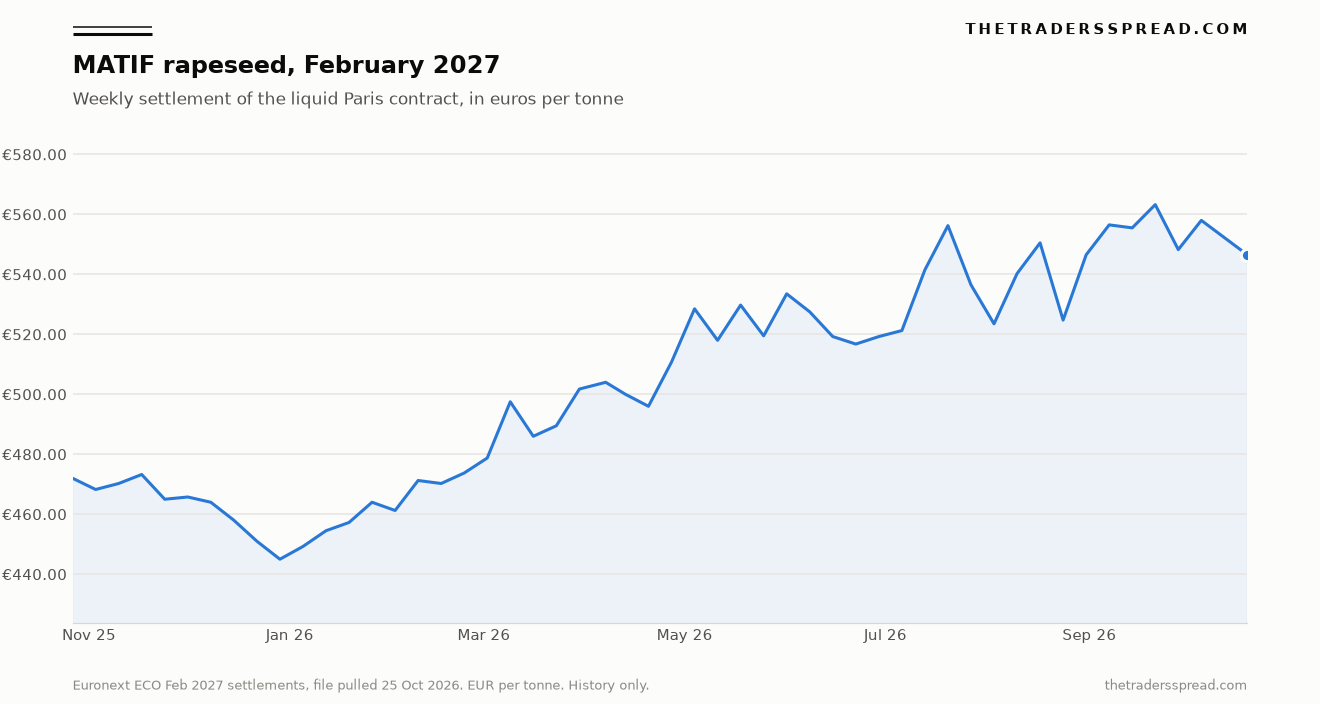
The weekly closes open at €469.50 on 31 October 2025 and end at €549.50 on 23 October 2026. The highest weekly close is €557.50 on 25 September 2026, below the highest daily settlement with volume, €563.25 on 21 September. The weekly line is a Friday sample of a daily file.
A fuel rule and a flat price are different objects
Fuel demand is real, and the rule is an energy share. The Commission's questions-and-answers note of 9 October 2023 sets a transport choice: a 14.5 percent cut in greenhouse-gas intensity by 2030, or a 29 percent renewable share in transport, up from 14 percent, plus a 5.5 percent sub-target for advanced biofuels and renewable fuels of non-biological origin, of which at least 1 percent is the non-biological fuel. Several oils, waste feedstocks and renewable electricity can fill that share. A tonne of ECO still has to find its own euro bid after the meal credit and the seed balance.
February 2027 settled at €440.00 on 2 January 2026, on 23 lots, at €563.25 on 21 September 2026 on 5,835 lots, and at €549.50 on 23 October. The 2030 targets were the same note across those dates, while the seed price moved by more than €100 a tonne. Crude can change what the replaced fuel is worth. Delivery under ECO is still a barge of double-zero seed at a port such as Ghent, with the oil extraction, the meal sale and the euro sitting between the energy screen and the settlement.
A large Canadian crop still has to reach a Paris barge
The September DG AGRI deck records Agriculture and Agri-Food Canada's reading of the Canadian crop. Production for 2026/27 is raised to 22.1 million tonnes, domestic use is expected at a peak of 14.4 million tonnes, up 10 percent on the season, and exports are revised down to 7.7 million tonnes, 14 percent below the previous year. A bigger crop beside a smaller export number already weakens the simple story, because seed that stays in Canada has a long road before it can meet a Paris barge price.
The customs file, situation at 20 October 2026, shows who has landed. From 1 July the Union imported 1,088,203 tonnes of rapeseed, 10 percent under the year-earlier window of 1,212,986 tonnes. Ukraine supplied 486,260 tonnes and 44.7 percent, Australia 185,116 tonnes and 17.0 percent, Canada 124,500 tonnes and 11.4 percent, Moldova 99,176 tonnes and 9.1 percent, and the United States 76,827 tonnes and 7.1 percent. In the same window of 2025/26 the Canada line was zero tonnes. Canada sits third in that arrival table, not in the seat that sets the Paris settlement.
Surveillance declarations can be corrected after publication, and the file's completeness warning covers export data for France, Bulgaria, Ireland and Greece. Imports in the same system are trade with countries outside the Union. The 2026/27 balance still calls for 6.418 million tonnes of third-country rapeseed against the 19.394 million tonne crop, with ending stocks at 0.722 million tonnes, and by 18 October about 1.09 million tonnes had shown up, mostly from Ukraine.
On 23 September 2026 the deck had Canada at $622 a tonne, up 32 percent on the year, the EU at $632, up 13 percent, and Australia at $576, up 12 percent, so the dollar levels sat close while the yearly changes travelled apart. AGRIColumn posted Euronext rapeseed commitments for 21 October 2026, and the cut in the speculative net long shows funds leaving while the customs file is still counting tonnes.
#COT #EURONEXT #RAPESEED – Reporting period 21.10.2026 (-7 days). Speculative funds reduced their #NET #LONG position from 45,758 lots to 31,634 lots, down 14,124 lots (-30.9%) in one week.https://t.co/W3bMsn9d3y pic.twitter.com/CWzhVnNAfU
— AGRIColumn (@Agricolumn_EU) October 21, 2026
Sunflower and rapeseed share a crusher and keep separate harvests
They share a crush industry and a vegetable-oil customer, and the September DG AGRI sheet has the harvests pointing different ways. EU rapeseed for 2026/27 is 19.39 million tonnes, 3.8 percent under 2025/26, on 6.359 million hectares at 3.05 tonnes a hectare, with the area about 5 percent higher and the yield down from 3.34. EU sunflower is 9.67 million tonnes, 14.2 percent above 2025/26.
IGC prices on 23 September 2026 also split: EU rapeseed at $632, EU sunflower seed at $690 and up 4 percent on the year, Ukrainian sunflower seed at $465 and down 15 percent from August. From 1 July to 18 October, sunflower seed imports rose 88 percent to 223,866 tonnes, with Argentina at 100,984, while rapeseed oil imports rose 45 percent to 191,464 tonnes and Ukraine supplied 152,550 of that oil. Sunflower oil imports fell 19 percent to 399,811 tonnes, of which Ukraine supplied 353,019 tonnes, an 88.4 percent share.
A shared coastline can still hit wheat, seed and oil together, which is why the wheat note on the Novorossiysk repairs belongs to a different commodity. Commission crush for 2026/27 is 24.858 million tonnes of rapeseed seed and 8.840 million tonnes of sunflower seed. Prospex*Agro posted on 21 October 2026 that September sunflower processing in Europe had recovered while rapeseed activity was the weaker leg, and the tonnes in that post are the brokerage's own reading.
RelatedWhat the Baltic Dry Index Measures Across Ship Classes
🇪🇺 Europe’s Sunflower Crush Rebounds As Global Processing Slows 🌻
— Prospex*Agro (@ProspexAgro) October 21, 2026
📈 Sunflower led September’s recovery in EU and UK oilseed crushing, while stronger soybean processing helped offset weaker rapeseed activity. However, cumulative sunflower crush remained below last year, leaving… pic.twitter.com/H3KlHctJob
| Reading | Rapeseed | Sunflower |
|---|---|---|
| EU production, 2026/27 versus 2025/26 | 19.39 million tonnes, down 3.8 percent | 9.67 million tonnes, up 14.2 percent |
| EU crush, 2026/27 projection | 24.858 million tonnes of seed | 8.840 million tonnes of seed |
| IGC price, 23 September 2026 | EU seed $632 a tonne, up 13 percent on the year | EU seed $690, up 4 percent on the year; Ukraine seed $465, down 15 percent from August |
| EU imports, 1 July to 18 October 2026 | Seed 1,088,203 tonnes, down 10 percent; oil 191,464 tonnes, up 45 percent | Seed 223,866 tonnes, up 88 percent; oil 399,811 tonnes, down 19 percent |
How to read the next Paris close
The expiry with the volume is the contract carrying the market. On 23 October February traded 9,214 lots and settled at €549.50, while November, with last trading at 18:30 on the last business day of October, traded 677 lots and settled at €511.75. Graindecision's Euronext board for that session matches these settlements and volumes and shows open interest of 107,862 lots on February against 3,300 on November. That open interest is Graindecision's figure for 23 October 2026.
From 25 September to 23 October the two expiries also told different stories in the same file. February went from €557.50 to €549.50. November went from €548.00 to €511.75, a drop of €36.25 a tonne. Quoting a single rapeseed price across that month means choosing one path and discarding the other.
Fifty tonnes times €549.50 is €27,475 a February lot, and fifty times €511.75 is €25,587.50 a November lot. A €0.25 tick is €12.50, so the €37.75 carry is €1,887.50 a lot when both legs are futures. A basis needs a named cash parcel and the premiums against the 40 percent oil basis. With only the two futures on the screen, the gap stays a calendar spread. Crush versus the crop, the origin table, meal versus oil, and the euro against the Canadian and Australian dollars then say more than the next headline. The commodities desk is full of contracts that look interchangeable until the delivery clause is opened, and Canadian canola keeps its own exchange, currency and grade rules.
What does MATIF mean on a rapeseed screen?
MATIF is the market name traders still use for Paris commodity futures. On rapeseed the listed contract is Euronext's ECO, fifty tonnes of conventional double-zero seed quoted in euros per tonne, with barge delivery at listed ports in France, Germany and Belgium. The delivery months are February, May, August and November. When a screen prints MATIF rapeseed it is that seed contract, not a vegetable-oil quote or the ICE canola future in Canada.
Why can November and February rapeseed settle far apart?
November and February are different delivery windows of the same specification, and the market prices storage, import timing, and the roll out of an expiring month between them. On 23 October 2026 November settled at €511.75 with 677 lots, while February settled at €549.50 with 9,214 lots. The €37.75 gap is a carry between two futures. It becomes a basis only when a named cash parcel is set against one of those contracts.
Does the Canadian canola crop set the EU rapeseed price?
A Canadian crop can lean on the Paris price, while the Paris price is still printed by a euro contract delivered in Europe. Agriculture and Agri-Food Canada, via the September Commission deck, has 2026/27 canola production at 22.1 million tonnes and exports at 7.7 million. EU customs data through 18 October show Canada as 11.4 percent of rapeseed imports so far this season, behind Ukraine at 44.7 percent and Australia at 17.0 percent.
What is still open
Which of those slow inputs will actually move the February settlement from here: the Ukrainian share of the import book, the split between oil and meal inside the crush, or the euro against the currencies of the other origins? The nearest contract will keep offering a single number until it stops trading. The balance sheet will keep offering several. Anyone still watching rapeseed a season from now can ask the same question of whatever Friday's file happens to show.
Figures above are reference readings from the sources named beside them, and they are not a recommendation to trade any contract.