

Polysilicon closed Bernreuter Research's global spot average at US$5.79 per kilogram on 4 November 2026, down 1.1% on the week, while InfoLink Consulting's non-China mono-grade average for orders dated 29 October to 4 November sat at US$18.50 per kilogram. Bernreuter builds its global average from Chinese prices plus an outside-China price, and the method note last reset that split to 95-5 on 12 March 2025. InfoLink prints the dollar column as a non-China origin price and leaves it unconverted from the yuan column. The lithium carbonate note is the same kind of unit problem, and polysilicon asks for the same care.
Updated 7 November 2026, with each figure below tied to the page that printed it and the date on that page.
The steps separate a spot index, a futures settlement and a producer's realized selling price on the Guangzhou PS contract, and they keep the unit, the grade, the tax and the origin on the figure.
Key figures on the sheet
- Bernreuter's global polysilicon spot average was US$5.79 per kilogram on 4 November 2026, 1.1% lower on the week. Source: Bernreuter Research, 4 November 2026.
- That note cut China n-type to CNY 39.5 per kilogram including 13% VAT, equal to US$5.24 ex-VAT, and p-type to CNY 30.5 per kilogram, or US$4.05 ex-VAT. Source: Bernreuter Research, 4 November 2026.
- InfoLink's non-China mono-grade average was US$18.50 per kilogram, high US$26.70 and low US$11.00, for 29 October to 4 November 2026. Source: InfoLink Consulting, 4 November 2026.
- OPIS left the China Mono Premium unchanged at CNY 38.786 per kilogram, printed as US$5.81, in the report dated 3 November 2026. Source: OPIS, via pv magazine, 6 November 2026.
- The OPIS Global Polysilicon Marker, for material made outside China, was US$19.234 per kilogram, or US$0.040 per watt, in the report dated 27 October 2026. Source: OPIS, via pv magazine, 30 October 2026.
- Daqo New Energy's average selling price was US$4.12 per kilogram in the third quarter of 2026, against a cash cost of US$4.23 and a total production cost of US$5.37. Source: Daqo New Energy, 27 October 2026.
- Guangzhou polysilicon futures, code PS, are quoted in yuan per metric ton, in lots of 3 tons, with a tick of 5 yuan per ton. Source: Guangzhou Futures Exchange rules, page dated 12 June 2026.
Step 1: The unit comes before the number
Bernreuter, InfoLink and OPIS write the spot sheet in kilograms, while the Guangzhou contract is quoted in tonnes. On the English rules page dated 12 June 2026, released 1 April 2026, Article 8 sets yuan per metric ton, Article 7 a lot of 3 metric tons, and Article 9 a tick of 5 yuan per metric ton. Article 17 names the code PS. Article 18 defines the day's settlement as the volume-weighted average of that day's trades.
Article 40 settles delivery on net weight, with each case at 600 or 750 kilograms, Article 45 requires a special VAT invoice, Article 41 folds packaging into the contract price, and Article 4 limits delivery to registered brands whose premiums sit in an annex.
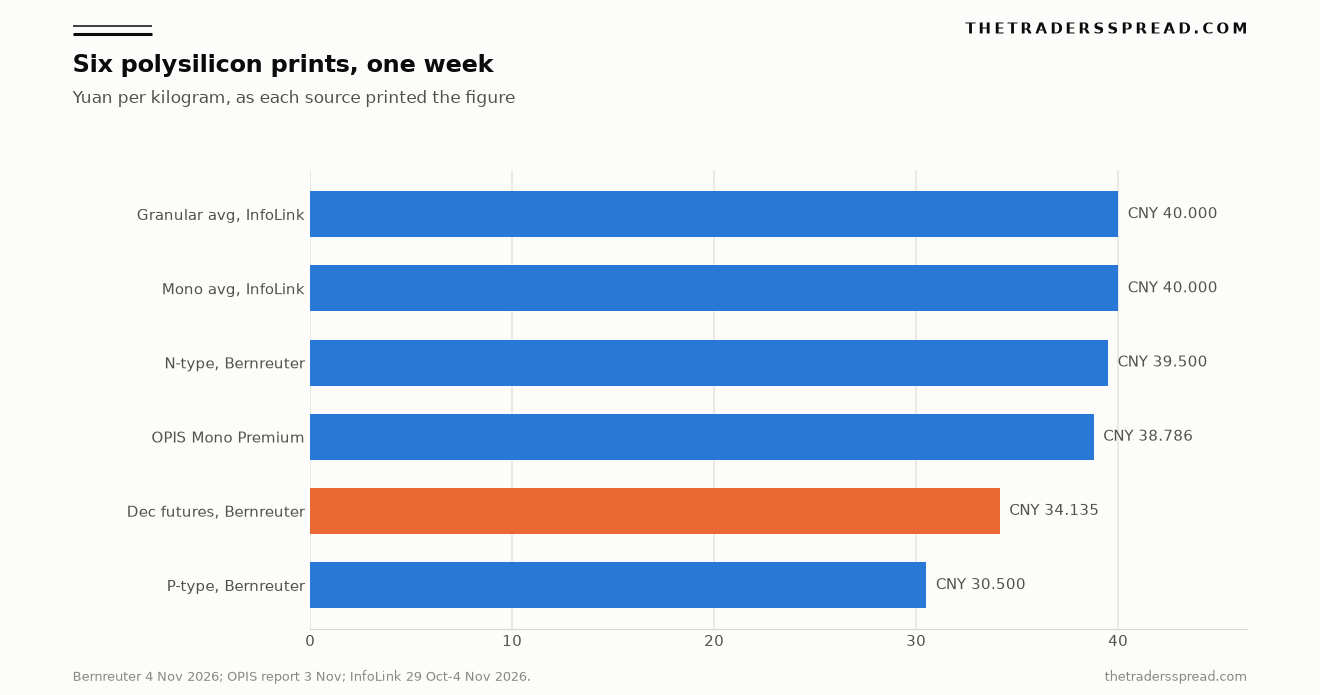
Bernreuter on 4 November printed the December average settlement at CNY 34.135 per kilogram, down from CNY 36.595 on 28 October. Multiplying 34.135 by 1,000 restates it as CNY 34,135 per tonne. That product is arithmetic on Bernreuter's figure, after the exchange's Chinese quote page returned a bot challenge, with the rules page supplying the unit. OPIS, published 30 October, wrote 26 October settlements from CNY 33.620 to CNY 37.180 per kilogram for November 2026 through October 2027, the highest about 4.14% under its spot assessment.
Step 2: Separate the grade before comparing two lines
N-type polysilicon feeds ingots for the higher-efficiency cells. P-type is the older mono grade, fluidized-bed granules are a third product, and dense Siemens chunks are a fourth. A bare "polysilicon" label has skipped the line that moves the number.
Bernreuter on 4 November cut both China indices by CNY 0.5 per kilogram, while most other providers, it wrote, still showed a flat price for high-quality n-type. PVinsights' lower-quality index fell CNY 0.3 that week after CNY 0.5 the week before, and Shanghai Metals Market's daily n-type index eased CNY 0.11, so the grade still has to be named.
InfoLink's 4 November note put n-type recycled material at CNY 42 to 43 per kilogram, with limited volume signed, and granular transactions at CNY 40 to 41. Its table for the same window averaged mono-grade yuan at 40.0, high 43.0 and low 40.0, and granular yuan at 40.0, high 41.0 and low 40.0. "40" and "42 to 43" can both cite InfoLink for one week, because Bernreuter says InfoLink takes the most common transactions and adjusts them slightly, rather than a volume-weighted mean.
Traceability is a further line on that page. Quotes exclude special-specification cost, and material with traceability documents was generally priced at a premium of CNY 3 to 5 per kilogram. The average and a traced cargo are adjacent products, the same way flake graphite versus synthetic anode material changes the print when the name on the barrel changes.
Step 3: See what 13% VAT does inside a yuan print
Bernreuter states that Chinese yuan quotes contain 13% value-added tax and that its dollar figures are net of that tax. The Wednesday pair is therefore CNY 39.5 and US$5.24 for n-type, and CNY 30.5 and US$4.05 for p-type, with the dollar number printed in the same paragraph as the yuan index.
Futures delivery generates a special VAT invoice, so the plant's price is a tax-invoice price in yuan per tonne for a registered brand. A spot index with the 13% removed, then written in dollars per kilogram, sits on another scale even when the cargo is similar.
OPIS can move the dollar gloss while the yuan print holds. China Mono Premium was CNY 38.786, rendered as US$5.82 and as CNY 0.081 per watt, in the 27 October report, and the same CNY 38.786, rendered as US$5.81, in the 3 November report. Both notes called the yuan assessment unchanged. US$5.81 sits beside 38.786, close to Bernreuter's VAT-inclusive 39.5, while US$5.24 has had the tax removed.
Step 4: Hold the China line apart from the export line
InfoLink's table for 29 October to 4 November put non-China mono-grade polysilicon at US$26.70 high, US$11.00 low and US$18.50 average. Those dollar prices are origin prices, left unconverted from the yuan column, and Bernreuter the same Wednesday called InfoLink's non-Chinese index flat at US$18.50.
The OPIS Global Polysilicon Marker, for material produced outside China, was US$19.234 per kilogram, or US$0.040 per watt, unchanged in the 27 October report and carried by pv magazine on 30 October. It sits near US$18.50 and far from the US$5.79 global average because a 95-5 China weight pulls the blend toward the Chinese ex-VAT level while the outside-China price stays firm.
On 6 November an unnamed participant, via OPIS, tied the calm in China prices largely to a self-discipline agreement that leaves a breach unpenalised, so a posted offer can hold while a transaction price slips. InfoLink the same week said suppliers were generally unwilling to sell below full cost, that meetings were still pending, and that only two companies were seen delivering orders already placed, with wafer makers drawing stock.
One week, set out as a table
Each row names the print and the window. The chart keeps yuan per kilogram only, so the US$18.50 origin price stays off that axis.
| What it measures | Figure | Window | |
|---|---|---|---|
| Bernreuter global average | China and non-China blend | US$5.79/kg | 4 November 2026 |
| Bernreuter China n-type | VAT-inclusive index and ex-VAT dollars | CNY 39.5/kg, US$5.24 | 4 November 2026 |
| Bernreuter China p-type | VAT-inclusive index and ex-VAT dollars | CNY 30.5/kg, US$4.05 | 4 November 2026 |
| InfoLink non-China mono | Origin average, high and low | US$18.50/kg (26.70 / 11.00) | 29 Oct to 4 Nov 2026 |
| InfoLink China mono | Yuan table average | CNY 40.0/kg (43.0 / 40.0) | 29 Oct to 4 Nov 2026 |
| InfoLink n-type recycled | Weekly reference band | CNY 42 to 43/kg | 4 November 2026 |
| OPIS China Mono Premium | Mono-grade for n-type ingots | CNY 38.786/kg (US$5.81) | Report of 3 November 2026 |
| OPIS marker | Produced outside China | US$19.234/kg | Report of 27 October 2026 |
| Daqo realized ASP | Selling price on shipments | US$4.12/kg | Q3 2026, released 27 October |
| December futures | Bernreuter's kilogram restatement | CNY 34.135/kg | 4 November 2026 |
Step 5: Read the futures print as its own contract
A Guangzhou settlement is the volume-weighted average of one contract's trades, in yuan per metric ton, for deliverable brands. A spot index surveys a named grade, usually per kilogram. Bernreuter on 4 November tied the 1.1% drop in the global average, to US$5.79, to a low futures price, and used that futures figure as an input while leaving the settlement and the spot index as separate prints.
OPIS on 30 October said spot deals were still clearing above the futures curve, because some long-term buyers still needed spot tonnes and balanced them with cheaper metal from futures traders. One participant said makers on the self-discipline agreement looked determined to hold fourth-quarter sales at CNY 40 per kilogram or higher, a 27 October stance that sits beside InfoLink's CNY 40 average and Bernreuter's CNY 39.5 n-type index a week later.
The aluminium note follows one exchange and one stock figure, while polysilicon in the same week arrives as this stack, still needing a unit conversion and a grade.
A producer filing is a third kind of number
Daqo New Energy's quarter ended 30 September 2026, released 27 October, records polysilicon the company sold. Average selling price was US$4.12 per kilogram, up from US$4.04. Cash cost, inventoriable production cost excluding depreciation and non-cash share-based pay divided by production volume, was US$4.23, down from US$4.57, and total production cost was US$5.37, down from US$5.95. Production was 53,469 metric tons against 43,675, above guidance of 40,000 to 45,000, and sales were 46,910 metric tons against 15,190. Revenue was US$194.2 million against US$62.7 million the quarter before and US$244.6 million a year earlier. Nameplate capacity is 305,000 metric tons at about 70% utilization.
Xiang Xu, chief executive of Daqo New Energy, said in the 27 October 2026 release: "Our average selling price increased by 2.0% sequentially to $4.12/kg, although the increase lagged the broader market recovery because Q3 shipments fulfilled orders signed before late July." He put n-type at CNY 30.5 to 33 per kilogram in the second quarter and about CNY 40 to 43 by quarter-end, after State Administration for Market Regulation guidance on 31 July, an August below-cost initiative Daqo co-signed, and a 3 September joint notice with the National Development and Reform Commission on cost accounting. The average clears old orders, while the offer band describes the later market.
PV Tech posted on 10 August 2026 that Tongwei, GCL Tech and Daqo were among eight producers signing a fair-pricing pact. Daqo's October release is the company's own account of that signature, and the tweet is the trade-press marker from August.
RelatedWhat Moves the Gallium Price Once Export Rules Bind
Tongwei, GCL Tech, Daqo among eight polysilicon leaders to sign fair pricing pact https://t.co/Sh9H4Nr8G3 #solar
— PV-Tech (@pv_tech) August 10, 2026
The US$4.12 selling price sat under the US$4.23 cash cost and the US$5.37 total cost. Inventory impairment was US$30.9 million, down from US$55.7 million, and gross margin was negative 31.2%, lines that describe Daqo's quarter while the spot index remains the week's survey. Fourth-quarter output is guided at 35,000 to 45,000 metric tons and 2026 at 175,000 to 185,000 including maintenance, a range the release says can change.
Who publishes the sheet, and how an average is built
Bernreuter posts a global average each Wednesday from EnergyTrend's China prices plus InfoLink's outside-China price, with dense mono as p-type and high-quality material as n-type. Multi-grade stayed in the blend until August 2023, and the latest weight on the page is the 95-5 split of 12 March 2025. InfoLink, in Bernreuter's account, talks to more than 100 companies and takes the most common transaction, while Shanghai Metals Market weights trades ahead of bids. Bernreuter sets SMM's non-Chinese and electronic-grade prices aside as unrealistically low. PVinsights often turns early, and SunSirs is often out of step with the other shops.
OPIS, a Dow Jones company, publishes the China Mono Premium and the Global Polysilicon Marker in the Global Solar Markets Report, and the public weekly face is the pv magazine column. On 6 November that column left the premium at CNY 38.786 per kilogram, with inventories above 500,000 metric tons, output still ahead of demand, and October cuts that might show more clearly from November. The post below is pv magazine pointing readers at that OPIS assessment.
China wafer prices steady on firm polysilicon amid weak fundamentals: In a new weekly update for pv magazine, OPIS, a Dow Jones company, provides a quick look at the main price trends in the global PV industry.
— pv magazine (@pvmagazine) November 6, 2026
The… 🔗 Link in Bio #Photovoltaics #EnergyStorage #RenewableEnergy
Stock lines need their own label. Citing the Silicon Branch, Bernreuter put October output at 109,500 metric tons, above SMM's 95,800 and a prior projection of 105,000, with supply ahead of demand by 14,000 metric tons and industry inventory at 587,000. November in that relay was 84,000 metric tons of output against 90,000 of demand. InfoLink looked for about 82,000 metric tons in November, with manufacturer stocks of 380,000 to 390,000 at end-October, and OPIS described inventories above 500,000 metric tons on both 30 October and 6 November. The counts can be current and still cover different sheds.
Questions that come up the next time the sheet is open
Why is a China polysilicon price so far from a non-China dollar price?
The cargos clear in different places, and one figure may be a blend. InfoLink's 29 October to 4 November window put China mono-grade at CNY 40 per kilogram and non-China mono at US$18.50 as an origin price. Bernreuter's US$5.79 on 4 November uses a 95-5 China weight from 12 March 2025, while OPIS marked outside-China material at US$19.234 per kilogram on 27 October.
Does the Guangzhou futures price use kilograms?
Article 8 of the English rules dated 12 June 2026 quotes the contract in yuan per metric ton, with a 3-ton lot and a 5-yuan tick. Bernreuter on 4 November printed December at CNY 34.135 per kilogram. Multiplying by 1,000 restates that print as CNY 34,135 per tonne, arithmetic on Bernreuter's figure after the Chinese quote screen returned a bot challenge.
What separates n-type from p-type on a polysilicon table?
N-type feeds higher-efficiency ingots and p-type is the older mono grade. On 4 November Bernreuter put n-type at CNY 39.5 per kilogram including 13% VAT, or US$5.24 ex-VAT, and p-type at CNY 30.5, or US$4.05 ex-VAT. InfoLink the same day quoted recycled n-type at CNY 42 to 43, with limited volume signed, and granular deals at CNY 40 to 41.
Why can a producer's selling price sit under the spot index?
Daqo's third-quarter selling price was US$4.12 per kilogram. Management put wider n-type offers near CNY 40 to 43 by the end of September, up from CNY 30.5 to 33, and Xiang Xu said the shipments filled orders signed before late July. A spot index records the surveyed week. A selling price records metal that has already left the plant.
A checklist for the next time an assessment is open
- Unit: kilograms on the research sheets, metric tons on Guangzhou PS, and watts only where the publisher already printed a per-watt line.
- Grade, from n-type and p-type to chunk, granular or recycled, plus a traceability premium such as InfoLink's CNY 3 to 5 per kilogram.
- Tax treatment, either yuan still carrying 13% VAT or a dollar equivalent with the tax removed, the split Bernreuter prints.
- Geography: China domestic, a non-China origin price, or a blend such as Bernreuter's US$5.79 beside InfoLink's dollar column.
- Publisher and window, whether the figure is a Wednesday print, a Thursday-to-Wednesday order book, or a quarterly filing.
- Kind of number: surveyed spot, a futures settlement, or a realized price such as Daqo's US$4.12 per kilogram for the third quarter of 2026.
- Stock definition when inventory appears: industry total, manufacturer sheds, or an above-500,000-ton comment, each with its source.
- The date written beside the figure, so a later week stays clear of an older print.
Disclaimer. Figures in the sections above are reference prints from the named publishers and from Daqo's 27 October 2026 release, each with its date. They are general information about how the quote is built, and they are not a recommendation to buy or sell polysilicon, a futures contract, or a share.