

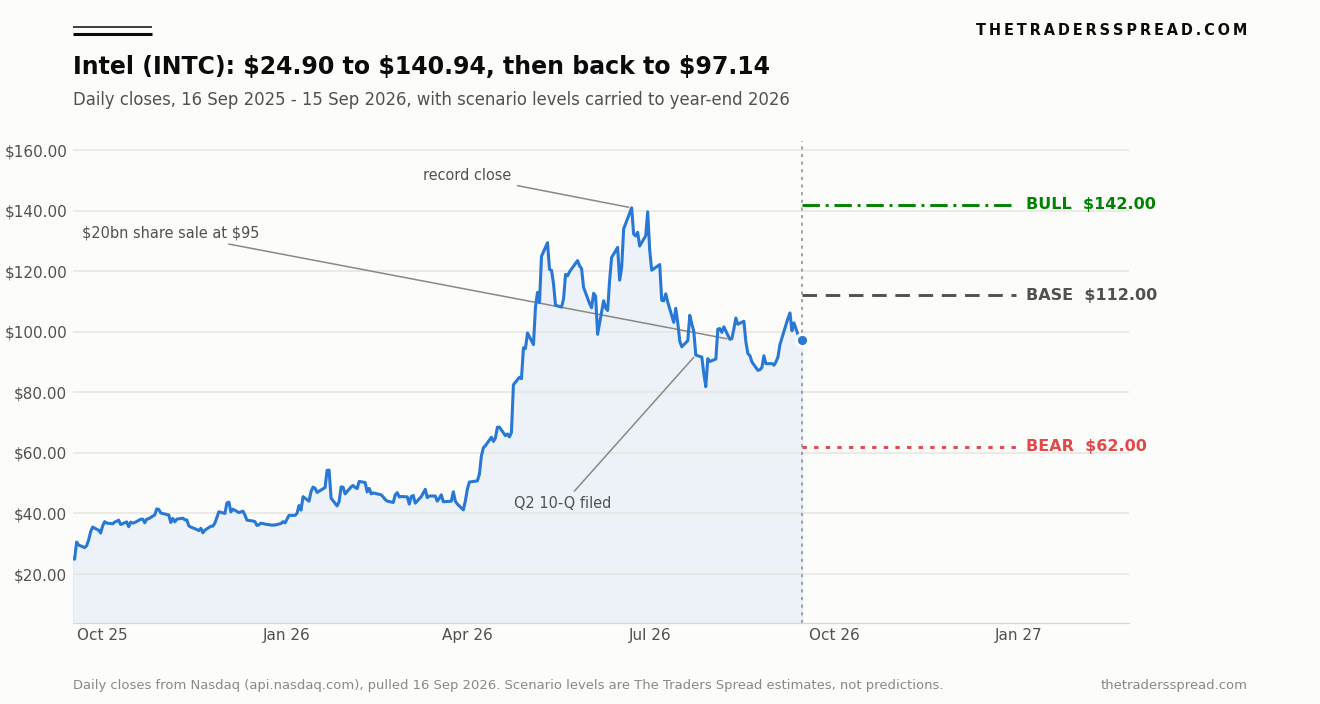
Twelve and a half billion dollars. Intel booked that as a loss in the three months to 27 June 2026, and not one cent of it came from selling chips. It is the mark-to-market charge on shares the company placed in escrow for the US Department of Commerce, revalued every quarter, and the Q2 10-Q states the cause without flinching: the loss was "driven by an increase in our stock price." Intel (INTC) closed at $97.14 on 15 September 2026, down 0.05% on the day, on 85.0 million shares against a three-month average nearer 103.9 million. The stock sits 290% above its September 2025 closing low of $24.90 and 31% below the record close of $140.94 printed on 22 June. Both of those sentences describe the same twelve months.
That accounting quirk does something specific to anyone reading Intel through its headline numbers, and almost nobody says it out loud. The escrowed-share liability runs opposite to the shareholder. When INTC rallies, GAAP earnings get worse. When INTC falls, GAAP earnings get better. Intel's fiscal third quarter closes on 26 September with the stock about 24% below the $128.32 close that anchored the June-quarter mark, so the same line that produced an $11.0bn GAAP net loss in Q2 should flip to a gain in Q3. Management's own guidance implies exactly that: Q3 GAAP EPS of $0.31 sits seven cents under the $0.38 non-GAAP figure, against a $2.58 chasm in Q2. The GAAP print is about to improve enormously for a reason that has nothing to do with wafers.
Key facts
- INTC last traded at $97.14, a market capitalisation of $513.4bn — Nasdaq, 15 September 2026
- Intel Foundry lost $2,089m at the operating line in Q2 2026, a 36% operating loss margin — Intel Q2 2026 Form 10-Q, 24 July 2026
- Foundry revenue from external customers was $293m in the quarter, against $5,477m of intersegment revenue — Intel Q2 2026 Form 10-Q, 24 July 2026
- Data Center and AI revenue rose 59% year on year to $6,262m, with segment operating income of $2,474m against $633m — Intel Q2 2026 earnings release, 23 July 2026
- Intel sold 210,526,315 shares at $95.00 on 10 August 2026, upsized from $15bn to $20bn, with the full greenshoe exercised the next day — Intel Form 8-K, 12 August 2026
- The Department of Commerce holds warrants over 241 million shares at $20.00, exercisable only if Intel stops owning at least 51% of its foundry — Intel Q2 2026 Form 10-Q, 24 July 2026
- Nasdaq's consensus one-year target is $113.50, 16.8% above spot — Nasdaq, 15 September 2026
The $293 million the foundry story is built on
Intel Foundry reported $5,765m of revenue in Q2 2026, up 31% year on year. That is the figure that gets quoted. For judging whether anybody outside Intel wants to buy Intel wafers, it is close to meaningless. Of that $5,765m, some $5,477m was intersegment: Intel's fabs selling to Intel's product groups at transfer prices the company says are "intended to approximate market pricing." The revenue that came from genuine third parties was $293m. On a $513bn market capitalisation, the entire external foundry franchise is running at roughly $1.2bn a year.
The composition is worse than the headline. External foundry revenue was $22m in Q2 2025 and $293m in Q2 2026, and the 10-Q attributes the increase "primarily due to Altera's transition to an external customer following the deconsolidation of Altera in Q3 2025." Altera is the programmable-logic business Intel owned outright until it sold 51% of it in September 2025. Intel separately discloses $181m of Q2 revenue from Altera as a customer. Set that against the $293m external line and the arithmetic on genuinely new, arms-length foundry demand becomes uncomfortable to look at.
This is the gap between the narrative and the ledger.
Intel's own framing is markedly more guarded than the one circulating in commentary. The 10-Q states that "substantially all of our Intel Foundry business supports internal manufacturing for Intel Products," and that the company "aim[s] to develop a more significant external foundry business in the future." The path runs through Intel 14A rather than 18A, and the customers are not signed. The company describes "continued progress towards meeting performance and design milestones for potential significant customers to evaluate Intel 14A for their future products," and then states that the pace of expansion "will ultimately be dictated by the amount of committed demand for Intel 14A that we are able to obtain." Committed demand, in the filing's own framing, is the variable, not the assumption. Anyone underwriting $97 on foundry economics is underwriting a customer list that does not yet exist in a public document.
Intel 18A is making the foundry worse before it makes it better
The half-year numbers contain a detail that inverts the standard bull argument. Intel Foundry's first-half operating loss narrowed to $4,526m from $5,488m, an improvement of $962m. Progress, on the face of it. The filing then explains where the improvement came from: roughly $1.8bn of lower period charges, including the absence of a $797m non-cash impairment and accelerated depreciation charge taken in Q2 2025 on manufacturing assets judged to have no remaining use, plus $391m of lower inventory charges.
Working the other way was $830m of lower product profit. The cause, in Intel's words, was "an increased mix of higher-cost wafers manufactured on our Intel 18A process node."
Strip out the charges that did not repeat and Intel Foundry's underlying economics deteriorated in the first half of 2026. The node that the entire re-rating rests on is currently a margin headwind, because 18A wafers cost more to make than the Intel 3 and Intel 4 wafers they are displacing and the price Intel Products pays does not yet cover the difference. That is normal for a new node early in its ramp. It is not what a reader would infer from a loss line that shrank by $962m, and it means the 2027 break-even target for the segment depends on a yield-driven cost curve that has not shown up in the segment accounts yet.
Run the reported improvement forward mechanically and the picture is stark. A $962m annual improvement rate against an annualised loss near $9bn puts break-even somewhere around 2031. Adjust for the fact that most of that improvement was a charge that did not recur and the extrapolation stops working altogether. The bull case requires the 18A cost curve to bend hard in the next four quarters, and the disconfirming evidence would appear in exactly one place: the Foundry operating loss line, without a one-off attached to it.
What actually re-rated is the data-centre line
Intel's product business is doing something genuinely impressive and it is being narrated as a foundry story. Data Center and AI revenue reached $6,262m in Q2 2026, up 59% year on year, and segment operating income went from $633m to $2,474m. Client Computing and Physical AI added 13% to $8,877m. Together, Intel Products earned $4,817m of operating income on $15,139m of revenue, a 31.8% segment margin. Consolidated gross margin climbed to 40.4% from 27.5%.
Lip-Bu Tan, Chief Executive Officer at Intel, put it this way in the Q2 release: "Our Q2 results represent our strongest revenue growth in more than fifteen years, enabled by greater speed, accountability, and customer focus."
| Segment (Q2 2026) | Revenue | Operating income | Q2 2025 operating income |
|---|---|---|---|
| Client Computing and Physical AI | $8,877m | $2,343m | $2,053m |
| Data Center and AI | $6,262m | $2,474m | $633m |
| Intel Foundry | $5,765m | $(2,089)m | $(3,168)m |
| All Other | $701m | $230m | $69m |
| Corporate unallocated | — | $(1,416)m | $(2,755)m |
| Consolidated | $16,128m | $1,796m | $(3,176)m |
Source: Intel Q2 2026 Form 10-Q, Note 2 Operating Segments, filed 24 July 2026.
The scale of the beat is easy to miss because the GAAP headline buried it. Three months earlier, alongside Q1 results, Intel guided Q2 revenue to $13.8bn–$14.8bn and non-GAAP EPS to $0.20. It delivered $16.1bn and $0.42. Revenue came in $1.3bn above the top of the company's own range and non-GAAP earnings arrived at more than double the guide. That is the kind of quarter that normally re-rates a semiconductor stock. INTC fell 7.9% the session after the 10-Q landed, from $100.23 to $92.32, because the number on the front page was an $11.0bn loss.
This is where the comparison with the rest of the desk matters. Nvidia's most recent guidance and AMD's margin problem are both stories about accelerator economics. Intel's Q2 was a story about x86 server CPUs being scarce and expensive in an AI build-out that needs host processors alongside the GPUs. Different mechanism, same demand wave. It also explains why Broadcom's custom-silicon franchise keeps surfacing alongside it: purpose-built silicon and advanced packaging are where Intel says its non-CPU growth comes from, and Q2 brought a named Fortinet collaboration on a security processor.
The August share sale reset the clearing price
On 10 August 2026 Intel sold 210,526,315 shares of common stock at $95.00 apiece, according to the 8-K filed two days later. The deal launched as a proposed $15bn offering and priced at $20bn. J.P. Morgan, Goldman Sachs, Morgan Stanley and Citigroup ran the book. On 11 August the underwriters exercised their option over a further 31,578,947 shares in full, taking gross proceeds to roughly $23bn. Net proceeds on the base deal alone were about $19.7bn, earmarked for general corporate purposes "including capital expenditures and working capital."
Spot is $97.14. The August buyers paid $95.00.
That $95 print is the most useful single level on the chart, because it is the only recent price at which an identified, size-constrained pool of institutional capital actually committed cash. It also explains the shape of the tape since: INTC traded $81.88 on 29 July, spent August between roughly $89 and $103, and has oscillated around the offering price ever since. The 50-day moving average sits at $97.39, within a quarter of a percent of spot. The 200-day sits at $76.15, a reminder of how much of this year's move is recent.
The dilution is real and it compounds a pattern. Shares issued and outstanding went from 4,994m at the December 2025 year-end to 5,043m at 27 June, and the August offering takes the count to roughly 5,285m. Weighted diluted shares in Q2 2026 were 5,104m against 4,369m a year earlier, a 17% increase. Intel is funding a capital programme that consumed $6,192m of investing cash flow in the first half, plus a further $1,423m routed through financing on extended payment terms, while government capital incentives fell to $167m from $964m a year earlier. Operating cash flow of $8,102m in the half covers that, barely, and only after a $14.2bn cash payment to buy Apollo out of the Ireland Fab 34 joint venture in April.
Dave Zinsner, Chief Financial Officer at Intel, was explicit about where the money goes: "AI-driven compute continues to strengthen, and to support expected growth this year and next across products and foundry, we are meaningfully increasing our investments in equipment, clean room space, and substrates."
The warrant that prices a foundry Intel cannot sell
Buried in Note 4 is the structural feature that most valuation work ignores. Alongside the escrowed shares, Intel issued the Department of Commerce warrants over 241 million shares at $20.00 each. They become exercisable only if Intel "cease[s] to directly or indirectly own at least 51% of our foundry business." At $97.14, that is roughly $18.6bn of intrinsic value the government collects the moment Intel sells the foundry down below majority control.
The obvious strategic answer to a segment losing $2.1bn a quarter is to separate it, partner it, or sell a stake in it. Washington has priced that door and handed Intel the bill. Whatever one thinks of the policy, the cleanest route to closing Intel's sum-of-the-parts discount now carries a toll, and a shareholder derivative suit filed in Delaware in March 2026 challenging the arrangement is still live.
The counterparty view is not uniformly bearish, and the most recent move on the tape came from the sell side. On 8 September, Northland Securities analyst Gus Richard upgraded Intel from Market Perform to Outperform with a $120 price target, citing material progress in the turnaround and a server-CPU shortage that hands Intel pricing power. INTC closed at $104.47 that day, up 9.05% from Friday's $95.80. The Motley Fool's account of the session pairs the upgrade with a DigiTimes report that Intel plans a further 10% CPU price increase later this year, which would be the third such move in 2026.
Pricing power is the swing factor the bears have to respect. It is also fragile in a way the 10-Q half-concedes: Intel attributes its ASP gains mostly to "a higher mix of premium products sold, with demand-based pricing actions contributing to a lesser extent." Mix is durable. Shortage pricing is not, and it reverses the moment hyperscale capex plans normalise or a competitor's supply loosens.
The call: base $112, bull $142, bear $62
Base case, $112, roughly 45% likely. Intel keeps beating its own revenue guidance on x86 scarcity, Q3 lands inside or above the $15.8bn–$16.8bn range, and the Q3 GAAP print flatters itself with an escrowed-share gain that sophisticated readers discount. Foundry losses grind lower without a step change. The multiple holds near 8x enterprise value to annualised revenue and the stock converges on Nasdaq's $113.50 consensus. This is the path of least resistance and it requires nothing new to happen.
Bull case, $142, roughly 25% likely. This needs two things the base case does not. An 8-K naming a significant external 14A customer with committed wafer volume, and a Foundry operating loss under $1.5bn in a quarter with no one-off doing the work. Get both and the segment stops being a $9bn-a-year cash incinerator and starts being an option, the sum-of-the-parts argument reopens despite the warrant, and $142 is simply a retest of the 22 June record close of $140.94 and the $142.35 twelve-month high. On annualised non-GAAP earnings near $2.40 that is about 59 times, the same multiple the market pays today on lower earnings.
Bear case, $62, roughly 30% likely. No anchor customer signs for 14A, Intel accelerates manufacturing expansion anyway as the filing says it intends to, capex outruns the $23bn raised in August, and a second equity offering arrives inside twelve months. Server CPU supply loosens, the pricing actions reverse, and gross margin gives back half of this year's 12.9-point gain. At that point the market stops paying a foundry multiple for a product company and 8x revenue compresses toward 5x. $62 is 36% below spot, 19% below the 200-day moving average, and still nearly 40% above where INTC traded in March 2026.
What would change my mind, in order of how much it would move the analysis: a named 14A design win with disclosed volume commitments; external foundry revenue excluding Altera crossing $500m in a quarter; Foundry operating loss below $1.5bn on clean economics; and, on the downside, any announcement of further equity issuance. A close below $81.88, the 29 July low, would kill the base case outright. Realised volatility has run at 78% over the past year and 72% over the past sixty days, so position sizing matters more here than the levels do.
RelatedAmerican Express (AXP) Falls 3.67% After Outlook Raise
FAQ
Why did Intel report an $11bn loss in a quarter when it made $1.8bn of operating income?
The gap is almost entirely the $12.5bn mark-to-market charge on shares held in escrow for the Department of Commerce. Those shares are accounted for as a derivative liability and revalued each quarter. Because INTC rose sharply during the June quarter, the liability grew to $15.6bn from $2.7bn at the December 2025 year-end, and the increase flowed through the income statement.
Does that mean Intel's GAAP earnings will improve if the stock falls?
Yes, mechanically. The relationship is inverse. With INTC about 24% below the June-quarter reference close going into the 26 September quarter end, the same line should produce a gain in Q3. Intel's own guidance of $0.31 GAAP versus $0.38 non-GAAP reflects a far narrower gap than Q2's $2.58 spread.
Is Intel Foundry close to break-even?
Not on the disclosed numbers. The segment lost $2,089m in Q2 2026 and $4,526m in the first half, a 40% operating loss margin. Most of the year-on-year improvement came from charges that did not repeat rather than better unit economics, and underlying product profit within the segment fell $830m on a higher mix of costlier Intel 18A wafers.
How much has Intel diluted shareholders this year?
Share count has gone from 4,994m at the 2025 year-end to roughly 5,285m after the August offering, about 5.8%. Weighted diluted shares in Q2 2026 were 17% higher than a year earlier. A further 143 million escrowed shares sit undelivered, and the Commerce Department holds warrants over another 241 million at $20.00 that only become exercisable if Intel drops below 51% ownership of the foundry.
What is the significance of the $95 offering price?
It is the most recent price at which a large, identified pool of institutional capital committed cash rather than expressing an opinion. Spot at $97.14 is 2.3% above it and the 50-day moving average of $97.39 sits almost exactly on it. Levels like that act as reference points for months.
Is Intel still in the Dow Jones Industrial Average?
No. S&P Dow Jones Indices announced on 1 November 2024 that Nvidia would replace Intel in the DJIA, effective before the open on 8 November, ending a quarter-century of membership. It has no bearing on the analysis above.
Disclaimer
This article is analysis and information, not investment advice, and nothing in it is a recommendation to buy, sell or hold any security. Scenario levels are estimates derived from public filings and market data, not predictions. Trading and investing carry risk and capital is at risk. Readers should conduct their own research and consider their circumstances before acting on any market analysis.