

Synopsys is asking holders to treat two profit numbers as one business. The investor-day release of 30 September 2026 sets fiscal 2027 non-GAAP earnings per share at $19.04 to $19.12, and GAAP earnings per share in the same table at $8.16 to $8.61. The last Nasdaq close, Friday 2 October, was $489.90. On the non-GAAP midpoint of $19.08 that close is 25.7 times earnings. On the GAAP midpoint of $8.385 it is 58.4 times. Both multiples use Synopsys's own targets and one Yahoo Finance print from that session. One reading sets aside more than $1.5 billion of annual amortization and nearly $1 billion of stock-based pay. The other treats Ansys purchase accounting as a cash cost that repeats in full. They cannot both be a comfortable description of the same close, and the release does not pick a price.
Revenue does not settle it. The same release puts fiscal 2027 revenue at $11.10 billion to $11.20 billion and calls the $11.15 billion midpoint growth of approximately 15%. On 26 August the company had already guided fiscal 2026 revenue to $9.690 billion to $9.740 billion, midpoint $9.715 billion. Fifteen percent on that midpoint is $11.17 billion. The new midpoint is $22 million lower, which is 14.8% growth, not a break with August. From the 29 September close of $415.09 to Friday, the shares rose 18.0%. The price moved harder than the revenue framework.
Change the anchor and the jump shrinks. On 27 August, the session after the earnings call, the close was $464.89. Against that print, $489.90 is a 5.4% gain.
Fiscal 2027 ends on 31 October 2027. The prices below run only to 31 December 2026. Synopsys did not publish a share-price target.
The figures in one place
- Last close: $489.90 on 2 October 2026, NasdaqGS, Yahoo Finance daily bars retrieved 4 October 2026. Session range $483.24 to $500.03.
- Fiscal 2027: revenue $11.10 billion to $11.20 billion, non-GAAP EPS $19.04 to $19.12, GAAP EPS $8.16 to $8.61. Synopsys release, 30 September 2026.
- Same release: non-GAAP operating margin about 44.0% at the midpoint, GAAP operating margin about 20.7%, free cash flow about $3.1 billion.
- Repurchase intention: about $1 billion over the coming months, subject to market conditions. Longer-run ceiling: up to 50% of free cash flow.
- Amazon: a multi-year agreement the release writes as "$1B+". No fiscal 2027 revenue split is stated. Synopsys release, 30 September 2026.
- Shares outstanding: 191,636,646 as of 24 August 2026, Form 10-Q cover. At $489.90 the equity value is $93.88 billion.
- At 31 July 2026: debt $10.037 billion in the debt footnote, cash $3.606 billion, net debt about $6.43 billion. Form 10-Q.
What 30 September put on the page
Sassine Ghazi, president and chief executive, framed the demand side as more than one engine. "AI is creating multiple, reinforcing growth engines for Synopsys. The acceleration of frontier intelligence is fueling an unprecedented demand for compute power while increasing system complexity," he said in the 30 September growth release.
Shelagh Glaser, chief financial officer, said the framework "reflects confidence in both our growth trajectory and our ability to scale efficiently while helping customers re-engineer their engineering to accelerate AI-powered products." From a fiscal 2026 estimate through fiscal 2030, company revenue growth is mid-teens, about 15% compounded. Inside Design Automation, EDA is "13%+" and simulation and analysis is "10%+". Design IP is "17%+". Non-GAAP EPS growth and free-cash-flow growth are each in the mid-20s. The fiscal 2030 non-GAAP operating margin is about 50%.
Year one is hotter on earnings than on cash.
Fiscal 2026 non-GAAP EPS was guided on 26 August to $15.04 to $15.10, midpoint $15.07, in the earnings exhibit to that day's 8-K. The fiscal 2027 non-GAAP midpoint of $19.08 is 26.6% higher, the top of a mid-20s rate taken in one step. Free cash flow does not match: about $2.6 billion for fiscal 2026 against about $3.1 billion for fiscal 2027, up about 19%. Capital expenditure rises from about $225 million to about $500 million, and operating cash flow from about $2.8 billion to about $3.6 billion. The extra investment spend eats part of the cash-flow gain.
| Item | Fiscal 2026 guide, 26 Aug | Fiscal 2027 target, 30 Sep |
|---|---|---|
| Revenue | $9.690 billion to $9.740 billion | $11.10 billion to $11.20 billion |
| Non-GAAP EPS | $15.04 to $15.10 | $19.04 to $19.12 |
| GAAP EPS | $3.84 to $4.08 | $8.16 to $8.61 |
| Non-GAAP operating margin | midpoint about 41.5% | midpoint about 44.0% |
| GAAP operating margin | midpoint about 10.4% | midpoint about 20.7% |
| Free cash flow | about $2.6 billion | about $3.1 billion |
| Diluted shares | 192 million to 194 million | 190 million to 192 million |
From 41.5% to 44.0% is 2.5 points in one year, then about 6 more points to a fiscal 2030 non-GAAP margin near 50%. Synopsys says several 2028 to 2030 items cannot be reconciled to GAAP without unreasonable effort. Fiscal 2027 can: amortization adds 13.9 points to the 20.7% GAAP margin, stock-based pay 8.7, restructuring 0.7.
In dollars the expense bridge takes out $1.540 billion to $1.550 billion of amortization, $960 million to $980 million of stock-based compensation, and $50 million to $100 million of restructuring. Per share, the release adds back $8.06 to $8.12 for amortization, $5.03 to $5.13 for stock-based pay and $0.26 to $0.52 for restructuring, then removes $2.84 to $2.89 for tax. The non-GAAP tax rate is a flat 18%. The share count in that maths is 191 million. The low column sums to $19.04 and the high column to $19.12. The bridge is arithmetic. It is not cash, and fiscal 2027 guides another year of it.
How the shares reached Friday
The chart is the daily close from 1 April 2026 through 2 October 2026. The lines to 31 December are three prices, not a forecast path.
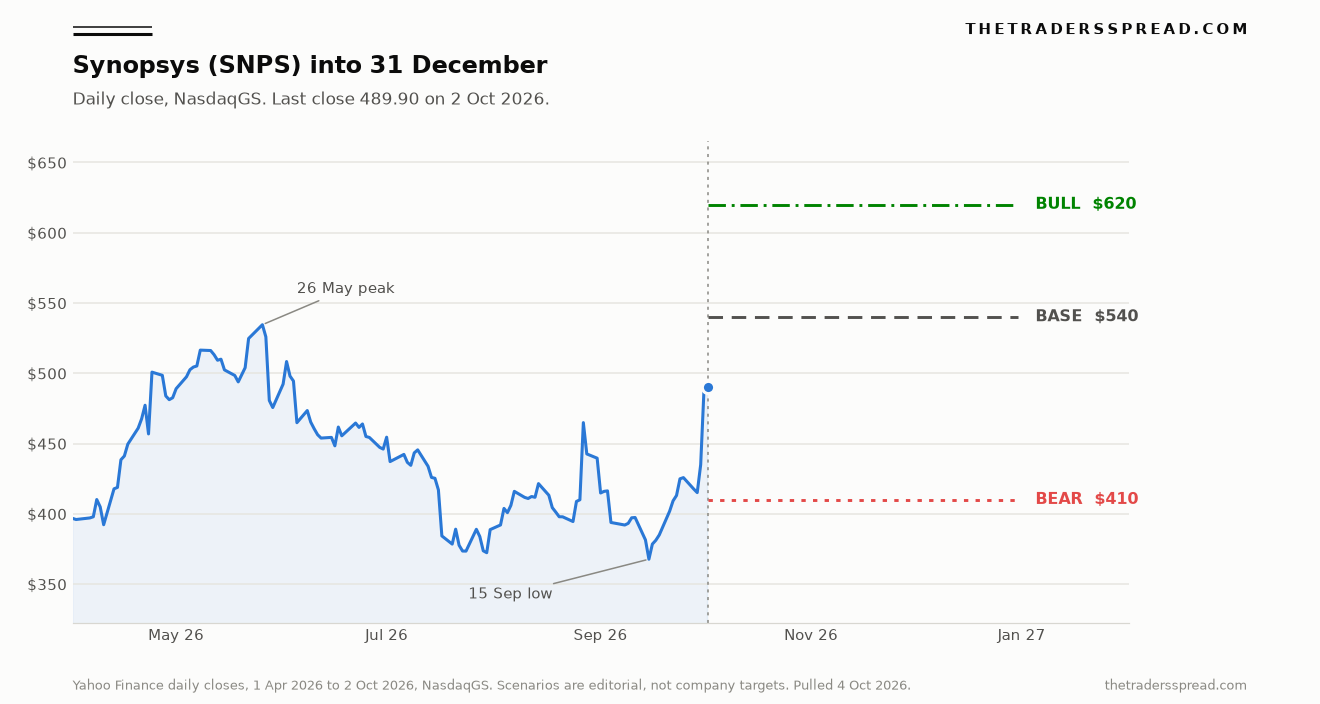
From the 31 December 2025 close of $469.72, Friday's $489.90 is a 4.3% gain for the year to date. The path inside that year is not mild. The high on this Yahoo series is $539.48 on 26 May, when the close was $534.56. The low is $362.55 on 15 September, when the close was $367.70. Friday is 35.1% above that low and 9.2% below that high.
August is the precedent for December. The 26 August release set the call for 2:00 p.m. Pacific, after the cash close, and the shares finished that session at $410.00. The next session closed at $464.89, up 13.4%. Six sessions later, on 4 September, the close was $393.84, back through the pre-call price. The 15 September low finished the giveback. The October move has had one flat session, not three weeks.
The quarter those August targets sat on is in the same exhibit. Revenue for the three months ended 31 July was $2.477 billion, against $1.740 billion a year earlier. GAAP EPS was $2.84. Non-GAAP EPS was $3.91. Design Automation revenue was $2.003 billion. Design IP was $473.8 million, up 10.8% from $427.6 million. Ghazi's line that day: "One year after the transformational acquisition of Ansys, we are executing with focus, extending our leadership and gaining momentum." The tax note dates the Ansys close to the third quarter of fiscal 2025, so the Design Automation comparison is not a clean organic read. Expected Ansys revenue inside the fiscal 2026 guide is $2.98 billion, about 31% of the $9.715 billion midpoint.
Design IP is the row that argues with the long-term model. For the nine months ended 31 July, IP revenue was $1,335.0 million against $1,344.7 million, down about 0.7%, even after the third quarter grew. A 17% compound rate through fiscal 2030 is a forecast on a base that has not started compounding. Adjusted operating margin in the quarter was 45.2% in Design Automation and 26.5% in Design IP. GAAP operating income was $357.5 million, 14.4% of reported revenue. The segment margins and the GAAP margin are not the same object.
Volume marks the days that mattered. On 30 September the close was $434.94 on 4.49 million shares, up from $415.09. On 1 October the shares opened at $467.85, ranged from $462.00 to $496.95, and closed at $490.54 on 6.66 million shares, about 3.3 times the prior 20-session average of 2.01 million. Friday opened at $497.86, touched $500.03, and closed at $489.90 on 3.33 million shares.
Amazon named a sum. OpenAI did not.
The Amazon release calls it a "multi-year, $1B+ agreement" and says the business is moving toward application-optimized IP on a licence-plus-royalty model, with Amazon as the lead customer. Scope also covers EDA, simulation and analysis, and agentic tools. Synopsys will use Amazon EC2, cloud storage and Bedrock, and will work on Trainium and Graviton. The companies cite more than 15 years of collaboration. Peter DeSantis, SVP, foundational AI, custom silicon, quantum computing at Amazon, said: "From Graviton to Trainium, purpose-built chips deliver better performance at lower cost because they're designed for exactly what customers need."
The release does not say how much of the "more than $1 billion" falls in fiscal 2027, or how licence and royalty split, or when volume starts. The revenue midpoint is already about 15% above the August fiscal 2026 guide. If the contract is inside that guide, it supports the number. If it is extra, the guide is conservative. The document does not say which, so the sum cannot be stacked on top of $11.15 billion.
Custom silicon is a crowded customer list. Broadcom supplies a different slice of the same build-out, accelerators and networking rather than design IP. For Synopsys the narrower point is that hyperscaler chips raise the value of a differentiated block and also raise customer concentration, which the company's own risk language already flags.
The OpenAI arrangement has no dollar sign. The release describes a multi-year effort to build GPT-Synopsys, a model meant to operate Synopsys tools, with revenue sharing and a joint go-to-market. OpenAI will licence Synopsys EDA tools for the model. Customer design data is not used to train it, and early engagements with semiconductor customers are under way. Greg Brockman, president and co-founder of OpenAI, said the aim is to help engineers "explore more designs and get to a working chip faster." No contract value, no seat count, no general-availability date. A real product path can still be worth nothing precise in a December price.
A royalty stream that already exists is a different security. Arm Holdings is paid when chips ship. Synopsys is describing a step toward licence plus royalty from a business whose last nine months were flat in dollars.
One billion dollars is about 1% of the count
At Friday's close, $1 billion purchases about 2.04 million shares, 1.1% of the 191.6 million outstanding on 24 August. At the 15 September low of $362.55 it would have purchased about 2.76 million. The release names no price and no calendar beyond "the coming months," and it is subject to market conditions.
Next to the diluted-share ranges it looks like an offset. Fiscal 2026 was guided at 192 million to 194 million diluted shares. Fiscal 2027 is 190 million to 192 million. The midpoints, 193 million and 191 million, differ by about the number of shares $1 billion buys here. The ranges overlap at 192 million. Stock-based pay of $960 million to $980 million is a similar pile of dollars. The two do not cancel share for share. A reader who treats the repurchase as a material cut in the count is ahead of the guide.
Borrowings have been falling since the Ansys financing, which is why a small repurchase can still fit. At 31 July long-term debt was $9.017 billion and the current portion $1.020 billion. The footnote totals debt at $10.037 billion. Cash was $3.606 billion, so net debt was about $6.43 billion. On 31 October 2025 long-term debt was $13.462 billion and the current portion $22 million. Non-GAAP interest and other expense is guided at $455 million to $465 million for fiscal 2027, against $481 million to $485 million in the August fiscal 2026 guide. Smaller stock of debt, still a large interest line.
Goodwill was $26.835 billion at 31 July. Net intangibles were $11.459 billion, down $1.22 billion from 31 October 2025, beside $1.210 billion of amortization in the earnings exhibit. Using the August share count, Friday's price and July net debt, equity value is $93.88 billion and enterprise value about $100.3 billion. Dates do not match. On that sketch, $3.1 billion of fiscal 2027 free cash flow is a 3.3% equity yield and about 3.1% on enterprise value. Half of free cash flow, the stated ceiling, is about $1.55 billion. The repurchase intention fits inside it.
RelatedSuper Micro (SMCI) $48 Bull Case Against a $26 Bear
Export rules sit under the targets. The August guide assumes "no further changes to export control restrictions or the current U.S. government Entity List restrictions," and the September caution repeats export restrictions and tariffs. No China revenue share appears in the investor-day release, so none is invented here. Intel is a separate product and a separate forecast, useful only as a reminder that policy can reprice a semiconductor tape. Synopsys supplies tools and IP into that tape. It does not fabricate the chips.
Three prices for 31 December
The base case is $540, 10.2% above Friday and a retest of the 26 May high of $539.48. On the fiscal 2027 non-GAAP midpoint that is 28.3 times. On the GAAP midpoint it is 64.4 times. It needs the fiscal 2027 band to survive the fiscal 2026 report, and it needs the market to pay roughly the multiple you get by laying the old high onto the new earnings guide. It does not need a new regime. Weight on this desk: 40%.
The bull case is $620, 26.6% above Friday and about 15% above the May high. It is 32.5 times the non-GAAP midpoint, because 32.5 times $19.08 is $620, and 73.9 times the GAAP midpoint. Reaching it by 31 December means the market capitalises OpenAI and the Amazon contract as growth beyond a guide that is already a 15% step-up, A close through $539.48 would show that case in the price. Weight: 25%.
The bear case is $410, 16.3% below Friday. It is the 26 August close, the last print before the earnings reaction, and it is 1.2% under the 29 September close of $415.09. On non-GAAP fiscal 2027 earnings it is 21.5 times. On GAAP earnings it is 48.9 times, which is not a distressed software multiple. The path is a replay: a defensible guide, a brief jump, a giveback toward the pre-event price. The 1 October low was $462. A close back through 30 September's $434.94 would put $410 in view. Weight: 35%.
The weights are this desk's. No options surface was pulled. Bias is bull because $540 and $620 both sit above $489.90. Conviction is 3 out of 5 because August already retraced a guide-raise, Design IP has not compounded at 17%, and Friday is 25.7 times non-GAAP earnings and 58.4 times GAAP earnings at once. The reference close is $489.90. The level that retires the bullish paths is $410. The central price is $540, not $620.
What would change the weights is a filing. A fiscal 2026 result at or above the August high end, $9.740 billion of revenue and non-GAAP EPS of $15.10, plus any fiscal 2027 dollar figure on the Amazon agreement, would shift weight toward $620. Fourth-quarter revenue under the $2.530 billion floor, or a cut to the $11.10 billion fiscal 2027 floor, would shift weight toward $410. The fourth-quarter guide still standing is revenue of $2.530 billion to $2.580 billion, non-GAAP EPS of $4.10 to $4.16, and GAAP EPS of $0.60 to $0.85. Nine-month revenue of $7.162 billion plus a $2.555 billion fourth-quarter midpoint is $9.717 billion, in line with the $9.715 billion full-year midpoint. The open argument is the multiple on the year after this one.
Questions that follow from the documents
What did Synopsys guide for fiscal 2027?
Revenue of $11.10 billion to $11.20 billion, GAAP EPS of $8.16 to $8.61, and non-GAAP EPS of $19.04 to $19.12, for the year ending 31 October 2027. Non-GAAP operating margin is about 44% at the midpoint, and free cash flow about $3.1 billion. Those figures are in the 30 September 2026 release. They are not a forecast of the share price.
Why are the two earnings numbers so far apart?
The release walks from GAAP to non-GAAP by adding back amortization, stock-based compensation and restructuring, then adjusting tax. Amortization alone is $1.54 billion to $1.55 billion. Net intangible assets on 31 July were $11.46 billion. The gap is Ansys purchase accounting running through the income statement, and the fiscal 2027 guide says it continues.
Does the Amazon deal add $1 billion to next year's revenue?
The release calls the agreement multi-year and "$1B+". It does not say how much is recognised in fiscal 2027. Stacking the whole sum on a midpoint that is already about 15% above the August fiscal 2026 guide would double-count unless Synopsys says the contract is extra. Until then it is evidence of a named lead customer, not an add-on to $11.15 billion.
Did the shares hold the August guide raise?
No. The session after the 26 August release closed at $464.89, up 13.4% from $410.00. By 4 September the close was $393.84, and the low on 15 September was $362.55. The move from $415.09 on 29 September to $489.90 on 2 October is larger, and it has been tested by one flat session.
What can the repurchase change?
At $489.90, $1 billion buys about 2.04 million shares, near 1.1% of the August share count. The diluted-share midpoint slips from 193 million to 191 million. That drift is about the size of the authorization at Friday's price. It is too small to carry the multiple from 25.7 times non-GAAP earnings to 32.5 times.
This is analysis, not a recommendation. The $620, $540 and $410 levels are scenarios for the share price, not instructions to transact. Capital is at risk, including the loss of the amount committed.