

Constellation Energy closed the Nasdaq regular session on 6 October 2026 at $300.40, up 12.2% on the day, and that print still sits 27.2% under the $412.70 intraday high of 15 October 2025. Those two facts do not fit one story. Treating Tuesday as a new range means paying a price the shares spent most of this year below. Treating the stock as broken means ignoring a session that opened at $291.11, never traded back to the prior close of $267.62, and finished above the 50-session and 200-session averages. From the 7 October 2025 close of $358.16, the shares are still down 16.1%. The figures are Yahoo Finance daily prices for CEG, retrieved at 06:52 UTC on 7 October 2026, before the next US cash open. The session lined up with a Google announcement whose first new megawatts are expected in 2028, not this quarter.
The company release is two agreements, and the equity moved as if it were one. A 20-year contract is tied to 890 megawatts of new capacity at 11 Constellation-owned units in Illinois, Pennsylvania and New Jersey, with the first uprate expected by 2028 and more than $4.3 billion of investment by the company. A separate 15-year contract covers 2,700 megawatts the fleet already produces in PJM. On the 355 million shares outstanding at 30 June 2026, the $32.78 move is about $11.6 billion of equity value, roughly 2.7 times a $4.3 billion floor, and less if the investment is larger. The release gives no ceiling and no price per megawatt-hour. The 15-year block adds no megawatts. Tuesday can be a re-rating of power the plants already make.
Key facts
- Regular-session close $300.40 on 6 October 2026, up 12.2% from the 5 October close of $267.62, on 13.48 million shares. Source: Yahoo Finance CEG daily chart, retrieved 7 October 2026 at 06:52 UTC.
- Session range $291.11 to $309.80. The open was $291.11, so the gap up from $267.62 was not filled. The close finished $9.40 under the high. Same Yahoo pull.
- Intraday high of the past year $412.70 on 15 October 2025. Intraday low $228.63 on 1 July 2026, with that day's close at $236.50. The last close is 27.2% under the high and 31.4% above the low. Same Yahoo pull.
- Google and Constellation announced a 20-year agreement tied to 890 megawatts of new nuclear capacity at 11 units, with the first uprate expected by 2028 and more than $4.3 billion of investment by Constellation, plus a separate 15-year agreement for 2,700 megawatts of existing PJM supply. Source: Constellation release, 6 October 2026.
- Full-year 2026 adjusted operating earnings guidance is $11.50 to $12.50 a share. Second-quarter GAAP earnings were $1.42 a share and adjusted operating earnings were $2.55. The company said it cannot reconcile that guidance to GAAP. Source: Constellation earnings release, 6 August 2026.
- Cash and cash equivalents were $697 million at 30 June 2026, down from $3,641 million at 31 December 2025. Long-term debt was $19,111 million, up from $7,250 million. Shares outstanding were 355 million, up from 312 million. Source: Constellation Form 10-Q for the quarter ended 30 June 2026, filed 6 August 2026.
- Calvert Cliffs, a 1,790 megawatt plant the company calls Maryland's only nuclear station, is covered by a separate 20-year Amazon agreement for 690 megawatts, including about 190 megawatts of new capacity guided for 2030 to 2032, and more than $3 billion of site investment. Source: Constellation release, 30 September 2026.
The session, set against the last year
Daily closes from 7 October 2025 through 6 October 2026 are below. Lines to the right of the last print are scenarios for 31 December 2026, not orders.
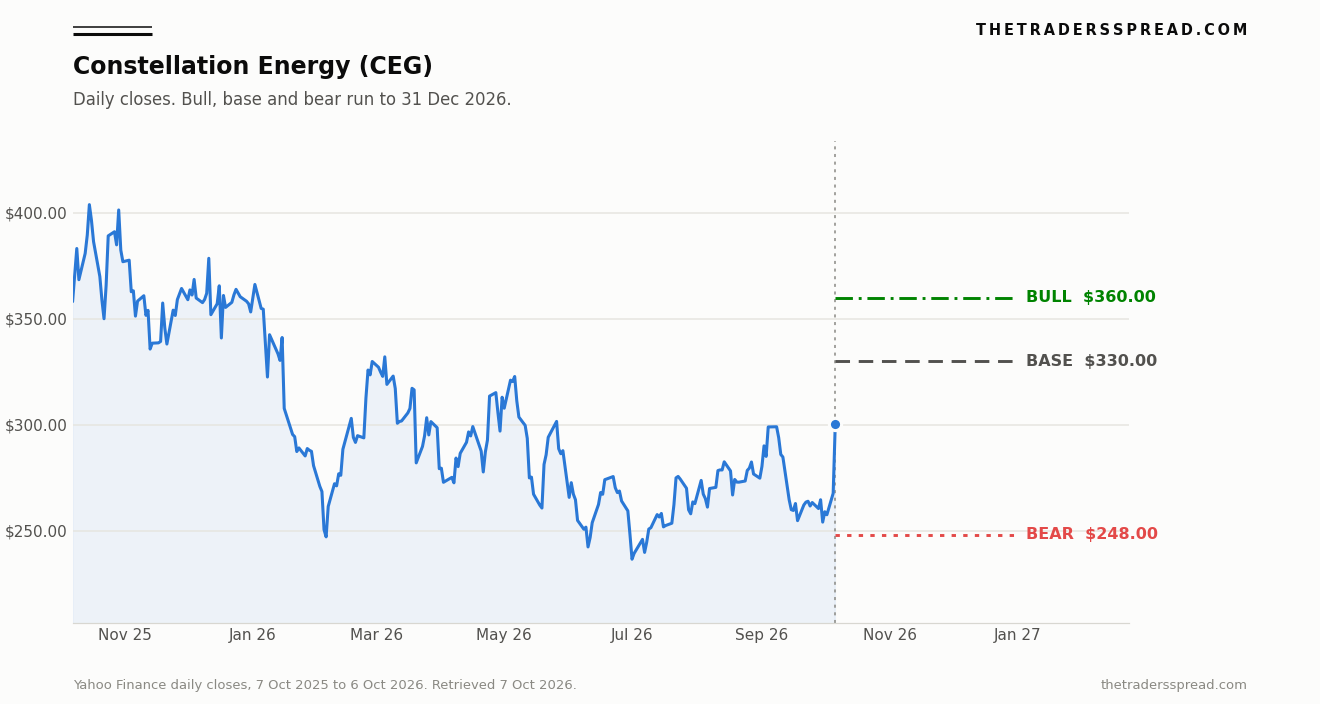
Tuesday's range was $291.11 to $309.80. Volume was 13.48 million shares, against 3.52 million the session before. Calculated through 6 October, the 50-session average is $271.95 and the 200-session average is $287.10. The prior close of $267.62 sat under both of that day's own averages, $271.34 and $287.30. The 6 October finish was the first close back above the 200-session average since 8 September.
From $267.62 to an open at $291.11 is an 8.8% gap, and the day's low was also $291.11. That space was not traded.
| Case | Level | Versus $300.40 | What it lines up with |
|---|---|---|---|
| Bull | $360 | +19.8% | Near the $358.16 close of 7 October 2025. Under the $366.25 close of 2 January 2026. |
| Base | $330 | +9.9% | Just under the $332.07 close of 5 March 2026. |
| Bear | $248 | -17.4% | Just above the $247.20 intraday low of 30 September 2026. |
A single session can reprice a stock after a corporate disclosure and still leave the argument open. This desk has already covered that pattern, including Accenture after its latest quarterly print. The CEG version has a timing problem those reactions do not. The megawatts in the headline are not a current-quarter figure.
What Google signed, and what it did not
The primary document is Constellation's release of 6 October 2026. It describes 890 megawatts of new nuclear capacity for the PJM grid, paid for through a 20-year agreement covering equipment at 11 units the company says it owns in Illinois, Pennsylvania and New Jersey. The capacity is described as new output. The first uprate is expected by 2028. Investment is more than $4.3 billion, on Constellation's side of the ledger, with roughly 4,400 existing jobs and about 7,200 construction jobs cited for the building period. Those job counts are the company's.
A second contract, 15 years rather than 20, covers 2,700 megawatts from the operating fleet. One agreement builds capacity later. The other commits generation that already exists. Folding both into a single 20-year headline drops the larger megawatt figure.
Google is the named counterparty. The release calls Google a subsidiary of Alphabet and stops there. A five-year technology agreement, under which Constellation selected Google Cloud and Gemini Enterprise, carries no dollar figure. It is not the power contract.
"This long-term clean energy collaboration with Google can serve as a model for how technology companies and the energy industry can work together to responsibly develop the digital economy and invest in our nation's energy infrastructure in a way that delivers grid-wide benefits for all, funded by private entities."
Joe Dominguez, chairman, president and CEO of Constellation, said that in the 6 October release. Private capital is paying, on the company's account, for capacity that stays on the regional grid.
"We're committed to meeting our growth responsibly by actively investing in clean, reliable power that brings new capacity to our nation's grids."
Amanda Peterson Corio, global head of energy and power at Google, said that in the same release. It is a statement about the buyer's load. It is not a tariff.
No 8-K came with it. On the morning of 7 October 2026 the SEC submissions feed for CIK 0001868275 showed a latest filing dated 2 October, a Form 4, and no Form 8-K dated 6 October. A missing current report does not make the release false. It does mean price, margin and spend timing were not yet in a filed exhibit. The EDGAR company page is where that exhibit would appear.
The quarter that has to carry a 2028 project
None of Tuesday's agreement is in the last reported quarter. The accounts on file are the second quarter of 2026, published 6 August, for the three months ended 30 June.
GAAP net income was $1.42 a share, down from $2.67. Adjusted operating earnings were $2.55, up from $1.91. Between them sits an unrealized loss of $0.94 a share. Adjusted earnings rose while GAAP earnings fell. The quarter does not have one earnings number.
Full-year 2026 adjusted operating earnings guidance was raised to $11.50 to $12.50 a share. At $300.40 that is 26.1 times the bottom and 24.0 times the top. Management said the guide cannot be reconciled to GAAP, because hedge marks and the nuclear decommissioning trusts cannot be projected. Four times $2.55 is $10.20, under the bottom of the range. Repeating the second quarter would miss the guide. That is a check, not a forecast of the second half.
Shane Smith, executive vice president and chief financial officer, said in the 6 August earnings release: "Our second-quarter results and increased full-year EPS guidance demonstrate the earnings power of our expanded platform, strong operational and commercial performance, and the disciplined execution of our capital allocation strategy." The expanded platform is Calpine. The same release says Constellation acquired Calpine in January 2026 and is still integrating it. A guide that already assumes that fleet does not, on its face, include a Google uprate whose first megawatts are expected in 2028.
The balance sheet shows what the expansion cost. The Form 10-Q filed on 6 August puts cash and cash equivalents at $697 million on 30 June 2026, against $3,641 million at 31 December 2025. Long-term debt was $19,111 million, against $7,250 million, before a further $363 million due within a year. Short-term borrowings were $5,226 million, against $1,650 million. Common shares outstanding were 355 million, against 312 million. The earnings release uses a different share count for the per-share math: 360 million average diluted shares in the quarter, against 314 million a year earlier. Goodwill was $11,527 million, against $420 million. Quarterly operating revenue was $7,504 million, about 23% above the $6,101 million of the year-earlier quarter. That comparison includes Calpine. It is not an organic growth rate.
Set against June's $697 million of cash, more than $4.3 billion is a build, not a balance already in the bank. At $300.40 the June share count implies about $106.6 billion of equity value. Tuesday marked about $11.6 billion of that, more than the project floor.
An offset is signed, not received. In August the company agreed to divest the Brazos Valley Energy Center, a 606 megawatt gas plant, to LS Power for $860 million before adjustments. Completion needs Department of Justice approval. Management said it expected that approval by the end of 2026, and called the disposal the last one the Calpine commitments require. A quarterly print and the share price can also move apart, as they did in the Jabil session after its fiscal fourth quarter. October's agreements are not in the August range.
Calvert Cliffs is not one of the 11
The photograph with this piece is Calvert Cliffs, on the Chesapeake in Maryland, taken in May 2012. It is not a picture of the Google agreement. The 6 October release puts those 11 units in Illinois, Pennsylvania and New Jersey.
On 30 September 2026 Constellation announced a 20-year Amazon agreement for Calvert Cliffs, which it calls Maryland's only nuclear plant. The station is 1,790 megawatts. The deal supports more than $3 billion of site investment and about 190 megawatts of new capacity between 2030 and 2032. The contract covers 690 megawatts, including that uprate, and the company said it also supports a further 20-year license. Power stays on the PJM grid. The 30 September release adds that the plant produces about 80% of Maryland's clean energy, enough for more than 1.3 million homes. Those new megawatts are a next-decade item, beside a Google uprate dated 2028, after a year in which the share price fell 16.1%.
August was already crowded. By the 6 August release the company had signed a further 920 megawatts of nuclear agreements, 15 to 20 years, starting 2029 to 2032. A 176 megawatt Walmart contract in that book would allow 30 megawatts more at Dresden in Illinois. Crane, the company said, was closer to a 2027 restart after an NRC fuel-license step and a FERC waiver. Three delivery years sit inside one share price.
Output in that quarter was slightly lower. Nuclear generation, including owned output at Salem and the South Texas Project, was 44,160 gigawatt-hours against 45,170 a year earlier. Excluding those stations, the capacity factor was 93.0% against 94.8%, with 86 planned refueling days against 41.
RelatedVisa (V) vs Mastercard (MA) After Client Incentives
The demand behind these contracts is not a straight line. Data-center load is why large buyers are signing, and it is also a permitting fight in places the company does not control. The Oklahoma data-center moratorium market is one contract where that friction is already priced, separate from anything Constellation has announced.
Base, bull and bear into 31 December
The base case is a close near $330 on 31 December 2026, 9.9% above $300.40. Megawatts, states and private funding are already in the release, and the shares had spent weeks under the 200-session average, so a partial repair needs the fewest new facts. No priced filing is assumed before year-end. The shares closed at or above $330 in 70 of the 251 sessions in this series, last at $332.07 on 5 March 2026. Getting there repairs part of the drawdown. It does not treat the 2028 megawatts as fully valued.
The bull case is $360, 19.8% above the last close, near the $358.16 close of 7 October 2025 and under the $366.25 close of 2 January 2026. Thirty-two sessions closed at or above $360. The path needs a price on the 2,700 megawatt agreement, or a filing that puts uprate earnings inside the $11.50 to $12.50 range. Neither is in the 6 October release. The intraday high of $412.70 is still 14.6% above $360, so this is not a new-high case.
The bear case is $248, 17.4% under the last close, just above the $247.20 low on 30 September. It needs the gap from $267.62 to $291.11 to fill. About $11.6 billion of equity value, on June's share count, is a lot if the 15-year block is thin and the cash leaves years before the megawatts. Only eight closes in the year finished under $248. That is the disappointment path, not the central one.
No probabilities are attached. The base needs the fewest new facts, the bull a priced document, the bear a filled gap. From $300.40 the case stops holding if the shares go back through $267.62 and stay there. An 8-K or the next quarterly report that brings these agreements into the $11.50 to $12.50 range before 2028 would pull the central case toward $360. A week back through $267.62, or a cut to the August guidance, would retire $330 and leave $248. The chart stops at 31 December 2026. A 2028 delivery date can be the wrong clock for this share price.
Questions that change the reading
Did Alphabet sign the nuclear agreement?
Google is the buyer on the text of Constellation's 6 October 2026 release. That release says Google is a subsidiary of Alphabet. It does not say Alphabet is the contracting party. A headline that swaps in the parent is shorthand. The plants stay with Constellation. The 11 units in the uprate are described as Constellation-owned, in Illinois, Pennsylvania and New Jersey.
When does the new capacity arrive?
The Google release says the first uprate is expected by 2028. The 890 megawatts come from upgrades at existing units, not from a reactor at a new site. Calvert Cliffs is outside that list. The Amazon-linked addition there, about 190 megawatts, is guided for 2030 to 2032. The 31 December 2026 date on the chart is a share-price horizon. It is not an in-service date for either project.
Why is the bear case under the last trade?
A downside case has to sit below the print it is judged against. At $248 the bear case is 17.4% under the $300.40 close, and just above the $247.20 intraday low on 30 September 2026. It is where the shares would be if the gap from $267.62 to $291.11 filled and the late-September washout returned. It is a 31 December scenario. It is not a claim that the price must get there.
Which session does $300.40 belong to?
It is the Nasdaq regular-session close on 6 October 2026, from Yahoo Finance, on a pull made at 06:52 UTC on 7 October before the next US cash open. It is not a premarket indication. On that same pull the one-year chart's previous-close field was a window reference, not Tuesday's prior session. The prior session closed at $267.62 on 5 October.
Was the $4.3 billion sitting in cash?
Not on 30 June 2026. The 10-Q showed $697 million of cash and cash equivalents, long-term debt of $19,111 million and short-term borrowings of $5,226 million. The Google release describes the sum as investment across a construction period, with the first uprate expected by 2028. June's cash balance does not prove the program is unfunded. It shows the money was not already sitting in cash at the quarter-end, three months before the announcement.
This is analysis, not a recommendation. The $360, $330 and $248 levels are scenarios for the 31 December 2026 close, measured from the 6 October print, and they can be wrong. Capital is at risk, including the loss of the amount committed to the shares.