

Roughly $33.2 billion of Palantir Technologies' market value disappeared during Wednesday's session, and the company did not do a single thing to lose it. Palantir (NASDAQ: PLTR) traded at $166.99, down 7.19% from Tuesday's $179.92 close, when we pulled the quote at 12:22 ET on 2 September 2026. In the 24 hours before that, Palantir announced a prime contract with US Army Contracting Command and hired the former chief executive of AIG. Both were good news. Neither mattered.
What did matter was visible in a pair of exchange-traded funds nobody writes headlines about. In the same live pull, the iShares Expanded Tech-Software ETF (IGV) was down 3.17% while the VanEck Semiconductor ETF (SMH) was up 1.22%, and the S&P 500 proxy SPY was up 0.43%. This was not a risk-off day. It was not an AI-is-over day either, with Nvidia adding 4.57% to $227.37. It was a day on which the market decided to stop paying for enterprise software revenue at the price it paid last week, and Palantir carries the most expensive revenue in the group.
The tape split cleanly down the middle
The full board we pulled at 12:22 ET separates into two columns with almost no overlap. On the losing side: MongoDB −11.80%, Palantir −7.19%, Datadog −5.36%, CrowdStrike −5.06%, Cloudflare −4.60%, ServiceNow −4.21%, Snowflake −4.03%, Zscaler −3.26%, Salesforce −1.57%. The WisdomTree Cloud Computing Fund (WCLD) was down 2.25%.
On the other side: Nvidia +4.57%, Micron +1.50%, and the semiconductor ETF up 1.22%. Broadcom (−0.14%) and TSMC (−0.24%) were effectively flat. Dell rose 7.82%. GitLab, which reported the night before, rose 12.82%.
That last pair is the tell. GitLab and MongoDB both reported strong quarters on 1 September. One of them was rewarded with a 13% gain and the other was handed a 12% loss. The difference between them is not execution. It is what each was already being charged for.
Palantir sits at the extreme end of that spectrum. Using the 2,568,694,000 diluted weighted-average shares the company reported for the quarter ended 30 June 2026, the $166.99 print puts the equity at roughly $428.9 billion. Against the midpoint of Palantir's own full-year 2026 revenue guidance of $8.150–8.158 billion, that is about 52.6 times forward sales. On Monday's close of $186.38 it was 58.7 times. MongoDB, after Wednesday's fall, trades near 10.6 times an annualised run rate of its most recent quarter. Palantir is being charged roughly five times what the market pays for the software company that grew 30% and raised guidance twenty-four hours earlier.
MongoDB beat, raised, and lost an eighth of its value
The trigger is documented, and it is not a Palantir document. MongoDB filed its fiscal second-quarter results with the SEC on 1 September. The numbers, taken from the Exhibit 99.1 press release attached to that 8-K, were not ambiguous:
- Total revenue of $771.8 million, up 30% year over year, described by the company as its highest growth rate in several years
- Subscription revenue of $747.1 million, up 31%
- Remaining performance obligations of $1,519.2 million, up 91%; current RPO up 73% to $797.3 million
- Non-GAAP operating margin of 24%, against 15% a year earlier
- Free cash flow of $137.6 million, close to double the $69.9 million of the year-ago quarter
- Full-year fiscal 2027 guidance raised
"We delivered strong second quarter results, highlighted by 30% year-over-year revenue growth—the highest level of growth in several years—and continued strong profitability," said CJ Desai, President and Chief Executive Officer of MongoDB, in the release. His finance chief was more specific about the shape of it. "Our second quarter results reflect very strong and growing operating leverage in our business," said Mike Berry, Chief Financial Officer of MongoDB. "We delivered a non-GAAP operating margin of 24%, up significantly from 15% a year ago, while free cash flow nearly doubled year-over-year to $137.6 million."
The stock fell 11.8%.
There is no reading of those figures in which the business disappointed. What disappointed was the price the business had already been assigned. A company can beat, raise, double its RPO and expand margin by nine points, and if the multiple is doing the work rather than the fundamentals, the multiple is what gets marked. Every portfolio manager who owns a basket of high-multiple software names read that result on Wednesday morning and applied it to the rest of the basket. Palantir sits at the top of that basket by a wide margin.
Two pieces of good news the market declined to pay for
Palantir's own 48-hour news flow was, if anything, constructive.
On 1 September the company announced that Palantir USG had received a prime contract from Army Contracting Command to manufacture and deliver eight Tactical Intelligence Targeting Access Node ground stations, four in the Advanced configuration and four Basic, with subsystems integrated from Anduril, L3Harris, Sierra Nevada, Strategic Technology Consulting and World Wide Technology. "TITAN was shaped by the Soldiers who used it, in the conditions they used it in, against the standard they set," said Akash Jain, President and Chief Technology Officer of Palantir USG.
The following morning Palantir said Peter Zaffino, until recently Chief Executive Officer and Executive Chairman of AIG, would join as Global Head of Financial Services. "Peter has spent his career challenging inertia and rejecting incrementalism within large enterprises," said Alex Karp, Co-Founder and Chief Executive Officer of Palantir Technologies. Zaffino's own line in the release: "The organizations that will lead in the future are those that are building durable AI infrastructure today."
Read those two announcements as a trader rather than a fan and the reason the tape shrugged becomes obvious. The TITAN award carried no disclosed dollar value in Palantir's release, which did not stop several outlets from publishing figures ranging from $127 million to $192 million. And Zaffino does not start until 15 January 2027. Neither item adds a dollar to 2026 revenue, and 2026 revenue is what the $428.9 billion is being paid against. Against a guided $8.15 billion year, a nine-figure hardware award is under 2% of the number even at the top of the range being reported.
That is not a criticism of either announcement. It is an observation about what a 52-times-sales multiple does to news: it raises the threshold for what counts as material until almost nothing clears it. A company priced at 10 times sales can be moved by a $150 million contract. A company priced at 53 times sales cannot.
Where the 52 times actually comes from
Be exact about what Palantir has delivered, because the multiple is not attached to a weak business. The Q2 2026 results filed with the SEC on 3 August are extraordinary by any standard applied to software:
- Revenue of $1.935 billion, up 93% year over year and 19% sequentially
- US commercial revenue of $764 million, up 149%; US government revenue of $809 million, up 90%
- Closed total contract value of $3.373 billion, including a record $2.132 billion of US commercial TCV, up 153%
- US commercial remaining deal value of $6.238 billion, up 124%
- GAAP income from operations of $912 million, a 47% margin; GAAP net income of $1.062 billion
- Adjusted free cash flow of $1.220 billion, a 63% margin
- A Rule of 40 score of 155%
"Demand for AI sovereignty has now been unleashed. And Palantir is the only company that has demonstrated it can transform tokens into actual economic value," Karp said in that release. "This quarter was otherworldly."
He is not wrong about the quarter. The problem is arithmetic rather than argument. Annualise the June-quarter GAAP net income of $1.062 billion and Palantir trades at about 101 times earnings on that basis. Set the $428.9 billion against the midpoint of full-year adjusted operating income guidance of $4.889–4.897 billion and the ratio is roughly 88 times. Those multiples require the 93% growth rate to persist for years, and any repricing of the discount rate applied to distant cash flows hits them harder than it hits anything else in the index. This is the same duration mechanic that makes the September Fed decision a live variable for long-duration equities, and it is why a 3% move in a software ETF becomes a 7% move in Palantir.
Context for the fall matters as much as the fall. Palantir closed at $107.27 on 25 June and $186.38 on 31 August, a run of 73.7% in ten weeks. Wednesday's price gives back 24.5% of that advance and leaves the stock up 57.0% from the 25 June low of $106.37. It is 19.5% below the 52-week high of $207.52 set on 3 November 2025. On a two-session view, from Monday's close through midday Wednesday, the decline is 10.40% and about $49.8 billion of market value.
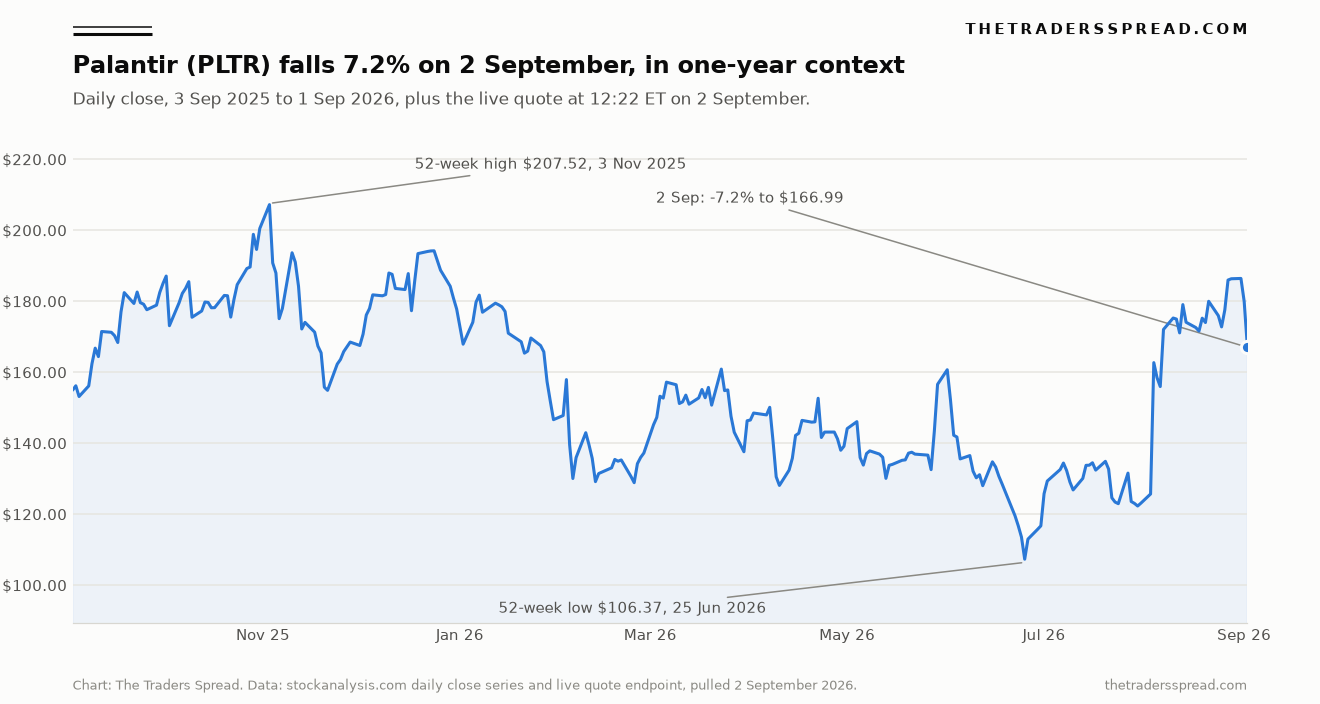
Tuesday is part of the same story and is usually left out of it. Palantir fell 3.47% on 1 September, closing at $179.92, and it did so on a session in which the broad tape was firm and the stock had a bullish sell-side note behind it flagging the Maven programme's trajectory. Two consecutive down days without a company-specific negative is a different signal from one bad Wednesday, and it moves the start of the de-rating back to before MongoDB's numbers were public. The most defensible reading is that positioning in high-multiple software began unwinding on Tuesday and MongoDB's Wednesday reaction confirmed to the market what the unwind was about.
Volume is the one figure that argues against panic. Palantir had traded 21.3 million shares by 12:22 ET against a 20-session average of 37.0 million. A capitulation would look heavier than that by lunchtime. What the tape showed instead was steady, unhurried selling: the stock opened at $176.99, printed its session high of $177.57 within minutes, and then ground lower all morning to a low of $166.55. That is the signature of positioning being reduced rather than a shock being absorbed.
RelatedMaxLinear (MXL) Falls 12.7% in the 8 October Session
What this changes
The first thing it changes is the evidentiary bar for good news. Palantir spent Tuesday and Wednesday announcing exactly the kind of thing that used to move it — a prime defence award and a marquee commercial hire — and the stock fell 10.4% across the two sessions anyway. Until the software complex stabilises, the reasonable expectation is that company-specific positives get netted against a sector discount rather than banked.
The second is the composition of the AI trade. For most of 2026 the AI complex traded as one instrument. Wednesday broke that. Semiconductors rose while the software layer fell, on the same tape, in the same hours. Traders who have been treating Palantir as a proxy for AI exposure were holding a different asset on Wednesday than they thought they were holding, and our own coverage of Nvidia's guidance-driven 9.3% gain sits on the opposite side of exactly this divide.
Third, insider supply is now part of the picture, though at a scale that deserves proportion. A Palantir director filed a Form 144 with the SEC on 1 September covering 1,342 shares with an aggregate market value of $250,121.96. That is a rounding error against a $429 billion company and explains none of Wednesday's move. We raise it only because a great deal of commentary on the day reached for insider selling as an explanation, and the filing record does not support that reading. The most recent Palantir Form 4 on EDGAR before Wednesday was dated 24 August. No insider filing landed on either 1 or 2 September.
There is also something this move does not change, and saying so is part of reporting it honestly. Palantir carried $9.2 billion in cash, cash equivalents and short-term US Treasury securities at 30 June, generated $1.216 billion of cash from operations in the June quarter alone, and posted GAAP operating income of $912 million. Nothing about Wednesday touches the balance sheet or the cash generation. A company with those figures does not have a financing problem when its shares fall 7%, which is precisely why the fall is legible as a repricing rather than a warning.
Fourth, the read-across runs both ways. If a 30% grower that raised guidance can lose 12% of its value, the same logic sits over every high-multiple name reporting into the autumn. The specific thing to watch is not Palantir's next contract but whether IGV stabilises relative to SMH. As long as that spread keeps widening, Palantir's own operating results are the second-order variable and the group multiple is the first.
Fifth, and most concretely, Palantir reports its third quarter in early November against guidance of $2.160–2.164 billion. That print will land into whatever multiple regime exists by then. The company has guided to roughly 11.6% sequential growth; the question the market asked on Wednesday, and answered badly for MongoDB, is what such a number is worth rather than whether it will be hit.
One caveat on the numbers here. Every price in this article comes from a live pull of the stockanalysis.com quote and daily history endpoints at 12:22 ET on 2 September 2026, with the US session still open. The closing prints will differ from the midday figures quoted throughout, and the 7.19% is a session-to-date move rather than a closing change. The fundamental figures are taken directly from filings on SEC EDGAR and are not subject to that caveat. Coverage that attached specific dollar values to the TITAN award is not supported by Palantir's own release, which disclosed none; we have not repeated those figures as fact.
For a comparison of how a differently-priced enterprise software name has traded through the same period, see our Okta analysis; for another instance of a single-session 7% fall in a heavily retail-owned stock, see MicroStrategy's 7.3% decline.
Disclaimer: This article is published for information and analysis only. It is not investment advice, an offer, or a recommendation to buy or sell any security. Figures are accurate as at the times stated and markets move. The Traders Spread does not hold positions in the securities discussed. Anyone acting on market information should carry out their own research or consult a licensed adviser.