

A nomination price is not the chance of becoming the 2028 presidential winner, and JD Vance's 47.1 cents on the Republican book is not a 47.1% chance he takes the oath. The habit of quoting 2028 presidential odds off the nomination screen is the error. Those are different payoffs. On 18 October 2026 the winner contract, the one that pays if he is elected, printed a yes price of 0.2045 on Polymarket's gamma API, bid 0.204 and ask 0.205. The Republican nomination contract, pulled in the same pass, had him at 0.471, bid 0.468 and ask 0.474. Folding the second figure into the first more than doubles what the winner book is actually pricing. The winner leg is not a ghost print: $17,167,174 has traded on it, $444,518 was resting in the book, and the last trade was 0.205.
Multiply the two liquid hurdles and the flattering reading falls apart. A 47.1% nomination price times a 34.5% price on Republicans to win the White House is 16.2%. The winner book, at 20.45 cents, is charging an extra 8.9 points for a correlation premium it never itemises: 20.45 divided by 47.1 implies a 43.4% chance that a Vance-led ticket wins the general, against an unconditional party price of 34.5. That gap is the whole disagreement. Links to Polymarket are affiliate links, from which The Traders Spread may earn a commission at no cost to you. The 2028 presidential winner market is the deep one, with $717,126,844 traded on the event and $60,181,421 of liquidity. The party contract is the thin prior, about $2.5 million of lifetime volume. We use it anyway, and we do not gift the favourite the 8.9 points without a sized reason.
- JD Vance yes on the winner book was 0.2045 at 07:15 UTC on 18 October 2026, bid 0.204 / ask 0.205, with $17,167,174 traded and $444,518 of liquidity — Polymarket gamma-api, 18 October 2026
- His Republican nomination yes was 0.471, bid 0.468 / ask 0.474, on $15,912,956 of volume and $316,655 of liquidity — Polymarket gamma-api, Republican Presidential Nominee 2028, 18 October 2026
- Republicans were 0.345 to win the presidency and Democrats 0.635, on an event with only $2,493,081 of volume — Polymarket gamma-api, party-winner book, 18 October 2026
- Desk fair for the Vance winner leg is 0.471 times 0.345, or 16.2%, against a market price of 20.45 cents — The Traders Spread calculation, 18 October 2026
- The winner event's rules put election day on 7 November 2028 and name the Associated Press, Fox News and NBC as the calling sources, with an inauguration fallback on 20 January 2029 — Polymarket event rules, retrieved 18 October 2026
- A 49-cent print on Robert F. Kennedy Jr. in the Republican nomination book had zero reported volume and $15 of liquidity, so it is ignored — Polymarket gamma-api, 18 October 2026
Nomination is a different payoff
The Republican nomination rules, read off the same gamma payload, pay yes if the named person wins and accepts the 2028 Republican nomination. A later replacement does not reopen that contract. Official party sources are the resolution. The winner contract pays on who is elected, or, if the Associated Press, Fox News and NBC have not agreed by inauguration day, on who is inaugurated.
Vance can be the nominee in a world where the ticket loses. On the letter of the nomination rules he can also stay the yes resolution if the party swaps him out before November 2028, while the winner leg follows whoever is actually elected. Same person, two instruments.
Our note on the Republican nominee book is about that first instrument. The figure in its headline is not today's price. Today's nomination yes is 47.1 cents, down 0.55 cents on the day, 1.35 cents on the week and 4.15 cents on the month. The winner yes went the other way over the week, up 2.7 cents, even as it slipped 0.6 cents on the day and 0.6 cents on the month.
Amendment XXII says no person shall be elected president more than twice. Donald Trump still has a winner leg at 1.25 cents and a nomination leg at 1.95 cents. A third election is what the amendment forbids, so a Trump nomination price is not a Trump presidency price. The Vance gap is the same kind of split, at a size people actually quote.
Five names, three books
Ranked by yes price on the winner event, and ignoring anything without a real book, the top of the card on 18 October was Vance, then Alexandria Ocasio-Cortez, Jon Ossoff, Gavin Newsom and Marco Rubio. Fifty-four priced legs on that event summed to 0.917. This is not an overround that needs a vig haircut. The board is slightly short of a dollar, not stuffed past one.
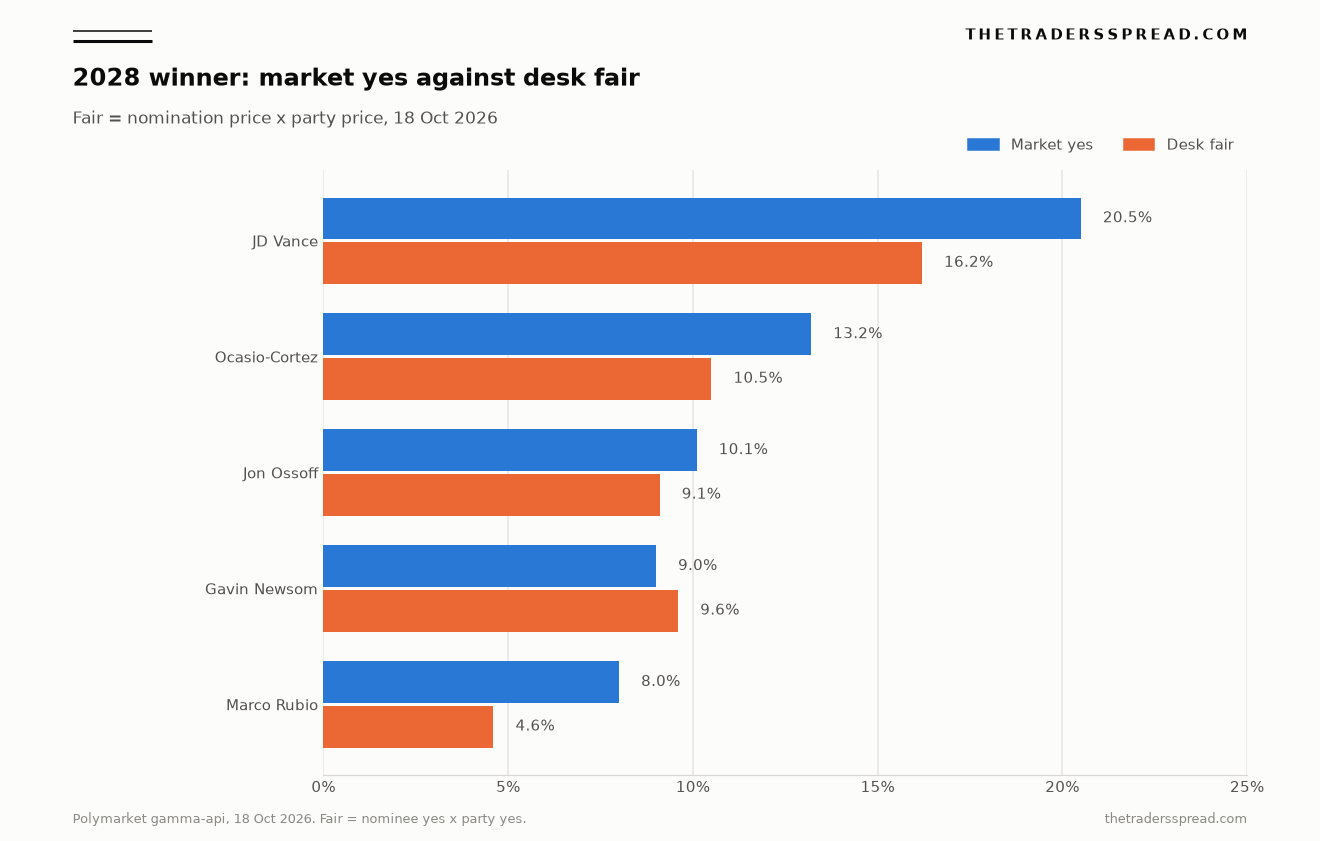
The chart rounds each winner yes half-up to one decimal, so Vance's 20.45 cents is drawn at 20.5, Ocasio-Cortez's 13.15 at 13.2, Ossoff's 10.05 at 10.1, Newsom's 8.95 at 9.0 and Rubio's 7.95 at 8.0. Fair values are the product of that person's nomination yes and their party's yes, also to one decimal. The table underneath keeps the raw gamma prints.
| Name | Winner yes | Nomination yes | Implied win if nominated | Desk fair | Winner liquidity |
|---|---|---|---|---|---|
| JD Vance | 20.45c | 47.1c | 43.4% | 16.2% | $444,518 |
| Alexandria Ocasio-Cortez | 13.15c | 16.55c | 79.5% | 10.5% | $366,700 |
| Jon Ossoff | 10.05c | 14.35c | 70.0% | 9.1% | $365,771 |
| Gavin Newsom | 8.95c | 15.05c | 59.5% | 9.6% | $399,631 |
| Marco Rubio | 7.95c | 13.25c | 60.0% | 4.6% | $272,675 |
Sources are the Polymarket gamma API, retrieved 18 October 2026. Implied win if nominated is the winner yes divided by the nomination yes. Desk fair is the nomination yes times 34.5% for Republicans and times 63.5% for Democrats. Liquidity is the winner leg's liquidityNum.
The implied column is not one story. Ocasio-Cortez's winner price is 79.5% of her nomination price. Ossoff's ratio is 70.0%. Newsom's is 59.5%, a shade under the 63.5% Democratic party price. Rubio's is 60.0%, far above the 34.5% Republican base rate. Vance's 43.4% still sits 8.9 points over that base rate.
The same product that marks Vance rich marks Newsom slightly cheap: 15.05 cents times 63.5% is 9.6%, and the winner leg is 8.95. Ossoff is close, 10.05 against 9.1. Ocasio-Cortez is rich, 13.15 against 10.5. Rubio is the wide gap, 7.95 against 4.6. The premium is not a flat tax on every favourite. The focus stays on Vance because a nomination screen near 50 cents does the most damage there.
On 13 October, in a Georgia Senate debate, Jon Ossoff answered a direct question about 2028. "I have zero interest in running for president," he said. "I'm not running for president. I'm running for re-election to the Senate." Ossoff, the Democratic senator from Georgia, was quoted by Matt Dixon at NBC News on 14 October 2026. Five days later his winner yes was still 10.05 cents, on $5,985,591 of volume and $365,771 of liquidity, and his nomination yes was 14.35 cents. A categorical denial did not zero the leg.
The Democratic nomination book, which we covered when AOC's nomination contract was a thinner market, is still not this winner card. Today's nomination prints, not the older headline, are the ones above: Ocasio-Cortez 16.55 cents, Newsom 15.05, Ossoff 14.35. That event has traded $1,294,806,142. Depth is not the same thing as a presidency payoff.
The other side of the 20.45-cent print
Someone last traded Vance-the-president at 20.5 cents, and the ask is 20.5 against a 20.4 bid. Day volume on the leg was only $2,995, so this is a resting book, not a stampede. $444,518 of liquidity on a tenth-cent spread is still a price.
Vance is 20.45 of the 91.7 cents in priced winner legs, while he is 47.1% of a Republican nomination book whose liquid legs sum to 80.2 cents once a dead quote is stripped out. The offer at 20.5 cents is a bet that his share of Republican victories is too large, or that Republican victories themselves are scarcer than the winner card implies.
That second bet is the party contract. Democrats 0.635, bid 0.63 / ask 0.64, $1,246,690 traded, $250,884 of liquidity. Republicans 0.345, bid 0.34 / ask 0.35, $1,246,391 traded, $421,323 of liquidity. Event liquidity is $674,653, beside a winner event with $60,181,421. Using the thin book as the base rate is a choice. Backing the conditional out of the winner and nomination books would make the fair equal the market by construction.
We would rather show the thin prior than pretend the deep book has audited itself.
Sort the Republican nomination event by raw yes price and the first row is Robert F. Kennedy Jr. at 0.49. Volume: zero. Liquidity: $15. Ask: 0.98. No bid, no last trade. Drop that ghost and 43 names with at least $10,000 of liquidity and $1,000 of volume sum to 0.802, not the 1.292 you get if it stays. Vance at 47.1 cents is the real lead. The ghost is how a careless sort invents a coin-flip, and a second careless step turns the coin-flip into a presidency.
Sixteen days to a midterm, two years to an open seat
The winner rules schedule the election for Tuesday, 7 November 2028. Before that, a midterm. Axios, on 13 October 2026, put the vote on 3 November: sixteen days from this reading. The balance-of-power contract is the near instrument. If the Republican party leg moves from 34.5 cents toward the 43.4 cents already implied by Vance's two deeper books, the gap in this note closes without his winner price moving at all.
Asked by Tony Dokoupil of CBS Evening News whether there was any chance he would not run, the vice president said: "Of course there's a chance." He called himself a procrastinator about big decisions. Joe Walsh reported it for CBS News from a Michigan town hall that aired on 17 October 2026. A 47.1-cent nomination price is a bet on a campaign the principal says he has not decided to start. Open-seat books often do that. They are still not a general-election forecast.
There is no incumbent seeking re-election. Amendment XXII blocks a third election, so there is no sitting president whose vote share you can shade. What is left is a party brand, a vice president who may not be the nominee, and a Democratic field spread across several names rather than piled on one.
David Axelrod, Barack Obama's former chief strategist, told Mike Zapler at Axios on 13 October: "An opening, yes. A guarantee, hardly." He added that 2028 "depends on who the candidate is, and what kind of bonds of trust that candidate can build." Axios also noted competitive red-state Senate races in states Trump had carried by double digits in 2024. A Senate map is not a presidential win probability. It is a reason to let the party contract move after 3 November before treating 20.45 cents as a view of January 2029.
At the Republican midterm convention, Vance told the room the contrast was "not about this or that policy" but "the party of common sense beating the party of the crazies." NPR's Tamara Keith aired the line on Morning Edition on 11 September 2026, and reported the crowd warmer for Trump than for the vice president. A nomination price can rise on an evening like that. Copying it onto the winner contract is the mistake.
The premium we will not pay
The clean objection is correlation. Vance is more likely to be nominated when the Republican party is strong, and those are worlds where the party is also more likely to win the general. Then the product is a lower bound, not a point, and the winner book is already paying 43.4% against a 34.5% party price.
We will not pay that 8.9-point premium, because we cannot size it. A couple of points would still leave 20.45 cents above the product. Paying all 8.9 turns the call into a tautology: the fair becomes the market. Nothing opened for this note, not Axelrod's map, not Vance's refusal to decide, not Ossoff's price after a denial, says the conditional should be 43% rather than something nearer 34.5. No poll page opened this session was clean enough to import a head-to-head number. The premium stays at zero. The objection stays on the page.
RelatedFed December Decision Odds: 25bp Hike at 78.5 Cents
A number retires the call, not a mood. If the Republican party yes rises from 34.5 cents to about 43.4, then 0.471 times that price meets 0.2045. If the nomination yes falls while the winner leg holds, the rich reading gets worse. The path that makes 20.45 look cheap is a nomination price still near 47 cents and a sourced conditional materially above 43.
The other way to be wrong skips the party contract. The winner event has $717,126,844 behind it and the party event has $2,493,081. If 34.5 cents is stale, the product is a bad fair. The Republican bid-ask is a full cent, 0.34 to 0.35, against a tenth of a cent on Vance's winner leg. A one-cent band does not cover a four-point gap. A book that barely trades can still be the wrong centre. The published fair is the product, 16.2%, not a blend with 20.45. Blending would hide the choice.
What would make 20.45 cents fair
On the Vance leg, 20.45 cents sits above a 16.2% fair. The fair is 0.471 times 0.345: the nomination yes times the Republican party yes, both from Polymarket's gamma API on 18 October 2026, neither taken from the winner leg being judged. Stored as a probability, that is 0.162. The market is 4.2 points higher. The contract's own spread is 0.1 point. The gap is outside the spread and inside a long list of ways a thin prior can be wrong. It is still the call.
Above fair describes 20.45 against 16.2. It is not an instruction, and it is not a view on whether he would be a strong nominee. The nomination book can keep him as the Republican favourite at 47.1 cents. This contract should not be quoted as if 47.1 were the chance he becomes the 2028 presidential winner.
The same product leaves the rest of the card mixed, which is a check rather than a second call. Newsom's 8.95 cents is below a 9.6% product. Ossoff's 10.05 is close to 9.1. Ocasio-Cortez's 13.15 is above 10.5, but off a 16.55-cent nomination price, so the public misreading is smaller than Vance's. Rubio's 7.95 against 4.6 is the largest relative gap: a 60% conditional on a 34.5% party base rate. If refusing the premium is right, Rubio is richer than Vance. If the premium is real and larger for the vice president than for the secretary of state, the ranking is backwards. Only the Vance figure is the fair this note prints.
A party yes through 43 cents, a nomination yes that collapses because he declines, or a conditional taken from a survey opened and dated: any of those retires 16.2% before 7 November 2028. Until one arrives, the 2028 presidential winner is a 20.45-cent Vance contract over a 16.2% product, and the 47.1-cent screen is a different bet.
Questions the price actually answers
Is a nomination price the chance someone becomes president?
No. The Republican nomination contract pays if the named person wins and accepts the nomination, and a later replacement does not change it. The winner contract pays on who is elected, or who is inaugurated if the wire services have not agreed by 20 January 2029. Vance at 47.1 cents to be nominated and 20.45 cents to be the 2028 presidential winner is the gap those rules produce, measured on 18 October 2026.
Why is the desk fair 16.2% rather than the market price?
Because using the winner price as the fair would make the comparison circular. The 16.2% is his 47.1% nomination yes times the 34.5% Republican yes on the separate party contract. The winner book implies a 43.4% chance the ticket wins if he is nominated. We do not add that 8.9-point premium, because we cannot size the correlation that would justify it. The party book is thin, and that is the main weakness of the fair.
What if the nominee is replaced before election day?
On the nomination rules retrieved with the gamma payload, a replacement before election day does not change the nomination resolution. The winner contract follows the person who wins the election, or the person inaugurated. A trader who owns "Vance is the nominee" does not automatically own "Vance is president," and a swap between convention and election day is one of the paths that splits them.
Does Ossoff's price survive him saying he will not run?
As of the 18 October pull, yes. He told a Georgia Senate debate on 13 October that he had zero interest in running and was running for re-election, in remarks NBC News published the next day. His winner yes was still 10.05 cents, and his nomination yes 14.35 cents. The book is charging for the chance the answer changes, not for a campaign he has opened.
When does the winner market resolve, and what could move the fair first?
The event end on the gamma record is 8 November 2028, and the rules describe an election on 7 November 2028, with an inauguration fallback on 20 January 2029. The nearer shock is the 3 November 2026 midterm, sixteen days from this reading. A shift in the Republican party yes toward 43 cents would put the product on top of Vance's 20.45-cent winner price and retire the gap.
This is analysis, not a recommendation to take either side of a contract. Prices move, rules have edge cases, and the party prior used here is a thin book beside a deep one. Capital is at risk.