

Benjamin Netanyahu is still prime minister of Israel, and the contract that pays if he is out by 31 December 2026 trades at 40.5 cents. On the same venue, the chance he is the next person sworn into the job after the 27 October election is priced at 28.5 cents. Both figures are Polymarket outcome prices from the Gamma API on 19 October 2026. The pair cannot be a comfortable story about the next ten weeks. One book says there is only a 28.5% chance he takes a fresh oath, on rules that ignore caretaker time and that do not have to name anyone until the end of 2027. The other, which pays if he leaves or if a resignation or removal is announced by 11:59 p.m. Eastern Time on 31 December, sits at 40.5 cents. That packs a large slice of an exit into a window Israeli coalition law rarely clears.
The gap is a clock, not a disagreement about the polls. Official results are on the Central Elections Committee calendar for 4 November. The president then has seven days to hand the first mandate to a Knesset member, who gets 28 days and an extension of up to 14. Used in full from that results date, the first window dies on 23 December, eight days before this contract's deadline. A second nominee gets 28 days and no extension, which pushes a full second attempt into January. Between April 2019 and November 2022 Israel held five general elections, and the outgoing prime minister stayed in the chair while the arithmetic failed. Traders who read "unlikely to be sworn in again" as "out by New Year" are pricing two different payoffs. This desk separated them on 3 September in the next-prime-minister piece. The subject there was who takes the oath. The subject here is whether Netanyahu is gone before the year is.
Searches for Netanyahu out odds usually land on the horse race. The tradable object is narrower. On the Netanyahu out event, the only leg still open is the one labelled December 31. Links to Polymarket are affiliate links, from which The Traders Spread may earn a commission at no cost to you. Earlier dates on the same event have already settled, every one of them at a yes price of zero.
Key facts
- The December 31 yes outcome is 40.5 cents, with a 40 cent bid, a 41 cent ask and a last trade at 42 cents. The spread is one cent. — Polymarket Gamma API, 19 October 2026
- That leg has matched $2,755,442, against $115,658 of liquidity, $33,888 in the prior 24 hours and $77,393 over the prior week. — Polymarket Gamma API, 19 October 2026
- The yes price is about 13 points lower than a month earlier and about 3 points higher than a day earlier. Over a year it is down about 14.5 points, from roughly 55 cents. — Polymarket Gamma price-change fields, 19 October 2026
- On the separate next-prime-minister market, Netanyahu's own leg is 28.5 cents and Gadi Eisenkot's, spelled Eizenkot on the book, is 47.7 cents. Naftali Bennett is at 11.5 cents. — Polymarket Gamma API, 19 October 2026
- The Petek's average of the last 10 polls puts the Netanyahu bloc on 52 seats and the change bloc on 51, with the Arab parties on 13, against the 61 a majority needs. — The Petek, 18 October 2026
- A Direct Polls survey for i24NEWS the same day put the outgoing coalition on 57 seats, four short of a majority, from 525 adults and a reported margin of ±4.2 points. — i24NEWS, 18 October 2026
- The 25th Knesset dissolved on 17 July 2026 by 62 votes to zero after a full term, the first on-schedule election since 1988. The outgoing government keeps governing until a new one is formed. — Israel Compass, citing the Knesset; Ruth Levush, Law Library of Congress, 9 October 2026
Two contracts, two clocks
The event text retrieved on 19 October says the market resolves yes if Netanyahu "announces that he will resign as Prime Minister of Israel, or otherwise steps down from/is removed from this position by December 31, 2026, 11:59 PM ET." An announcement before that stamp is enough, even if he is still in the office when the words are spoken. Otherwise that text resolves no. The leg text is a shade wider: yes if he "ceases to be Prime Minister of Israel for any period of time" between creation and the deadline, and an announcement resolves the leg yes immediately, whatever the effective date. Both name official Israeli government information as the primary source and allow a consensus of credible reporting.
He has not tripped either version. The December leg has been open since 24 July 2025 and was still taking orders on 19 October 2026. A yes resolution would have closed it.
The succession market asks who is sworn in after this election. Its rules, also read from Gamma that morning, require a formal oath. "Any interim or caretaker Prime Minister will not count." If nobody new has been sworn in by 31 December 2027, it resolves to Other. Caretaker time, which is the whole subject of the December contract, is excluded there on purpose.
Netanyahu at 28.5 cents on that leg means 71.5 cents against him being the person sworn in. December at 40.5 cents is the price of an exit, or of an announcement, inside 2026. The 31-point gap covers paths where he never takes another oath and is still prime minister when this contract dies. A January swearing-in loses here and pays someone else on the other book. Eisenkot at 47.7 cents is a different question. The 3 September note already took it up.
Where 23 December comes from
Israel Compass, using the Central Elections Committee timetable, dates official results to 4 November 2026 and the appeals deadline to 18 November. Steven Ganot's explainer in the Jerusalem Post on 13 October, published with The Media Line, sets out the statute that starts once results exist. The president consults the factions and must assign the task within seven days. He is not required to choose the largest list, or the candidate with the most recommendations. The chosen member has 28 days. Extensions can add 14, so the first attempt tops out at 42 days. If it fails, the president has three days to name someone else, who gets 28 days and no extension. After that, 61 members have 21 days to petition for a candidate of their own, who then gets 14 days. Fail that, and the Knesset dissolves for an election within 90 days.
From 4 November, a first mandate assigned on the last legal day and extended in full expires on 23 December. Eight days remain before 11:59 p.m. Eastern Time on the 31st. A second mandate that starts after a failure on the 23rd cannot finish inside the year. Assign him on 6 November instead of the 11th and a fully used first mandate ends on 18 December. The second attempt still lands in January.
A full second mandate misses this contract.
Ruth Levush, Law Library of Congress, 9 October 2026, quotes Basic Law: The Government, section 30(b): the outgoing government "shall continue to perform its functions until the new Government is formed." Dissolution on 17 July, by 62 votes to zero after a full term, set an on-schedule election, the first since 1988. It did not change the person in the chair.
A confidence vote is a lower bar than a 61-seat coalition. Ganot writes that an initial confidence vote needs a majority of those voting, not 61 yes votes, so a minority government is possible if enough members abstain. Constructive no-confidence is harder: at least 61 members must express confidence in a named alternative. The fast path into this contract is a confidence vote during the first mandate, or an announcement from Netanyahu himself. It is not a second round in January.
Dated exit contracts behave like this on other subjects. The Putin out-by-New-Year leg was worth a note of its own because "out by a date" is not "who governs afterwards." A calendar cutoff, such as the US-Iran ceasefire priced through 31 October, dies on the stamp even when the argument underneath is still live. The election can settle the succession market and still leave this one open on 1 January.
The book, the polls, the chart
The chart is the December contract only. Blue bars are the Gamma prices, 40.5 and 59.5. Orange bars are our 32 and 68. Nothing on it is an order.
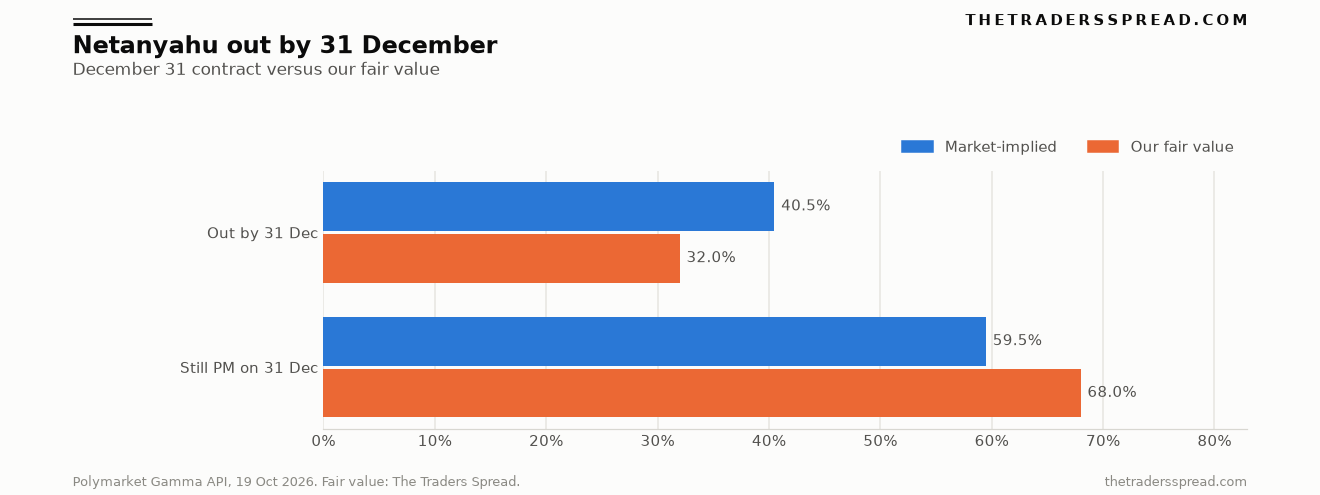
Liquidity of $115,658 and a one-cent spread, 40 bid against 41 offered, is a book a desk can read. The last trade at 42 cents is through that mid. Over the past day the yes outcome rose about 3 points, so 18 October was closer to 37.5. Over the past month it fell about 13 points, from about 53.5. We are marking today's mid.
The $124.6 million on the event is all six legs. March 31 alone matched $104,205,875 and settled at zero, as did April, May, June and July. December has matched $2.76 million. Open interest on the event was about $440,000. A day of $33,888 can nudge a one-cent spread. It does not invent the price.
| Reading | Market or seats | Our figure | Source and date |
|---|---|---|---|
| Out by 31 December, yes | 40.5% | 32% | Gamma, 19 October 2026; fair value, this note |
| Still prime minister on 31 December | 59.5% | 68% | Same leg, complementary outcome |
| Netanyahu sworn in next | 28.5% | Not set here | Separate Gamma leg, 19 October 2026 |
| Netanyahu bloc, Petek average of 10 polls | 52 seats | 9 short of 61 | The Petek, 18 October 2026 |
| Outgoing coalition, i24NEWS / Direct Polls | 57 seats | 4 short of 61 | i24NEWS, 18 October 2026 |
The Petek average is the centre. Likud and Yashar are on 22, B'Yachad on 12, his bloc 52, the change bloc 51, Arab parties 13. Rounded averages need not sum to 120. Likud runs from 18 to 29 across those ten polls. Kantar for Kan 11 on 18 October has Yashar on 23 and Likud on 21. His bloc's parties on those Kan seats add to 51.
i24NEWS is the high print we opened rather than borrowed from a roundup. Direct Polls, 18 October, 525 adults, margin ±4.2 points: Likud 25, Yashar 21, Bennett's list 13, governing bloc 57, opposition 49, Arab parties 14. Four seats short is not 61, and that margin is wide enough that 57 is a reading. It is still the friendliest verified number on his bloc, and it does not clear the line.
On the succession book he was 28.5 cents, bid 28 and ask 29. Eisenkot was 47.7 on $3.33 million matched. Bennett was 11.5 and Liberman 2.85. That event had matched $48.6 million. His leg alone was about $8.65 million, with roughly $511,000 of liquidity, deeper than December. The December 31 contract is the one priced here.
Who is willing to pay 40.5 cents
A richer yes than 32 is not a foolish reading. An opposition mandate in the first days of November carries the 42 days plus what is left of December. The announcement rule is shorter. He need not leave the office by the 31st if he has said he is going. A deal dated 20 December, with a swearing-in on 4 January, can still resolve yes.
There is a polling tail. Likud at 29, the top of The Petek's range, plus a strong religious bloc, is how a Knesset reaches 61 without a centrist defector. i24NEWS at 57 is one small-list surprise away. Parties under the 3.25% threshold hand their votes, in effect, to lists that cleared it. The Reservists and Amcha Israel are the names The Petek has at that line.
Liberman has described the political version of that tail. On 15 October, in a post reported by Keshet Neev in the Jerusalem Post, the Yisrael Beytenu chairman said a coalition would consist "exclusively of Zionist parties," and then: "Likud without Netanyahu can be a significant partner." He said he knows members inside Likud who, in his view, will not stay tied to the haredi parties. If several of them cross, the first mandate still covers it. We have a sentence from a party leader, not a list of names, so the path stays inside a branch rather than becoming the base case.
The change bloc's public line runs the other way, and it is days old. Naftali Bennett, leader of B'Yachad, floated Netanyahu as a minister on 11 October and withdrew it the same day. Maya Zanger-Shamir and Jerusalem Post staff quoted the walk-back on 12 October: "I've said it a thousand times, Netanyahu bears direct and personal responsibility for the October 7 massacre, and therefore he must go." Eisenkot's reply at the Hador conference was "I do not accept it." Yair Golan, chairman of the Democrats, said his party would not sit with Netanyahu and his allies. Paying 40.5 cents is, in part, a bet that one of those lines bends.
Related2026 Balance of Power: Democrats Sweep at 62.5 Cents
Fair value at 32 cents
Our fair value for the yes outcome is 32 cents, a probability of 0.32. The traded mid is 40.5, so yes sits 8.5 points above fair value, against a one-cent spread. On this site that relationship is labelled Above fair. It describes the price. It is not an instruction.
Three branches produce the 32. They are judgements, not a fitted history. In 15% of cases his bloc reaches 61. Polls sit at 52 to 57, and we use only a 6% chance he then announces an exit: about 0.9 of a point. In 46% he is short of 61 and an opposition member gets the first mandate, with a 55% chance of a confidence vote or an announcement by 31 December. Forty-six times 55% is 25.3 points. In the other 39% he holds the mandate for the full 42 days, and a 15% chance of an early collapse adds 5.9 points.
The sum is 32.1, rounded to 32 cents. The other outcome is 68 cents against 59.5 in the market. A 75% success rate on the opposition branch would meet the traded price. We do not use it. Liberman's line on 15 October still binds that branch: his party will "not support any minority government, including a minority government for a transitional period." Five elections from 2019 to 2022 ran past 65 days when a coalition had to be negotiated.
His bloc at 48 or below, with an opposition mandate in early November, would pull fair value into the high 30s. Reaching 61 from an i24NEWS-style 57 would pull it down. Results well before 4 November would push it up. A resignation announcement reprices the contract the day it is made.
Until the president's letter names someone, 40.5 cents pays for a close the red lines do not support. The succession book can be right that he is not sworn in again, and he can still be prime minister when this one ends. Both are on Polymarket's Israel board. Only this one dies with 2026.
Questions the price gets asked
What does Netanyahu out by 31 December pay on?
Yes if he announces a resignation, steps down, or is removed by 11:59 p.m. Eastern Time on 31 December 2026. The leg text also pays if he ceases to be prime minister for any period after the market opened in July 2025. An announcement is enough even when the departure takes effect later. No if he is still in office on the deadline and has not announced that he is leaving. The government of Israel is the primary source.
Does the 27 October election settle it on the night?
No. Voters elect a Knesset, not a prime minister. Official results are timetabled for 4 November. He remains in office under Basic Law section 30(b) until a new government is formed. A bloc that already has 61 can move quickly. A hung Knesset, which is what the 18 October averages describe, does not produce an exit on election night. This contract can still be open at Christmas in either case.
Why is 32 cents under the traded 40.5?
Because a full second mandate misses 31 December if the first one uses its time. We put only a 46% chance on an opposition member getting that first mandate, and a 55% chance they then finish in time. Those two weights, plus a thin tail in which his own bloc both wins and somehow still produces an exit, sum to 32. The screen at 40.5 needs a faster opposition close than Liberman's red lines suggest.
How is this different from the next-prime-minister contract?
That contract pays the person sworn in after the 2026 election, ignores caretakers, and can resolve as late as the end of 2027. Netanyahu is 28.5 cents there. Eisenkot is 47.7. A new prime minister sworn in during January is a loss for this December leg and a win for someone on the other book. We set no fresh fair value for that board in this note.
What would make 40.5 cents look right?
An opposition first mandate in early November, plus a public crack in the refusal to sit in a minority or with a post-Netanyahu Likud fragment. Raise the conditional success rate on that branch from 55% to about 75% and fair value meets the market. A resignation announcement does it immediately, at 100, under the rules as written. A certified 61 for his bloc does the opposite.
This is analysis, not advice. Fair value is a judgement about a probability, built from prices, polls and statutes retrieved on 18 and 19 October 2026. It is not a solicitation, and it is not a forecast that a given headline will print. Capital is at risk. Earlier legs on this event settled at zero. That is history, not a promise about December. The venue's own rules control how the contract settles.