

I have kept the US government shutdown book open on a second screen since 5 August, when the October 1 contract printed 23.5 cents and a Congress that had already lapsed twice in twelve months made that price look thin rather than rich. What I did not expect was for the question to be settled a month early. It was. On 2 September the President signed H.R. 6500, the Continuing Appropriations and Extensions Act, 2027, and section 106 of Division A carries federal funding to 11 December. There is no appropriations expiry anywhere between this morning and the date the market resolves. The contract still quotes 2.2 cents on Polymarket's October 1 shutdown market, 26 days out, and that residual is not a forecast of anything. Links to Polymarket are affiliate links, from which The Traders Spread may earn a commission at no cost to you.
Look at the actual tape rather than the headline number. Best bid is 1.5 cents. Best ask is 2.8 cents. The 2.2% that gets quoted around is the midpoint of a 1.3-cent spread, which means the spread is roughly sixty per cent of the quantity it claims to measure. A book that wide cannot express "half a per cent" even if every participant in it believed exactly that. Resting liquidity is $27,758 against $10,559 of lifetime matched volume, so the book standing there is 2.6 times larger than everything that has ever traded through it. The screen is showing you a market maker's quote width. It is not showing you a crowd's reading of appropriations law.
Key facts
- H.R. 6500 became Public Law 119-103 on 2 September 2026; section 106(3) of Division A funds the government through 11 December 2026 — govinfo enrolled bill text, retrieved 5 September 2026
- Senate passed the measure 90-6 on 8 August (Record Vote 228); the House agreed to the Senate amendments 370-48 on 1 September (Roll no. 286) — congress.gov bill status, 5 September 2026
- Yes leg on the October 1 shutdown market: 2.2% mid, 1.5c bid / 2.8c ask, $10,559 lifetime volume, $27,758 resting liquidity — Polymarket gamma API, 06:54 UTC 5 September 2026
- The same leg was 23.5% a month ago and 4.2% on 30 August, a fall of 21.35 points in thirty days — Polymarket CLOB price history, 5 September 2026
- Three of twelve FY2027 appropriations bills have passed the House; the Senate Appropriations Committee has reported none — Rep. Tom Cole floor remarks, 1 September 2026
- Fiscal 2026 required four separate appropriations laws and was not finished until 3 February 2026 — Public Laws 119-37, 119-74, 119-75 and 119-86, cited in section 101 of H.R. 6500
- Our fair value on the October 1 contract: 0.5%, against a 2.2% mid and a 1.5c bid — The Traders Spread, 5 September 2026
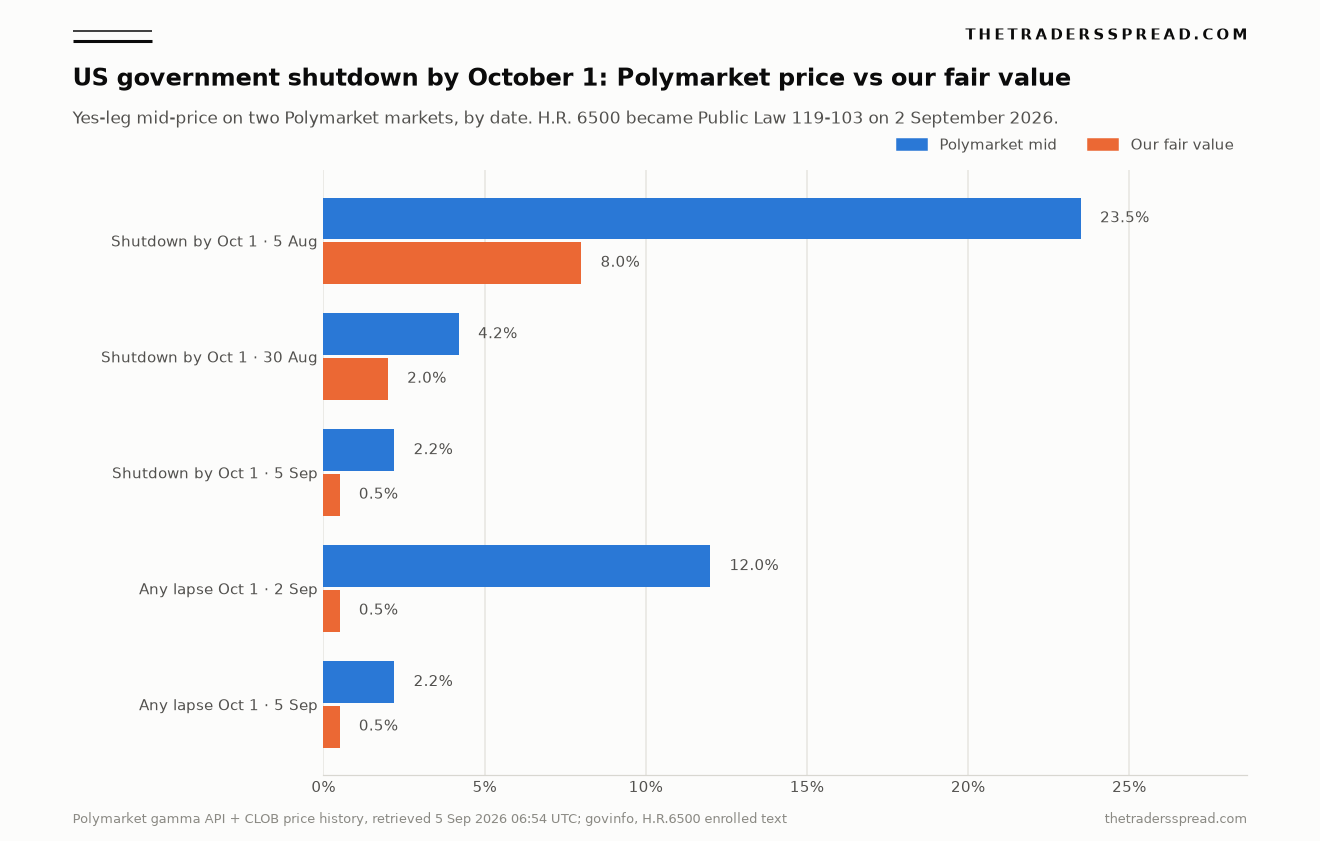
The statute closed the question three days ago
The mechanics are worth walking through, because the market's residual price only makes sense once you know how little room the law leaves. H.R. 6500 began life as the AGOA Extension Act, a House-passed shell that cleared the floor 340-54 on 12 January. The Senate used it as a vehicle. Cloture on the motion to proceed was invoked 89-4 on 3 August, cloture on the substitute amendment 91-6 on 7 August, and the amended bill passed 90-6 on 8 August. The House took up the Senate amendments on 1 September under suspension of the rules, which requires two thirds, and got 370.
Those are not the margins of a contested funding fight. They are the margins of a bill nobody wanted to be blamed for blocking nine weeks before a midterm.
Section 101 of Division A does the work that matters for resolution. It appropriates continuing funds by reference to each of the twelve fiscal 2026 appropriations acts by name, running through the Agriculture act in division B of Public Law 119-37, the Defense act in division A of Public Law 119-75, the Homeland Security and Further Additional Continuing Appropriations Act, 2026, and the rest. Every account funded in fiscal 2026 is carried forward. There is no orphaned agency, no subcommittee left out of the enumeration, and no separate expiry date buried in a division. Section 106 sets one termination trigger for the lot of it: the enactment of the applicable full-year bill, or 11 December 2026, whichever comes first.
Rep. Tom Cole (R-OK), chairman of the House Appropriations Committee, put the timing plainly on the floor that day. "I am proud to say we are now sending this funding extension to President Trump without waiting for the clock to run out," he said in a committee statement issued after the vote. He also told the chamber that the committee had reported all twelve FY2027 bills by mid-June, the earliest since fiscal 2020, and that the Senate had "yet to report a single bill out of the Senate Appropriations Committee, much less across the Senate floor."
Both halves of that sentence matter. The first half is why the October 1 contract is dead. The second half is why the December one, if it existed, would not be.
A 1.3-cent spread cannot say "half a per cent"
Polymarket's minimum tick on this market is a tenth of a cent, so the venue is not the constraint. The constraint is that nobody is standing close enough to the true value to quote it. The last trade printed at 3.4 cents, well above the current mid, which tells you the most recent participant to cross the spread paid up rather than waited.
Divide resting liquidity by matched volume and the picture sharpens. On the shutdown contract the ratio is 2.63. On the companion market it is 5.91. A book several times deeper than its own trading history is a book being quoted by someone who is paid to quote it, into a crowd that has stopped caring. Prices produced that way are anchored to inventory risk and tick conventions, not to a considered view of what section 106 says.
We have made this argument on this desk before in a very different setting. When we looked at the Democratic nominee market and found a twenty-cent quote sitting on a thin order book, the failure mode was the same: a headline percentage treated as a consensus estimate when the underlying book had almost nobody in it. The difference here is that the true answer is not merely uncertain, it is written down in the United States Statutes at Large.
Anyone reading the printed 2.2% as "the market thinks there is a one-in-forty-five chance of a shutdown" has mistaken a quote width for a belief. The bid is where the belief actually lives, and the bid is 1.5.
Two different questions, one identical price
Polymarket runs a second contract on the same calendar date. The Federal Appropriations Lapse market resolves Yes if "a partial or full" lapse occurs on 1 October, and its rules say explicitly that "a lapse of any duration affecting any portion" of the federal government qualifies, "regardless of whether it results in any operational impact." The shutdown market requires agencies to suspend non-excepted operations and furlough staff.
One of those is strictly a superset of the other. Every shutdown is a lapse; not every lapse becomes a shutdown. The lapse contract must therefore trade at or above the shutdown contract at all times, by construction, and for most of August it did — 17.5% against 20% on 8 August, 12% against 9.5% on 26 August.
This morning both print 2.2%.
The convergence is not the interesting part. The path is. On 1 September, the day the House sent the bill to the President, the lapse market closed at 11%. On 2 September, signature day, it closed at 12%. It did not break below 6% until 3 September and did not reach 2.2% until this morning, three days after the statute existed. Total lifetime volume in that contract is $2,463. That is not a market digesting information slowly; that is a market with nobody in it, marked by a quoting algorithm that reprices when it gets around to it.
Two contracts with materially different resolution language, sitting at an identical price, is about as clean a demonstration as this venue offers that neither number is carrying information. Traders who read Polymarket quotes as data should hold that example somewhere accessible.
Why the base rate is the wrong instrument today
Count the October 1 boundaries from fiscal 1997 through fiscal 2026 and you get thirty of them. Two produced a lapse beginning on that date: fiscal 2014, on 1 October 2013, and fiscal 2026, on 1 October 2025. That is 6.7%, and it is roughly where I would have started an unconditional estimate in early August, before adjusting upward for a Congress with an unusually fresh record of failure.
That record is genuinely bad. The fiscal 2026 shutdown ran from 1 October to 12 November 2025, forty-three days, the longest on record, and ended only when Public Law 119-37 was signed. Funding then lapsed again on 31 January 2026 and stayed lapsed until the Consolidated Appropriations Act, 2026 was signed on 3 February; the January contract on that second lapse settled Yes on $157.3m of volume, the largest shutdown book the venue has run. Fiscal 2026 needed four separate public laws and was not fully funded until four months into the fiscal year.
On 5 August I carried 8% on the October 1 contract against a market at 23.5%, and the market was wrong in the expensive direction. By 30 August, with a 90-6 Senate vote already banked and the House majority's own appropriations chairman whipping for the bill, I had moved to 2% against a market at 4.2%.
Today none of that arithmetic applies, and pretending otherwise would be the analytical error. Base rates describe the distribution of outcomes when the outcome is unknown. Here the funding authority for 1 October is enacted law with a certified enrolled text and a public law number. Conditioning on that removes the question from the reference class entirely. The only residual paths to Yes are a new statute that pulls the expiry date forward, signed within 26 days, or a resolution dispute over language that the rules do not appear to leave open.
We ran a similar conditioning exercise on the Anthropic biggest-IPO market, where the absence of an S-1 on file was doing more work than any narrative. The principle is the same in both directions: when a documentary record exists, it outranks the prior.
The date nobody has written a market on
Funding expires on 11 December. That is 97 days from today. Rosa DeLauro (D-CT), ranking member on House Appropriations, framed it exactly that way on 1 September: "We have 101 days until government funding expires. There is no time to waste." In the same statement she called eleven of the twelve committee-reported House bills "deeply flawed" and lacking "the bipartisan support necessary to become law."
Three House-passed bills. Zero Senate floor action. Zero bills reported out of Senate Appropriations. A midterm election on 3 November that will consume most of October, and a lame-duck stretch of roughly four working weeks after it to write and pass twelve bills or another stopgap.
Polymarket has no contract on that date. I searched the venue's open events on 5 September and found exactly two live US shutdown markets, both pointed at 1 October, plus a combined shutdown-and-House-control market whose shutdown leg already resolved Yes when funding lapsed on 31 January. That combined market now functions as a House 2026 proxy, with the Democratic branch at 85.85% and the Republican branch at 11.85% on $335,873 of volume. Its shutdown component is settled history.
So the venue's entire live shutdown exposure is aimed at a date that Congress legislated out of existence three days ago, while the date that actually carries risk has no instrument at all. That gap is the story here, more than the 1.7 points of theoretical edge on a contract nobody trades. We made a comparable point about legislative calendars driving prices in the Clarity Act market, where Senate floor days, not policy substance, set the odds.
RelatedECB October Rate Decision: No Change at 90.5 Cents
The call
Our fair value on the October 1 shutdown contract is 0.5%, against a 2.2% mid, a 1.5-cent bid and a 2.8-cent ask. The price sits above fair value, and the call field on this piece records that.
The base case, at roughly 99.5%, is that the contract resolves No. Public Law 119-103 funds every fiscal 2026 account through 11 December, the enumeration in section 101 covers all twelve appropriations acts, and there is no intervening expiry. Nothing has to go right for this outcome; something would have to go actively and unprecedentedly wrong.
The path to Yes, which I put at well under one per cent, requires Congress to pass and the President to sign a new law moving the funding expiry earlier than 11 December, inside 26 days, during a stretch when both chambers are largely out. No Congress has done that. A second, smaller path is a resolution edge case: some agency-specific funding interruption that a resolver treats as a partial lapse. Section 106 sets a single date for all covered accounts, so the room for that is narrow, but it is not literally zero, which is why the number is 0.5 and not 0.1.
Honesty about magnitude matters more than the direction here. The gap between 2.2% and 0.5% is 1.7 points on a contract with $10,559 of lifetime volume and a spread of 1.3 cents. The uncertainty band around my own 0.5% is wider in relative terms than the mispricing itself, and the spread would swallow most of it before anything settled. This is a clean example of a market being wrong, and simultaneously an example of why being right about a thin book is often worth very little.
What would change my mind: a rescission or repeal vehicle actually moving in either chamber; an Office of Personnel Management notice describing a lapse before 1 October; a court order touching the validity of the appropriations in Public Law 119-103; or Polymarket publishing a resolution clarification that captures a closure not caused by a lapse in appropriations. Absent one of those, the statute is the answer and the price is furniture.
FAQ
Why is the market still at 2.2% if a shutdown is legally off the table?
Because 2.2% is the midpoint of a 1.5-cent bid and a 2.8-cent ask on a book with $10,559 of lifetime volume. Nobody is being paid enough to grind the quote down to its true value, and the cost of doing so exceeds the profit. The bid, at 1.5 cents, is closer to what participants actually believe.
What exactly does H.R. 6500 do?
It became Public Law 119-103 on 2 September 2026. Division A appropriates continuing funds for every account carried in the twelve fiscal 2026 appropriations acts, at fiscal 2026 rates with limited exceptions, and section 106 terminates that authority on the earlier of the relevant full-year bill or 11 December 2026. Divisions B through D extend expiring authorities to the same date.
Could a shutdown still happen in 2026?
Yes, on 11 December rather than 1 October. Three of twelve FY2027 bills have passed the House, none has cleared the Senate, and the Senate Appropriations Committee has not reported any. That is a real deadline with real distance still to cover, and it falls inside a lame-duck session after the 3 November midterms.
Why do the two Polymarket shutdown markets have the same price?
They should not. One resolves on any appropriations lapse of any duration; the other requires furloughs and suspended operations, which is a strict subset. They print 2.2% each because both books are being quoted mechanically rather than traded. The lapse contract carried a 9-point premium to the shutdown contract on signature day and only closed it three days later.
How did you get to 0.5%?
By starting from the enacted statute rather than a historical base rate. The unconditional rate of lapses beginning at an October 1 boundary is two in thirty since fiscal 1997, about 6.7%. Conditioning on a signed public law that funds all twelve bills through 11 December removes almost all of that, leaving only new-legislation risk and resolution ambiguity.
Does the record 2025 shutdown change the read?
It changed the August read, not this one. Forty-three days of lapse from 1 October 2025, then a second lapse from 31 January to 3 February 2026, justified pricing this Congress above the historical base rate while the outcome was open. Once the stopgap was signed, that history stopped being predictive.
This article is analysis, not investment advice. Prediction market contracts and the instruments discussed here carry the risk of total loss of capital, and prices quoted are point-in-time snapshots taken at 06:54 UTC on 5 September 2026 that will have moved by the time you read this. Do your own research and consider your own circumstances. The Traders Spread does not tell readers which side of any market to take. Polymarket is not available to residents of certain jurisdictions, including the United States, and readers are responsible for checking the rules that apply to them. Our full sourcing for this piece includes the enrolled text of H.R. 6500 on govinfo, the CRFB FY2027 appropriations tracker, and the record of the 2025 shutdown. Readers tracking how we score geopolitical contracts can compare our method on the Iran blockade market, where we also read the price as too high against our own fair value.