

When I pulled the hourly price tape on Polymarket's board for the next prime minister of Romania this morning, one line stopped me. At 08:00 UTC last Thursday, 17 September, Alexandru Nazare, the interim finance minister, traded at 52.85%. Eight hours later, after President Nicușor Dan named MEP Siegfried Mureșan as his candidate instead, Nazare had fallen to 12.35%. At 06:49 UTC today he was back at a 33.3% midpoint, the highest price on the board, while Mureșan, the man actually holding the mandate, sat at 17.85%. I have watched a lot of political boards reprice a nomination. I have rarely seen one hand the favourite's crown back to a man who was passed over, inside four days, before the nominee has even published a cabinet list. The board's verdict is plain: Mureșan fails, and whoever comes next is the real contest. On the first half of that verdict we agree. On the second half, we think the market is pricing the wrong menu of names.
Here is what we think the price misses. Mureșan is the third attempt since the Bolojan government was dismissed in early May, and the first attempt, Eugen Tomac, withdrew before any vote. That matters because Article 89 of Romania's Constitution lets the president dissolve Parliament only "after the rejection of at least two requests for investiture." Adrian Veștea's cabinet was rejected on 22 June. A failed Mureșan vote would be the second rejection, and it opens the door to a snap election for the first time in this crisis. The board prices a backroom fourth nominee. It barely prices the ballot box, and most of the names a new parliament could produce are either priced near zero or have no leg at all.
Key facts
- Alexandru Nazare traded at a 33.3% midpoint (bid 31%, ask 35.6%), Sorin Grindeanu at 29.2% and Siegfried Mureșan at 17.85% on the "Next Prime Minister of Romania?" board — Polymarket gamma-api, read 06:49 UTC 22 Sep 2026
- The event has matched $3.96 million across all legs, with $505,647 on Grindeanu, $326,649 on Nazare and $113,375 on Mureșan — Polymarket gamma-api, 22 Sep 2026
- Nazare's leg fell from 52.85% to 12.35% between 08:00 and 16:00 UTC on 17 Sep, the day Mureșan was named — Polymarket CLOB price history, pulled 22 Sep 2026
- Investiture needs 233 votes in a joint sitting. The three parties backing Mureșan (PNL, USR, UDMR) hold 170 seats between them — Radio Romania International, 17 Sep 2026
- PSD's National Standing Bureau voted unanimously on 21 Sep not to back the Mureșan government — AGERPRES, 21 Sep 2026
- Adrian Veștea's cabinet won only 189 votes against the 233 needed on 22 Jun 2026 — Xinhua, citing HotNews, 22 Jun 2026
- Article 89 allows dissolution only after at least two investiture requests have been rejected, and elections must follow within three months (Article 63) — Constitution of Romania, via Constitute Project, read 22 Sep 2026
Four days, three favourites: what the tape shows
Through the first half of September the market treated Nazare as the consensus answer, a finance minister who could plausibly be acceptable to both the Social Democrats and the Liberals. His leg traded at roughly 51% to 53% from 15 to 17 September. Mureșan was an afterthought at 1.6%.
Then the president moved. The consultations at Cotroceni Palace ran for close to six hours on 17 September, and HotNews reported that the shortlist in the room contained two official proposals, Grindeanu from PSD and Mureșan from the PNL-USR-UDMR bloc, plus two names floated in talks, Nazare and Luca Niculescu, with Leonardo Badea, the National Bank's first deputy governor, added late. Dan picked Mureșan because, in his words, he was the person "who received the most votes from the parties at today's consultations." Mureșan's leg reached 39.3% by 20:00 UTC that evening.
It did not hold. The slide started on the weekend and accelerated at midday Monday, when PSD's leadership ruled out support. By 12:00 UTC on 21 September Mureșan was at 14.65%. Nazare, who had spent the weekend around 21% to 23%, jumped to 39.3% by 16:00 UTC and has since settled near a third.
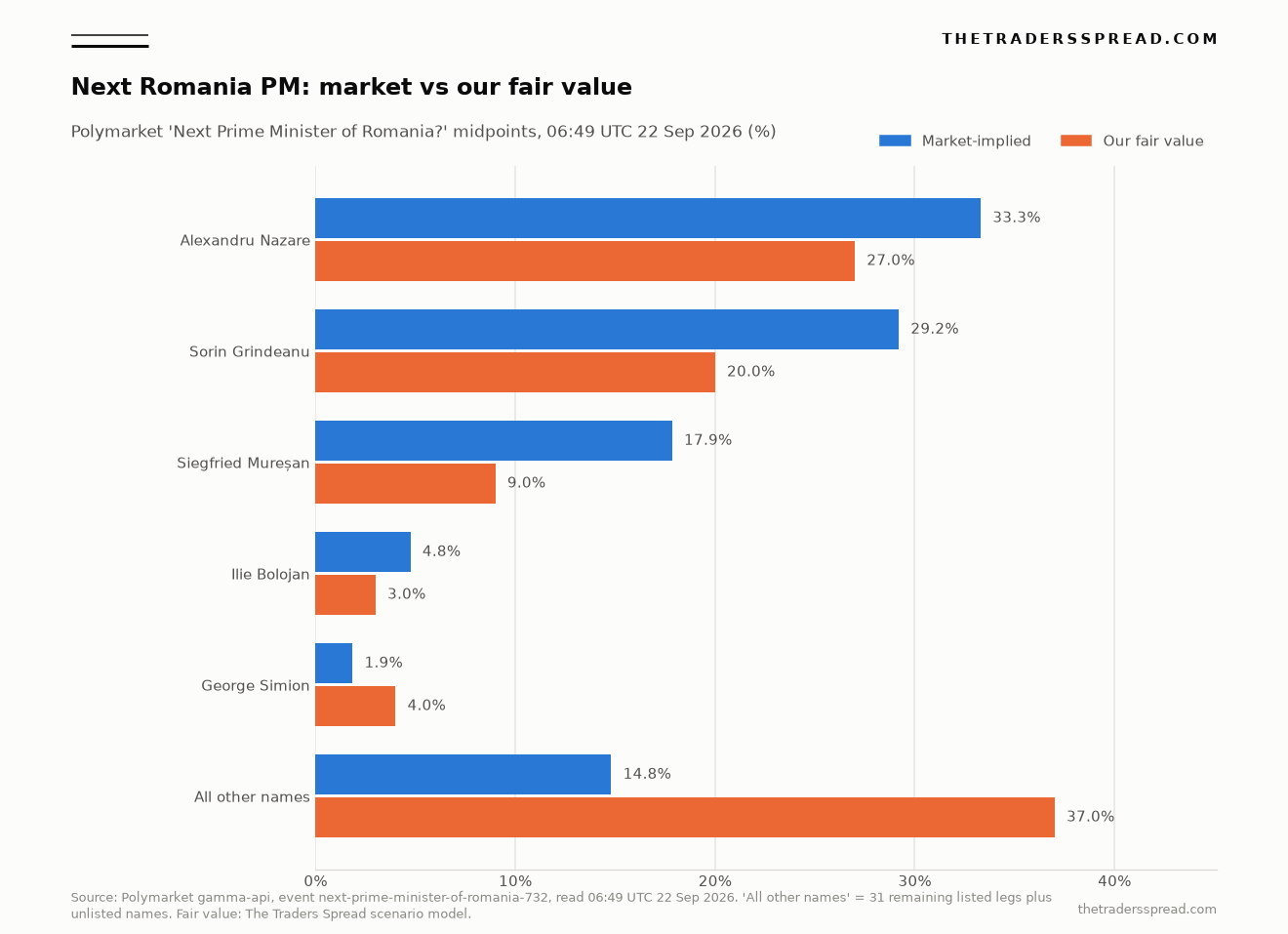
In the chart, "All other names" collects the 31 remaining listed legs plus the candidates who have no leg at all.
| Candidate | Midpoint 22 Sep, 06:49 UTC | 17 Sep, 08:00 UTC | Matched volume | Our fair value |
|---|---|---|---|---|
| Alexandru Nazare | 33.3% | 52.85% | $326,649 | 27% |
| Sorin Grindeanu | 29.2% | 19.95% | $505,647 | 20% |
| Siegfried Mureșan | 17.85% | 5.4% | $113,375 | 9% |
| Ilie Bolojan | 4.75% | n/a | $200,019 | 3% |
| George Simion | 1.85% | n/a | $66,265 | 4% |
| All other names | 14.8% | n/a | n/a | 37% |
One mechanical point before the politics. The listed "Yes" prices sum to 101.75%, so there is less than two points of overround spread across 36 priced legs. That is tight for a multi-candidate political board, which suggests the headline numbers are not a liquidity mirage. The Mureșan leg shows $46,660 of resting liquidity with a spread of 17.1% to 18.6%.
Where would 233 votes come from?
Article 103 of the Constitution gives a prime minister-designate ten days from appointment to seek Parliament's confidence for a programme and a full cabinet list, voted by the deputies and senators in joint session. Approval takes a majority of all members, which is the 233 figure every party leader in Bucharest now quotes. Radio Romania International puts the combined seats of PNL, USR and UDMR at 170; Visegrad Insight counts 169. Either way, Mureșan starts roughly 63 votes short.
Some of the gap is soft. The national minorities' parliamentary group has historically voted with governments, and the Balkan Insight report on the nomination quotes journalist Dan Tapalaga putting the pro-Mureșan ceiling at "no more than 190 votes." Even at 190, 43 more have to come from somewhere, and the list of places is short:
- PSD, the largest party, said no on Monday. Grindeanu said the recommendation now goes to the party's National Political Council, the body that decides such questions under PSD's statutes.
- AUR, George Simion's party, has repeated that it will not vote for any government it is not part of.
- The smaller groups: Uniți pentru România (17 deputies, and its own candidate is Victor Ponta), PACE (which wants a majority that ends "the harmful administrative experiments promoted by Ilie Bolojan," in our translation of its HotNews statement) and POT (which asked for a technocratic cabinet).
Nothing in that list adds up to 43 friendly votes. The precedent is not encouraging either. Veștea, a Liberal whom even some of his own colleagues rejected, according to Radio Romania International, finished on 189 votes in June. Put that beside the 170 to 190 range for Mureșan's bloc and you have the whole story of this crisis: nobody has come within 40 votes of 233 without either the other big bloc or AUR.
Sorin Grindeanu, Chairman of the Social Democratic Party, framed Monday's decision in terms that leave very little room: "As the PSD said three weeks ago in Sinaia, it will only vote for a government in which it participates," he said, according to AGERPRES. His party labelled the proposed cabinet "the Bolojan 2.0 Government," which tells you how PSD intends to campaign against it.
Article 89 is the clause the board is not pricing
This is where the market and our model part company. The board's shape, with Nazare and Grindeanu together at 62.5%, only makes sense if you assume the crisis ends in a negotiated fourth nomination. That is a reasonable base case. It is not the only one, and the constitutional mechanics change after the next vote.
The Constitution's text is explicit. The president "can dissolve Parliament if no vote of confidence has been obtained for the formation of the Government within 60 days of the first request, but only after the rejection of at least two requests for investiture." The 60-day condition was met long ago. The two-rejection condition has not been, because Tomac, nominated on 4 June according to Xinhua, stepped aside without a vote. Veștea's defeat counts once. A defeated Mureșan would count twice.
Kelemen Hunor, President of the Democratic Alliance of Hungarians in Romania (UDMR), spelled out the consequence at Cotroceni on 17 September. "It is not desirable for the next government to fall in parliament. That means the conditions for early elections will be met," he said, speaking in Romanian, as reported by HotNews (our translation). USR's leader, Dominic Fritz, went further in the same session and argued that early elections must be "a real opportunity" rather than a theoretical option in the text.
Two things follow. First, Dan would gain a lever he has never had in this crisis, the credible threat of dissolution, and that threat may be what finally pushes PSD and PNL toward a technocrat such as Nazare. That path is part of why we still rate Nazare the single likeliest name. Second, if the threat is carried out, Article 63 requires elections within three months, and the next prime minister is then chosen by a parliament that does not exist yet. In that branch the favourites on today's board lose much of their edge.
The market's resolution rules matter here. Polymarket resolves this event to the next person who is formally appointed by the president and wins a parliamentary vote of confidence by 31 December 2027; caretakers do not count. A snap election in early 2027 followed by an investiture months later would still fall inside that window. The event's API metadata lists an end date of 31 December 2026, which does not match the 2027 deadline written in the rules. We read the rules text as controlling, and anyone reading the board should note that the two dates disagree.
What the order book is quietly telling you
Look past the top three and the board gets strange. Nine O'Clock listed the president's options last week as Grindeanu, Mureșan, Nazare, Badea and Ponta. Victor Ponta has a leg at 0.9%. Leonardo Badea has no leg at all, and neither does Luca Niculescu, the other name HotNews placed on the shortlist. On the Polymarket "Next Prime Minister of Romania?" board, any unlisted winner would fall to a "someone else" outcome that currently has no price. Links to Polymarket are affiliate links, from which The Traders Spread may earn a commission at no cost to you.
That gap is a large part of why our "All other names" bucket is 37% against the market's 14.8%. The technocrat route that PNL itself floated at Cotroceni, where Senate President Mircea Abrudean described the party's second option as "an authentic technocratic government with a limited mandate" in a post reported by HotNews, does not have to run through Nazare. It could run through a central banker, a diplomat, or a career civil servant of the kind Kelemen Hunor described. Several of the names that fit that brief trade at 0.1% to 0.35%.
Volume tells a second story. Grindeanu's leg has matched $505,647, more than four times Mureșan's $113,375, and it has history: after PSD put him forward on 24 June, his leg touched 37.9% in early July before sliding back to the teens. His current 29.2% rests on a genuine argument: PSD is the largest party, and if the Liberal-led route is exhausted, a PSD-led cabinet is the obvious next thing to test. Our objection is arithmetic. A PSD-led government needs either PNL, which has ruled out sitting with PSD, or AUR, whose votes PSD negotiator Marian Neacșu said were not being sought. Grindeanu's cleanest path may actually run through an election, which is why most of his 20% in our model sits in that branch.
The people doing the counting
Mureșan is not pretending the numbers are easy, and on Monday evening he put the choice to PSD bluntly. "PSD has a choice: support this government, which will break the political deadlock in less than a week; reject the government and indefinitely prolong the crisis it triggered five months ago through a no-confidence motion," Siegfried Mureșan, Prime Minister-designate of Romania, wrote on Facebook, as quoted by AGERPRES.
The president's own words at the nomination were hardly a vote of confidence in a quick result. "Romania needs a Government. We do not have a clear majority despite all these hours of talks," Nicușor Dan, President of Romania, said, according to AGERPRES. That is a president describing a test, not a deal.
Even Mureșan's own camp sounds measured. Ilie Bolojan, President of the National Liberal Party and the interim prime minister, said the nomination "was made almost three months late" and that PNL would try to form a government "within our possibilities and depending on our electoral weight," as reported by AGERPRES. Electoral weight, in this parliament, is 170 seats.
The minorities' leader, Varujan Pambuccian, gave the most candid read of the day, according to HotNews: "We are exactly in the same situation as 3-4 months ago. Almost nothing has changed. There is no certain majority." He had asked Dan to wait a week or two. Dan did not.
RelatedElon Musk Tweets October Odds: The Book Has No Peak
The pattern will look familiar. Our note on how Germany's Basic Law protects Friedrich Merz made a similar point: constitutional procedure, not headlines, decides who holds office. The same lesson ran through our reads of the Berlin election's seat-tie rule and the Swedish government-formation board.
Our call: fair value against the market
We model the event as a two-stage tree. Stage one is the Mureșan vote. We give him a 9% chance of winning 233 votes, against a market price of 17.85%. The path exists: a PSD split at the National Political Council, or a late package for the smaller groups. But the party's leadership decided unanimously, AUR is closed, and the June vote showed the ceiling of a one-bloc government sits near 190. On the Mureșan leg the market sits about nine points above our fair value.
Stage two splits the remaining 91%. We put roughly 59 points on a fourth designation that wins a vote without an election, with Nazare the most likely single beneficiary, and roughly 32 points on dissolution followed by a snap election and a new investiture before the end of 2027. Adding the branches gives our fair values: Nazare 27%, Grindeanu 20%, Mureșan 9%, Bolojan 3%, Simion 4% and 37% for everyone else. In the election branch we assume a parliament where AUR is a larger force, which is why Simion's 1.85% looks cheap to us while still being small.
- Base case (59%): Mureșan falls short, the dissolution threat forces a technocrat or cross-party nominee through by year-end. Nazare is the modal name, but not the only one.
- Election case (32%): Dan dissolves after a second rejection, elections follow within three months, and the next investiture comes from a new parliament in 2027.
- Mureșan case (9%): PSD's National Political Council reverses its bureau or enough of its MPs defect.
What would change my mind. A PSD National Political Council vote that overturns the bureau would push our Mureșan number above the market's within the day. A public statement from Dan ruling out dissolution would move roughly 20 points from our election branch back to Nazare and Grindeanu. A cabinet list that includes PSD-aligned independents would signal a quiet deal, and we would reprice Mureșan toward 25%. Any of the three can be checked against the Nazare leg, which has become the market's barometer for the no-deal outcome.
FAQ
Who is the current prime minister of Romania?
Ilie Bolojan leads an interim government. His cabinet was dismissed by a PSD-AUR motion of no confidence in early May 2026, and under Article 110 it carries on only with routine public business until a new government is sworn in. Polymarket's rules exclude caretakers, so Bolojan would only resolve the market by winning a fresh vote of confidence, which we price at 3%.
How many votes does Siegfried Mureșan need?
He needs 233 votes from deputies and senators sitting together, a majority of all members. His three backers, PNL, USR and UDMR, hold about 170 seats according to Radio Romania International. PSD's leadership decided on 21 September not to support him, and AUR says it backs only governments it joins, which leaves a gap of roughly 40 to 60 votes.
Can President Nicușor Dan call early elections?
Not yet. Article 89 lets the president dissolve Parliament only after at least two investiture requests have been rejected and 60 days have passed since the first request. Adrian Veștea's defeat on 22 June counts as one rejection. Eugen Tomac withdrew without a vote, so it does not count. A rejected Mureșan cabinet would satisfy the condition.
Why is Alexandru Nazare priced ahead of the actual nominee?
The market expects Mureșan to fail and treats Nazare, the interim finance minister, as the most plausible compromise afterwards. HotNews reported he was on the president's shortlist before the nomination. His leg recovered from 12.35% to about 33% within four days, largely after PSD rejected the Mureșan government on 21 September.
When does the Polymarket board resolve?
The written rules resolve the event to the next prime minister who is appointed and wins a confidence vote by 31 December 2027, with "Other" if nobody does. The event's API metadata shows a 31 December 2026 end date, which conflicts with that text.
Disclaimer
This article is analysis and information, not financial or betting advice. Prediction-market prices can move sharply on political news, positions can lose their entire value, and any capital committed is at risk. Odds quoted were read at the stated UTC times on 22 September 2026 and will have changed since. Fair values are The Traders Spread's own estimates, not a forecast of any outcome.