

A price-hit contract pays when a one-minute candle extreme touches the named level, and the same rule still counts that touch after the last trade has already left the level.
On the gamma read of 19 November 2026 the event what-price-will-bitcoin-hit-before-2027 was active and open, with 47 market rows, 28 of them still open, volume of 90,493,537.75, liquidity of 3,441,646.86 and a 24-hour volume of 722,147.97. The record's updatedAt stamp was 2026-11-19T06:55:13Z. A loose reading treats that whole ladder as one Polymarket price hit with one clock. The open up leg at 100,000 says it will immediately resolve on a one-minute High from 14:00 ET on 24 November 2025 through 23:59 ET on 31 December 2026, while the open down leg at 60,000, created at 2026-07-21T06:39:29Z, starts the test at its own creation and names the Low. Links to Polymarket are affiliate links, from which The Traders Spread may earn a commission at no cost to you. The ladder is the open price-hit event those rows sit on.
The worked example below is that event. The subject is the contract rule.
Updated 19 November 2026 with the gamma fields and the contract sentences read that morning.
1. Read the extreme the leg names
On a loose reading, hit means whatever print a trader can point at, from a last trade to a wick on another exchange. The sentences in this book are narrower, and the arrow on the row decides which way they narrow.
An open up leg names the High. The 95,000 up leg, still accepting orders when gamma was read, says it resolves to Yes if any Binance one-minute candle for BTC/USDT, from the creation of that market through 11:59 PM ET on the last day of the year specified in the title, has a final High equal to or greater than the price in the title. Outcome prices on that row were 0.0275 and 0.9725, volumeNum was 1,449,783.21 and liquidityNum was 125,998.33. The test is one field on one candle. A last trade that tags the level and a High that does are the same result only when they happen to land on the same print.
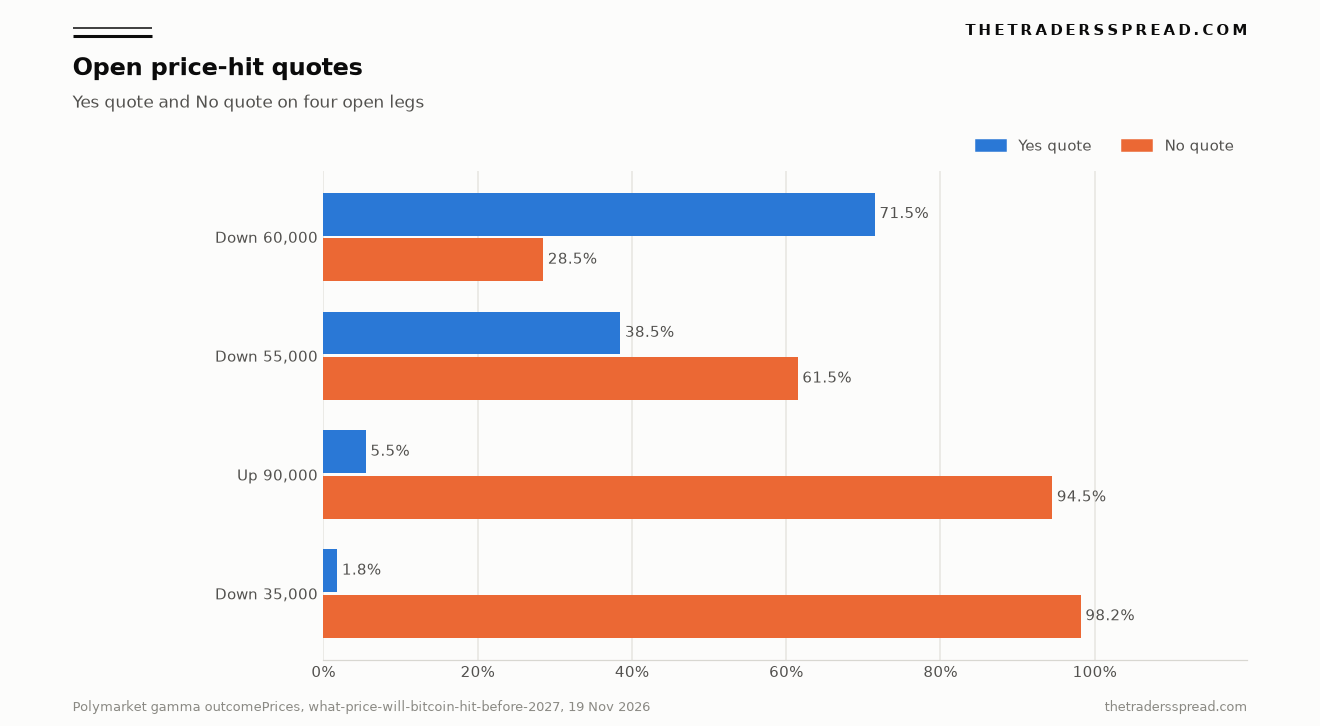
An open down leg names the Low. The 60,000 down leg created on 21 July 2026 uses the same window shape, from its own creation through 11:59 PM ET on the year in the title, and it swaps the field: a final Low equal to or lower than the price in the title. Outcome prices were 0.715 and 0.285, volumeNum 2,596,378.32, liquidityNum 90,815.14. Best bid on that row was 0.71, best ask 0.72 and lastTradePrice 0.71, so the displayed Yes price of 0.715 sits between the bid and the ask and is already off the last trade. Someone who quotes the last trade as the market is quoting a third number.
One resolved down leg at 75,000, closed at 2026-09-15 20:52:57+00, uses a third wording: Yes if a one-minute candle has a final High or Low equal to or beyond the listed price, above for an up label and below for a down label. That sentence sits on a closed row with volume. The open legs above each keep a single field.
2. Lock the print to one pair and one timeframe
Every description checked in this read names Binance, the BTC/USDT pair, and the one-minute candle, with the chart set to 1m. The resolution link written into those texts is the BTC/USDT page on Binance. The same paragraphs then say the outcome depends solely on that pair, and that prices from other exchanges, other pairs or other spot markets are outside the resolution.
That is a harder screen than a headline about a price being hit. A print on some other venue can cross the level and leave this contract untouched, because the text never appointed that screen. The level test is the candle extreme, not the last trade that prints afterwards on some other book.
The field is the final High or the final Low of a one-minute bar on the pair the text names. A Bitcoin above contract that picks the noon candle is a different family: there the argument is which single candle of the day is appointed. Here the argument is whether any one-minute extreme inside a long window qualifies, and which extreme.
3. Copy the window from that leg alone
Three window sentences are live on this event at the same time. They share an endDate of 2027-01-01T05:00:00Z and still describe three different opens.
The first sentence is a dated span plus the word immediately. On the open 100,000 up leg, gamma's description says the market will immediately resolve to Yes if any one-minute candle between 24 November 2025, 14:00, and 31 December 2026, 23:59, in the ET timezone, has a final High at or above the price in the title. That row was created at 2025-11-24T18:55:12Z, inside the day the window names. Outcome prices were 0.0225 and 0.9775, volumeNum 4,530,319.28, liquidityNum 107,231.85. Best bid was 0.022, best ask 0.023 and lastTradePrice 0.021. The exclusion sentence about prints before creation is absent from this description. The down leg at 55,000, also created on 24 November 2025, uses the same dated span and names the Low instead of the High, with outcome prices 0.385 and 0.615, volumeNum 8,503,152.28 and liquidityNum 97,094.71.
The second sentence starts at creation and names 11:59 PM ET on the last day of the year in the title. That is the 95,000 up leg and the July 60,000 down leg. Both add an explicit line that price action before the market's creation is out of scope. A low that printed in June is inside the dated window of the 55,000 leg's text and outside the July 60,000 leg's text. Pasting one sentence onto the other leg is the loose reading this book punishes.
The third sentence starts at creation and ends at 23:59 ET on 31 December 2026, and it leaves out the before-creation line. The open 90,000 up leg, created at 2026-02-06T15:44:31Z, is written that way, with outcome prices 0.055 and 0.945, volumeNum 3,483,691.92 and liquidityNum 136,568.77. A fourth pattern sits on the open 1,000,000 up leg: the description uses the dated span back to 14:00 ET on 24 November 2025, the row was created at 2026-02-18T17:18:55Z, and the before-creation sentence is absent. Outcome prices were 0.0015 and 0.9985, volumeNum 3,720,976.82, liquidityNum 347,177.80. Both the text and the creation timestamp are in that gamma row. This read has no dispute record that picks a winner between them.
A weather contract that settles on one station's reading, covered in the station-rule piece, has the same family of mistake: the event page looks like one instrument, and the row text appoints a specific print. Here the print is a candle field and the station is one pair.
4. Hold the event title apart from the leg
The event title on gamma is "What price will Bitcoin hit in 2026?" The slug is what-price-will-bitcoin-hit-before-2027. The short description field reads "What price will Bitcoin hit before 2027?" The endDate is 2027-01-01T05:00:00Z. A reader who picks any one of those four strings and treats it as the window has already left the leg text.
Where a leg says "the last day of the year specified in the title," the title's year is 2026, so that sentence names 31 December 2026. Where a leg writes "31 December 2026, 23:59" in the ET timezone, the date matches and the clock is explicit. On 31 December, US Eastern Standard Time is five hours behind UTC, so 23:59 ET is 04:59 UTC on 1 January. The event endDate of 2027-01-01T05:00:00Z sits one minute later. The slug's "before 2027" can be waved at the whole of 1 January by someone who wants a longer window. The leg text stops on the last day of the title year.
Early closes already in the file show what a touch does to the calendar. The 85,000 up leg carries outcome prices of 1 and 0, volumeNum 921,124.22, umaResolutionStatus resolved, and a closedTime of 2026-09-21 11:40:30+00. Its description is the creation-through-11:59-PM form, it names the High, and the closedTime sits months before that last evening. An older 90,000 up leg, separate from the open one, closed even sooner, at 2025-11-29 14:34:27+00, with outcome prices of 1 and 0, volumeNum 23,188.85, on the immediately-resolve wording. A displayed 1 with real volume, after a closedTime, is a settled touch. A 1 on a row that never recorded volume is a different object, and the next step is how to tell them apart.
5. Read volume before a printed 0 or 1
Gamma will hand back a 0 or a 1 in outcomePrices on rows that are finished, and it will also hand back rows where the price field is empty or the volume field is empty. Those are different facts, and the loose habit is to read every 1 as "the level already hit" and every 0 as "the level is dead."
The archived down leg at 60,000 created at 2026-06-07T18:25:55Z is the clean empty case. It is archived, active is false, volumeNum is 0, liquidityNum is 0, and outcomePrices is absent, so the row has no traded price to quote. A second down leg at the same label, from the following day, did trade and later resolved: outcome prices 1 and 0, volumeNum 137,448.13, closedTime 2026-06-24 18:54:19+00. Same round number on the event page, one settlement and one zero-volume field.
RelatedSupreme Court Polymarket Resolution Follows Orders
A further up leg at 75,000, gamma id 1345529, returns outcome prices of 1 and 0, umaResolutionStatus resolved, closedTime 2026-03-17 02:59:37+00, and no volumeNum at all. The 1 sits on a closed row with an empty volume field, so it stays out of the live quote comparison. The text on that row still uses the creation-to-23:59 form and names the High. How a resolved row is proposed and challenged is a separate mechanism, set out in the proposal-and-dispute explainer. The field this read contains is umaResolutionStatus, and on the settled rows above it says resolved.
6. Set liquidity next to the quote
A price with no size beside it is an incomplete row. The open legs below are the worked book: each has a volumeNum, a liquidityNum and an outcomePrices pair away from a bare 0 and a bare 1. The figures are the gamma fields at the precision the feed returned.
| Open leg | Extreme in the text | Yes price | No price | volumeNum | liquidityNum |
|---|---|---|---|---|---|
| Down 60,000, created 21 July 2026 | Low, from that leg's creation | 0.715 | 0.285 | 2,596,378.32 | 90,815.14 |
| Down 55,000 | Low, dated window from 24 Nov 2025 14:00 ET | 0.385 | 0.615 | 8,503,152.28 | 97,094.71 |
| Down 50,000, created 5 Feb 2026 | Low, dated window from 24 Nov 2025 14:00 ET | 0.2125 | 0.7875 | 6,368,747.88 | 98,520.89 |
| Up 90,000, created 6 Feb 2026 | High, from that leg's creation to 23:59 ET on 31 Dec 2026 | 0.055 | 0.945 | 3,483,691.92 | 136,568.77 |
| Up 95,000, created 8 June 2026 | High, from creation through 11:59 PM ET | 0.0275 | 0.9725 | 1,449,783.21 | 125,998.33 |
| Up 100,000 | High, dated window, immediately | 0.0225 | 0.9775 | 4,530,319.28 | 107,231.85 |
The down leg at 50,000 is the awkward row in that grid. It was created at 2026-02-05T14:44:10Z, and the description still opens the window at 14:00 ET on 24 November 2025, with the before-creation sentence absent. Liquidity of 98,520.89 beside a Yes price of 0.2125 says the quote has size on the day of the read. Whether a December 2025 low falls inside the text this row will settle on is a question the description and the creation timestamp answer differently.
| Wording now on the book | Where it shows up | What a loose reading does with it |
|---|---|---|
| High, immediately, dated ET window, no before-creation line | Open up leg at 100,000 | Treats every up leg as if it shared this start clock |
| Low, from this market's creation, before-creation line present | Open down leg at 60,000 from 21 July 2026 | Imports June lows that the sentence leaves out |
| High, from creation to 23:59 ET on 31 Dec 2026 | Open up leg at 90,000 from 6 Feb 2026 | Stretches the start back to the event's first day |
| High or Low "beyond" the level, one sentence for both arrows | Resolved down leg at 75,000, closed 15 Sep 2026 | Pastes that combined sentence onto legs that name only one field |
Four open prices already fall on a tenth of a percent, so the chart can use them without a second rounding. Three of them are in the table: the July 60,000 down leg at 0.715 and 0.285, the 55,000 down leg at 0.385 and 0.615, and the February 90,000 up leg at 0.055 and 0.945. The fourth is the 35,000 down leg, on the same dated Low window as the 55,000 row, at 0.018 and 0.982, with volumeNum 3,999,186.72 and liquidityNum 109,998.80. Yes and No on the chart are those two outcome prices.
Questions the row text actually answers
Does a price-hit contract wait for a daily close?
The open descriptions name a final High or a final Low on a Binance one-minute BTC/USDT candle, inside the window that particular leg writes down. A daily settlement print from another vendor is a different instrument. The 85,000 up leg was already at outcome prices of 1 and 0, volumeNum 921,124.22, resolved, with a closedTime of 21 September 2026, while its text still ran to the last evening of the year in the title.
What is a 0 or a 1 when volume is missing?
The archived 60,000 down leg from 7 June 2026 has volumeNum 0, liquidityNum 0 and no outcomePrices, so the row has no percentage to repeat. The up leg at 75,000 filed as id 1345529 has outcome prices of 1 and 0, a resolved status and a closedTime of 17 March 2026, with volumeNum absent. One row never grew a price. The other's 1 is a closed field with no volume beside it, and it stays out of the quote table.
Why do legs in one event open their windows on different clocks?
Each row stores its own description. The 100,000 up leg starts at 14:00 ET on 24 November 2025 and says it will immediately resolve. The July 60,000 down leg starts at its creation on 21 July 2026 and puts earlier prints out of scope. The February 90,000 up leg starts at its own creation and ends at 23:59 ET on 31 December 2026.
When a print falls inside the dated window on one leg and before the creation timestamp on the leg beside it, which of those two sentences is the book going to live with?
Analysis of contract wording only. A prediction-market stake can be lost, and settlement follows the written print even when a reader was watching a different screen.