

What is the Sweden prime minister market actually pricing three days before the country votes: who wins Sunday night, or who is standing on the steps of Rosenbad when the dust settles? The rules answer that plainly, and the answer is the second one. Polymarket's Next Prime Minister of Sweden event resolves to whoever is "officially appointed and assumes office" after the 13 September general election, with interim and caretaker holders expressly excluded and a backstop that pays "Other" if nobody has taken the job by 30 June 2027. Links to Polymarket are affiliate links, from which The Traders Spread may earn a commission at no cost to you. That distinction is not pedantry. It is the whole trade, because Sweden's last three governments took 18, 36 and 131 days to form.
Here is what the order book does not price. Add the ten named legs together at this morning's mid prices and they sum to 100.25%, which leaves the entire tail of Swedish outcomes on exactly zero. No compromise candidate. No fourth failed Speaker's vote and the extraordinary election that follows it. No 30 June 2027 expiry with a caretaker still in Rosenbad. Magdalena Andersson at 80.5% and Ulf Kristersson at 18.5% between them account for 99.0 points of that book, and the remaining eight named leaders share 1.25. Meanwhile the pollster whose numbers the market is trading on describes the race as sitting inside its own margin of error.
- Andersson trades at 80.5%, Kristersson at 18.5%, Jimmie Åkesson at 0.6% and Ebba Busch at 0.35% — Polymarket gamma-api, pulled 10 September 2026
- The ten priced legs sum to 100.25%, leaving nothing at all for "anyone else" — Polymarket outcome prices, 10 September 2026
- Novus has the S-led opposition on 50.7% against 48.1% for the Tidö bloc, a 2.6-point gap it calls "inom felmarginalen" — Novus väljarbarometer, 9 September 2026, n=2,292
- Liberalerna moved from 1.9% to 5.8% in a few weeks, which Novus calls one of the most dramatic movements in modern Swedish opinion polling — Novus, 9 September 2026
- 19% of voters made up their minds during the 2022 election weekend itself — Novus post-election survey, cited in its 7 September 2026 release
- A Speaker's nominee is rejected only if at least 175 of 349 members vote against — Regeringsformen, chapter 6, via riksdagen.se
- Formation ran 18 days in 2014, 36 in 2022 and 131 in 2018, counted from election day to the vote that installed the prime minister — Riksdagen; Expressen, 30 August 2026
The resolution date on the ticker is not the resolution date
Every leg in the event carries an endDate of 13 September 2026. That is election day, and it is wrong as a settlement date the way a coupon date is wrong as a maturity. The rules are explicit: the individual "must officially assume office", and "any interim or caretaker Prime Minister will not count toward the resolution of this market."
Sweden's constitution builds a gap into that sentence. Under Regeringsformen, the newly elected Riksdag assembles on the fifteenth day after election day, which puts the first sitting on 28 September. Only then does the Speaker begin talks with the party leaders, propose a candidate, and put it to the chamber within four days, and the proposal falls only if more than half the members vote against it — at least 175 of 349. Four rejected proposals and the procedure stops until a fresh election has been held.
That threshold is why a Swedish prime minister can take office without ever commanding a majority. It is also why the process can grind. In 2018 it ground for 131 days.
So a trader looking at 80.5% is not buying a poll. They are buying a poll, plus a seat translation, plus a Speaker's round, plus the willingness of four parties who disagree about Vänsterpartiet to sit on their hands. Priced correctly on Sunday and in November are different exercises, and the Andersson leg has to clear both.
A 2.6-point gap that the pollster will not call
Novus published its most recent väljarbarometer on 9 September, with fieldwork running 6 to 8 September and 2,292 respondents. It put the S-led opposition on 50.7% and the Tidö bloc on 48.1%. Torbjörn Sjöström, chairman and opinion analyst at Novus, wrote in the accompanying analysis that with those figures "the difference of 2.6 percentage points is within the margin of error, it continues to point to an extreme nail-biter" (translated from the Swedish).
He is being literal. At n=2,292 the sampling standard error on a margin between two mutually exclusive shares of that size is about 2.1 points, which puts a 95% interval of roughly ±4.1 points around a 2.6-point lead. Sampling error alone leaves roughly a one-in-nine chance the Tidö bloc is ahead in the population. House effects and late movement widen that.
The party detail comes from the 7 September release, the last one with a full table.
| Party | Novus, 7 Sep 2026 | Change | 2022 result | 2022 seats |
|---|---|---|---|---|
| Socialdemokraterna (S) | 27.0% | +1.2 | 30.33% | 107 |
| Sverigedemokraterna (SD) | 19.7% | −1.0 | 20.54% | 73 |
| Moderaterna (M) | 17.9% | +0.7 | 19.10% | 68 |
| Vänsterpartiet (V) | 7.8% | −0.6 | 6.75% | 24 |
| Miljöpartiet (MP) | 7.8% | 0.0 | 5.08% | 18 |
| Centerpartiet (C) | 7.7% | −0.6 | 6.71% | 24 |
| Kristdemokraterna (KD) | 6.0% | −0.5 | 5.34% | 19 |
| Liberalerna (L) | 4.3% | +1.0 | 4.61% | 16 |
Sources: Novus väljarbarometer, 7 September 2026; Valmyndigheten official 2022 results. The 2022 seat column adds to 176 for the Tidö parties and 173 for the rest, which is the three-seat majority that produced the current government.
Run the 9 September bloc shares through the same seat machine and the opposition takes roughly 179 seats to the Tidö bloc's 170. That looks comfortable until you notice where 175 sits. Four seats of slack. A 2.3-point error in the bloc margin — one standard error, not two — puts the opposition on exactly 175, and anything past that hands back the arithmetic.
The Liberal threshold is the trade inside the trade
Sweden's 4% threshold does something no vote-share number captures. A party finishing at 3.9% contributes nothing; at 4.1% it takes roughly fifteen seats out of the other bloc's pile. One party sits on that line, and it is on the Tidö side.
Liberalerna polled 1.9% in Novus's late-August reading. On 7 September it printed 4.3%. On 9 September, 5.8%. Sjöström's own framing: going from 1.9 to 5.8 percent in a few weeks "is among the most dramatic movements in modern Swedish opinion polling." The mechanism he describes is a tactical-vote campaign — L told centre-right voters that there would be no Tidö government without it, and M and SD voters moved across. He also notes the flaw in that pitch, which is that a Liberal party at 1.9% was not costing the bloc anything as long as those votes went to M or KD instead.
Both directions of that move are live on Sunday.
| Scenario | Tidö bloc seats | S-led bloc seats | Majority (175)? |
|---|---|---|---|
| Novus 9 Sep as printed, L clears at 5.8% | 170 | 179 | S-led, by 4 |
| L falls out at 3.5%, everything else held | 162 | 187 | S-led, by 12 |
| Bloc margin misses by 2.6 points toward Tidö | 179 | 170 | Tidö, by 4 |
| Bloc margin misses by 2.3 points toward Tidö | 174 | 175 | S-led, by nothing |
Seat figures are our own allocation of 349 seats across parties clearing the 4% threshold, applied to the Novus shares. They ignore the constituency-level 12% back door and adjustment-seat mechanics, which move single seats rather than blocs.
The asymmetry shapes the tail. Nothing on the opposition side is near the line: MP at 7.8%, V at 7.8% and C at 7.7% all sit at roughly double the threshold. On the Tidö side L is the swing and KD at 6.0% is the next closest. The threshold lottery in this election runs one way, and it runs against Kristersson. That argues for Andersson being a strong favourite. It does not argue for 80.5%, because the threshold is not the only thing that has to go right.
What our model says the legs are worth
We build the fair value in two stages: a probability that each bloc controls the seat arithmetic, then a conditional probability that a specific person takes the oath. Stage one starts with the 2.6-point Novus margin and a total error standard deviation of 3.0 points, which combines the 2.1-point sampling error with roughly two points of house effect and late swing. Novus's own 2022 post-election work found that 19% of voters decided during the election weekend itself, which is the empirical case for not treating a Wednesday poll as a Sunday result.
That gives about an 81% chance the opposition leads the popular vote. Folding in the one-sided threshold risk and a 6% slice for genuinely hung arithmetic leaves roughly 74% for an S-led seat plurality, 20% for Tidö, and 6% where neither side has a clean route.
Stage two is the part the market appears to skip.
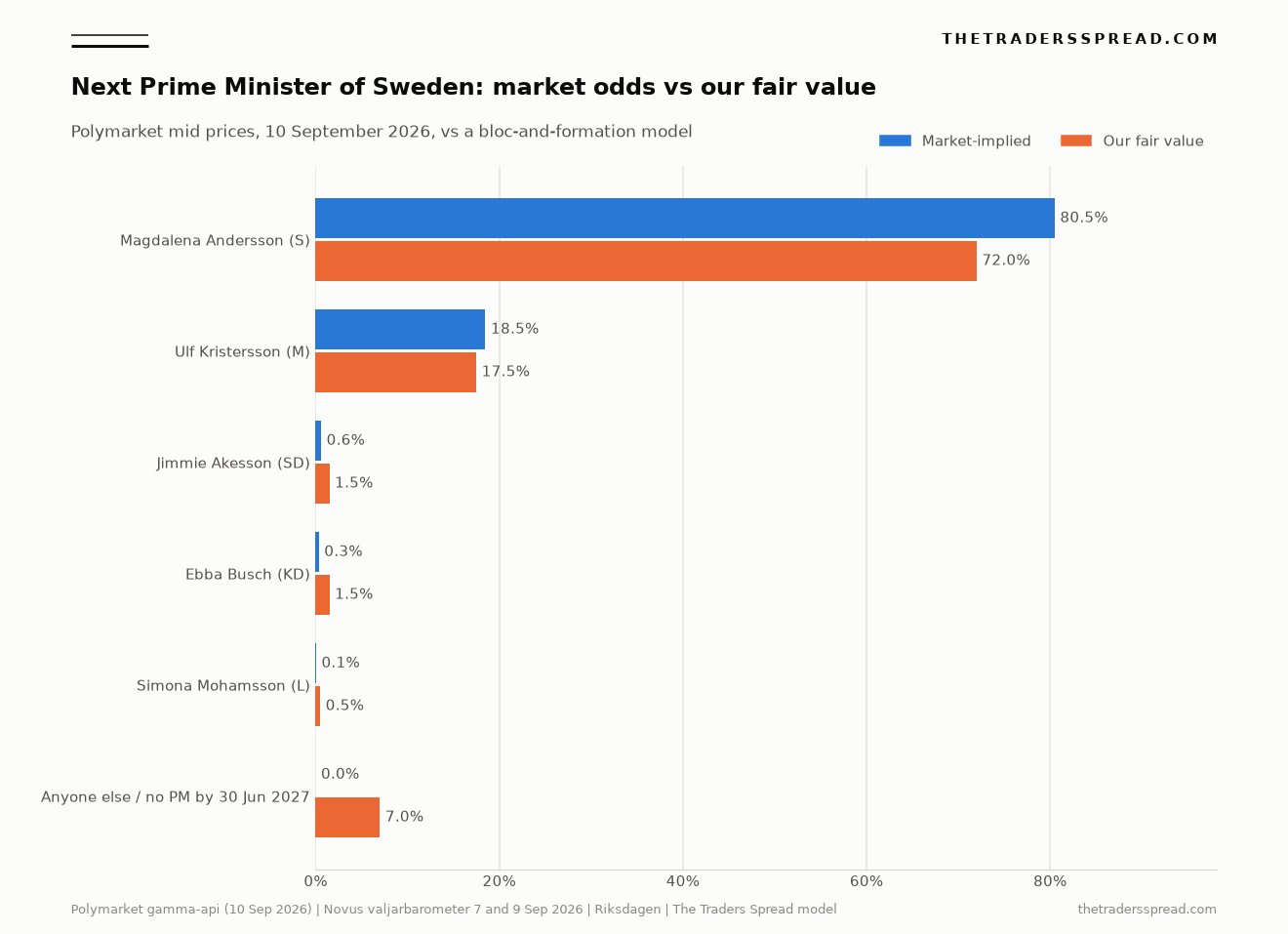
| Leg | Market, 10 Sep | Our fair value | Read |
|---|---|---|---|
| Magdalena Andersson (S) | 80.5% | 72.0% | Above fair |
| Ulf Kristersson (M) | 18.5% | 17.5% | In line |
| Jimmie Åkesson (SD) | 0.6% | 1.5% | Below fair |
| Ebba Busch (KD) | 0.35% | 1.5% | Below fair |
| Simona Mohamsson (L) | 0.05% | 0.5% | Below fair |
| Anyone else, or no PM by 30 Jun 2027 | 0.0% | 7.0% | Below fair |
Conditional on an S-led plurality we put Andersson at 94%: she leads the largest party, she has done the job before, and negative parliamentarism means Centerpartiet only has to abstain rather than endorse a government that Vänsterpartiet supports. Conditional on a Tidö plurality we put Kristersson at 80% rather than something close to certainty, because Novus now has SD statistically larger than M, Moderaterna's level is the weakest since August 2022, and Åkesson's party is openly bidding for ministerial posts. A bloc that wins while its largest component is not the one holding the prime minister's office is a bloc that has to negotiate the title itself. The Busch leg at 0.35% is the cheapest expression of that argument on the board.
Multiply through and Andersson lands at 72%, Kristersson at 17.5%, and about 7% sits in the tail: a different Social Democrat, a cross-bloc caretaker who never converts to a real appointment, four failed Speaker's votes, or a June 2027 expiry.
Formation risk is a nine-month exposure, not a Sunday night one
The three most recent Swedish formations, all confirmed on Riksdagen's own record, ran 18 days in 2014 (Stefan Löfven approved on 2 October), 36 days in 2022 (Kristersson approved on 17 October) and 131 days after the 2018 election, when Löfven was finally approved on 18 January 2019.
The 2022 case is the one people reach for, and it is the least applicable. The Tidö parties fought that election as a declared governing project, which is why Liberalerna can campaign in 2026 on the line that there is no Tidö government without them. Nothing equivalent binds the other side.
Tommy Möller, professor of political science at Stockholm University, gave Expressen the word for it on 30 August: låsning, deadlock. "The Centre Party's votes are probably required to secure a red-green majority. Then it's total deadlock. Then either C or V has to change its position. I'd guess one of them will," he said, translated from the Swedish. Centerpartiet has refused Vänsterpartiet a place in government; Vänsterpartiet says it will bring down any government it is not in. A long, difficult autumn for Andersson, Möller adds, is unavoidable.
He does not expect a fresh election. "An extra election is something you want to avoid. It's mostly a threat you use in negotiations." That is the case for holding our tail at 7% rather than higher, not for holding it at zero.
That is the 2018 setup, not the 2022 one.
Our central estimate for the swearing-in is therefore early November 2026, around seven weeks after the vote, with a distribution that has a real left tail in late September and a fat right tail running into the new year. Readers who followed our work on the Israeli next-PM market will recognise the shape: a leadership contract whose named favourite is priced off polls while the actual settlement depends on coalition mechanics that polls do not measure.
What the book is missing
The clearest signal that this event is priced as an election rather than an appointment is the sum of the legs. At 100.25% there is no room for anything the ten named politicians do not cover, and the "another candidate" leg has no price and no volume.
RelatedKharg Island: December Control at 7.5 Cents, Fair Lower
Volume says the same. Andersson has traded $580k against $84k of resting liquidity, Kristersson $409k against $117k. Yet the Åkesson leg at 0.6% has taken $1.58m and Nooshi Dadgostar's at 0.05% $1.02m, out of $5.09m across the event. Most of the flow went through legs now worth almost nothing: the fingerprint of a book that spent the year trading a narrative and only lately started trading the outcome.
The discipline is the same whichever way a favourite is mispriced: read the rules, then decide what the number has to survive. Our note on the Brazilian presidential market came out against a favourite for similar reasons, and the Venezuela leadership market turned entirely on a resolution source almost nobody had opened. European contracts are not immune, as our French presidential piece set out.
The call
Our fair value on Magdalena Andersson is 72%. The market's 80.5% is 8.5 points above that, which makes this leg the one we mark as rich. The gap is not a claim that Kristersson is undervalued — at 18.5% against our 17.5% he is close enough to fair that there is nothing to say. The gap lives almost entirely in the tail the book prices at zero and we price at 7%.
Base case, roughly 72%: the opposition converts a 2.6-point bloc lead into about 179 seats, the Speaker nominates Andersson in early to mid-October, and she takes office in the first week of November. Bull case, around 15%: Liberalerna's tactical surge fades on the day, the Tidö bloc loses L's 5.8% below the threshold, and the S-led side wins by twelve or more seats, making formation quick and cheap. Bear case, around 20%: the bloc margin misses by 2.3 points or more toward Tidö, comfortably inside one standard error of the current Novus reading, and Kristersson or a negotiated alternative takes the job instead.
The remaining slice is the one worth watching. Four failed Speaker's votes trigger an extraordinary election within three months and reset the clock past Christmas. A caretaker Kristersson government continuing into 2027 does not resolve this market at all until somebody is actually appointed.
What would change our mind: a final-week poll showing the bloc gap above five points, which would put an S-led majority outside one standard error and justify something in the mid-eighties. A Liberal collapse back under 4% in the last published readings would do the same from the other direction. Movement the other way — the gap closing under a point, or Moderaterna recovering the lead over SD inside the Tidö bloc — argues our 72% is itself too high.
Resolution is what to watch, not the exit polls. The Riksdag convenes on 28 September, the Speaker's first nomination follows, and nothing settles until someone has actually taken office, with 30 June 2027 as the backstop.
FAQ
When does the Sweden prime minister market actually resolve?
Not on election night. The rules require the individual to be "officially appointed and assume office", and explicitly exclude any interim or caretaker prime minister. If nobody has taken office by 30 June 2027 the event resolves to "Other". Our central estimate for the swearing-in is early November 2026, based on the 36-day formation after the 2022 election and the 131-day one after 2018.
Why is Andersson at 80.5% if the polls show a 2.6-point race?
Because 2.6 points of bloc lead converts to roughly nine seats under Sweden's proportional system, and the threshold risk currently sits on the Tidö side with Liberalerna. That combination genuinely makes her a strong favourite. Our disagreement is about the size of the tail, not the direction: the market leaves nothing for a hung Riksdag, a compromise candidate, or a formation that runs past the June 2027 backstop.
What is the 4% threshold and why does Liberalerna matter so much?
A party needs 4% of the national vote (or 12% in a single constituency) to take any seats in the 349-member Riksdag. Liberalerna polled 1.9% in late August and 5.8% on 9 September. At 3.9% the party contributes nothing to the Tidö bloc; at 4.1% it contributes around fifteen seats. No party on the opposition side is anywhere near that line.
How many votes does a Swedish prime minister need?
None, in the positive sense. Under chapter 6 of Regeringsformen the Speaker's nominee is rejected only if at least 175 of the 349 members vote against. Abstention is enough to let a nominee through, which is why Sweden runs minority governments as a matter of routine. Four rejected nominations force an extraordinary election within three months.
Could Jimmie Åkesson become prime minister?
Novus now has Sverigedemokraterna statistically larger than Moderaterna, and the party is openly seeking ministerial posts. Novus also notes that Moderaterna is defending the prime minister's post against that pressure, and no party in the bloc has nominated Åkesson for it. We carry the leg at 1.5% against a market price of 0.6% to reflect the scenario where the Tidö bloc wins and the largest party in it refuses to be a junior partner again.
Disclaimer
This article is analysis and information, not investment advice or a recommendation to take any position. Prediction market contracts carry the risk of total loss of capital, and the fair values above are our own modelled estimates rather than statements of fact. Odds, poll figures and liquidity were accurate at the time of retrieval on 10 September 2026 and change continuously. Do your own research and never commit capital you cannot afford to lose.