

The popular reading of Sunday's wipeout, that a CDU knocked out of a state parliament for the first time must drag Friedrich Merz out of the Chancellery with it, gets the German constitution wrong. Under the Basic Law, a German chancellor does not fall when his coalition cracks or when he loses a vote of confidence. He falls when he quits, when he dies, or when a majority of the Bundestag elects someone else by name. Polymarket's board on whether Merz is out as chancellor before 31 December 2026 traded at a 23.5% midpoint at 06:53 UTC on Monday 21 September, with about $1.83 million matched on that leg alone. That price is not absurd. The man has just watched his party post 4.9% in Mecklenburg-Vorpommern and 17.2% in Saxony-Anhalt. But the price bundles three very different routes to the exit, and only one of them, his own resignation, is realistically open before New Year's Eve.
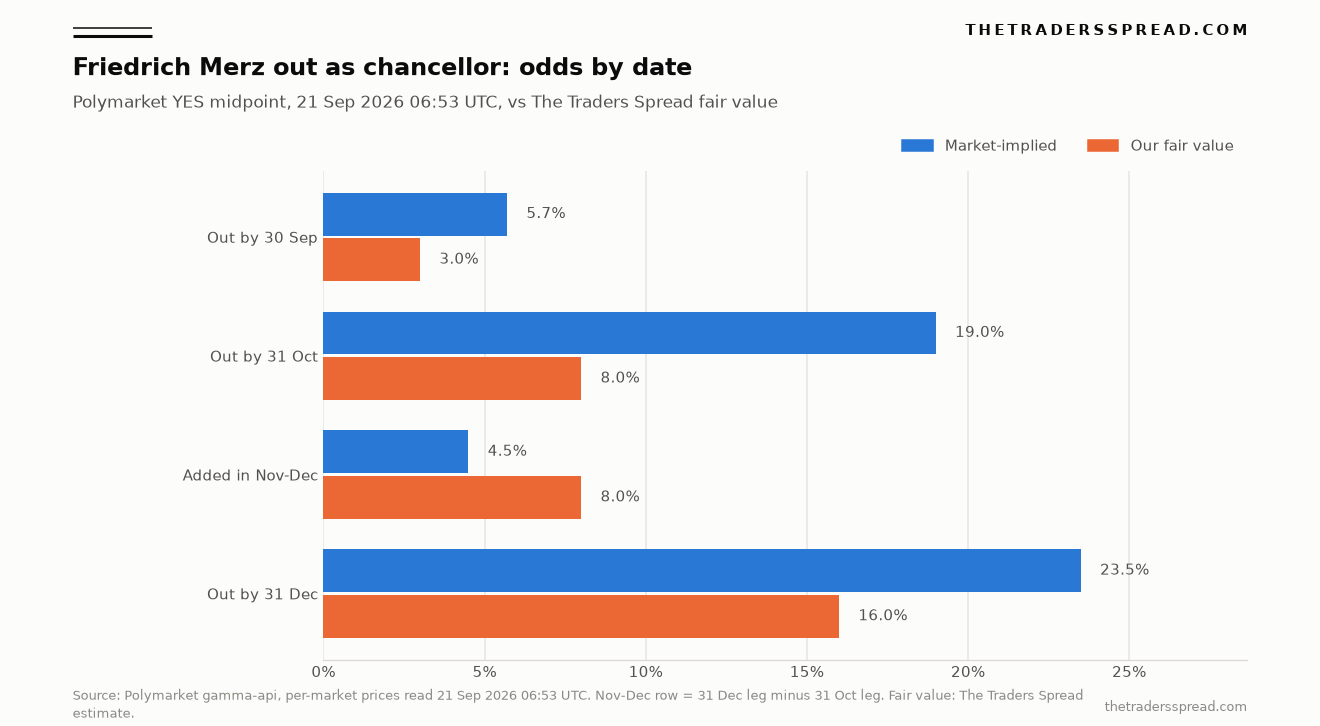
Here is the part the headline number hides. The market has placed 19 of its 23.5 points before 31 October and only 4.5 points across November and December. That is backwards. The 2027 federal budget, the fight that already split the coalition in September, is scheduled for its final Bundestag vote on Friday 27 November. If Merz breaks, the budget endgame is the likelier place for it to happen, not the next five weeks. We put the whole year-end leg at 16%, and we think the market has most of its risk in the wrong month.
Key facts
- Polymarket "Merz out before December 31, 2026" leg: 23.5% midpoint (23¢ bid, 24¢ ask), $1,827,309 lifetime volume, $102,038 liquidity (Polymarket gamma API, 21 Sep 2026 06:53 UTC)
- The 31 October leg sits at 19% and the 30 September leg at 5.7% (same source and timestamp)
- Saxony-Anhalt, 6 September: AfD 43.8% of the list vote, CDU 17.2%, down from 37.1% in 2021; AfD holds 39 of 83 seats (Statistisches Landesamt Sachsen-Anhalt, data as of 8 Sep 2026)
- Mecklenburg-Vorpommern, 20 September: AfD 38.2%, SPD 35.5%, CDU 4.9%, below the 5% threshold (Landeswahlleiter M-V, preliminary result, 20 Sep 2026)
- Berlin, 20 September: Die Linke 25.7%, CDU 18.8% (down 9.5 points), AfD 16.3% (Landeswahlleiter Berlin, preliminary, 21 Sep 2026 03:33)
- Removing a chancellor against his will needs 316 of 630 Bundestag votes for a named successor; the CDU/CSU and SPD won 328 seats in February 2025 (Bundeswahlleiterin, final result)
- 2027 budget: €555.44bn of spending, net borrowing of €118.73bn, final vote planned for 27 November 2026 (Deutscher Bundestag, August 2026)
What the Basic Law actually allows
Start with the text, because the market's own rules send you there. The Basic Law gives the Bundestag exactly one way to dismiss a chancellor. Article 67 says parliament "may express its lack of confidence in the Federal Chancellor only by electing a successor by the vote of a majority of its Members." That is the constructive vote of no confidence. Its landmark use came on 1 October 1982, when Helmut Kohl replaced Helmut Schmidt with 256 of 495 votes, the Bundestag's archive records, and that only worked because the FDP switched coalition partners.
Article 68 runs the other way. The chancellor asks for confidence; if he loses, the President may dissolve the Bundestag within 21 days, on the chancellor's proposal. Nothing in Article 68 removes him. Article 69(3) then obliges a departing chancellor to keep running the government until a successor is appointed.
We have a very recent test case. On 16 December 2024 Olaf Scholz lost his confidence vote with 207 votes for, 394 against and 116 abstentions, well short of the 367 he needed, according to the Bundestag's own record. He kept running the government, first as chancellor and later in a caretaker role, until Merz was elected on 6 May 2025. A lost confidence vote bought Germany an election, not a new head of government.
Now read the Polymarket rule against that backdrop. The board resolves YES "if Friedrich Merz ceases to be the Chancellor of Germany for any period of time" by the deadline, and it adds a clause that matters more than anything else on the page: "An announcement of Friedrich Merz's resignation/removal before this market's end date will immediately resolve this market to 'Yes', regardless of when the announced resignation/removal goes into effect." Government of Germany is the named source, with a consensus of credible reporting as backup.
So there are three doors. One: Merz announces he is going, most likely as part of a negotiated handover to another Union figure. Two: 316 members elect a successor under Article 67. Three: a snap-election path moves fast enough that a new Bundestag convenes before 31 December, which under Article 69(2) ends his tenure even if he stays on as caretaker. The third door is almost bricked up. Article 39 allows 60 days from dissolution to polling day and 30 more for the new chamber to meet. Scholz's timetable, from lost vote to election, took 69 days. Beating the deadline from here would need a confidence vote within days and an early-December election, and neither governing party wants an election while the AfD is surging.
The ladder the market has built
The year-end leg launched in November 2025 and printed 23.5% on its first daily close on 6 November 2025. It sits at exactly the same number ten months later, after a year in which it traded as low as 9% (5 April) and as high as 29.5% (16 September). What changed in between is the shape of the curve, not the level.
Polymarket opened the September and October legs on 15 September, nine days after Saxony-Anhalt, and money went straight into the near dates. The year-end leg jumped from 17.5% on the 14 September daily print to 24.5% on the 15th and 29.5% on the 16th, then gave back ten points in a day. We could not tie the spike to a single primary-source event. It coincided with a week of open CDU infighting and a government denial of minority-government plans, but nothing on the record that week altered the constitutional arithmetic. You can see the full ladder on Polymarket's Merz board. Links to Polymarket are affiliate links, from which The Traders Spread may earn a commission at no cost to you.
| Leg | Bid / ask | Midpoint | Lifetime volume | Our fair value |
|---|---|---|---|---|
| Out before 30 Sep 2026 | 5.3¢ / 6.1¢ | 5.7% | $234,029 | 3% |
| Out before 31 Oct 2026 | 18¢ / 20¢ | 19.0% | $62,683 | 8% |
| Added across Nov-Dec (implied) | n/a | 4.5 pts | n/a | 8 pts |
| Out before 31 Dec 2026 | 23¢ / 24¢ | 23.5% | $1,828,510 | 16% |
Source: Polymarket gamma API and CLOB order book, read 21 September 2026 06:53 to 06:58 UTC.
Two things stand out. The October leg is thin, with $62,683 traded, so a handful of tickets set that 19%. And the year-end book is lopsided: 4,976 shares offered at 24¢ against a wall of 46,567 shares at 26¢.
The hazard implied by the ladder is odd. The market charges roughly 13 points for the 31 days of October. Across the 61 days of November and December it charges 4.5. A market that feared the budget would not price those months at a third of the October rate.
Sunday's numbers, read properly
Nobody should shrug off the election results. The Mecklenburg-Vorpommern figure is, per CNBC's reading of ARD projections, the CDU's lowest result in any state since the Second World War.
| State (date) | CDU list vote | AfD list vote | Winner | Status |
|---|---|---|---|---|
| Saxony-Anhalt (6 Sep) | 17.2% (2021: 37.1%) | 43.8% (2021: 20.8%) | AfD, 39 of 83 seats | Final count |
| Mecklenburg-Vorpommern (20 Sep) | 4.9% | 38.2% | AfD, SPD second on 35.5% | Preliminary |
| Berlin (20 Sep) | 18.8% (-9.5 pts) | 16.3% (+7.2 pts) | Die Linke, 25.7% | Preliminary |
Election-night coverage slightly overstated two of these. CNBC, citing ARD projections, put the Berlin CDU on 19.1% and the Linke on 25.3%; the returning officer's preliminary count has 18.8% and 25.7%. The Mecklenburg-Vorpommern CDU figure of 4.9% held. We covered the Berlin board's seat mechanics in our Berlin election odds analysis last week.
Merz called the result a "disaster" on Sunday night, then refused to give ground. "What needs to be done now requires backbone, steadfastness, and patience," Friedrich Merz, Chancellor of Germany and chairman of the CDU, said in a statement reported by CNBC. "I will demonstrate these qualities as chairman of the CDU and, above all, as chancellor of our country." That is not the language of a man drafting a resignation letter.
The AfD reading was different. "We have displaced the CDU as the people's party," Alice Weidel, co-leader of the AfD, told ZDF, per the same CNBC report. Yet the AfD sits outside every federal majority calculation, which is why its surge makes a Merz exit harder, not easier. Any snap election would hand it more seats, and both governing parties know it.
Who could actually pull the lever
Walk through the people with a hand on each door.
The SPD cannot remove Merz on its own. Its 120 seats are nowhere near 316, and an Article 67 vote needs a candidate the SPD would elect alongside most of the Union. Leaving the coalition leaves Merz in office at the head of a minority government, an option a government spokesman dismissed on 13 September: "Speculation about a possible minority government is completely unfounded," n-tv reported (our translation). Thorsten Rudolph, an SPD member of the Bundestag, set out the party's stance in the 8 September finance debate: "This government must not fail over a budget, and it will not fail over a budget," he said, according to the Bundestag's report of the debate (our translation).
The arithmetic of a Union-AfD combination does exist, and the SPD leader said so out loud. "There is a second majority in the Bundestag alongside the Union and SPD, and that is the Union and AfD," Lars Klingbeil, Vice-Chancellor, Finance Minister and SPD co-leader, said in Celle, as reported by Merkur (our translation). "But I do not want that." On the 2025 seat count, 208 Union plus 152 AfD makes 360. The firewall against the AfD makes that majority unusable for electing a chancellor.
That leaves the Union itself, and the realistic YES scenario is a Kanzlertausch: Merz agrees to step aside, a successor such as Hendrik Wüst or Markus Söder is proposed, and the SPD votes for that person under Article 63 or 67. Every step needs someone to move first. Söder, asked by Bild whether Merz was still the right man, answered "Yes, he stands by the reforms," and added, "I am not responsible for the CDU, I am not its chairman," Merkur reported (our translation). Lukewarm, and conditional. Not a push.
Inside the Chancellery the line on Sunday was to shut the debate down. Philipp Amthor, the CDU politician who manages federal-state relations at the Chancellery, blamed "the difficult personnel discussions" of recent weeks for the Mecklenburg-Vorpommern campaign and said, "It is good and right for these personnel discussions not to be continued now," CNBC reported. CNBC also noted that no top-level ally had publicly called for Merz to go.
The sister market agrees that change is a live possibility over a longer window. On Polymarket's next German chancellor board, "no next chancellor before 2028" trades at 47%, with Wüst at 24.5%, Söder at 21.5% and Boris Pistorius at 8.5%. Treat those with care. The Wüst leg has traded $1,671 in total, so a single order can move it. Read together with the Merz board, the market says roughly a 53% chance of a new elected chancellor by the end of 2027 and 23.5% of Merz being gone within 101 days. That front-loading is the bit we doubt.
Where the 23.5% could be right
We should say plainly what would make us wrong. The strongest case for the market is that German chancellors do sometimes leave mid-term without losing a vote. The Chancellery's own list shows Konrad Adenauer handing over to Ludwig Erhard in 1963 and Willy Brandt to Helmut Schmidt in 1974, both through resignation, which is exactly the door the Polymarket rule treats as instant YES the moment it is announced. Merz is 70, his party just lost a state parliament entirely, and CNBC reports calls from within the CDU for him to be replaced.
There is also a trigger that has now been pulled. Before Sunday, n-tv reported that if the CDU failed to enter the Mecklenburg-Vorpommern parliament, a debate inside the party about Merz's future was considered possible. It failed. The next fortnight will show whether that debate starts in public.
The second case is the budget. The Budget Committee starts its line-by-line work on 23 September and the plenary vote is planned for 27 November. Christian von Stetten, who chairs the Union's Mittelstand caucus, has called the draft "not approvable", Merkur reported. If the coalition cannot pass a budget, the fastest face-saving exit for the Union is a new chancellor rather than new elections. That scenario, not an October coup, is where most of our 16% comes from.
A third, smaller risk is the wording: a credibly reported December deal for a January handover would count as YES. We have priced that in.
RelatedElon Musk Tweets October Odds: The Book Has No Peak
For readers tracking the market side, German politics has so far barely touched the DAX forecast we published this month or the euro's EUR/USD outlook; a disorderly chancellor change during budget season would test that.
Our call: 16% by New Year's Eve, with the risk in November
Our fair value for Friedrich Merz being out as chancellor before 31 December 2026 is 16%, against a market midpoint of 23.5%. In the house terms of this desk, the market trades above our fair value.
We build that 16% from the three doors. The resignation route, a negotiated Kanzlertausch announced before year-end, carries almost all of it at roughly 14 points. A constructive vote of no confidence without Merz's consent gets about 1 point, because it needs the SPD to elect a Union successor the Union itself has not chosen. The snap-election route that seats a new Bundestag before 31 December, plus death or incapacity, shares the last point.
By date, we have 3% by 30 September, 8% by 31 October, and a further 8 points across November and December. That last increment is nearly double the market's 4.5 because the 27 November budget vote is the one scheduled event that could force the Union's hand. The market's 19% for October looks rich for a period that has no scheduled trigger and in which the Chancellery is openly telling the party to stop discussing personnel.
Base case (about 84%): Merz stays, the budget passes in late November with concessions to the SPD on pensions and care, and the leadership fight is parked until 2027. Bear case for Merz (16%): a budget stalemate or a further polling collapse pushes the CDU leadership to broker a handover, announced before Christmas.
What would change our mind: a named senior CDU figure, Wüst or a state premier, calling publicly for Merz to go; the SPD saying it would vote for a Union successor; or the Budget Committee's 23 September start slipping. Any one of those moves us toward the market. If the October leg keeps trading near 19% through a quiet October, we will read that as noise rather than information. Track the live ladder on Polymarket.
FAQ
Does the SPD leaving the coalition resolve the Merz market to YES?
No. Under Article 67 of the Basic Law the Bundestag can only remove a chancellor by electing a successor with 316 votes. If the SPD walked out, Merz would stay in office heading a minority government until he resigned or someone else was elected. The Polymarket rule resolves YES only when he ceases to be chancellor or a resignation or removal is announced.
What happens if Merz calls and loses a confidence vote?
He stays chancellor. Article 68 lets the President dissolve the Bundestag within 21 days on the chancellor's proposal, which leads to an election within 60 days. Olaf Scholz lost a confidence vote on 16 December 2024 and kept running the government until Merz was elected on 6 May 2025. The deadline for this board would likely pass before a new chamber met.
Would an announced handover in January count before 31 December?
Yes, if the announcement comes before the deadline. The rules state that an announcement of Merz's resignation or removal before the end date resolves the market to YES immediately, regardless of when it takes effect. A deal reported in December for a January handover would therefore settle the board as YES, provided the reporting is credible and consistent.
Why is the October leg so much higher than your fair value?
The market put 19 points of risk before 31 October, when the period has no scheduled trigger and the Chancellery is asking the party to drop personnel debates. The October leg has traded only $62,683, so few orders set that price. We see the 27 November budget vote as the real pressure point, which is why our November-December increment is larger than the market's.
Who would replace Merz if he went?
Polymarket's separate next-chancellor board shows Hendrik Wüst at 24.5% and Markus Söder at 21.5%, with 47% on no new chancellor before 2028. Those legs are very thin, with under $2,000 traded on each of the two leaders. Any successor would need a Bundestag majority, which in practice means SPD votes for a Union candidate.
Disclaimer
This article is analysis and information, not financial or betting advice. Prediction-market prices can move sharply on news, positions can lose their entire value, and any capital committed is at risk. Odds quoted were read at the stated UTC times and will have changed since.