

A Yes price on the AI downturn contract is a payment for a checklist, and the checklist has six named tests. The contract resolves Yes only after three of those tests occur inside one 90-day window that ends by 11:59pm Eastern on 31 December 2026. On the primary prints retrieved for this piece, two of the six are true.
At 08:39 UTC on 21 November 2026, the Yes outcome on the December contract of the AI downturn market on Polymarket was 0.5995. The bid was 0.599, the ask was 0.600, the last trade was 0.600, and the spread was 0.001. Gamma recorded a one-day change of +0.506 and a one-week change of +0.5315, with volume of 3,364,546 and liquidity of 53,136. The same event's March group is already closed, with a Yes outcome price of 0. Data as of 21 November 2026.
Key facts from the 21 November retrieval
- Question on the open contract: "AI bubble burst in 2026?" Deadline 11:59pm Eastern on 31 December 2026.
- Yes at 0.5995 at 08:39 UTC on 21 November 2026. One-day change +0.506. One-week change +0.5315.
- Score from primary sources that day: 2 of 6 tests true. SOXX and the supplier test, the latter through SMCI.
- Nvidia's 20 November close was $125.53, 48.42 percent under the $243.37 high. The 50 percent line is $121.69.
- Fair value on the count is 0.50. The Yes price sits 0.0995 above that figure.
What the Yes price is paying for
The market description, re-read from gamma on 21 November 2026, says a downturn is three of six events inside 90 days of the deadline. The six are the rows below. The description adds that the contract stays unresolved until three of them have been met, whatever a headline says about a burst. A separate contract on this desk, the Jensen Huang exit market, already separates a news event from the rule that settles it, and the same split applies here.
Equity closes below come from Nasdaq's historical table for 20 November 2026, the last session before this retrieval, and the highs come from Nasdaq's own chart series. "Close," where an equity test is still unmet, means the drawdown has passed half the required percentage. Half of 50 percent is 25 percent. Half of 40 percent is 20 percent.
Six tests on the latest primary prints
| Test | Rule | Latest primary print | Score |
|---|---|---|---|
| 1. Nvidia | Close 50 percent below the all-time high | $125.53 on 20 Nov 2026, against a $243.37 high on 6 Oct 2026. Drawdown 48.42 percent. Line $121.69. | Unmet, and close |
| 2. SOXX | Close 40 percent below the all-time high | $123.40 on 20 Nov 2026, against a $218.65 high on 22 Jun 2026. Drawdown 43.56 percent. Line $131.19. | True |
| 3. Bankruptcy | OpenAI or Anthropic declares bankruptcy | CourtListener case-name search, 21 Nov 2026: no bankruptcy petition with either company as debtor. | Unmet |
| 4. Acquisition | OpenAI is acquired | OpenAI Rule 7.1 disclosure, filed 16 Nov 2026: Microsoft and SoftBank each hold 10 percent or more. A stake, and a listing is a separate market. | Unmet |
| 5. H100 rental | At or below $1.00 for five consecutive days | Silicon Data H100 index $3.08 as of 20 Nov 2026. Visible daily readings $2.88 to $3.13. | Unmet |
| 6. One supplier | Any one of TSM, ASML, AVGO, ANET, SMCI closes 50 percent below its own high | SMCI $21.65 on 20 Nov 2026, against a split-adjusted high of $122.90 on 8 Mar 2024. Drawdown 82.38 percent. | True |
Nvidia is $3.84 above the line that would score
Nasdaq's historical table for NVDA shows a 20 November 2026 close of $125.53, with a session high of $143.725, a low of $124.50, and volume of 633,418,400 shares. The highest high on the chart series is $243.37 on 6 October 2026. The drawdown from that high to the 20 November close is (243.37 − 125.53) / 243.37, which is 117.84 / 243.37, or 48.42 percent. A 50 percent decline would require a close at or below $121.69, and the session low of $124.50 stayed above that line.
Forty-eight percent is past the halfway mark of a 50 percent test, so the row is marked close. The gap from $125.53 to $121.69 is $3.84, about 3 percent under the Friday close, and that gap is the open question on this name.
SOXX cleared its 40 percent line on the same close
Nasdaq's historical table for SOXX shows a 20 November close of $123.40, a high of $135.41, a low of $122.20, and volume of 88,477,700. The highest high on the chart from 1 January 2016 through that session is $218.65 on 22 June 2026. The drawdown is (218.65 − 123.40) / 218.65, which is 95.25 / 218.65, or 43.56 percent. The rule needs 40 percent, so the close has to be at or below 60 percent of the high, and 0.60 × 218.65 is $131.19. The print of $123.40 is under that line.
On that chart, the 20 November close is the first close at or below $131.19 after the June high, and it is the only one. The test is true on the day retrieved, and a resolver can date it to 20 November 2026.
The bankruptcy register we searched has no debtor petition
The register is CourtListener, the public RECAP mirror of federal dockets. On 21 November 2026 a case-name search for OpenAI returned about 134 cases. The newest on the first page is Flinn Artificial Intelligence Technologies v. OpenAI OpCo, a patent case in the District of Delaware, docket 1:26-cv-01455, filed 12 November 2026. The other first-page results are civil suits. A case-name filter for OpenAI or Anthropic limited to bankruptcy courts returned no cases. RECAP can lag a brand-new petition. On the register as it stood that day, neither company appeared as a bankruptcy debtor, so the test scores unmet. A civil complaint the firm is defending is a different kind of docket from a debtor's own petition, which is what the rule asks for.
A 10 percent stake is the disclosure OpenAI actually filed
The acquisition test asks whether OpenAI is acquired. The primary document is OpenAI's own amended Rule 7.1 disclosure, Document 1850, filed 16 November 2026 in the OpenAI copyright litigation in the Southern District of New York, No. 25-md-03143, also captioned 1:23-cv-11195. The filing on the RECAP archive says OpenAI, Inc. changed its name in October 2025 to OpenAI Foundation. The Foundation states that it has no parent corporation and that no publicly held corporation has a financial interest of 10 percent or more. OpenAI Group PBC states that it is partially owned by the Foundation, and that Microsoft and SoftBank each have a financial interest of 10 percent or more on an as-converted basis.
A 10 percent interest is a stake the company put on a court form. The form describes partial ownership and contractual rights over the public-benefit corporation and its board, and it stops there. An acquisition would be a transfer of the company to a buyer. The OpenAI IPO ladder on this desk is a different market, and it measures a first-day close for a listing, which leaves the acquisition line on this contract untouched. The fourth test scores unmet on the 16 November disclosure.
The H100 index is still near three dollars
The rule points at the SiliconData Silicon Index and scores a Yes-side condition only after the H100 rental price is at or below $1.00 for five consecutive days. The H100 page of that index, ticker SDH100RT, read $3.08 per GPU-hour as of 20 November 2026, up 6.9 percent over seven days. The daily table on the same page runs from $2.88 to $3.13 and ends at $3.08. None of those readings is at or below $1.00, so five consecutive days under the line are absent.
A frequently-asked block on the same page says the current H100 rental price is $2.53, which disagrees with the dated $3.08 print. Both figures are more than double $1.00, so the disagreement leaves the score unmet and nowhere near close.
One supplier name is enough, and SMCI is that name
The sixth test is a group. Any one of five closes, each measured against its own high, completes it. Nasdaq's historical table for SMCI shows a 20 November close of $21.65, an open of $23.095, a high of $23.52, a low of $21.465, and volume of 48,447,630. The highest high on the chart series is $122.90 on 8 March 2024. The drawdown is (122.90 − 21.65) / 122.90, which is 101.25 / 122.90, or 82.38 percent. Half of $122.90 is $61.45, and $21.65 is far below it, so the test is true.
The series is split-adjusted, which is why the March 2024 high prints at $122.90 rather than a four-figure pre-split price. Super Micro's Form 8-K filed 6 August 2024 says the board authorized a 10-for-1 forward split, expected to become effective at 5:00pm Eastern on 30 September 2024, with trading on a split-adjusted basis on 1 October 2024. The 50 percent line of $61.45 is on that same scale as the $21.65 close. The first close at or below $61.45 after the high was $60.88 on 5 August 2024, and the latest close that still qualifies is 20 November 2026.
The other four pages opened and none of them clears 50 percent alone. TSMC closed at $318.71 against a $487.47 high on 5 October 2026, a 34.62 percent drawdown, with the line at $243.74. ASML closed at $1,266.22 against a $1,999.96 high on 30 June 2026, a 36.69 percent drawdown. Broadcom closed at $304.41 against a $495.00 high on 3 June 2026, a 38.50 percent drawdown. Arista closed at $167.62 against a $217.41 high on 9 October 2026, a 22.89 percent drawdown, short of the 25 percent mark used for "close." Those four drawdowns are context beside a test that SMCI has already made true.
The two true tests share 20 November only on the later close
From 20 November 2026 to the 31 December deadline is 41 days, inside a 90-day span. If the SOXX breach and the SMCI condition are both dated to that close, they already share a day, and any third test from then through the deadline joins them inside one window.
The alternative date for SMCI is the first breach, 5 August 2024, at $60.88. The distance from 5 August 2024 to 20 November 2026 is far longer than 90 days. On that reading the supplier event and the SOXX event do not share a window, the live cluster shrinks to a single true test, and two further tests would still be required. The count of tests that are true on the day retrieved stays two either way. The fair value below uses the later-close reading, and the first-breach reading is the revision that would cut it.
RelatedIs the UK inflation favourite a band behind the pace?
Fair value is one half
A test scores 1 when the latest primary print meets the rule and 0 when it misses, and an equity test that has passed half the required drawdown without reaching it is marked close. Two tests already score 1, the contract needs a third inside the same window, and the only still-open test marked close is Nvidia, which is given an even chance, so fair value is 0.50.
The arithmetic is 0.5 for Nvidia and 0 for bankruptcy, the acquisition, and the H100 index. The two tests that already score 1 are conditions in hand on the shared-date reading, so they set the number still required at one and stay out of the sum. Folding 2 and 6 into a ratio of one third would treat finished items as if they were still coin flips. 0.5 + 0 + 0 + 0 = 0.50.
| Yes probability | |
|---|---|
| Market, gamma outcome price at 08:39 UTC on 21 Nov 2026 | 0.5995, shown as 60.0 percent on the chart |
| Fair value from the six-test count | 0.50 |
| Gap, market minus fair | 0.0995 |
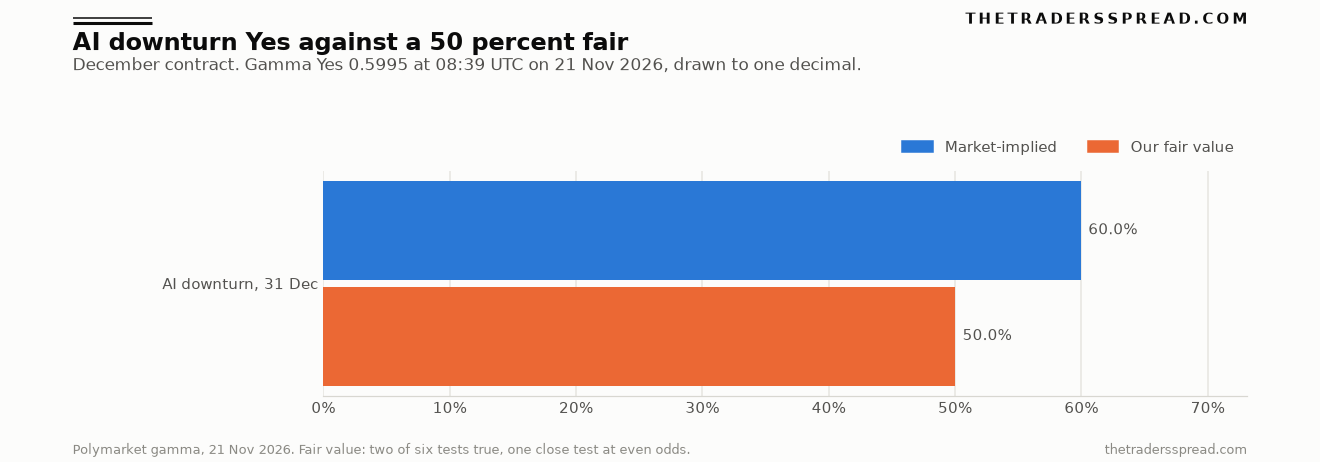
The gap of 0.0995 is wider than a 0.05 band around the fair value, so the Yes price sits above the fair. The quote is rich relative to a checklist on which two tests print true and one more is a coin flip.
What would change the fair value
A Nvidia close at or below $121.69, while the 20 November SOXX close and a still-valid SMCI close remain inside the same 90 days, would make three tests true on the shared-window reading. Fair value would move to 1. Five Silicon Index sessions at or below $1.00 would do the same, and so would a bankruptcy petition by OpenAI or Anthropic, or a transaction in which OpenAI is actually acquired. Each of those is a third test joining a pair that, on our dating, already shares 20 November.
The revision in the other direction is the dating of SMCI. If the supplier event is frozen at the first close under $61.45, which was 5 August 2024, it falls outside any 90-day window that also contains the SOXX close of 20 November 2026. The live count of tests that can share a window with a new event drops from two to one. Fair value would then be revised sharply down, because two further tests would be required and only Nvidia is close enough to receive the even chance. A revised SOXX close above $131.19 would knock the second test off as well. The method stays binary either way: a drawdown that is merely close keeps scoring 0 until the close crosses the line.
FAQ
What does a Yes on the AI downturn contract actually require?
Three of the six tests in the table have to occur inside one 90-day window ending by 11:59pm Eastern on 31 December 2026. A headline that uses the words bubble or burst leaves the contract unresolved until that count is actually met.
Which two of the six tests are already true?
The two true tests are SOXX and the supplier test. The SOXX close of $123.40 on 20 November 2026 is 43.56 percent under the $218.65 high, past the 40 percent rule. Super Micro's close of $21.65 the same day is 82.38 percent under its split-adjusted high of $122.90, so one supplier name completes the sixth test. Nvidia, the bankruptcy search, the acquisition disclosure, and the H100 index are unmet.
Why is fair value 50 percent when two tests already pass?
The contract needs three tests, so two true tests leave one still required. Nvidia is the only unmet test marked close, and it is given an even chance of printing before the deadline. Bankruptcy, an acquisition, and the H100 index are given none, because their latest prints are nowhere near the rule. One half times the single close test is 0.50, and the Yes price of 0.5995 sits above it.
This is analysis of a contract and of public prices, and it is not a recommendation to take either side. Capital is at risk on the contract and on the shares named above.