

Lando Norris started the F1 Spanish Grand Prix from pole, 0.011 seconds clear of Kimi Antonelli, and he was still leading when he peeled into the Madring pit lane at the end of lap 15. Antonelli had stopped a lap earlier. The Jolpica pit-stop record logs his stop at 31.843 seconds and Norris's at 35.134, and when the order settled on lap 16 the McLaren was fifth, behind Charles Leclerc, Max Verstappen and both Mercedes. Leclerc then led on a long first stint until he pitted on lap 48, which is the lap Antonelli inherited the lead he kept to the flag, 4.351 seconds ahead of Verstappen. Lewis Hamilton, third on lap 4, completed only six laps. Twenty-five points turned a 66-point lead over George Russell into an 81-point one, with 233 points left to win. Polymarket barely flinched: Antonelli's championship leg went from 87.4% at 13:00 UTC on race day to 90.9% at 15:00.
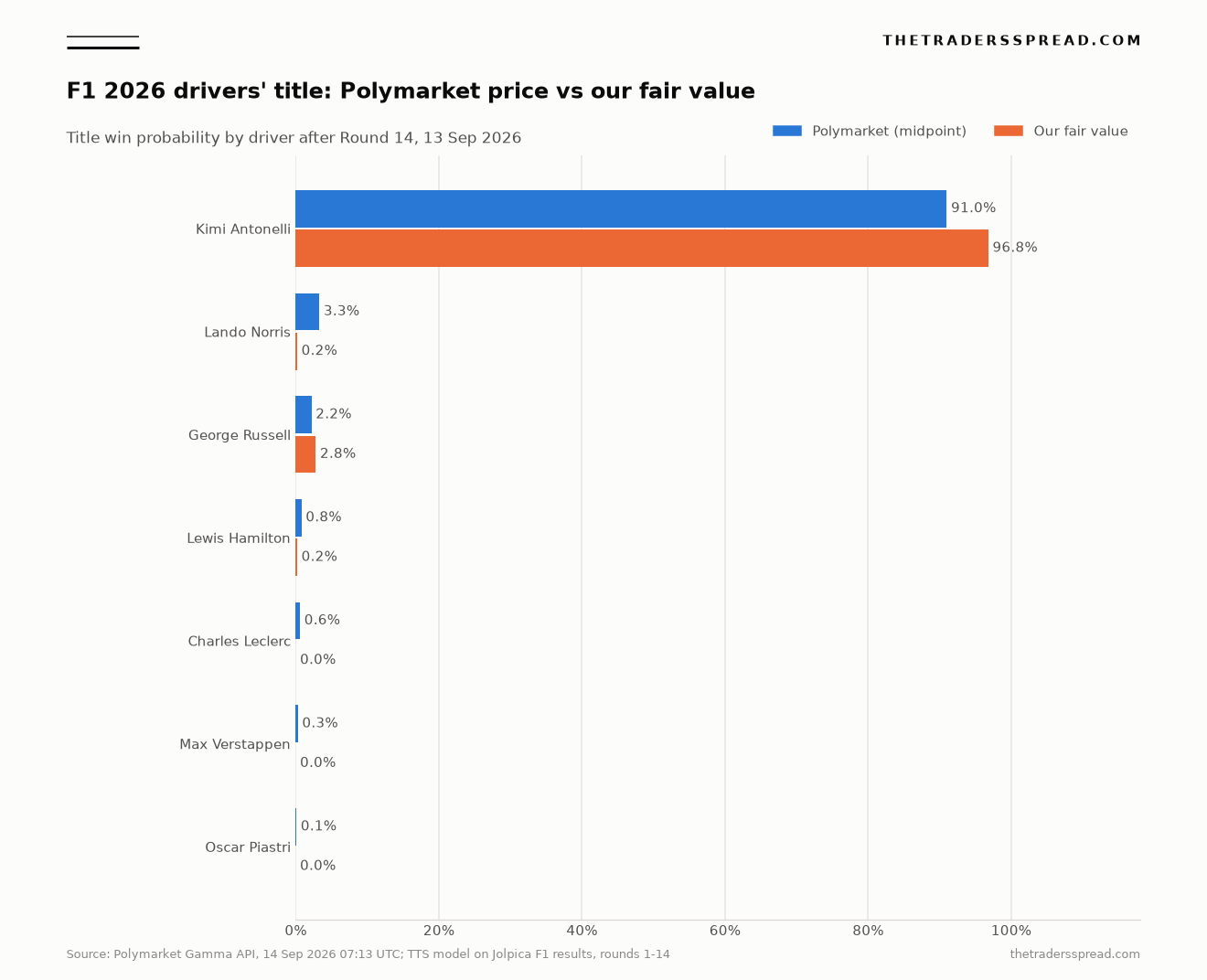
That muted move is the story. We replayed the nine remaining Grands Prix and the Singapore sprint 100,000 times by resampling this season's actual race results, and Antonelli is champion in 99.9% of the runs. Getting that number down to the 91 cents the Polymarket F1 Drivers' Champion market charges takes an assumption that he leaves roughly every second remaining race with nothing, against two pointless Sundays in 14 so far. After weighting in rival-form scenarios and a haircut for events no results file can capture, our fair value is 96.8%. The board also ranks the chasers backwards: Norris, 106 points adrift in a McLaren, trades at 3.25%, above Russell at 2.15%, who is 81 behind in the same car as the leader. Links to Polymarket are affiliate links, from which The Traders Spread may earn a commission at no cost to you.
Key facts
- Antonelli's leg is bid at 90.9 cents and offered at 91.0, a 90.95% midpoint, on $4.34 million of lifetime volume and $175,254 of liquidity — Polymarket Gamma API, 14 September 2026, 07:13 UTC
- After Round 14 the standings read Antonelli 292 points (eight wins), Russell 211, Hamilton 191, Norris 186, Leclerc 167 — Jolpica F1 API driver standings, read 14 September 2026
- Nine Grands Prix and one sprint (Singapore, 10 October) remain, worth at most 233 points to any single driver — formula1.com 2026 race schedule pages, read 14 September 2026
- The event has traded $202.9 million across 22 driver legs, and the Antonelli leg accounts for 2.1% of it — Polymarket Gamma API, 14 September 2026
- The leg rose from 71.2% at 12:00 UTC on Italian Grand Prix day to 84.95% by 15:00 UTC, then from 87.4% to 90.9% on Spanish Grand Prix day — Polymarket CLOB price history, read 14 September 2026
- Our model returns 99.9% on raw race data and a 96.8% fair value after scenario weighting and a 2-point haircut — The Traders Spread calculation on Jolpica results for rounds 1 to 14, 14 September 2026
- Since 2010 the largest title lead lost with nine Grands Prix to go was 40 points, by Fernando Alonso in 2012 — Jolpica historical driver standings, 2010 to 2025
Eighty-one points, 233 available, one rulebook
The scoring has not changed shape. Grands Prix pay 25, 18, 15, 12, 10, 8, 6, 4, 2 and 1 to the top ten, and sprints pay 8 down to 1 for the top eight, which is exactly what the round-by-round data shows. There is no bonus for fastest lap. Russell set the quickest lap in Madrid, a 1:35.587 that formula1.com lists as the circuit record, and he scored ten points for fifth place, the standard fifth-place haul with nothing added.
Nine rounds remain on the official calendar: Baku on 26 September, then a round formula1.com bills as the Gulf Air Bahrain Grand Prix in Malaysia, run at Sepang on 4 October, then Singapore, the season's last sprint weekend, on 9 to 11 October. Austin, Mexico City, São Paulo, Las Vegas and Qatar follow, and Abu Dhabi closes the year on 6 December. We checked the session timetable on each remaining event page; Singapore's is the only one with a Sprint Qualifying session. Nine times 25 plus eight makes 233.
The market's own housekeeping confirms the arithmetic. Polymarket has already closed the legs of drivers who cannot reach 292, which is why Pierre Gasly's leg, on 41 points, is settled: 41 plus 233 is 274. Liam Lawson's is still open, and the reason is a curiosity. He has 59 points, and 59 plus 233 is exactly 292. If he won every remaining race and sprint while Antonelli scored nothing, they would tie, and F1's countback would hand Lawson the title on nine wins to eight.
The rules matter for timing. The market resolves "as soon as the official results of the final scheduled race of the 2026 F1 season are known", with official Formula 1 information as the primary source. A driver who becomes mathematically unable to win resolves No at that point. If the season is cancelled or unfinished by 28 February 2027, the market resolves to "Other". On the rules as written, a clinch in Austin does not settle the winning leg early; the capital sits until Abu Dhabi, 83 days from today.
When could the clinch come? The earliest is Singapore, and only on a near-perfect sequence. In our base simulation Antonelli wraps it up at Austin (Round 18) in 22.4% of runs, Mexico City in 39.6% and São Paulo in 25.5%. The rest go later.
What the order book shows
The Antonelli leg has been repricing all season. Its first daily print, on 10 December 2025, was 5.1%. It stood at 9.3% before the Chinese Grand Prix and 31.2% by early April. Five straight wins from Shanghai to Monaco took it to 70% on 9 June, and it dropped back to 52.65% by 30 June, after a retirement in Barcelona and third place in Austria. From late July it sat near 74% for six weeks, through Norris's back-to-back wins in Hungary and the Netherlands. Monza broke that stall: between 12:00 and 15:00 UTC on 6 September the price jumped from 71.2% to 84.95%. Madrid added only 3.5 points more, even though the lead grew by 15.
| Driver | Points | Gap | Polymarket midpoint | Leg volume | Our fair value |
|---|---|---|---|---|---|
| Kimi Antonelli (Mercedes) | 292 | 0 | 90.95% | $4.34m | 96.8% |
| George Russell (Mercedes) | 211 | -81 | 2.15% | $2.77m | 2.8% |
| Lewis Hamilton (Ferrari) | 191 | -101 | 0.80% | $5.41m | 0.2% |
| Lando Norris (McLaren) | 186 | -106 | 3.25% | $6.84m | 0.2% |
| Charles Leclerc (Ferrari) | 167 | -125 | 0.55% | $5.33m | under 0.1% |
| Max Verstappen (Red Bull) | 145 | -147 | 0.25% | $6.16m | under 0.1% |
| Oscar Piastri (McLaren) | 120 | -172 | 0.10% | $6.49m | under 0.1% |
Sources: Jolpica F1 API standings; Polymarket Gamma API, 14 September 2026, 07:13 UTC; our model.
Three things stand out. First, the money has gone to the long shots. The favourite's leg has traded $4.34 million, while eliminated legs such as Oliver Bearman's traded $12.9 million before closing at zero, so the price that matters is set on one of the thinner books in the event. Second, the book is lopsided. At 07:22 UTC the CLOB order book held $51,206 of bids within a cent of the 90.9-cent best bid, against $5,940 offered within a cent of the 91.0-cent best ask. Bids are queuing, and offers are thin.
Third, the discount on Antonelli is not funding cost. Adding the best asks across all nine open legs comes to 99.1 cents for a set that pays $1 in 83 days whichever of those nine drivers is champion. That discount works out at roughly 4% a year, a funding-sized number rather than a view on any driver, and it is spread across the whole F1 drivers' board. The midpoints sum to 98.15%. If the whole board carries only a funding-sized discount, the 9-point gap between Antonelli's price and certainty is a view about racing, not about money. We took the same approach to overround in our Senate control analysis, and the thin-favourite problem echoes what we found on the 2028 Democratic nominee book.
How we got to 96.8%
The engine is deliberately simple, so anyone can rebuild it. For each future Grand Prix we draw one of this season's 14 races at random and give every driver the points he scored that day. Drawing whole races, rather than each driver separately, keeps each finishing order internally consistent: two drivers cannot both win, and a weekend where Mercedes was slow is slow for both Mercedes. Retirements come along automatically, because they are in the record. The Singapore sprint is drawn the same way from the five sprints run so far. Ties break on wins. Each scenario runs 100,000 seasons.
The raw record is lopsided. Antonelli has averaged 19.0 points per Grand Prix with 12 podiums from 14 starts. Russell averages 12.6, Hamilton 12.2 and Norris 11.0. Antonelli has two zero-point Grands Prix (a retirement in Barcelona and 15th at Silverstone), Russell and Norris three each. Our scenarios and weights:
| Scenario | What it assumes | Antonelli | Weight |
|---|---|---|---|
| Season form | All 14 races resampled | 99.9% | 55% |
| Recent form | Rounds 8 to 14 only | 99.8% | 20% |
| Leader stress | Antonelli scores zero in an extra 25% of races | 97.9% | 15% |
| Severe stress | Antonelli scores zero in an extra 50% of races | 86.2% | 5% |
| Mercedes slump | Both Mercedes drawn from their worst seven races, rivals from their best seven | 97.6% | 5% |
The weighted blend is 98.8%. From that we take a flat two points for things a results file cannot see: an injury or illness that costs several races, a sporting sanction that strips points, calendar disruption, and resolution disputes. That leaves 96.8% for Antonelli, 2.8% for Russell and about 0.4% shared among Hamilton, Norris and the rest. The haircut is judgment, and we are publishing it as such. Doubling it to four points would give 94.8%, still well above the market.
The implied-assumption test is the cleanest way to see the gap. Holding everything else fixed, the extra blank rate that brings our season-form run down to 91% is 43%. Add his existing record and that works out to Antonelli scoring nothing in roughly half of the remaining Grands Prix. He has not had two pointless races in a row all season.
Sixteen seasons of nine-race run-ins
Precedent points the same way, with one caution attached. Using Jolpica's historical standings, we checked every season since 2010 (the first under the current points scale) at the moment nine Grands Prix remained. Six of the 16 leaders at that point went on to lose: Hamilton in 2010 (12 points ahead), Alonso in 2012 (40), Nico Rosberg in 2014 (14), Hamilton in 2016 (19), Sebastian Vettel in 2017 (14) and Piastri in 2025 (34). All six leaders who were 47 or more points clear held on, including Verstappen in 2022 with 80 and in 2024 with 70.
The caution sits in who beat them. In three of the six lost leads, 2014, 2016 and 2025, the champion was the leader's own team-mate. That makes Russell, not Norris, the chaser this history points to, and it sits badly with a market that prices Norris higher. It also tempers the comfort of an 81-point cushion: the only driver with the same equipment is the one in second place.
What a results model cannot see
The fairest case for 91% is that race data describes the past, and the past can end abruptly. Development can turn the pecking order within weeks. Our Mercedes-slump scenario tries to capture that and still returns 97.6%, because 81 points takes a long time to spend even when the rivals are drawing from their best days. What it cannot model is a sudden, total loss of pace, and that is the one story in which Norris outranking Russell makes sense: if the Mercedes stops being the best car, both its drivers fall together, and the best of the rest benefits. The market's 3.25% on Norris is a bet on that regime change. In our slump scenario Norris reaches 1.8%, and in every other scenario he is close to zero.
The calendar is the second risk. This season's results record shows a five-week gap between Japan on 29 March and Miami on 3 May, and one of the remaining rounds is a Bahrain-branded race held in Malaysia. A calendar that has already moved could move again, and the "Other" clause exists for a season left unfinished by 28 February 2027. We treat that as remote, though not zero, and it sits inside the two-point haircut.
The third is absence. With nine races left, one missed Grand Prix would not change much. Three missed races would, and nothing in the results file tells us how likely that is. A market pricing 9 points of doubt against our 3.2 is, in effect, charging roughly three times our estimate for everything outside the data.
RelatedWill the Bank of Russia hold the key rate on 23 October?
The call: 96.8% fair against a 91-cent market
Our fair value for Antonelli as 2026 world champion is 96.8%. The Polymarket midpoint is 90.95%, so the market trades 5.8 points below our number, and on our scale that makes this a below-fair-value price rather than an in-line one. Capital is tied up until the Abu Dhabi results are official on 6 December, so we also ran the number with that cost included. Discounting 83 days at a 5% annual cost of capital shaves about 1.1 cents, and the adjusted gap is still near 4.7 cents.
How it resolves, by our numbers: Antonelli champion 96.8%, Russell 2.8%, anyone else 0.4%. In the base run the most likely clinch is Mexico City on 1 November. The market settles on the official Formula 1 classification after the final scheduled race, and any rival still mathematically alive then resolves No with it.
Three things would change my mind. The first is a fast collapse in the lead. If Russell took 40 points out of it across Baku and Sepang, leaving 41 with 183 to play for, our leader-stress run falls to 89.3%, below today's price, and the call would move to avoid. The second is two consecutive Grands Prix in which neither Mercedes reaches the podium, which would be the first real evidence for the slump scenario. The third is any report that Antonelli will miss a race, or any stewards' decision that removes points. Short of those, an 81-point lead over a field that has shared the season's other six wins among four drivers is worth more than the market's 91 cents gives it credit for.
FAQ
When does the Polymarket F1 drivers' champion market resolve?
On its rules, as soon as the official results of the final scheduled race of 2026 are known. On today's calendar that is the Abu Dhabi Grand Prix on 6 December. Drivers who become mathematically unable to win resolve No earlier. If the season is cancelled or unfinished by 28 February 2027, the market resolves to "Other". Official Formula 1 information is the named resolution source.
Is there still a fastest-lap bonus point in 2026?
No. The 2026 results carry no bonus for the fastest lap. George Russell set the fastest lap of the Spanish Grand Prix in Madrid, 1:35.587, and scored exactly ten points for fifth place. The maximum any driver can add from here is 233 points: 25 for each of nine Grands Prix and eight for the Singapore sprint.
Why does Polymarket price Norris above Russell?
The most coherent explanation is a bet on a change in the car pecking order. If Mercedes lost its edge, both Antonelli and Russell would suffer, and Norris would be the strongest non-Mercedes candidate. The standings and this year's results point the other way: Russell is 25 points ahead of Norris and drives the car that has won ten of 14 races.
Can Antonelli clinch the F1 title before Abu Dhabi?
Yes, though the market's winning leg would still wait for the final race on its rules. The earliest mathematical clinch is Singapore, and only if rivals barely score. In our base simulation the clinch comes at Austin in 22.4% of runs, Mexico City in 39.6% and São Paulo in 25.5%, with the remainder later in the year.
How does this compare with other near-certain markets?
Prices above 90% often hide the same question: is the missing 9% a real risk or a funding charge? We faced it with the Fed book in our rate-cut odds analysis, and with a front-runner in our Sweden election call. The F1 board is unusual because its whole-market price already accounts for time value.
Disclaimer
This article is analysis, not investment advice. The fair value above comes from our own model, built on public race results and stated assumptions, and it can be wrong. Prediction market prices are probabilities set by traders and can move sharply on a single race, an injury or a rules ruling. Event contracts can lose their entire value, and capital is at risk. Check the full resolution rules and the legal status of prediction markets where you live before using them.