

63.5%.
That is the Yes price on the contract asking whether Democrats win the 2026 Texas race for the US Senate. At 07:30 UTC on 4 October 2026, Polymarket's gamma-api showed a best bid of 63 cents, a best ask of 64, a last trade at 64, and a displayed mid of 63.5. The election is on 3 November. A month is not much time, and 63.5 cents is a favourite's price in a state Republicans have not lost in more than 30 years.
The group title on the screen says James Talarico (D). The question does not. It asks whether the Democrats win, and the rules say the names are there for the convenience of traders. If Talarico is replaced as the nominee before election day, the label is updated and the dollar pays on the replacement. Links to Polymarket are affiliate links, from which The Traders Spread may earn a commission at no cost to you. The book sits on the Texas Senate election winner event.
The surprising part is the setting, not the decimal. A Democratic price this far above 50 cents, this late, needs a reason. The polls we could open do not give us a gap we will defend against that mid, so fair value on the Democratic Yes is 63.5% as well. The call is that the contract is in line.
Registered voters can hold both ideas at once. In the Marist Poll of 17 to 20 September, Talarico led Ken Paxton 50% to 44% on the ballot and still trailed 43% to 52% on who would actually win. The market is pricing a favourite. A large share of the electorate is not. We do not turn that second question into a probability, and we do not move fair because of it.
The words that decide the dollar
Read the resolution text before the name. Every live leg carries the same description. The market resolves on the winner of the 2026 midterm Texas US Senate election, inclusive of any runoff. A candidate represents a party if he or she is that party's nominee. Greens, Libertarians and other names may be added later. An independent is not folded into the Democratic or Republican option, whatever their past affiliation.
The candidates may be named for convenience. If a named candidate is replaced as the nominee before election day, the name is updated and the market resolves on the replacement nominee of that party. Talarico at 63.5% is a label on a party contract. It is not a contract on Talarico the person.
The resolution sources are the Associated Press, Fox News and NBC. The market resolves once all three have called the race for the same candidate. If they never do, it resolves on the official certification. A split decision on election night does not, by these words, produce a dollar. It produces a wait.
The event's listed end is 04:59 UTC on 4 November 2026. That timestamp is not the resolution rule. Trading metadata and the payoff condition are different sentences, and only the second one says when a holder is paid.
Texas does not use a general-election runoff for this seat. The runoff clause still matters, because the text does not limit itself to the November ballot. We looked at a different election book, the Bulgaria presidential race, where the price was about a later round rather than a slogan on a name. Stopping at the group title is the same mistake here.
Wikipedia's page on the race, as we opened it on 4 October 2026, names Republican Ken Paxton and Democrat James Talarico as the nominees, with the election dated 3 November 2026. It says Democrats last won a Senate election in Texas in 1988 and last won any statewide office in 1994. The Texas Tribune, on 22 September, called it a state Republicans have not lost in more than 30 years, and reported that Paxton beat John Cornyn in the 28 May runoff by 28 percentage points after a close first round on 3 March. Those are the names on the labels. They are not the payoff.
Two live legs, eleven that are not
Thirteen markets hang off the event. Two are active.
The Democratic leg, "Will the Democrats win the Texas Senate race in 2026?", group title James Talarico (D), was at 63.5 cents Yes. Bid 63, ask 64, last trade 64, spread one cent. Volume on that leg was about $1.01 million, liquidity about $229,000, and volume in the prior 24 hours about $158,900. Polymarket's own one-day change was plus 3 cents, the one-week change plus 3 cents, and the one-month change plus 13 cents. The Democratic nominee contract is the leg this fair value refers to.
The Republican leg, "Will the Republicans win the Texas Senate race in 2026?", group title Ken Paxton (R), was the complement: Yes 36.5 cents, bid 36, ask 37, last trade 37. Volume about $1.01 million, liquidity about $252,000, prior-day volume about $105,600. The one-month change was minus 13 cents, the one-week change minus 3, the one-day change minus 2. Last trades of 64 and 37 add to 101 cents. The mids add to 100. Use the mids.
Across the event, gamma-api reported about $2.01 million in volume, about $264,500 in the prior 24 hours, about $476,000 over the prior week and about $1.03 million over the prior month. Liquidity was about $482,000 and open interest about $1.03 million. The event record updated at 07:29 UTC, the two live markets at 07:30. This is not a deserted contract, and a 13-cent month move is not a tick.
Ten slots titled Person A through Person J, plus an Other leg, were inactive: no outcome price, no volume. The description leaves room to turn those legs on if another candidate is added. Until then the live book is a two-outcome event.
Depth is not the same thing as a poll. On an unrelated October contract we counted the votes sitting behind a 70.9-cent print. Here the Democratic leg alone has cleared a million dollars. That makes 63.5 a traded price. It does not make it a forecast we have to adopt.
Three polls that are not 63.5
Fair value needed a poll we opened, with a pollster, a date, a sample and a result. The New York Times/Siena toplines, Cook Political Report, RealClearPolling, The Economist's Senate model and the Silver Bulletin forecast did not come back usable on 4 October: a block, or a paywall with no probability on the page. They are not in the number. Three horse-race surveys did open.
| Poll | Field dates | Sample | Talarico | Paxton | Rest |
|---|---|---|---|---|---|
| Emerson College Polling / Nexstar | 12 to 14 September 2026 | 1,000 likely voters, credibility interval ±3 points | 47% | 46% | Ted Brown 2%, undecided 4% |
| Marist Poll | 17 to 20 September 2026 | 1,139 registered voters, margin of error ±4.4 points | 50% | 44% | Other 2%, undecided or refused 4% |
| Fox News, Beacon Research (D) and Shaw & Company Research (R) | 24 to 28 September 2026 | 881 likely voters, ±3 points | 51% | 49% | Don't know 1%. Registered voters in the same release: 53% to 46% |
Emerson's release, published 17 September and sponsored by Nexstar, said there had been no significant movement since August: Talarico up a point, Paxton down a point. It put Talarico at 48% favourable and 42% unfavourable, against 40% and 48% for Paxton. Emerson's own headline was a dead heat. A one-point gap inside a three-point interval is that.
Fox's likely-voter cut, released after 6pm ET on 1 October, is 51% to 49%. The document warns that rounding can push a column off 100, and 51 plus 49 plus 1 does. Registered voters in the same survey led Talarico 53% to 46%, against 51% to 48% when Fox asked registered voters on 23 to 27 July. The likely-voter screen, not the calendar alone, separates a seven-point registered-voter lead from a two-point likely-voter lead.
Marist's ±4.4 is not a textbook margin. The packet says the design effect is 2.33 and that the published margin already includes it. Party identification in the sample was 33% Democratic, 39% Republican and 25% independent. A six-point lead among registered voters, inside 4.4 points, is visible and not settled.
Two-candidate shares, leaving undecided voters and Ted Brown unallocated: Emerson 47 divided by 93, or 50.5% Talarico. Fox likely voters 51 divided by 100, or 51.0%. Marist 50 divided by 94, or 53.2%. The plain average is 51.6%.
51.6% is a vote share, not a win probability. A candidate a point and a half above half wins more often than 51.6% of the time if the error is small, and may not be a favourite at all if the error is wide or the polls are biased. Choosing a standard deviation and calling the result fair value would be a number we invented. Sampling error alone would make the leader look too certain for a race with a month left, because it ignores turnout, late movement and shared methods. That is an upper bound on confidence, not a model.
Who voters think wins
Marist asked the same 1,139 registered voters who they thought would actually win, regardless of their own vote. Talarico 43%. Paxton 52%. Another party's candidate 1%, unsure 4%, no response 1%.
Independents make the split sharper. On the ballot they backed Talarico 55% to 35%, with 9% undecided. On the winner question they went 43% Talarico and 50% Paxton.
Intensity runs the other way. Among supporters, 81% of Talarico's said they supported him strongly, against 66% of Paxton's. That follow-up sits on a base of 1,033. A harder Democratic vote and a more doubtful electorate can both be true. Neither is a price.
"Texas Hispanic voters, who broke for Trump in 2024, now break for Talarico by 15 points, 54% to 39%," Spencer Kimball, executive director of Emerson College Polling, said in the 17 September release. "These voters disapprove of the president 53% to 41%, and 51% think the state is on the wrong track rather than the right direction."
Kimball is describing a subgroup inside a one-point statewide race, not a win probability. Emerson's methodology note says subgroup intervals are wider than the ±3 on the full sample. The quote is a named pollster, on the record, pointing at a slice that would have to move if a Democrat were going to win Texas. It does not justify marking 63.5% rich or cheap.
Advertising arrived. The price still rose
On 22 September the Tribune reported that the Senate Leadership Fund, aligned with Senate majority leader John Thune, was taking its Texas advertising to $100 million. The story attributed the figure to a person familiar with the group, granted anonymity. Nearly $70 million had already been spent, with a further $30 million to be booked through Texas PAC. Total Republican general-election spending was put above $140 million, with six weeks left.
September had already flipped the air war, on those figures. Texas PAC alone had spent nearly $66 million in the month, against about $22 million from Talarico, and other Republican groups took the month's Republican total to about $103 million. The Democratic Senatorial Campaign Committee and Senate Majority PAC had not committed advertising money to Texas. Talarico had taken in $30 million between April and June, the Tribune said, and had used that to dominate the summer airwaves.
During the primary, Thune described the group's support for Cornyn as a "business decision", the Tribune reported, one that would have let the party put money into Michigan and North Carolina instead of Texas.
RelatedWill the Bank of Russia hold the key rate on 23 October?
Over the month to 4 October the Democratic Yes rose 13 cents, while this advertising was being reported on the Republican side. We cannot see which orders were hedges and which were views about the polls. A heavy Republican advertising month and a higher Democratic price are both in the record. A story in which the ads simply cheapened the Democrat is not what the month did.
The 36.5-cent price is the other side of the same book, on the Republican nominee contract. The label says Paxton. The question says Republicans.
In line, on purpose
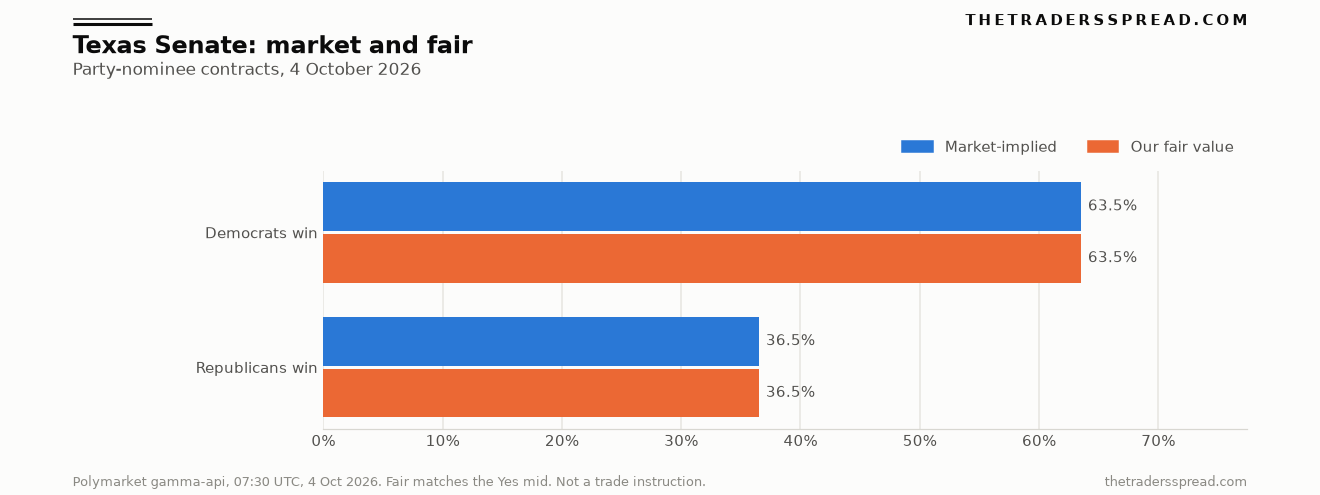
Our fair value is 63.5% that the Democratic nominee wins and 36.5% that the Republican nominee wins. We put nothing on a third-party winner. Emerson had Libertarian Ted Brown at 2% of likely voters, a ballot share rather than a 2% chance he takes the seat, and the Other leg was not trading. The two fairs add to one because the two live prices do.
The Fox likely-voter result is a two-point lead. Emerson called 47% to 46%. Marist's registered-voter lead is six points, and the same respondents expect Paxton to win. Handicapper pages we could not open are not smuggled in through a second-hand table. A homemade map from "Tossup" to a percentage would be fiction. Until a probability we have actually opened sits clearly off 63.5%, fair stays at the mid.
We have marked other books in line when an outside read and the contract sat together, including the Fed's October decision against November futures. A gap has to be a number we will say out loud.
What would move it. A new survey from a named pollster, with dates and a sample, showing Paxton ahead outside the margin among likely voters, would put fair below the mid. The market would then be above fair. A run of likely-voter polls with a Democratic lead that still looks heavy after ordinary late error, or a published win probability we can open and cite, would put fair above the mid. One more six-point lead among registered voters would not. We already have that print.
A nominee change would not, on these rules, switch the party being paid. The text says the name updates. A night when the Associated Press, Fox News and NBC disagree delays the dollar until certification. That is timing, not a different winner.
The 13-cent rise over the past month is the other live fact. From near a coin flip to 63.5 cents, in a state with this history, is a large move, and it happened while the polls we opened were still between a tie and a modest Democratic lead. Traders may be turning a small lead into a moderate favourite, which is a conversion we will not fake with a formula. Or they are ahead of the polls. We cannot measure that gap with the documents in hand on 4 October.
Questions the contract actually answers
Does 63.5% mean James Talarico is priced at 63.5%?
No. 63.5% is the Yes mid on "Will the Democrats win the Texas Senate race in 2026?" Talarico is the group label because he is the nominee. If the party replaces him before election day, the rules say the name changes and the contract follows the new nominee. A reader who wanted Talarico the person, and not the Democratic nominee, is in the wrong market.
When is the holder paid?
Once the Associated Press, Fox News and NBC have called the race for the same candidate, including a runoff if there is one. If those three never agree, payment follows official certification. The listed end of 04:59 UTC on 4 November 2026 is the event's end field. It is not a substitute for that paragraph. Election day is 3 November.
Why is your fair value identical to the price?
Because Emerson, Marist and Fox, the three polls we opened, show a tie to a modest Democratic lead, and a vote share near 52% is not a win probability we can defend without inventing an error bar. Fair at the 63.5% mid is the in-line call. It is not a claim that the market cannot be wrong. It is a refusal to pretend we know the direction.
What if Ted Brown or some other candidate wins?
Neither party contract pays. Independents are excluded from both options even with a party past, and other candidates can be added as their own legs. Brown was at 2% in Emerson's likely-voter sample. The Other market was inactive, with no volume, on the 4 October pull. A 2% ballot line is not a 2% chance of winning.
Is the book deep enough to take the mid seriously?
Event volume was about $2.01 million, open interest about $1.03 million, liquidity about $482,000, and about $264,500 traded in the prior 24 hours. The Democratic spread was one cent. That is deep enough that 63.5 is a real print, and not so deep that a 13-cent month move can be ignored.
This is analysis, not a recommendation. It does not say to take either side of the Texas Senate contracts. Prediction markets can be wrong, polls move, and capital is at risk.