

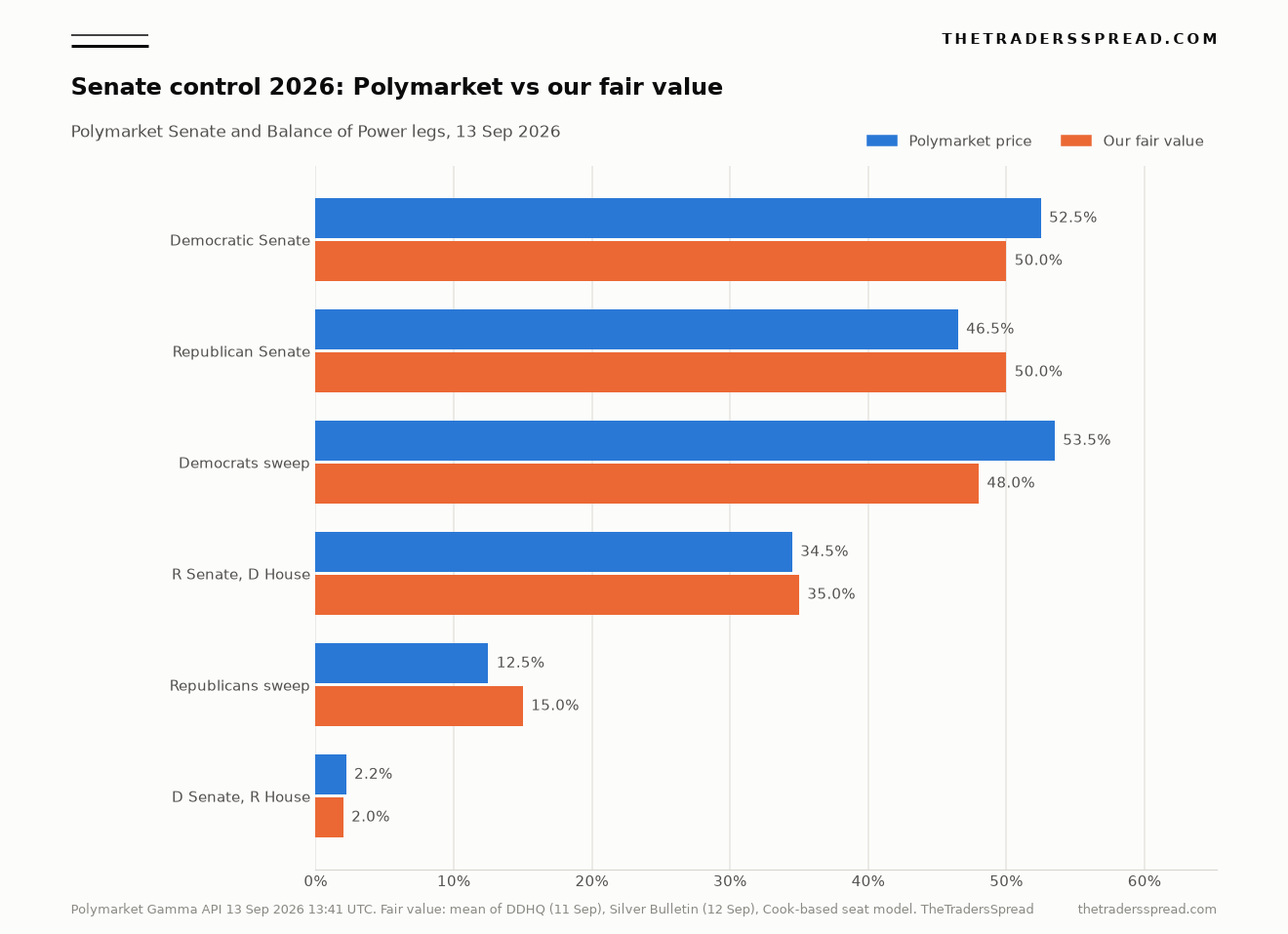
The line repeated most often about the 2026 Senate map, that Democrats cannot win the chamber without Texas, does not survive Polymarket's own state prices. We ran all 35 of the exchange's Senate race books through one correlated simulation, and in the runs where James Talarico loses Texas, Democrats still reach a majority 30.6% of the time. The seats they genuinely cannot afford are Georgia and North Carolina: lose Jon Ossoff's race and the Democratic chance of control falls to 8.8%, lose Roy Cooper's and it falls to 9.7%. That reframes what the headline number measures. Polymarket's Senate control market trades the Democratic Party at 52.5 cents and the Republican Party at 46.5 cents, and because those legs sum to 99.0%, the normalised Democratic price is 53.0%. It rests on $4.36 million of lifetime volume, and on the evidence below it is two and a half to three points richer than the independent forecasts justify.
Here is the part nobody quoting 52.5% mentions. Polymarket prices Senate control three different ways, and after the overround is stripped out they land within 1.1 points of each other: 53.0% in the control book, 53.7% when its 35 state books are simulated together, and 54.1% implied by the Balance of Power legs. That coherence is easy to mistake for accuracy. Step off the exchange and the agreement disappears. Kalshi, the CFTC-regulated venue listing the same question, has Democrats at 48.5 cents. Decision Desk HQ's model says 50%. Silver Bulletin's says 56.5%. A seat model we built on Cook Political Report's 20 August ratings, updated with Silver Bulletin's Ohio and Michigan polling averages, says 44.5%. The three forecasts average 50.3%. Polymarket's books agree because traders arbitrage them against each other, and that tells you nothing about whether the shared level is right.
Key facts
- Polymarket's Senate book quotes the Democratic leg at 52.5 cents and the Republican leg at 46.5 cents, a 99.0% sum that normalises to 53.0% Democratic — Polymarket Gamma API, 13 September 2026, 13:41 UTC
- The Balance of Power book's two Democratic-Senate legs (Democrats Sweep 53.5%, D Senate and R House 2.2%) add to 55.7%, or 54.1% after removing that book's 3.05-point overround — Polymarket Gamma API, 13 September 2026
- Kalshi's Democratic Senate contract is bid at 48 cents and offered at 49, with 3.56 million contracts traded and 1.76 million open — Kalshi Trade API, 13 September 2026
- Republicans hold 53 seats, Democrats 45 and independents 2; with Vice President JD Vance holding the tie-break, Democrats need a net gain of four — congress.gov member API and Inside Elections, September 2026
- Cook rates six seats Toss Up (Alaska, Iowa, Maine, Michigan, Ohio, Texas), five of them Republican-held — Cook Political Report ratings dated 20 August 2026
- Decision Desk HQ's model gives Democrats 50% and Silver Bulletin's FLIPR gives them 56.5% — DDHQ, 11 September 2026, and Silver Bulletin, 12 September 2026
- In 13.4% of our simulated outcomes Democrats finish on exactly 50 seats, which the market's rules hand to Republicans in all but one edge case — The Traders Spread calculation, 13 September 2026
Fifty-one seats, or fifty and the gavel
Start with the arithmetic the market is built on. The member list we pulled from the congress.gov API on 13 September shows 53 Republicans, 45 Democrats and two independents, Bernie Sanders and Angus King, who caucus with the Democrats. Thirty-five seats are on the ballot: 33 regular Class II races plus special elections in Ohio and Florida. Cook's ratings page counts 34 Democratic-held and 31 Republican-held seats that are not up, so Democrats need 17 of the 35 contested seats to reach 51. They currently hold 13 of them.
Why 51 and not 50? The Senate control market on Polymarket awards the chamber to the party with a majority of voting seats, and failing that, to the party that holds half the seats and the vice presidency. JD Vance holds that office, so a 50-50 chamber is a Republican chamber for resolution purposes. Links to Polymarket are affiliate links, from which The Traders Spread may earn a commission at no cost to you.
That clause matters more than it looks. When we simulate the state books together, Democrats finish on exactly 50 seats in 13.4% of outcomes. A reader who treats the Senate as a coin flip between "Democrats flip four" and "Republicans hold" is missing that the single most likely result, a 50-seat Democratic caucus, belongs to the other side.
Then there is Nebraska. The rules count an independent toward a party only if he formally caucuses with it or announces that he will, and they allow the market to stay open until 4 January 2027 waiting for that announcement. After that date, an independent who has not declared counts for nobody. Dan Osborn, running as an independent against Pete Ricketts, told NBC News in July 2025 that he would not caucus with either party. Polymarket's Nebraska book prices the independent at 31.5 cents against 67 cents for Ricketts. If Osborn wins and keeps his word while Democrats reach 50, nobody holds a majority, Democrats have half the seats but not the vice presidency, and the rules fall through to their last test: control goes to the party of the first President pro tempore the new Congress selects. That slice is 3.4% of our simulations. We split it evenly; pushing all of it to one side moves the result between 51.9% and 55.3%.
Three Polymarket routes and one dissent
The Democratic Senate leg has travelled a long way. It bottomed at 23.5 cents on 25 October 2025, peaked at 53.5 cents around 12 April 2026, and was back at 41.5 cents on 1 July, according to the CLOB price history. The last month has been quieter: daily closes between 49.5 and 52.5 cents, a standard deviation just under one cent, and the same 52.5-cent close on 14 August as today. The book behind that price is thin near the touch. At 13:49 UTC the Democratic token showed $21,995 of bids between 47 and 52 cents and $31,142 of offers between 53 and 58 cents.
| Route to a Democratic Senate price | Raw price | Normalised | Volume | Liquidity |
|---|---|---|---|---|
| Polymarket Senate book, Democratic leg | 52.5% | 53.0% | $2.60m | $201k |
| Polymarket Balance of Power, sweep + split legs | 55.7% | 54.1% | $2.99m + $1.75m | $318k + $171k |
| Polymarket, 35 state books simulated jointly | 53.3% | 53.7% (tails trimmed) | n/a | n/a |
| Kalshi CONTROLS-2026-D, mid | 48.5% | 48.5% | 3.56m contracts | 1.76m open |
One raw quote is plainly inconsistent. The Balance of Power market has "Democrats Sweep" at 53.5 cents, a full cent above the Democratic leg of the Senate book. Democrats cannot sweep Congress without winning the Senate, so the sweep is a subset of the Senate outcome and cannot be worth more. Normalising both books shrinks the contradiction to a 1.1-point gap, which is roughly what spreads and the Balance of Power book's 3.05 points of overround absorb, so it is not free money. It does show which book is doing the pricing: the $11.8 million Balance of Power event is the deeper one, and the Senate book follows it.
Kalshi is the real outlier. Its Democratic contract is 4.5 points below Polymarket's normalised price on a question with the same substance, although the two sets of rules differ in wording and Kalshi's contract does not close until 1 February 2027. Closing a gap like that means posting collateral on two venues with different account rules for up to five months, which is why a cross-venue arbitrage this size can persist. The gap is information about who is trading, and on this question Kalshi's order book is the more sceptical one.
The event also carries the same scaffolding we described in our analysis of the House control market at 86.6%: seven empty legs labelled Party A to Party F and Other, with zero volume and no quote.
Where the 35 state books put the pivot
To test whether the 52.5% headline squares with the individual races, we took every Polymarket Senate race book at 13:50 UTC, normalised each leg by its book's total, and turned each price into an implied margin. Every simulated election then draws one shared national error with a 3.5-point standard deviation and a separate 5-point error for each race, over 400,000 runs. Safe-seat underdogs trading at two to five cents, such as the Democrat in Wyoming, were capped at 1.5% to remove the usual favourite-longshot floor. The trim moves the answer from 53.3% to 53.7%.
| Seat | Held by | Cook, 20 Aug | Polymarket Democratic price | Democratic control if this seat is lost |
|---|---|---|---|---|
| Georgia (Ossoff) | D | Lean D | 92.7% | 8.8% |
| North Carolina (open) | R | Lean D | 91.1% (Cooper) | 9.7% |
| New Hampshire (open) | D | Lean D | 85.4% (Pappas) | 12.9% |
| Maine (Collins) | R | Toss Up | 70.5% (Jackson) | 20.3% |
| Alaska (Sullivan) | R | Toss Up | 66.6% (Peltola) | 22.0% |
| Michigan (open) | D | Toss Up | 63.5% (El-Sayed) | 23.6% |
| Ohio special (Husted) | R | Toss Up | 51.5% (Brown) | 29.5% |
| Texas (open) | R | Toss Up | 49.0% (Talarico) | 30.6% |
| Iowa (open) | R | Toss Up | 39.5% (Turek) | 35.4% |
Read the last column top to bottom and the map sorts itself. Democrats are expected to win 16.6 of the 35 contested seats, which puts their average finish at 50.6 seats, a whisker above the 50 that is not enough. Georgia, North Carolina and New Hampshire are the floor. Maine and Alaska, where the books sit roughly 20 points more confident than Cook's Toss Up label, are the pair that turn a likely 49 into a live 51. Texas, priced at 49 cents for Talarico against Ken Paxton, is the upside rather than the requirement.
The simulation lands on 53.7%, within a point of the control book. So the state books do not contradict the headline. They share its optimism about Maine and Alaska.
Why our number is 50%, not 53%
We build fair value from three independent estimators and weight them equally.
The first is Decision Desk HQ's Senate forecast, which gave Democrats 50% with a projected 51 seats when it last updated on 11 September; it read 48% on 27 and 28 August. The second is Silver Bulletin's FLIPR model, which on 12 September put the Democratic chance at 56.5%, up from a low of 51.1% earlier that week. Its notes credit Sherrod Brown's 4-point lead in its Ohio average, Abdul El-Sayed's 2.9-point lead over Mike Rogers in Michigan, and three Texas polls showing Talarico ahead by two to five points.
The third is ours. We mapped Cook's 20 August ratings to probabilities (Solid 99%, Likely 92%, Lean 80%, Toss Up 50%) and ran them through the same correlated simulation, which returns 37.4% because Democrats would need four of six coin flips while defending Michigan. Replacing the Ohio and Michigan coin flips with Silver Bulletin's polling averages, converted at a 6-point error (74.8% for Brown, 68.6% for El-Sayed), lifts that to 44.5%.
(50.0 + 56.5 + 44.5) / 3 = 50.3%, which we round to 50%.
We leave out Kalshi and Polymarket's own state books because they are prices rather than forecasts. Adding both as fourth and fifth equal inputs gives 50.6%, so the conclusion does not depend on that choice.
The national environment has not moved enough to explain the recent rally. We recomputed the generic ballot from the poll file behind Silver Bulletin's generic-ballot average: across 24 surveys with fieldwork ending between 14 August and 8 September, the influence-weighted, house-adjusted margin is D+7.09, against D+7.18 for the preceding 30 days. The raw unweighted mean is D+5.96. The Democratic leg rose from 49.5 cents on 24 August to 52.5 cents without the national number moving. That rise came from race-level polling in Ohio, Texas and Michigan, which is real information but concentrated in three contests.
What the 52.5% is quietly assuming
Maine carries the most weight. Susan Collins has held the seat since 1997, according to the congress.gov roster, and Cook still called it a Toss Up in August. Polymarket's Maine book gives her 29.5 cents against 70.5 for Democrat Troy Jackson. If the truth is closer to Cook's even money, our simulation says the chance of Democratic control drops by about ten points, from 53.7% to 44%, because losing Maine takes Democratic control down to 20.3%. Alaska is the same bet in a smaller state: Mary Peltola at 66.6% against a Toss Up rating.
Nebraska is the rules risk. An Osborn win looks like a Democratic pickup on a map, but the resolution text treats a non-caucusing independent as nobody's seat. The market may also stay open until early January if caucus intentions are unclear, which ties up capital well past election night.
Runoffs are the timing risk. The rules let a runoff decide a seat even after November, and Georgia requires a majority to win outright; Polymarket runs a separate book on whether Georgia avoids a runoff.
A tight generic ballot would be the disconfirming signal for Democrats. Our 30-day average is D+7.09; if it slipped under D+5, the Ohio and Texas leads would come under pressure together, because the simulation's shared national error hits every race at once.
RelatedProposal vs Dispute: How Polymarket Resolution Works
The call: 52.5% against a 50% fair value
Our fair value for the Democratic leg of the Senate control market is 50%, against a 52.5-cent price and 53.0% after normalising. On this desk's scale that is a "no" call: the market prices the Democratic leg above our fair value, by 2.5 points on the quoted price. The mirror image holds for the Republican leg, quoted at 46.5 cents against our 50%. The gap is modest, and it sits inside the spread between the two public models, so we hold it with moderate conviction rather than high.
Our distribution runs as follows. Democrats finish on 51 seats or more in 48% of outcomes; the usual route is holding every Democratic seat, Michigan included, flipping North Carolina and winning three of Maine, Alaska, Ohio, Texas and Iowa. They finish on exactly 50 in 14%, and the vice-presidential tie-break gives that to Republicans apart from about 2 points of the Nebraska edge case. They finish on 49 or fewer in 38%, the Republican majority case, most likely if Maine holds for Collins and the national environment tightens.
For the Balance of Power legs, combining our 50% with the 83% House fair value this desk published gives Democrats Sweep 48% against 53.5%, Republicans Sweep 15% against 12.5%, and Republican Senate with a Democratic House 35% against 34.5%.
The market resolves on certified state results and the organisation of the 120th Congress, with runoffs counting and a possible extension to 4 January 2027 if independents have not declared a caucus.
Three things would move us toward the market: Cook shifting Ohio or Texas to Lean D, DDHQ climbing above 55%, or Kalshi's contract rising to meet Polymarket. We would move further away if Collins leads the Maine polling average or Osborn restates that he will not caucus once the race is close.
FAQ
Why does a 50-50 Senate count as a Republican win?
The market's rules say that if no party wins a majority of voting seats, control goes to the party holding half the seats and the vice presidency. JD Vance is Vice President until January 2029, so a 50-50 chamber resolves Republican. Our simulation of Polymarket's state books puts Democrats on exactly 50 seats in 13.4% of outcomes, which makes this rule one of the biggest single swing factors in the price.
What happens if Dan Osborn wins Nebraska?
Independents count toward a party only if they formally caucus with it or announce that they will. Osborn has said he will not caucus with either party. If he wins and holds that line, his seat counts for nobody after 4 January 2027. With Democrats on 50 in that scenario, the market falls back on the party of the first President pro tempore, which is genuinely uncertain.
Why is Kalshi's price lower than Polymarket's?
The two venues have separate users, collateral and account rules, so a price gap can survive for months. On 13 September Kalshi's Democratic Senate contract was bid at 48 and offered at 49 cents, against 52.5 on Polymarket. Closing the gap would mean funding positions on both platforms until the contracts settle, and Kalshi's does not close until 1 February 2027.
How does this differ from the House control market?
The House market is priced at around 86.5% for Democrats, and our fair value there was 83%. The Senate is far closer because the 2026 map is mostly Republican-held and Democrats must flip four seats net. We treat them separately: our House analysis covers the chamber-level popular vote, and this piece covers the Senate seat arithmetic only.
Does the congressional calendar affect the Senate price?
Only at the margin. Floor fights such as the government funding deadline and the remaining Senate session days shape campaign messaging, but the control market resolves on November's results. Race polling in Maine, Alaska, Ohio and Texas has moved the Democratic leg far more in the past month than any vote on the floor.
Disclaimer
This article is analysis, not investment advice. Prediction market prices are probabilities set by traders and can move sharply on new polling, candidate news or rule interpretations. Event contracts can lose their entire value, and capital is at risk. Check the full resolution rules on each venue and the legal status of prediction markets where you live before using them.