

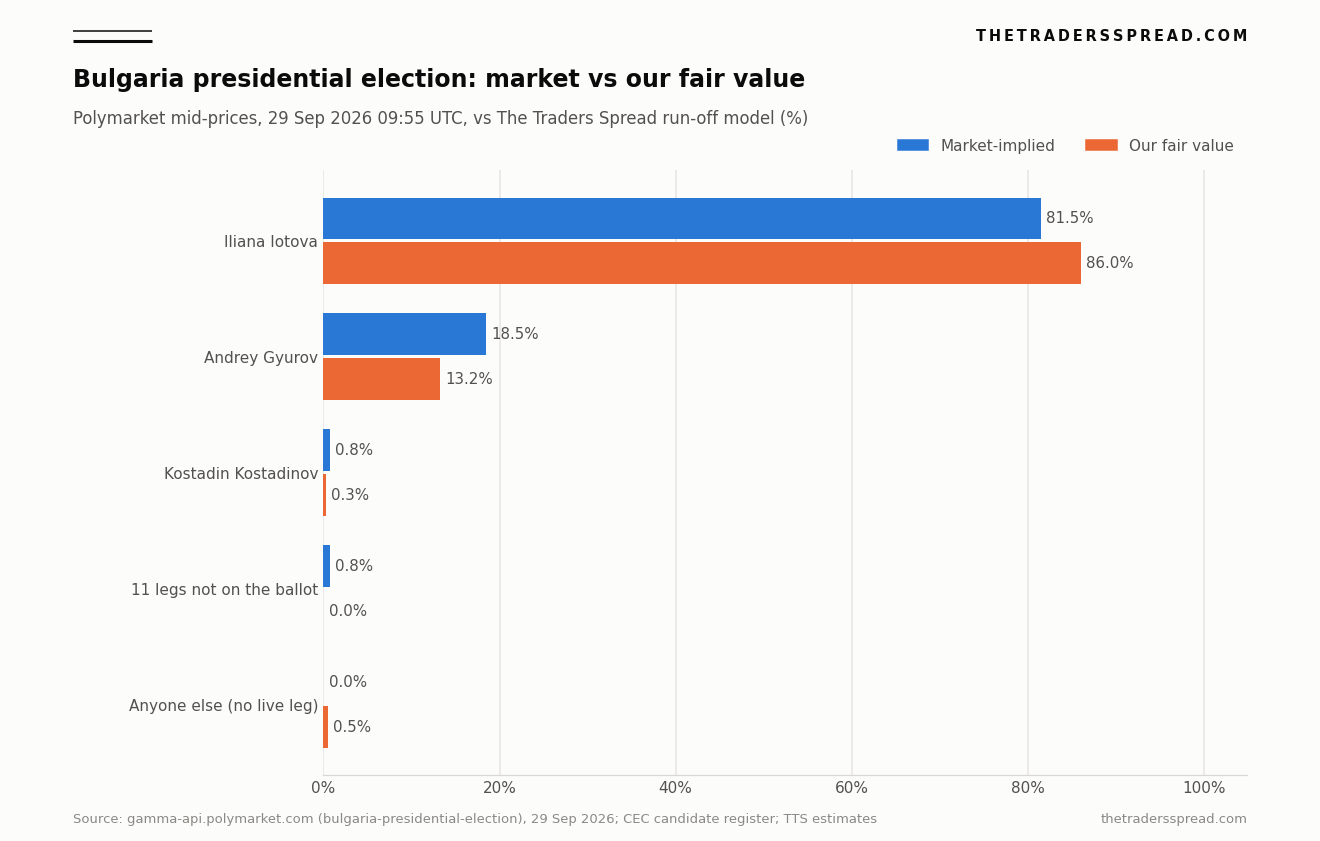
What is the Bulgaria presidential election market actually pricing when it puts Iliana Iotova at 81.5%? Not the first round on 25 October. Bulgarian law makes a first-round win close to unreachable, so the price is really a forecast of a single head-to-head on 1 November, almost certainly Iotova against the former caretaker prime minister Andrey Gyurov. Read that way, the number looks slightly too low rather than too high. At 09:55 UTC on 29 September the Bulgaria Presidential Election board on Polymarket showed Iotova at 81.5 cents and Gyurov at 18.5 cents, on $871,684 of lifetime volume and $109,496 traded in the prior 24 hours. Links to Polymarket are affiliate links, from which The Traders Spread may earn a commission at no cost to you.
The detail most coverage skips is the turnout clause. A candidate wins outright only with a majority of valid votes and turnout of at least 50% of the electoral roll. April's snap parliamentary election, the most energised vote Bulgaria has held in years, reached 50.70%. The last presidential first round, in November 2021, drew 40.47%. Iotova could plausibly take half the vote on 25 October and still face a run-off, which is precisely what the sociologist Andrey Raichev predicted last week. So the contract is not a popularity poll. It is a bet on arithmetic between two electorates that already exist, and the April vote counts tell us how big each one is.
Key facts
- Iotova 81.5%, Gyurov 18.5%, Kostadin Kostadinov 0.75% on the Polymarket event board — gamma-api.polymarket.com, 29 Sep 2026 09:55 UTC
- 14 priced legs sum to 101.5%, an overround of 1.5%; buying every leg at the best ask would cost 103.3 cents — Polymarket order book, 29 Sep 2026
- 27 candidate pairs are on the ballot, the most since direct presidential elections began — The Sofia Globe, 25 Sep 2026
- First-round win needs over 50% of valid votes and at least 50% turnout; a run-off, if needed, is on 1 November — The Sofia Globe, 25 Sep 2026
- Progressive Bulgaria won 1,444,920 votes in April; PP–DB, which backs Gyurov, won 408,846 — Central Election Commission results, 19 Apr 2026
- Turnout was 50.70% in April and 40.47% in the 2021 presidential first round — CEC results as compiled by Wikipedia
- The winner takes office for a five-year term beginning in January 2027 — The Sofia Globe, 25 Sep 2026
Two thresholds on one ballot
The presidency is decided by a two-round system. To win on the first ballot a pair must clear two bars at once, a majority of valid votes and a turnout of at least half the electorate. If either bar is missed, the top two pairs meet again a week later, and in the second round a simple plurality wins whatever the turnout. According to The Sofia Globe's election factfile, about 6.7 million Bulgarians at home and abroad are eligible, the official campaign opened on 25 September and ends at midnight on 23 October, and 24 October is the statutory day of contemplation.
No candidate has ever won in round one.
That record is not an accident of weak candidates. Rumen Radev took 49.42% on the first ballot in November 2021, a hair short of a majority, on a turnout that would have failed the 50% test anyway; he then won the run-off with 66.72% of the vote on a turnout of 34.85%. In 2016 turnout was higher at 56.28%, but the field was split and Radev led the first round with only 25.4%. The two thresholds have never been met by the same candidate on the same day. For 2026 to break that pattern, the electorate would need to beat April's 50.70%, itself 11.89 points above the previous parliamentary vote, and Iotova would need to beat the fragmentation of a 27-pair ballot that includes a Revival nominee, several nationalist independents and the former caretaker agriculture minister Ivan Hristanov.
The favourite's odds are therefore the product of two probabilities: that she reaches the run-off (close to certain) and that she wins it. A 48% Iotova share on 25 October would not be a miss; it would be the base case.
Reading the board, leg by leg
The event page lists 40 legs, which overstates the contest. Twenty-five are inactive placeholders labelled "Person B" through "Person Z" and one is an inactive "Other" leg, all with zero volume. That leaves 14 priced, active legs, and only three of them belong to people who are actually on the Central Election Commission's ballot. The candidate list closed on 22 September. Boyko Borissov, Vassil Terziev, Nikolai Denkov, Rosen Zhelyazkov, Delyan Peevski, Rosen Plevneliev and five others are still quoted, at 0.05% to 0.15% each, even though none of them filed.
| Leg | Mid price | Best bid / ask | Lifetime volume | 24h volume | On the ballot? |
|---|---|---|---|---|---|
| Iliana Iotova | 81.5% | 81.0 / 82.0 | $276,520 | $46,852 | Yes (No. 25) |
| Andrey Gyurov | 18.5% | 18.0 / 19.0 | $158,744 | $32,319 | Yes (No. 4) |
| Kostadin Kostadinov | 0.75% | 0.5 / 1.0 | $72,325 | $18,262 | Yes (No. 11) |
| Boyko Borissov | 0.15% | 0.1 / 0.2 | $56,156 | $2,964 | No |
| Vassil Terziev | 0.15% | 0.1 / 0.2 | $37,348 | $2,966 | No |
| Nine further legs | 0.05% each | none / 0.1 | $16,129 to $69,721 | $0 to $3,349 | No |
Source: gamma-api.polymarket.com event bulgaria-presidential-election, pulled 29 Sep 2026 09:55 UTC. Prices in cents per $1 share.
Two warnings before anyone quotes those tail prices. First, nine of the legs have no bid at all, so the displayed 0.05% is the midpoint between zero and a resting 0.1-cent ask, not a traded price. Seven of them printed no volume in the 24 hours to our pull; their lifetime volume dates from months when the field was open. Second, the tail adds up: the 11 legs for non-candidates carry 0.75 points of implied probability between them, identical to the Kostadinov leg, for outcomes that can no longer happen.
Summing the 14 mid prices gives 101.5%, an overround of 1.5 points. Using best asks the total is 103.3; using best bids it is 99.7. Normalise the mids and Iotova's implied probability is 80.3%, not 81.5%. That is the honest figure to set against a fair-value model. There is also a gap on the other side: Ivan Hristanov, who Balkan Insight counted among the three candidates generating the most attention, has no leg, and the "Other" leg that would cover him is inactive.
The price path matters as much as the level. Iotova opened on 20 January, the day after Radev announced his resignation, at 20.5%. She crossed 70% in early August after declaring on 24 July, fell to a September low of 62.5% on 14 September, and has since climbed to 81.5%, the highest daily close in the contract's life. The sharpest single move came between 26 and 27 September, when Gyurov dropped from 26.5% to 15.5%. We could not find a published poll that explains that repricing, so we treat it as flow rather than information, the same discipline we applied to Romania's next-PM board, where price and the formal process pointed in different directions.
The April arithmetic nobody has retired
Bulgaria voted only five months ago, and those counts are the best available census of the two camps. Progressive Bulgaria, the vehicle Radev built after leaving the presidency, won 1,444,920 votes and 131 of 240 seats. BSP–United Left, which also backs Iotova, added 97,753 despite missing the threshold. That is a 1.54 million-vote coalition before a single floating voter is counted.
| April 2026 party | Votes | Presidential stance |
|---|---|---|
| Progressive Bulgaria | 1,444,920 | Backs Iotova |
| BSP–United Left | 97,753 | Backs Iotova |
| GERB–SDS | 433,755 | No candidate, no endorsement |
| PP–DB | 408,846 | Backs Gyurov |
| DPS | 230,693 | Registered, nominated no pair |
| Revival | 137,940 | Fields Kostadinov |
| MECh, Velichie, Siyanie | 298,637 | MECh and Velichie field their own candidates |
Source: Central Election Commission final results, 19 April 2026; endorsements from CEC registrations and party statements to 22 Sep 2026.
Here is the synthesis we have not seen spelled out elsewhere. Suppose every April voter for GERB, PP–DB, DPS, Revival, MECh, Velichie and Siyanie turned out for Gyurov in the run-off, a coalition that would put nationalists alongside the liberal reformers they campaign against. That impossible bloc totals 1,509,871 votes, still about 33,000 short of Iotova's April base. Gyurov cannot win by consolidation alone. He needs Progressive Bulgaria voters to stay at home, or to switch, in a run-off that on past form will draw far fewer people than April did.
Differential turnout is therefore his whole case, and it is not a fantasy. The 2021 run-off drew 34.85%. A low-turnout second round rewards whichever side is more motivated, and Radev's government has given the opposition material: a clash with the European Commission over the budget deficit, a row over pardons signed by Iotova, and a foreign-policy line that pro-EU voters find alarming. The Global Metrics survey (23 June to 11 July, 1,503 face-to-face interviews) found 74% of PP–DB sympathisers ready to back Gyurov, but only 22% of Progressive Bulgaria voters and 19% of GERB voters. Iotova drew 78% of PB voters, 84% of BSP–OL voters and 37% of people with no party, according to Dnes.bg's report of the study. Global Metrics cautioned that this measures willingness to support, not a forecast, but a 37% draw among non-partisans is what makes the April arithmetic hard to overturn.
Raichev, the Gallup International Balkan co-founder, put the first-round numbers bluntly in an interview published by Dir.bg on 23 September: roughly 1.1 million votes for Iotova against 400,000 to 450,000 for Gyurov. "I would not be surprised if she gets 50% in the first round," he said. "That will not settle it in the first round and there will be a second round, because the number of voters will not be enough." He expects fewer than 3 million voters, against about 3.4 million in April.
GERB's silence is the swing variable
For the first time in its history GERB is fielding no presidential candidate and endorsing no one. That leaves roughly 434,000 April voters without instructions, and Boyko Borissov has spent September making clear he wants to be asked. "I don't give support nobody asked for. You don't do a favour nobody asked for," he told reporters in Vidin on 10 September, as reported by Plovdiv24. He called Iotova his "ideological opponent" and added that if he did help Gyurov and his running mate Georgi Kandev, it would be because he had begun to feel sorry for them. Three days later in Pazardzhik, according to Dir.bg, he said he had been taught "not to do harm, if I cannot help".
Gyurov has refused to go to GERB's leadership, saying he expects support from GERB voters but will not seek it from party headquarters. It is a principled stance and an expensive one. Raichev's read is that half of GERB's electorate will not vote at all without a candidate and the rest will split. "If GERB joins Gyurov, that is a very serious threat and danger for Iotova, but I do not see it for now," he told Dir.bg. Several GERB mayors and the MEP Emil Radev sit on Iotova's own initiative committee, a personal choice in Borissov's telling, and a detail that cuts against treating GERB's vote as a natural Gyurov reserve.
Gyurov's pitch is institutional balance. Launching his bid in Gotse Delchev on 1 September he said: "The answer is yes, I will run, but the more important question is 'why'," according to Balkan Insight. The concentration-of-power argument has a serious audience. Boryana Dimitrova, managing director of Alpha Research, told Radio Focus in early September that "the presidential elections are not a foregone conclusion, even though Iliana Iotova enters the campaign strongly", and asked whether one political circle holding the parliamentary majority, the government and the presidency would look to voters like an excessive concentration of power (Petel.bg, 6 Sep 2026). She also judged that a GERB abstention would make a run-off between the two main pairs all but certain.
Foreign policy splits the field, and the market barely cares
On 8 September Iotova told a Sofia campaign event that "the war in Ukraine cannot be solved through military means", and that "more weapons and wasted billions bring more victims and are pitting Orthodox nations against each other", according to Balkan Insight. Brussels Signal reported that she also ruled out Bulgaria joining the Franco-British coalition of the willing, while Gyurov answered two days later with a pledge to act as guarantor of the country's European path. For the order book this is mostly noise: April showed that a Radev-aligned line on Russia wins majorities in Bulgaria rather than costing them. For another board where a governing camp's favourite trades near 80%, see our read of Sweden's election at 80.5% for Andersson.
The fringe theory worth addressing is a run-off between Iotova and the Revival ticket of Kostadinov and Petar Volgin instead of Gyurov. Club Z argued on 21 September that Revival starts from 137,940 April votes against PP–DB's 408,846, a core almost three times smaller. We agree, and it matters for pricing only in one way: Iotova would win that run-off more comfortably than one against Gyurov, so the scenario adds a little to her probability rather than subtracting from it.
RelatedKharg Island: December Control at 7.5 Cents, Fair Lower
The call: market below our fair value
Our model builds the probability in two steps. We put a first-round Iotova win at 4%, because it requires both a majority and a turnout above April's already elevated level. We give an Iotova–Gyurov run-off 93%, an Iotova–Kostadinov run-off 2.5% and anything else 0.5%. Inside the Iotova–Gyurov run-off we assign Iotova 85.5%, reflecting a 1.54 million-vote base that the entire April opposition could not match on paper, offset by the real risk that a low-turnout second round punishes a governing party five months into office. Her chance against Kostadinov we set at 97%.
That produces a fair value of 86% for Iotova, 13.2% for Gyurov, 0.3% for Kostadinov and about 0.5% for an outcome with no live leg. Against the 81.5% mid (80.3% once the overround is stripped), the Polymarket price for Iotova sits below our fair value by 4.5 to 5.7 points. Gyurov's 18.5% sits above our 13.2%. The eleven non-candidate legs are worth zero to us.
- Base case (about 80%): Iotova leads the first round with 45% to 52% of the vote on a turnout under 50%, and wins the 1 November run-off by a margin in the high teens or wider.
- Stress case (about 6%): Iotova wins, but the run-off is close because GERB voters break for Gyurov and PB turnout sags; the contract stays volatile until the count.
- Upset case (about 14%): Gyurov wins a low-turnout run-off on differential motivation, most plausibly after a campaign scandal or an open GERB endorsement.
What would change our mind? Three things, in order of weight. A formal GERB endorsement of Gyurov, or Borissov campaigning for him, would cut our Iotova number by roughly 8 points. A first-round result in which Iotova polls below 42% while Gyurov clears 25% would signal that the April coalition is fraying. And any credible poll of a head-to-head showing the gap inside ten points would force a rebuild. Short of those, the arithmetic is the argument, and the arithmetic has not moved since April. For how we handled a comparable incumbent-coalition race, see our note on Brazil's presidential election and Lula's 61.5%, where the conclusion ran the other way, and the French presidential board, another two-round contest.
FAQ
When is the Bulgaria presidential election?
The first round is on Sunday 25 October 2026, with polls open from 7am to 8pm local time. If no pair wins outright, a run-off between the top two is held on 1 November. The new president's five-year term begins in January 2027.
Why is a first-round win so unlikely in Bulgaria?
A candidate needs more than half the valid votes and turnout of at least 50% of registered voters on the same day. No candidate has ever done it. Turnout in the 2021 presidential first round was 40.47%, and even April 2026's energised parliamentary vote only reached 50.70%, so the turnout bar alone is likely to force a second round.
Who are the main candidates?
Iliana Iotova, president since January 2026 after Rumen Radev resigned, runs as an independent backed by Progressive Bulgaria and the BSP, with Kiril Valchev as running mate. Andrey Gyurov, caretaker prime minister from February to May, is backed by PP–DB and runs with Georgi Kandev. Revival fields its leader Kostadin Kostadinov. 27 pairs are registered.
How does the Polymarket contract resolve?
The Bulgaria Presidential Election event resolves to the candidate who wins, including any second round, on a consensus of credible reporting, falling back on official CEC results if reporting is ambiguous. If no result is known by 31 December 2027 it resolves to "Other", although that leg is currently inactive with no trading.
What is the overround on this board?
The 14 priced, active legs sum to 101.5% at mid prices, an overround of 1.5 points. At best asks the total is 103.3%. Stripping it out lowers Iotova's implied probability to 80.3%.
Disclaimer: This article is analysis and information only, not financial, investment or betting advice. Prediction-market prices move quickly and the figures above were accurate at the time stated. Trading event contracts carries a risk of losing the full amount staked, and availability depends on your jurisdiction. Do your own research and consider your own circumstances.