

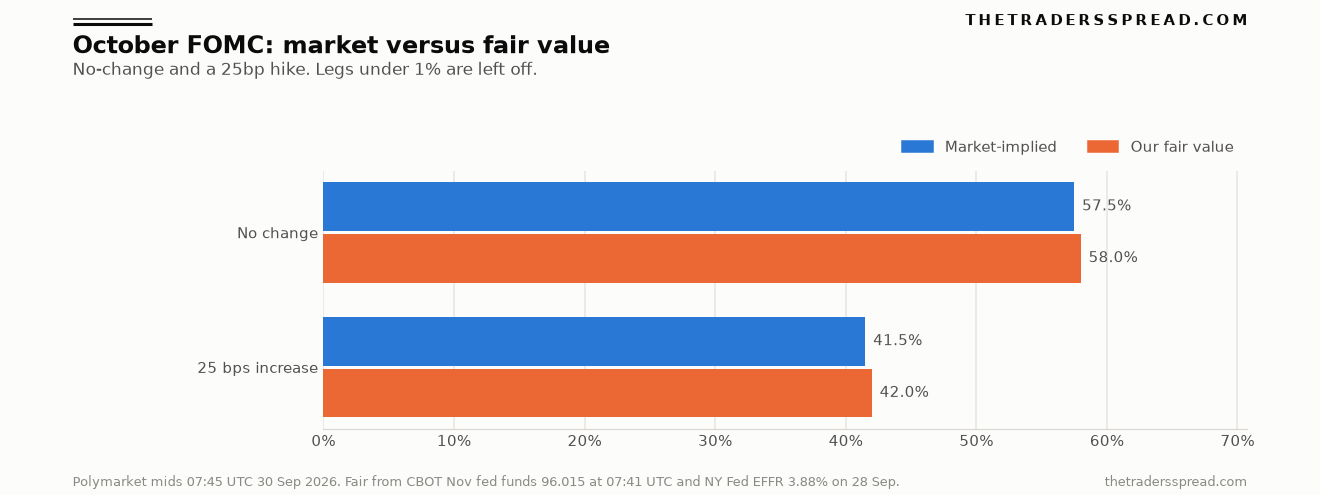
Two facts from this morning do not sit comfortably together. On the gamma book at 07:45 UTC on 30 September, the October no-change contract was the favorite at 57.5 cents, bid 57 and offered at 58. Fourteen days earlier the same committee's median projection put the federal funds rate at 4.1 percent at the end of 2026, a quarter point above the 3.75 to 4 percent range a 12-0 vote had just set.
Those prints are different objects. This piece is only the meeting on 27-28 October, the contract Polymarket lists as the October decision. It is not the September decision, already taken, and it is not the full-year cut count. Links to Polymarket are affiliate links, from which The Traders Spread may earn a commission at no cost to you. The quarter point in the dots has not been withdrawn. November fed funds futures, a month with no meeting, already price October as a 58 percent chance of no change, and the same curve puts about twice as much tightening on December as on this meeting.
Half a cent is not a gap. A 58 percent fair value is the offer on a 57/58 market.
Only this meeting
The contract pays on the change in the upper bound of the target range from the level in place before October. That bound is 4 percent. A 25 basis point increase takes it to 4.25, no change leaves it at 4, and a 25 basis point cut takes it to 3.75. The five brackets are a cut of 50 or more, a cut of 25, no change, a hike of 25, and a hike of 50 or more. A step off those brackets rounds up to the nearest 25.
The resolution source is the FOMC statement after the meeting on 27-28 October, listed on the Board's calendar. Gamma's end date is 29 October 2026 at 03:59 UTC, 11:59 p.m. Eastern on the 28th. The statement is due at 2:00 p.m. Eastern, the press conference at 2:30. If no statement is out by the end date, the rules resolve the market to no change.
September is already a result. On 16 September the Committee raised the target by a quarter point to 3.75 to 4 percent, 12 votes to zero. The new range, and a 3.90 percent rate on reserve balances, took effect on 17 September. October is not that hike.
Key facts
- No-change YES at 57.5 percent, bid 57 / ask 58, last trade 58. Gamma API, updated 07:45 UTC on 30 September 2026. The 07:34 update had this leg at 58.5, bid 58 / ask 59.
- A 25 basis point increase at 41.5 percent, bid 41 / ask 42, last trade 42. The two mids sum to 99 cents. Three tails add 1.35 cents. The five YES prices sum to 100.35 cents.
- Event volume $17.87 million, with $2.03 million in 24 hours. No-change volume $4.90 million. Liquidity about $2.22 million.
- Effective funds rate 3.88 percent on 28 September, target 3.75 to 4 percent, $110 billion of volume. New York Fed. It printed 3.88 every business day from 17 September. The 29 September rate was not in the feed at 07:41 UTC.
- Median end-2026 funds rate 4.1 percent, Summary of Economic Projections Table 1, 16 September, up from 3.8 in June. Participant range 3.9 to 4.4 percent.
- August CPI-U up 0.4 percent on the month and 3.4 percent on the year. Core up 0.3 and 2.4. Bureau of Labor Statistics, 11 September 2026. Gasoline rose 3.9 percent. Energy was up 16.3 percent on the year.
- July PCE up 0.2 percent and 3.7 percent on the year. Core PCE up 0.2 and 3.3. Bureau of Economic Analysis, 26 August 2026. August PCE was set for 8:30 a.m. Eastern on 30 September, after this fair value.
The hour the favorite flipped
It flipped in an hour on 29 September. The hour was not this morning.
Hourly CLOB prices for the 25 basis point increase, pulled on 30 September: 70.5 cents at 16:00 UTC on 28 September, the week's high. From 23:00 UTC that day through 14:00 UTC on the 29th the hike sat at 68.5 and no-change near 30.5. It was still 67.5 at 18:00 on the 29th. At 19:00 it was 47.5 and no-change was 50.5. By 22:00 the hike was 43.5 and no-change 55.5. The 68.5 cent print is in that file.
At 07:28 UTC on the 30th the CLOB still showed no-change at 57.5 and the hike at 42.5. Gamma at 07:34 printed 58.5 and 41.5. By 07:40 no-change was back at 57.5, bid 57 offered at 58, and the hike was still 41.5. November futures, on a scanner pull at 07:41 UTC, were still 96.015.
Governor Michael Barr does not explain that hour. He spoke at the Detroit Economic Club at 12:40 p.m. Eastern on 29 September, 16:40 UTC. "In my base case, further policy adjustments are likely to be needed to ensure inflation comes down to target in a timely fashion," Barr said, for himself, not for the Committee. The combined effect, he said, meant "we have been knocked off course" on the 2 percent goal. The hike contract was still 67.5 cents at 18:00 UTC. The break followed a speech that argued for more tightening.
August CPI was out on 11 September. July PCE was out on 26 August. August PCE was not due until the morning of the 30th. Nothing on the statistical calendar sits in the 19:00 UTC hour. The path is the fact. The cause is not established here.
From 70.5 cents on 28 September to 41.5 at 07:45 UTC on the 30th is 29 cents. The session change on November futures was about 0.021 price points, roughly two basis points of rate and about eight points of hike probability. The book moved several times further than the strip, and it moved onto the futures number. The strip did not print 68.
Where the 58 percent comes from
CME's FedWatch page returned HTTP 403 at 07:27 UTC on 30 September. The fair value below uses the same style of arithmetic, from a delayed CBOT quote and the New York Fed's effective rate. It is a probability read off a futures price. It is not a forecast of the vote, and it is not a suggestion to take a side.
November is the clean contract. No meeting falls in November, so every day of the month is after a decision taken on 28 October. In September the statement came out on the 16th and the new range was effective on the 17th. The same next-day convention puts an October change into effect on 29 October. November never sees the old rate.
Fed funds futures quote as 100 minus the month's average effective rate. A price of 96.015, the TradingView scanner print for CBOT November at 07:41 UTC on about 20,200 contracts, is an implied average of 3.985 percent. That is a delayed stream, not a CME settlement. The rate actually printing, with the range unchanged, is 3.88 percent, 13 basis points over the 3.75 percent floor and two basis points under the 3.90 percent rate on reserve balances.
A 25 basis point hike takes the range to 4 to 4.25 percent. Keep the 13 basis point gap and the effective rate goes to 4.13. The hike probability is (3.985 minus 3.88) divided by 0.25. The numerator is 0.105. The result is 0.42. The complement is 0.58. Forty-two percent for the hike. Fifty-eight percent for no change.
October futures are a thin check. They printed 96.11 on the same pull, about 1,900 contracts against November's 20,200. Twenty-eight of October's 31 days would still be at 3.88 if the range holds into the meeting, and three, the 29th through the 31st, would be at the new rate. An implied 3.89 percent solves for a post-meeting rate near 3.983, a hike probability of 41.3 percent and a hold of 58.7. The stored fair value is the November figure.
Swap the anchor from 3.88 to the 3.875 midpoint and the hold falls to 56 percent: (3.985 minus 3.875) divided by 0.25 is 0.44 for the hike. Futures settle on the effective rate, so 3.88 is the anchor and 58 is the stored fair value. One basis point of November rate is four points of probability. The half-point gap between a 57.5 cent mid and 58 percent is an eighth of a basis point of expected funds.
| October leg | YES mid | Bid / ask | Fair value |
|---|---|---|---|
| No change | 57.5% | 57 / 58 | 58% |
| 25 bps increase | 41.5% | 41 / 42 | 42% |
| 50 bps or more, increase | 0.65% | 0.6 / 0.7 | not separated |
| 25 bps decrease | 0.45% | 0.4 / 0.5 | not separated |
| 50 bps or more, decrease | 0.25% | 0.2 / 0.3 | not separated |
The tails trade. The 50 basis point cut did about $453,000 in the latest day, more than the hike leg's $407,000, and each tail is a two-sided book under one cent. The 10.5 basis point gap from 3.88 to 3.985 is used up by a 25 basis point hike at 42 percent, so a futures average has nothing left to assign to a cut or to a 50 basis point increase. Those three legs stay off the chart. On the live October book they are the residual.
The dot does not name a month
Table 1 on 16 September puts the median funds rate at 4.1 percent for the end of 2026 and the end of 2027, then 3.9 in 2028, 3.6 in 2029, and 3.2 in the longer run. June's median for 2026 was 3.8. On that path, 2 percent inflation is a 2029 event.
Figure 3.E is the count Table 1 hides. Against the chart's two-participant grid, September shows 2 participants in the 3.88 to 4.12 percent bin, 12 in 4.13 to 4.37, and 4 in 4.38 to 4.62. Eighteen in all. From the new 3.875 midpoint those bins are no further hike, one, and two. Sixteen of 18 have at least one more 2026 increase. Four have two. Two have none. The bins do not name October.
December can deliver the extra quarter point. The meeting is 8-9 December, with a new set of projections. October has none. A decision on 9 December is in force on the 10th: nine days on the post-October rate, 22 on the new one. December futures were 95.865 at 07:41 UTC, an implied 4.135 percent, about 3,400 contracts. Put 3.985 on the first nine days and the rate that solves the month is 4.196 percent. That step is 21.1 basis points, against October's 10.5.
Add the steps and the year-end gap is about 32 basis points, against one extra quarter point in the median dot. Weight the 2, 12 and 4 counts and the mean is 1.11 further hikes. The dots are from 16 September and the futures are from this morning. October is the smaller of the two meetings left on the curve.
Polling day, 3 November, sits between them. Control of the House is a separate contract, and it does not settle the funds rate. Chair Kevin Warsh, at Jackson Hole on 28 August, refused a date. "Here is my standard: We must be confident that underlying inflation is moving to our objective, clearly and at sufficient speed. Otherwise, we have work to do," he said in the symposium remarks, as Chairman. He also said he would be hard pressed to describe broad financial conditions as restrictive. The September hike was that work. The curve says the priced tightening is larger in December.
Inflation is not one number
Core CPI at 2.4 percent over the year to August is the quiet part of the wrong index. Headline CPI was 3.4 percent. Energy rose 2.1 percent in August and is up 16.3 percent on the year. Gasoline's 3.9 percent jump did more than a third of the monthly headline. The target is PCE. July PCE was 3.7 percent on the year and core PCE 3.3. The 2026 SEP medians, 3.7 and 3.4, sit on those rates.
The 16 September statement said: "Inflation remains elevated. Today's policy action will support a timelier return to the Committee's 2 percent goal. The Committee will deliver price stability." Uncertainty, it added, remains elevated owing in part to geopolitical developments. Shipping risk is a different contract. The desk's read on Strait of Hormuz transits does not settle October.
Related2028 Presidential Winner: Vance 20.5 Cents, Fair Lower
August PCE is the release this fair value does not contain. The BEA set it for 8:30 a.m. Eastern on 30 September, 12:30 UTC, hours after the futures quote used here. By publication the print will exist. The 58 percent will not have been revised for it. One basis point of rate on November futures moves the fair value four points. A print the futures ignore does not replace 58.
What would push 58 percent out of line
The comparison stored on this piece is in line. No-change at 57.5 percent is half a point under a 58 percent fair value, and 58 is the offer. The hike at 41.5 is half a point under 42. Neither gap clears a one-cent spread, and neither clears the two points between an anchor at the realised 3.88 percent and an anchor at the 3.875 midpoint.
The fair value leaves that band when November futures move. Four probability points per basis point of rate means half a basis point on November is already two points of the hold. A 27-cent move like 29 September's would be about seven basis points of November rate if the book and the strip were one object. They were not. The book travelled. If it runs again and the futures follow, 58 percent should be replaced. If the strip stays put, the fair value does not chase the book.
Minutes are due on 7 October and the Beige Book on 14 October. September employment and September CPI fall in that window on their usual schedules. This piece does not invent a BLS clock time. None of those releases makes 57.5 cents cheap or rich against 58 until November futures print a different rate.
Two things would change the mapping rather than the level. If funds print 3.83 or 3.93 while the range is still 3.75 to 4, the 13 basis point gap over the floor is gone and the 58 percent moves with the anchor. That gap has held since 17 September. A 50 basis point step at one meeting would also break the two-outcome frame. The 2026 dots run from 3.9 to 4.4 percent, the current midpoint or two quarter points, not a half point in October. Until November futures leave the span from 3.88 to 4.13, the tails have no evidence in the rate.
On that same October contract, price and fair value are the same number for a decision this morning. October has landed, narrowly, on no change. December still carries the larger share of the hike the median dot described on 16 September. Holding the two meetings apart is the call.
Questions the contract actually answers
Does this market include the September hike?
No. September was a quarter-point increase to 3.75 to 4 percent on 16 September, effective the next day. October measures the change in the upper bound from the level already in place. That upper bound is 4 percent. Counting September again double-counts a vote that has printed.
Is no change in October the same as no further hike in 2026?
No. The Committee still meets on 8-9 December, and that meeting includes new projections. Futures put about 21 basis points of expected tightening into December and about 10.5 into October. The year-count contract asks how many cuts arrive across the whole year, a third question.
Why 58 percent, and not the dot plot?
The dots do not name a month. A 4.1 percent median is one more quarter point by December, at whichever meeting delivers it. November futures contain only the October decision, so a 10.5 basis point gap divided by a 25 basis point step is 42 and 58. The histogram is context for the year. It is not an input to that division.
What if the move is not 25 basis points?
Rules round a non-standard step up to the nearest 25. The cut legs and the 50 basis point hike are priced between 0.25 and 0.65 percent. The two-outcome fair value gives them nothing, because the futures gap is used up by the 25 basis point hike. A real 50 basis point move would make the frame wrong. The SEP range for end-2026, 3.9 to 4.4 percent, does not contain one.
When does the contract resolve?
When the 28 October statement is out. Gamma's end date is 29 October at 03:59 UTC, still the statement day in Eastern time, and the press conference is set for 2:30 p.m. If no statement appears by that end date, the written fallback is no change.
Is 57.5 percent above the fair value or below it?
Half a point under 58 percent, with 58 sitting on the offer of a 57 to 58 market. That is in line. The hike leg, 41.5 against 42, is the same distance seen from the other side. An anchor at the 3.875 midpoint instead of the realised 3.88 percent effective rate would put the hold at 56. This article uses 3.88 because that is the rate the futures settle on.
This is analysis of a public contract and of published rates, not a recommendation to take either side. The book moved 27 cents in a day this week, and a cent either side of 58, while the fair value was being calculated. The resolution text decides the payout. Capital put to work on that basis can be lost.