

134.5 cents. That is the sum of the displayed YES prices on Polymarket's 2028 Republican nominee board, read from the Gamma API at 09:14 UTC on 3 October 2026.
Most of the surplus is not a price anyone can trade. A second Robert F. Kennedy Jr. row is marked at 49 cents, with a 98-cent ask, no bid, no last trade and $15 of liquidity. The Kennedy contract that has actually traded, about $16.8 million of lifetime volume and about $1.76 million of depth, is marked at 0.25 cents. Delete the dead row and the displayed prices sum to 85.5 cents.
J.D. Vance leads the contracts that have a bid. His YES price is 50.25 cents. Our fair value is 44 percent, so the contract sits above fair. The board is the Republican presidential nominee 2028 event. Links to Polymarket are affiliate links, from which The Traders Spread may earn a commission at no cost to you.
The ghost row is the whole apparent overround.
- Displayed YES prices sum to 134.5 cents, or 85.5 cents without the $15 Kennedy duplicate. Gamma API, 3 October 2026, 09:14 UTC.
- Bids on 32 names sum to 83.2 cents, and the asks on those names sum to 86.7 cents. Same pull.
- J.D. Vance is at 50.25 cents, with about $15.7 million of lifetime volume and about $437 on the day. Same pull.
- The event shows about $709.3 million of lifetime volume, about $396,324 on the day, and about $52.2 million of liquidity. Same pull.
- Harris/HarrisX, 26-28 September 2026: Vance 39 percent of Republicans. Echelon, 17-21 September, n=424: Vance 38 percent.
- Our fair value for Vance is 44 percent. The contract sits above that fair value. Judgment dated 3 October 2026.
Thirty-two names show a bid above zero. Those bids sum to 83.2 cents, and the asks on the same thirty-two sum to 86.7 cents. Lifting every one of those asks would cost about 87 cents and still would not cover every way the nomination can resolve. The missing cents are a name with no bid, or a person not listed yet. That is a hole under a dollar, not a book you can sweep for 134.5 cents, and it is not an arbitrage.
Gamma returns 128 rows. Eighty-five have no YES price. They are unused slots, placeholder titles from Person U onward, plus a row called Other, each with a zero bid and a one-dollar ask. Add those asks and the total becomes nonsense. The event is flagged negRisk, Polymarket's marker for outcomes meant to be mutually exclusive. A mutually exclusive set printing 134.5 cents of YES is a bad row in the export before it is a story about the party.
What the contract pays
The rules on the event, and on the Vance leg, are short. The market resolves Yes if the named person wins and accepts the 2028 Republican nomination for president. Otherwise it resolves No. The resolution source is a consensus of official Republican Party sources. One further sentence does real work: any replacement of the Republican nominee before election day does not change the resolution.
If the party nominates someone and later swaps them, the market stays with the person who won and accepted. It does not follow the November ballot. Eligibility to serve is not in the rules. The Twenty-second Amendment limits who can be elected president. It is not a line in this resolution text.
Gamma's endDate is 2028-11-08T04:59:00Z. That is 11:59 p.m. Eastern Standard Time on 7 November 2028, election day, because daylight saving time ends on 5 November that year. The rules do not state a convention date, and we will not invent one. The endDate keeps the market open through the election. It does not redefine the question as whoever is left on the ballot after a swap.
Twenty-five months sit between this pull and that timestamp. The nearer date is the US midterm election on 3 November 2026, thirty-one days out. A bad night for the president's party is a standard way an early succession book gets rewritten. Our notes on the Senate-control book and the House-control market are older than this pull. Their prices are not today's. The links are the calendar.
Six legs, and a fair value next to each
The chart covers the six legs this piece judges. Bars are last trades from the 09:14 UTC pull. Cruz is the awkward print: last trade 2.4 cents, against a 2.55-cent screen price, a 2.5 cent bid and a 2.6 cent ask. The other five last trades sit on the screen price or a tenth beside it.
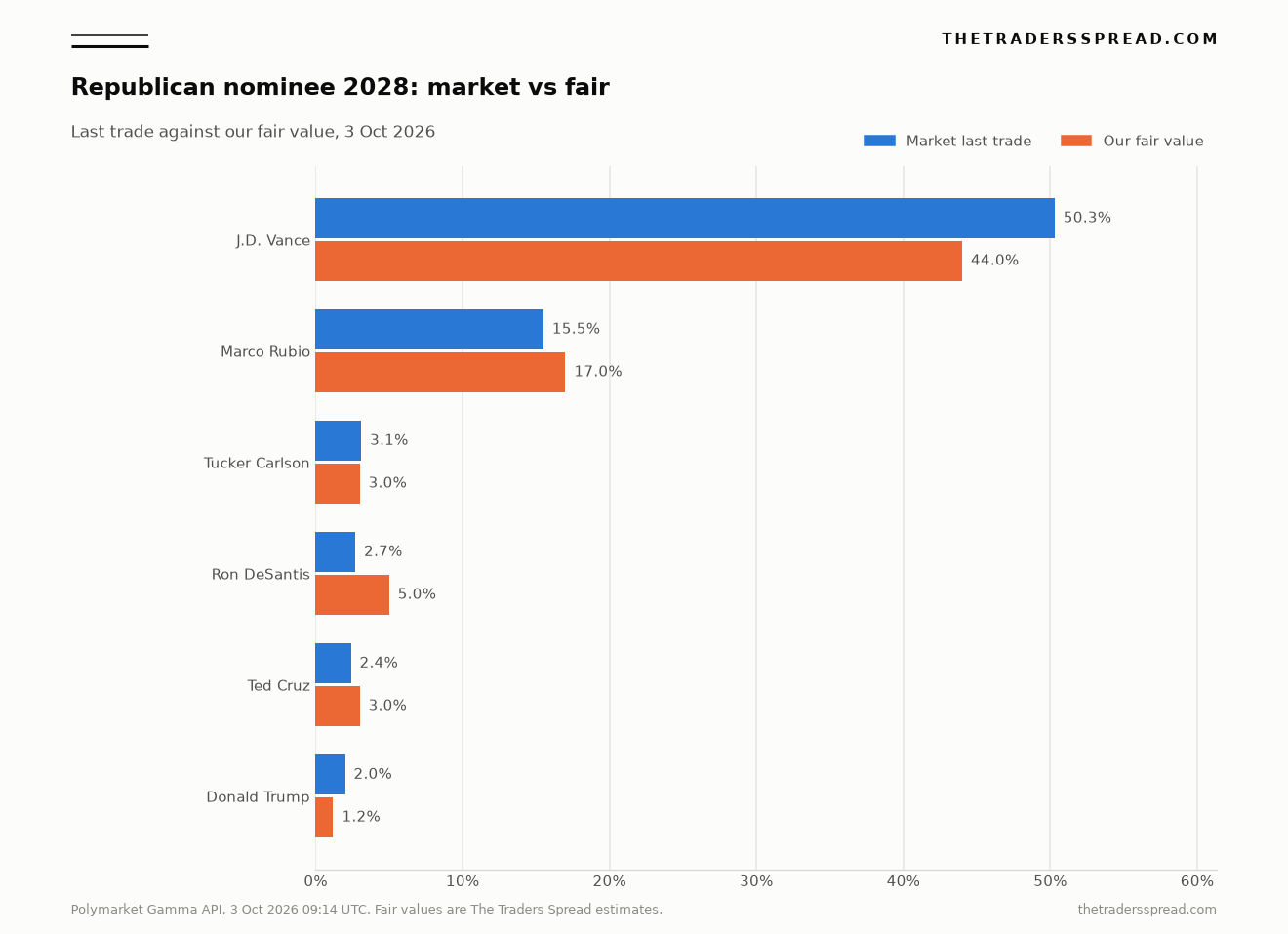
Add the screen prices, not the last trades. Vance 50.25, Rubio 15.45, Carlson 3.15, DeSantis 2.65, Cruz 2.55 and Trump 1.95 come to 76.0 cents. Our fairs on the same six are 44, 17, 3, 5, 3 and 1.2, or 73.2 cents. The rest of the priced book, plus the hole up to a dollar, is about 24 cents. Ours is about 27. The gap is the mix. Too much of the 76 sits on Vance.
| Leg | YES price | Bid / ask | Last | Our fair |
|---|---|---|---|---|
| J.D. Vance | 50.25% | 50.2 / 50.3 | 50.3% | 44% |
| Marco Rubio | 15.45% | 15.4 / 15.5 | 15.5% | 17% |
| Tucker Carlson | 3.15% | 3.1 / 3.2 | 3.1% | 3% |
| Ron DeSantis | 2.65% | 2.6 / 2.7 | 2.7% | 5% |
| Ted Cruz | 2.55% | 2.5 / 2.6 | 2.4% | 3% |
| Donald Trump | 1.95% | 1.9 / 2.0 | 2.0% | 1.2% |
The table is the same Gamma pull. Fair values are ours. Vance is the leg we store: the price is above fair. The Vance contract shows about $15.7 million of lifetime volume, about $437 on the day, and about $394,000 of liquidity. The spread is a tenth of a cent.
Vance is down 2.1 cents on the month and 0.8 on the week. Rubio is down 2.0 cents on the month, with about $10.7 million of lifetime volume and about $359,000 of liquidity. Cruz is the riser, plus 1.2 cents on the month, and he is still 2.55 cents, with about $760,000 of liquidity. Carlson did about $10,900 on the day against Vance's $437.
September ballots are a different object
A primary poll asks Republicans who they would pick if the vote were today. The contract asks who will win and accept the nomination in 2028. The numbers should rhyme. In late September they rhymed at the top and split underneath.
Harris Poll and HarrisX, 26 to 28 September 2026, 2,200 registered voters, asked Republicans whom they favour as the next Republican candidate. Vance 39 percent, marked down 5 from the prior reading. Trump Jr. 24, up 6. Rubio 17, down 4. Kennedy 9, Haley 5, Carlson 5, someone else 3. No unsure line on that slide. Source: the September 2026 key results.
Echelon Insights, 17 to 21 September 2026, surveyed 1,002 likely voters, margin plus or minus 3.6 on the full sample. Among Republicans and leaners, n=424, the leading shares on a primary held today were Vance 38, Rubio 20 and DeSantis 8, with Trump Jr. at 6, Cruz at 3, Carlson at 2 and unsure at 10. The omnibus topline is the source. The subgroup is smaller than 1,002, so 38 against 35 is not its own finding.
McLaughlin & Associates, 16 to 22 September 2026, 1,000 general-election voters. Republican primary list, n=430, leading lines: Vance 35, Rubio 15, Trump Jr. 14, DeSantis 6, Cruz 3, undecided 12, among other names. The same deck shows Vance at 35 in June, 35 in July, 32 in August and 35 in September. The September national release is the source.
Three questionnaires, one cluster for the leader: 35, 38 and 39. Rubio is at 15, 17 and 20. DeSantis, where listed, is at 6 and 8. Cruz is at 3 and 3. Carlson is at 5 on the Harris question and 2 on the Echelon ballot. We put his fair value at 3 percent, next to a 3.1-cent last trade. That leg is in line.
Trump Jr. is the name we will not pin. Harris has him at 24, McLaughlin at 14, Echelon at 6, and the contract at 1.55 cents, bid 1.5, ask 1.6, last trade 1.7. About $9.7 million has traded the leg, with about $600,000 of liquidity, so the quote is not empty. The ballots disagree with each other by more than a model should pretend to settle. He stays in the residual.
A high-30s plurality in a split field is worth more as a nomination chance than the raw share. The sitting vice president of a term-limited president gets that premium. He does not get a jump from 39, the highest of these three ballots, to a 50-cent contract. We stop at 44. Rubio's prints sit in the mid-to-high teens, so 17 is our fair, close to 15.45. DeSantis at 6 and 8 still has to get past the leader, so his fair value is 5, above the 2.65-cent contract. Cruz at 3 percent of two ballots is a 3 percent fair value.
What was said, and when
On 5 August 2025, a reporter asked President Donald Trump whether Vance was the heir apparent. CBS News reported the answer as "most likely," and quoted the longer line: "It's too early, obviously, to talk about it. But certainly he's doing a great job, and he would be probably favored at this point." He also described Secretary of State Marco Rubio as somebody who might "get together with JD in some form." The account is CBS News, that day.
The same report carried the two sentences that still fence the field, because this pull contains no later declaration. Rubio had told Fox News the previous month that Vance "would be a great nominee if he decides he wants to do that," and that he would be satisfied if secretary of state were "the apex of my career." Vance, in April 2025, told Fox and Friends: "When we get to that point, I'll talk to the president. We'll figure out what we want to do."
"Probably favored," with "too early" still attached, is a 2025 remark. Fourteen months on, the contract is still about 50 cents, and the September ballots still have the vice president under 40.
Trump's own leg is 1.95 cents, bid 1.9, ask 2.0, last trade 2.0. The Twenty-second Amendment says no person shall be elected president more than twice. He was elected in 2016 and in 2024. This contract pays on the nomination, which the amendment does not mention. We put that thinner path at 1.2 percent. The market already treats a third election as a tail.
The other board
Winning the White House is a different contract, pulled at 09:15 UTC the same morning. Vance was at 20.65 cents, bid 20.6 and ask 20.7, with about $1,875 of day volume. Rubio was at 9.05, Newsom at 7.85, Ossoff at 10.85, Ocasio-Cortez at 13.15 and Trump at 1.15. Presidential Election Winner 2028 showed about $712 million of lifetime volume. It pays on the election, from the Associated Press, Fox News and NBC, with an inauguration fallback. That is not this rule.
Divide 20.65 by 50.25 and the raw ratio is about 41 percent. Rubio's 9.05 divided by 15.45 is about 59 percent. That is a cross-book reading, not a cleaned conditional, and it ignores the rest of each book. On these raw prices a Rubio nomination converts into a presidency more readily than a Vance nomination.
Our 2 September note on the Democratic nominee book is a separate market, and this piece does not reopen it. Ocasio-Cortez's 13.15 cents is a print from this morning's winner pull, nothing more.
Volume is the wrong kind of loud
The nomination event shows about $709.3 million of lifetime volume, about $396,324 on the day, and about $52.2 million of liquidity. Those event totals equal the sum of the legs in this pull, so the partition is real. It is also easy to misread.
About $183,255 of the day's volume printed on Elise Stefanik, YES price 0.15 cents, and about $166,667 printed on Rand Paul, at 0.25 cents. Together that is about 88 percent of the day's $396,324. Vance's day was about $437. Sort by volume and the nomination looks like a fight between two people priced under half a cent.
Gamma sets holdingRewardsEnabled on these markets. Some of that penny-name turnover can be inventory earning a rebate, not a view of 2028. The pull has no rebate rate, and we will not invent one. Stefanik's row shows a rewardsMaxSpread of 2.5. Paul's shows zero there and still did about $167,000.
RelatedProposal vs Dispute: How Polymarket Resolution Works
Lifetime volume makes the same mistake at a larger scale. Byron Donalds shows about $44.4 million of it at 0.15 cents. Tom Brady's leg shows about $33.0 million at 0.05 cents. Kim Kardashian's shows about $2.29 million of liquidity, no bid, and a 0.1-cent price. Vance has less lifetime volume than Donalds, and a thin slice of the event's $52 million of depth. Sort by liquidity and the board changes. Skip the bid and both sorts fail.
Where 44 percent comes from
The cluster runs from 35 to 39 percent. Forty-four is a premium over that cluster, not a copy of it, and it is not a number in the 60s. The midterms are a month away, and the remarks we cite are from 2025. About six cents of risk is still inside the 50.25-cent price.
Six cents is not a wide disagreement. The error band on a nomination this far out is wider than the tenth-of-a-cent spread. The centre is still 44 against a market at 50.25, which is above fair, and it is not an instruction to take either side.
The Rubio contract is the other half of the same judgment. At 15.45 cents against a 17 percent fair value, it is close, and we do not store a separate reading on it. If he declares and the next national ballot puts him level with Vance, his fair value rises and Vance's falls. If he repeats the 2025 line in categorical form after the midterms, the 17 comes down.
What would move the fair value
A national survey after 3 November, built like the Echelon or McLaughlin ballot, with Vance at 50 percent or more of Republican primary voters, would pull 44 toward the contract. So would an on-the-record endorsement that drops the "too early" half of the August 2025 sentence. Neither is in hand this morning.
The fair value moves down if a rival opens a campaign and a comparable poll shows the leader under 30, or if Vance says he will not run. It does not move because someone deletes the 49-cent Kennedy row. That row was never a probability. Cleaning the export changes the sum on a screen. It does not change the chance that the vice president wins and accepts the nomination.
Forty-four percent is an average across jumps, including paths toward 15 and paths toward 80. It is not a schedule on which the contract eases from 50 to 44 and rests.
Questions the board raises
What does a YES on this market actually pay?
It pays if that named person wins and accepts the 2028 Republican nomination for president. The rules name a consensus of official Republican Party sources as the resolution. If the party later replaces its nominee before election day, the market does not follow the replacement. The Gamma endDate is 04:59 UTC on 8 November 2028. The nomination will be known earlier. The endDate is not the definition of the question.
Why do the YES prices add up to more than a dollar?
They add up to 134.5 cents only if you keep a Kennedy row that has no bid, no trades and $15 of liquidity. The Kennedy leg with real volume is at 0.25 cents. Without the dead row the displayed prices sum to 85.5 cents, and the live bids sum to 83.2. Eighty-five further API rows have no price. They are placeholders, not a secret field of candidates.
Is Vance's price a coin flip?
The screen says 50.25 cents, so YES costs about half a dollar, inside a one-tenth spread. That is a tight tradable price. It is not a finding that a fair coin matches the nomination. Our fair value is 44 percent. The month's change on the leg is minus 2.1 cents, which is a drift, not a collapse and not a confirmation.
Why are the polls so far from 50?
Because a ballot is not a win probability. Harris, Echelon and McLaughlin, all in the field between 16 and 28 September, put Vance at 39, 38 and 35 percent of Republicans. Rubio was at 17, 20 and 15. Trump Jr. was at 24, 6 and 14 in those same three instruments. The contract's 1.55 cents on Trump Jr. shows how far a price can sit from a hypothetical ballot.
What would change the 44 percent?
A post-midterm Republican primary poll with Vance at or above 50 percent, or a public Trump endorsement that is not hedged as "too early," would lift it. A rival taking the lead, or a refusal by Vance to run, would cut it. Removing the dead 49-cent row would do neither. The fair value is a judgment about the nomination, not a correction to a bad export.
Does the Constitution zero out Donald Trump's leg?
It zeros out a third election, not this payout. The Twenty-second Amendment bars being elected president more than twice, and Trump was elected in 2016 and 2024. This contract pays on the nomination. The leg was 1.95 cents on 3 October, with a last trade at 2 cents. Our fair value is 1.2 percent. The market already treats the path as a tail.
This is analysis, not a recommendation. Fair values are an editorial judgment about how the prices sit, not a forecast that contracts will converge to them and not an instruction to take either side. Prediction-market contracts can expire at zero. Capital is at risk.