

I have read the Oklahoma data-center moratorium board the way I read any contract that is only a few days old: the rules, then the legislature's file, then the price. Polymarket listed the event on 29 September 2026. At the gamma-api update of 07:25 UTC on 2 October, the December 2027 leg, the contract this note centers, showed a Yes price of 0.255, bid 0.25, ask 0.26, last trade 0.25. About $213,529 had traded on that leg and about $934,757 was resting in the book. New boards tempt a fast opinion, and I have learned not to give one until the bill pages are open. These pages do not hand me a probability that sits cleanly off that print. On this desk, that order is the method. I am not steering anyone toward a side.
The mistake is to hear "moratorium" and import every headline from this spring. The Oklahoma data-center moratorium event pays only if the state enacts a statewide halt, by statute or constitutional provision, before a named deadline. Links to Polymarket are affiliate links, from which The Traders Spread may earn a commission at no cost to you. A city ordinance does not count. A tax-incentive suspension, standing alone, does not count. House Bill 2992 and Senate Bill 259, both signed in May, do not count. Senate Bill 1488, the 2026 measure that used the word moratorium and a 100-megawatt data-center class, never received a committee report or a vote. That kills a vehicle. It does not measure 2027. Our fair value on the December 2027 leg is the same 25.5 percent the screen shows.
One calendar fact does the rest. The 2027 regular session's lawmaking window ends in May. The June leg already contains that session. December, 7.5 points higher, is the June price plus a second-half premium.
Key facts
- Center leg, "by 31 December 2027": Yes price 0.255, bid 0.25, ask 0.26, last trade 0.25. Volume about $213,529. Liquidity about $934,757. Gamma-api update 07:25 UTC, 2 October 2026. One-day price change: minus 0.09.
- Same timestamp, other legs: 31 December 2026 at 6.5 percent, 30 June 2027 at 18.0 percent, 31 December 2028 at 36.0 percent. Fair value on each leg equals that Yes price.
- Event listed 29 September 2026. Volume about $461,963, about $421,076 of it in 24 hours. Liquidity about $2.85 million. Open interest about $81,010.
- SB 1488, Senator Sacchieri: introduced 9 January 2026 as a moratorium until 1 November 2029 on data centers designed for 100 megawatts or more. First reading 2 February. No committee report and no vote. Session 2600.
- HB 2992, the Data Center Customer Ratepayer Protection Act, approved by the governor 11 May 2026, effective 1 July. Conference votes on 5 May: House 84-0, Senate 48-0. A cost-and-notice statute, not a construction halt.
- SB 259, the Groundwater Modernization Act, approved 20 May 2026. House 88-1, Senate 38-10. Effective 1 November. A groundwater permit requires low-consumptive cooling: permission with a condition, not a ban.
- Session menu on 2 October 2026: codes 2600 (2026 regular) and 2700 (2027 regular). No 2026 special session is listed.
What this contract counts as enactment
The resolution text is narrower than the political argument. A leg resolves Yes only if Oklahoma enacts a law, or a constitutional provision, establishing a statewide moratorium on new data centers between the market's creation and 11:59 p.m. Eastern Time on that leg's date. Otherwise it resolves No.
The halt has to prohibit or suspend, statewide, the approval, permitting, construction, grid interconnection, or operation of all new data centers, or of a subset that includes every new one with interconnection capacity above 100 megawatts, requested or nameplate. Exemptions for deals already signed do not spoil it, if the default is a ban rather than permission with conditions. A pause that lifts only when an objective condition is met can still qualify. A statute that merely authorizes the governor or an agency to impose a halt does not. The provision has to be mandatory on its face.
Local moratoriums are out. So are executive orders, agency orders, and a tax-incentive cut standing alone. Passage, even by both chambers, is not enactment, and neither is a governor's plan to sign. Enactment means signature, a veto override, a bill becoming law without a signature, or a statewide election. The date that counts is enactment, not the later effective date. A repeal or a court loss afterward does not unwind it.
Same habit as on the Merz chancellor contract, where the removal rule in the Basic Law is the document and the coalition headlines are not. Here the documents are the resolution text and the bill history. "Oklahoma is fighting data centers" will mis-score every leg.
I will not call the introduced text an automatic Yes. Section A covers a facility "designed to have a load of one hundred (100) megawatts or more" for storing, managing, and processing digital data. The contract's class is interconnection capacity above 100 megawatts. Close, not the same words, and never enacted. It is still the only 2026 statewide text that pairs "moratorium" with that class.
The bill that used the word, and the two that became law
SB 1488 is a measure of the 2nd Session of the 60th Legislature. The introduced PDF, request 2621, is stamped 9 January 2026 and carried by Senator Sacchieri. Section B is one sentence: "There is hereby established a moratorium on the building or establishing of data centers in this state until November 1, 2029." Before that date the Corporation Commission would have studied water, rates, nearby property values, and siting, then reported to the Legislature.
The history page stops early, which is the point. First reading, Senate journal page 63, 2 February 2026, opening day. Second reading the next day to Rules, then Appropriations, journal page 236. On 14 April, journal page 843, Representative Gann is entered as principal House author. No floor amendments, no committee amendments, no votes. The only version on the page is the introduced text.
Senator Kendal Sacchieri, Republican of Blanchard, said why she filed it. Steve Metzer of the Tulsa World, carried by Government Technology on 23 January 2026, quoted her release: "As data centers continue to grow rapidly across Oklahoma, we are confronting serious unknowns about how these large facilities affect our communities, our utilities, and our natural resources. This bill stems from those unknowns." She also said, "The goal is not to halt progress, but to ensure that progress does not come at the expense of Oklahomans' quality of life or their utility costs."
What passed was a different policy. House Bill 2992, the Data Center Customer Ratepayer Protection Act of 2026, was authored by Representative Brad Boles, Republican of Marlow, with Senator Grant Green, Republican of Wellston, as principal Senate author. Fourth reading on 5 May: the measure and the emergency passed 84-0. The Senate adopted the conference report the same day, 48-0. Approved 11 May 2026.
The Corporation Commission says it regulates large-load customers under that act, at 17 O.S. sections 900 through 906. Its page defines the class as new data centers, new cryptocurrency mining, and new artificial-intelligence computing facilities that contract to add 75 megawatts or greater, per facility or in aggregate behind one interconnection, after 1 July 2026. Outside an industrial park or a municipality, the purchaser has 60 days to notify the commission, the county commissioners, and adjoining owners by certified mail. Nothing in that page suspends construction or interconnection. Seventy-five megawatts is a billing class, not the contract's above-100 halt.
At the 6 August ceremonial signing, Boles drew that line in the House release. "With these two bills now law, Oklahoma families and businesses will not be forced to subsidize the infrastructure needs of massive data centers and other large-scale energy users," he said. Green, in the same release, said the framework makes those developments "pay their own way rather than shifting costs onto Oklahoma families, farmers, ranchers and small businesses." The ceremony was not the enactment. The release itself gives the May approval dates.
Senate Bill 259, the Groundwater Modernization Act, was carried by Senator Brent Howard, Republican of Altus, and Representative Carl Newton, Republican of Cherokee. The House passed it 88-1 on 6 May. The Senate, on the amended bill, passed it 38-10 on 14 May. The governor approved it on 20 May 2026, recorded at Senate journal page 1168 on 29 May. It takes effect 1 November and requires low-consumptive cooling, a closed loop or dielectric immersion, before a data center can get a groundwater permit.
Newton's line in that release is the tell: "For those communities that choose to allow data centers, this bill will ensure that water is conserved, and evaporation is limited." The enacted policy assumes permission. The contract wants the opposite, prohibited by default rather than permitted subject to conditions. A cooling standard on a permit fails the test even if the water policy is sensible.
Skim the effective date and you will mis-time it. The contract uses enactment. SB 259 was enacted on 20 May, before every deadline here. Had the text qualified, the board would already be settled. It does not qualify, so 1 November changes nothing.
Governor Kevin Stitt, in the same House release, put a caption on the pair. "In Oklahoma, we welcome the free market to drive prosperity, and we have also set clear guardrails for large load customers to solve for their own power needs." Guardrails, and an open door. I will not turn the sentence into a probability. The moratorium draft stayed in Appropriations.
Four dates, and where the regular session sits
Article 5, Section 26, of the Senate's compiled constitution sets regular session at noon on the first Monday in February, with sine die not later than 5 p.m. on the last Friday in May. The note on that section runs through State Question 620, adopted 14 March 1989. In an odd year the chambers also meet on the first Tuesday after the first Monday in January, only to organize and to canvass state officers under Article 6, Section 5, then recess until February.
Prices below are the gamma print at 07:25 UTC on 2 October 2026. Fair value is drawn on top of that print, and it matches.
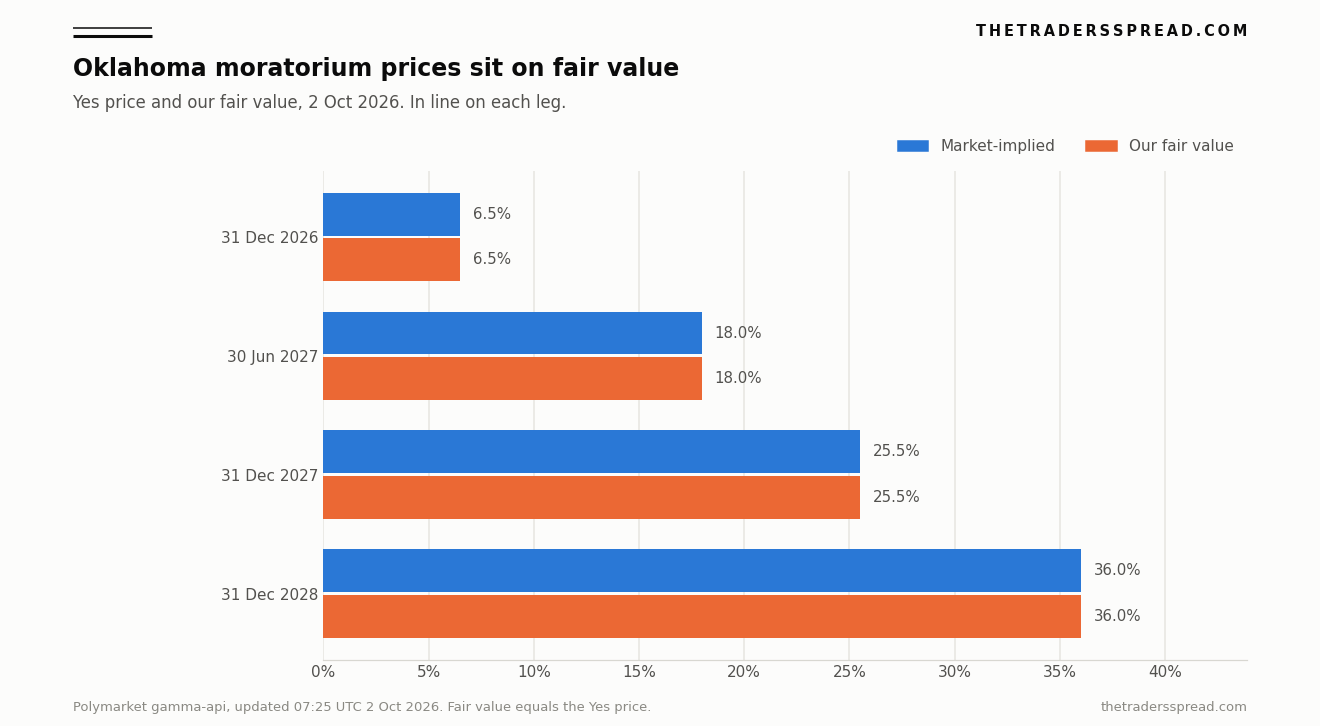
| Deadline | Yes price | Bid / ask | Last | Volume | Liquidity | Fair value |
|---|---|---|---|---|---|---|
| 31 December 2026 | 6.5% | 0.06 / 0.07 | 0.06 | $26,141 | $741,624 | 6.5% |
| 30 June 2027 | 18.0% | 0.17 / 0.19 | 0.18 | $174,616 | $891,239 | 18.0% |
| 31 December 2027 | 25.5% | 0.25 / 0.26 | 0.25 | $213,529 | $934,757 | 25.5% |
| 31 December 2028 | 36.0% | 0.35 / 0.37 | 0.37 | $47,677 | $289,213 | 36.0% |
Polymarket gamma-api, markets updated 07:25 UTC on 2 October 2026. Fair value equals the displayed Yes price. Volume and liquidity are volumeNum and liquidityNum, rounded to the dollar. The live book is the source for the prices. The legislature's pages are the source for refusing to move them.
December 2026, at 6.5 percent, is a residual. Regular session opened Monday 2 February and could not run past 5 p.m. Friday 29 May, the journal day that records SB 259's approval. Section 27 lets the governor call a special session. Section 27A lets two-thirds of each house do it, for purposes written into the call. The 2 October session menu has 2026 regular and 2027 regular, and no 2026 special. I am not marking 6.5 percent rich or cheap.
June 2027, at 18 percent, is the leg that contains a full regular session. Organizational Tuesday in 2027 is 5 January, and the constitution parks lawmaking until noon on Monday 1 February. Sine die is not later than 5 p.m. Friday 28 May. Both dates fall before 30 June. A qualifying moratorium enacted in that session would resolve June to Yes and, because these are nested "by this date" questions, every later leg as well.
About $172,395 of June's roughly $174,616 lifetime volume sits in the 24-hour field. Gamma's one-day change is minus 0.065 there and minus 0.09 on December 2027. I will not invent the headline behind those marks.
December 2027 is the center of this note, and 25.5 minus 18.0 is 7.5 points. The books are separate, so the gap is not a formal conditional probability. The questions are nested: "by December" includes "by June." The gap is what the board charges for an enactment that misses 30 June and still arrives by 31 December. After May, the remaining tools are a special session under Sections 27 or 27A, or a statewide election day in that half of the year. There is no autumn regular session. December does not hide an extra regular session.
December 2028, at 36 percent, adds another February-to-May regular session under the same rule, plus the off-session paths in 2028. Gamma created that leg at 15:50 UTC on 1 October. Lifetime volume and 24-hour volume match, about $47,677. The last trade, 0.37, sits a penny over the 0.36 display, inside a 0.35 to 0.37 quote. I would not mine a one-day-old leg for a gap. Fair value stays on the display.
Depth is why the screen gets respect. About $935,000 rests on the center leg, against about $2.85 million on the event and open interest near $81,000. This is not a thin market. On a thin book a desk may ignore the print. Here a lot of size agreed quickly, and the record still does not supply a measured number on the other side.
RelatedA US recession by 31 December is priced at 6.5 cents
In line, until the file changes
Fair value on the December 2027 leg is 0.255, the displayed Yes price at 07:25 UTC on 2 October 2026. The other legs sit on their own prints: 0.065, 0.18, and 0.36. The call is in line. On the Champions League board there was a gap worth defending, a traded price against a lower figure from the sporting record. On the October Federal Reserve contract the price stayed with the futures, because a split would have been a story rather than a number. Oklahoma belongs with the second.
Calling December 2027 rich is easy and not earned. SB 1488 never left committee, the signed bills do what the contract excludes, and no 2026 special session is on the menu. That explains why the price is not 70 percent. It does not choose between 15, 25, and 35. A miss on SB 1 in session 2700 is not a prefile survey.
Calling it cheap is not earned either. Sacchieri filed in January, Gann's name went on in April, and a ratepayer bill passed with almost no dissent. That is attention. A regular session opens on 1 February 2027, inside both June and December. Attention is not a probability.
What moves fair value off the screen is a change in the file.
A special-session call that names a statewide moratorium would turn the December 2026 residual, and the 2027 legs, into live vehicles. I would read the text before deciding which side of the price the fact sits on. A committee report on a 2027 moratorium bill would hit the June leg directly. Floor passage would still not be enactment, so I would not move fair value on the vote alone.
Adjournment with no vehicle would cut the other way. If 2027 reaches sine die with no mandatory statewide moratorium even introduced, June becomes a residual like today's 6.5 percent leg, and 25.5 percent would look rich. That file does not exist yet.
Between those files, the honest line is the traded one. The December 2027 contract at 25.5 percent, inside a one-cent market, is where this desk leaves it.
Questions the legs actually answer
Does a city or county pause resolve any leg to Yes?
No. The resolution text excludes a moratorium adopted by a local government, or limited to part of the state. A bare suspension of tax incentives or development awards is out as well. A city council vote is a different document from the one this board pays on. It is not an input to the fair value here.
Did HB 2992 or SB 259 already settle the board?
No. HB 2992, approved 11 May 2026 and effective 1 July, is the ratepayer act at 17 O.S. sections 900 through 906: a 75-megawatt large-load class, neighbor notice, and paperwork. SB 259, approved 20 May and effective 1 November, conditions a groundwater permit on low-consumptive cooling. Newton framed it for communities that choose to allow data centers. Permission with a condition is the shape the contract excludes.
Why is June 2027 the session, and December something else?
Article 5, Section 26, puts regular-session lawmaking between noon on the first Monday in February and sine die no later than the last Friday in May. In 2027 that is 1 February through 28 May, both before 30 June. The 5 January meeting is for organizing and for canvassing state-officer returns. The 7.5 point gap, from 18 percent to 25.5 percent, prices a second-half special session or a statewide election day, not a hidden autumn session.
Why match a price that moved 9 points in a day?
Gamma's one-day field was minus 0.09 on December 2027 and minus 0.065 on June. A young board can reprice hard. The center leg is still bid 0.25, ask 0.26, with about $935,000 resting. Yesterday's print is not a fair value, and neither is a round 20 percent. The file supports one claim: the 2026 moratorium bill is not law.
What would make 25.5 percent the wrong price?
A live vehicle would: a special-session call that names a statewide moratorium, a 2027 bill with a mandatory halt and a committee report, or a certified statewide vote inside the leg. Passage and a governor's promise are not enough. A finished 2027 session with no such bill would make 25.5 percent look rich. Neither file is on the legislature's pages today.
This is analysis of a prediction-market contract, not a recommendation to take either outcome. The Yes price can go to zero. Money placed on either outcome can be lost. Capital is at risk.