

The story going round about the Alaska Senate race is simple. Mary Peltola beat Senator Dan Sullivan by eight points in the 18 August primary, the market has run her up to 78.5%, and the seat is as good as flipped. The numbers don't back that up. On the certified primary count, Peltola took 49.54% and Sullivan 41.40%. That is a real lead. It also looks a lot like the result Peltola posted in Alaska's 2024 primary, which she then lost in November. The five public general-election polls we could check at their source average a Peltola lead of about 2.6 points. The Cook Political Report rates the seat a Toss Up. Inside Elections has it as Tilt Republican. Peltola herself told a debate audience this month that the race is "neck and neck". A market pricing her at nearly four in five is paying for a lead that the polls, the forecasters and the candidate all put much lower.
Look at who voted in August rather than at the gap between the top two names. Add up every registered Republican on the 2026 Senate primary ballot, including the Petersburg namesake Daniel J. Sullivan Jr., and they took 46.65% of the vote. In the 2024 House primary the four Republicans combined for 47.46%, so the Republican share is actually a little lower this time. Democrats took 51.27% this August against 51.32% two years ago. So the partisan split at the top of the ballot barely moved between the two primaries. What changed is turnout, which rose from 17.99% to 27.74%, and the national mood around a midterm. Both matter. But neither is shown by the eight-point headline gap, and that gap is the number the market has been trading on.
Key facts
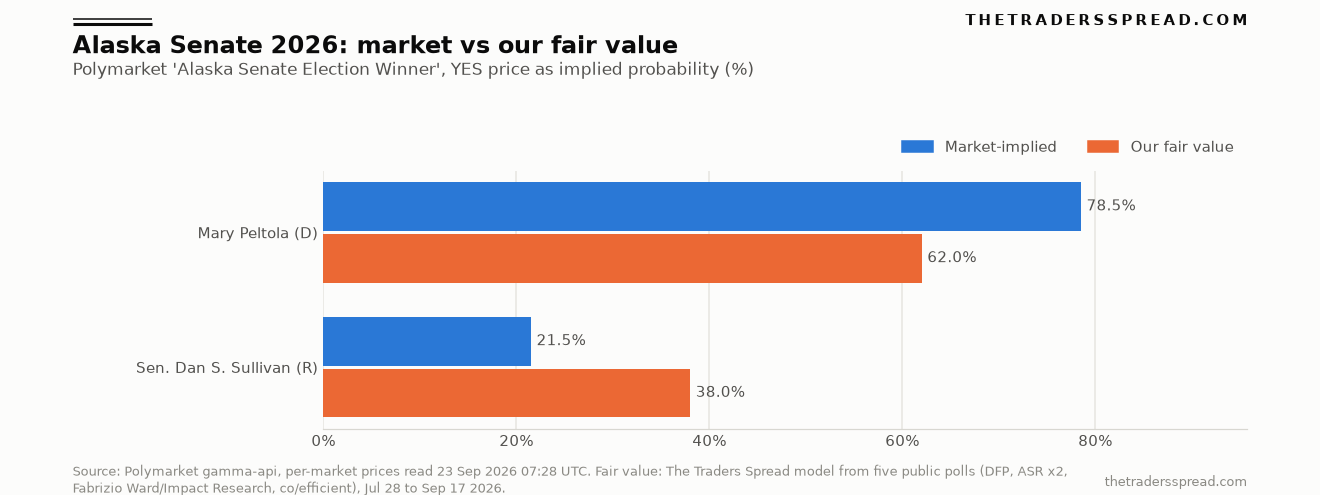
- Polymarket priced Mary Peltola at 78.5% (bid 78¢, ask 79¢) and Sen. Dan Sullivan at 21.5% to win the Alaska Senate race — Polymarket gamma-api, read 23 Sep 2026 07:28 UTC.
- The Peltola contract traded $161,920 in the 24 hours to that read, against $546,851 over its whole life. Resting liquidity was $102,562 — Polymarket gamma-api, 23 Sep 2026.
- Certified 2026 primary: Peltola 82,244 votes (49.54%), Dan S. Sullivan 68,726 (41.40%), Daniel J. Sullivan Jr. 4,107 (2.47%), turnout 27.74% — Alaska Division of Elections, official results, 31 Aug 2026.
- In the 2024 House primary Peltola took 50.89%. In that November's ranked-choice count she lost to Nick Begich, 48.78% to 51.22% — Alaska Division of Elections, 24PRIM summary and 24GENR RCV report.
- The latest independent poll, co/efficient (R), fielded 14–17 Sep, had Sullivan at 48% and Peltola at 46% among 799 likely voters — co/efficient Senate Battlegrounds, Sep 2026.
- The AARP poll by Fabrizio Ward and Impact Research, fielded 8–11 Sep, had Peltola ahead 53% to 47% after ranked-choice reallocation — AARP, 17 Sep 2026.
- Cook Political Report rates the race a Toss Up. Inside Elections rates it Tilt Republican — both ratings pages, read 23 Sep 2026.
Start with the resolution rules, because they set the clock
The contract text is short. It says: "This market will resolve according to the winner of the 2026 midterm Alaska U.S. Senate election, inclusive of any run-offs, currently scheduled for November 3, 2026." It then names its referees: "The resolution source for this market is the Associated Press, Fox News, and NBC. This market will resolve once all three sources call the race for the same candidate. If all three sources haven't called the race in this state for the same candidate, this market will resolve based on official certification." If results are not confirmed by 31 July 2027, the board resolves to "Other". The full text sits under the rules tab of Polymarket's Alaska Senate board. Links to Polymarket are affiliate links, from which The Traders Spread may earn a commission at no cost to you.
That matters because Alaska votes by ranked choice. Four names are on the general-election ballot, as certified by the Division of Elections candidate list: Gerald Heikes, Mary Peltola, Dan S. Sullivan and Daniel J. Sullivan Jr. If nobody clears 50% on first preferences, the Division's own election information page says tabulation rounds "will begin after the last counting of ballots on the 15th day following election day." For a 3 November election that is 18 November. A first-round majority could let all three news desks call it sooner. Otherwise, the earliest practical resolution comes a fortnight after polls close.
The board also has some untidy detail. It lists legs for Ann Diener, Dustin Darden, Richard Grayson and David Leslie, each bid at a twentieth of a cent. None of them is on the November ballot. Heikes is on the ballot and has no leg at all. That doesn't change the call, since any candidate outside the top two is a rounding error. It does show that the board was built before the primary and has not been tidied since. Traders who read only the two big numbers are trading a two-way race. In the actual count, the two minor Republicans' second preferences, or those voters leaving them blank, decide the margin.
We have been caught by this before. On this desk's Venezuela leader board the rules pointed to a different primary source from the one most traders were watching. Here the rules are plainer. But they still say the price is really a bet on how second preferences flow on 18 November, not on the first-round count on election night.
The 2024 precedent the board is not pricing
Every argument for the 78.5% price starts with the primary. So here is the one earlier primary that tells us most about this candidate in this electorate.
In August 2024 Peltola was the sitting congresswoman. She won 55,166 votes, or 50.89% of the House primary, per the Division of Elections summary report. Begich took 26.57% and Nancy Dahlstrom 19.90%. The headline gap was 24 points, three times this year's. Then turnout nearly doubled for November, and her first-round share fell to 46.42%. The official RCV detailed report shows Begich winning the third and final round with 164,861 votes to her 156,985, after 7,595 ballots exhausted.
| Measure | 2024 House race | 2026 Senate race |
|---|---|---|
| Peltola primary share | 50.89% | 49.54% |
| All registered Republicans, primary | 47.46% | 46.65% |
| All registered Democrats, primary | 51.32% | 51.27% |
| Primary turnout | 17.99% | 27.74% |
| Peltola first-round general share | 46.42% | not yet voted |
| Result | Lost the final round, 48.78% | Market: 78.5% to win |
If Peltola's share drops by the same 4.47 points from primary to general as in 2024, she starts November on about 45.1%. That is close to the 46% first-choice figure in the September AARP poll.
There are two honest objections. 2024 was a presidential year, and AARP notes that Donald Trump carried Alaska by 13 points. 2026 is a midterm with Trump in the White House, and midterms usually punish the president's party. Second, this year's primary drew far more voters, 166,992 against 108,906. Both points help Peltola. Neither makes the 2024 pattern irrelevant, and a 78.5% price treats it as though it were.
Five polls, one narrow lead, and the chart
We counted only polls whose numbers we could read at the pollster's or sponsor's own page. Wherever a pollster published a simulated ranked-choice final round, we used that margin, since that is the round the contract settles on.
| Pollster (sponsor) | Fielded | Sample | Peltola | Sullivan | Margin used |
|---|---|---|---|---|---|
| Data for Progress (D) | 28 Jul–4 Aug | 605 LV | 53% final | 47% final | Peltola +6 |
| Alaska Survey Research | 2–5 Aug | 1,371 LV | 50.8% final | 49.2% final | Peltola +1.6 |
| Alaska Survey Research | 20–23 Aug | 1,495 LV | 50.6% final | 49.4% final | Peltola +1.2 |
| Fabrizio Ward / Impact Research (AARP) | 8–11 Sep | 800 LV | 53% final | 47% final | Peltola +6 |
| co/efficient (R) | 14–17 Sep | 799 LV | 46% | 48% | Sullivan +2 |
The straight average is Peltola +2.6. The two sponsored polls from opposite camps roughly cancel. The two Alaska Survey Research readings, which weight to 2024 presidential vote and region, both come in under two points. The most recent poll, from a Republican firm, has Sullivan ahead. None of this describes a four-in-five favourite.
The price climbed in steps. The CLOB history for the Peltola contract shows 61.5¢ on 23 August, 65.5¢ on 16 September, 73.5¢ on 19 September and a peak of 80.5¢ on 22 September before settling at 78.5¢. Over 30 days that is a gain of 17.5 points. Our poll table shows no matching change in the race: the only poll fielded in that last week had Sullivan ahead. That volume looks like traders chasing the move rather than new information.
The pollster with the longest record on this race says the same. Ivan Moore, founder of Alaska Survey Research, wrote on 2 September: "So that's it, despite Peltola's absolute drubbing of Sullivan in the just-certified primary, we still anticipate a close race in November." Three weeks earlier he had noted that "+2 continues to be the most commonly measured result in this race."
What the bullish side has right
We are not arguing that Peltola is the underdog. The case for her is real, and it rests on the national environment more than the primary. co/efficient, a Republican firm whose own horse race shows Sullivan ahead, found Trump's job approval in Alaska at 45% approve, 51% disapprove. Moore's August sample of 2,063 registered voters put Trump's favourability at 40.3% positive and 56.3% negative. Sullivan's favourability in the same poll was 41.7% positive, 52.7% negative. Moore said the negative figure was close to the highest he had ever recorded for the senator.
Bob Ward, a partner at Fabrizio Ward, explained the shift for AARP. Affordability, he told AARP, is "seeding the discontent and what is taking a plus-13 Trump state and making it a battleground." A Republican pollster calling Alaska a battleground matters. But a battleground is a close race by definition, and that sits badly with a 78.5% price.
There is also a ranked-choice angle that works in Peltola's favour. The Data for Progress crosstabs show that many first-choice voters for Daniel J. Sullivan Jr. and Heikes rank nobody else, so their ballots exhaust before the final round rather than moving to the incumbent. Even when DFP moved every one of those exhausted ballots to Dan S. Sullivan, Peltola still led 52% to 48%. So the namesake on the ballot is a small drag on the senator, not a large one.
Add those up and Peltola is the favourite. We don't think they add up to 78.5%.
Who else is looking at the same data
The professional raters looked at the same polls and did not reach the market's conclusion. Cook's Senate race ratings list "AK Sullivan" among seven Toss Up seats. Inside Elections goes the other way and rates it Tilt Republican. Whatever you think of rating agencies, neither of them treats a Peltola win as a four-in-five outcome.
The candidate doesn't either. At the Kodiak fisheries debate on 12 September, Mary Peltola, the Democratic nominee and former U.S. Representative for Alaska, said: "This election is not a slam dunk. This is not a sure thing. This race is neck and neck." The Alaska Current reported the remark, and the debate recording is public. Candidates play down their chances to keep turnout up, so we give it less weight than the polls. Still, when the favourite's own read is "neck and neck", the market's certainty looks overdone.
This desk has made the same point about the chamber as a whole. Our Senate control piece put fair value for a Democratic majority at 50%. Alaska is one of the Republican-held seats a Democratic majority would most likely need. It is hard to hold that the chamber is a coin flip and also that this seat is 78.5% Democratic, unless you think Alaska is far safer than the other toss-ups. On the evidence above, it isn't.
The call: our fair value is 62%
Our model is simple and you can check it. We take the five-poll average of Peltola +2.6. We assume a standard error of six points on a state Senate polling average this far out, which is our assumption and not a published figure. That gives Peltola about a 67% chance. We then take five points off for two things the polls handle badly. One is the 4.5-point fall from primary to general in her 2024 race. The other is the chance that exhausted ballots from the two minor Republicans behave differently from any pollster's simulation. That leaves fair value at 62% for Peltola and 38% for Sullivan.
Against the 78.5¢ print, the Peltola contract trades about 16.5 points above our number. On the board's convention, the market is above our fair value.
RelatedSeptember CPI Odds: The 3.7% Bucket Sits Above Fair
- Base case, 42%: no one clears 50% on first preferences, tabulation starts on 18 November, and Peltola wins the final round by one to four points.
- Peltola outright, 20%: the midterm swing and higher turnout among young and rural voters take her past 50% in round one. AP, Fox and NBC call it within days.
- Sullivan, 38%: her share falls from primary to general as it did in 2024, Republican-leaning voters come home in October, and the senator wins the final round narrowly.
How it resolves: a call by all three desks for the same candidate settles it. If they disagree or hold off, the State Review Board's certification does. If nothing is confirmed by 31 July 2027, the board goes to "Other".
What would change my mind: two more nonpartisan polls with Peltola ahead by five points or more in the final round would push our fair value to about 70%. A nonpartisan poll showing Sullivan ahead would move it toward 50%. Early-vote turnout by region, which the Division of Elections reports, would also count, particularly rural turnout.
Frequently asked questions
Who decides the Alaska Senate market on Polymarket?
The contract names the Associated Press, Fox News and NBC. It resolves once all three have called the race for the same candidate. If they have not, official certification decides it. The rules count "any run-offs", which in Alaska means the ranked-choice rounds that begin on the 15th day after the 3 November election, if no one wins a majority outright.
Why is Peltola at 78.5% if polls show a close race?
Mostly because of the primary. Peltola beat Sullivan 49.54% to 41.40% on 18 August, and the price rose 17.5 points in the following month. The five polls we could verify at source average a Peltola lead of only 2.6 points. The newest one, a co/efficient survey fielded 14–17 September, shows Sullivan ahead by two.
Does the second Dan Sullivan on the ballot matter?
A little. Daniel J. Sullivan Jr., a registered Republican from Petersburg, took 2.47% in the primary. Data for Progress found that many of his voters rank no one else, so their ballots exhaust before the final round. When DFP moved all of those ballots to the senator anyway, Peltola still led 52% to 48%, which suggests a small effect.
Why is there no Gerald Heikes contract on the board?
The Polymarket event dates from October 2025, before the primary. It lists several people who are not on the November ballot and has no leg for Heikes, who is. Legs for people who are not on the ballot sit at a twentieth of a cent. This does not affect the two main prices, but anyone reading the board should know which names can still win.
When could this market pay out?
If a candidate wins a first-round majority, the three named outlets could call it within days of 3 November. If not, ranked-choice tabulation starts on 18 November. In 2024 the Division's final RCV report for the House race was stamped 30 November. The rules also allow up to 31 July 2027 before an "Other" resolution.
For more on the chamber-level markets this seat feeds into, see our breakdown of US House control odds and our look at the 2028 Democratic nominee board.
The Sullivan contract is the other side of the same pair and carries almost identical resting liquidity: $105,848 against $102,562 on the Peltola leg at our read.
Disclaimer: This article is analysis, not financial or betting advice. Prediction-market prices move quickly and every position puts capital at risk, up to the full amount staked. Prices quoted were read from Polymarket's public API at 07:28 UTC on 23 September 2026 and will have changed by the time you read this. Check the rules and the laws that apply where you live before trading.