

USD/DKK was still Friday's number when Copenhagen opened on Monday 19 October 2026. The Arne Jacobsen headquarters at Havnegade 5 is a renovation site. Danmarks Nationalbank says its people moved to Langelinie Allé 47 in September 2020, about 500 of them, and it expects the harbour works to run until 2030. The print on a dealing screen did not come from either address. The ECB reference for 16 October 2026 priced one US dollar at 6.6425 Danish kroner. A Monday retrieval of the Frankfurter feed of those rates still returns that Friday fix. The concertation that sets the reference runs at 14:10 on banking days, and there is no weekend print to replace it. A higher USD/DKK figure means more kroner per dollar, which is a weaker krone. Every case below is measured from 6.6425.
The useful fact is that Friday's dollar rate is not a Danish decision. On the ECB's books USD/DKK is a ratio. Divide Friday's EUR/DKK fix of 7.4748 by Friday's EUR/USD fix of 1.1253 and the result is 6.6425, the direct dollar fix to the last published decimal. From 17 October 2025 to 16 October 2026, EUR/DKK moved only from 7.4656 to 7.4759. USD/DKK moved from 6.2357 on 28 January to 6.6874 on 7 October. That dollar range, 0.4517 kroner, is about 44 times the euro-krone range of 0.0103. A weaker krone against the euro and a weaker krone against the dollar are different gaps. The bear case in our EUR/USD forecast, 1.1250, is where Friday's euro fix of 1.1253 already sits.
Six figures that fix the map
- USD/DKK at 6.6425 on the ECB reference dated 16 October 2026 — Frankfurter feed of ECB rates, retrieved 19 October 2026.
- EUR/USD at 1.1253 and EUR/DKK at 7.4748 the same day, and 7.4748 divided by 1.1253 equals the dollar fix — ECB reference via Frankfurter, 16 October 2026.
- Central rate 746.038 kroner per 100 euro, inside a narrower ERM II band of +/- 2.25 percent, or 729.252 to 762.824 kroner per 100 euro — Danmarks Nationalbank, fixed-exchange-rate FAQ.
- Current-account rate 2.1 percent since 11 September 2026, 40 basis points under the ECB deposit rate of 2.50 percent — Danmarks Nationalbank, 2 October and 23 September 2026; ECB, 10 September 2026.
- Foreign-exchange reserve 693.2 billion kroner at end-September, no intervention that month, and net intervention of -6.3 billion kroner from January through September — Danmarks Nationalbank, 2 October 2026.
- Federal funds target range 3.75 to 4 percent, with the median appropriate rate at 4.1 percent by the end of 2026 — Chair Kevin Warsh, FOMC press conference, 16 September 2026.
A peg with a number on it
Denmark's monetary policy has one job. The bank's fixed-exchange-rate FAQ states it without decoration: the sole purpose is to keep the krone stable against the euro. Interest rates are reserved for that task. They are not a tool for steering domestic demand. The government, in consultation with the bank, sets the exchange-rate policy. The bank conducts monetary policy inside that frame, and neither the Folketing nor the cabinet sets the policy rate. The central rate against the D-mark, and then against the euro, has been unchanged since January 1987.
The formal corridor is wider than the practice. Ordinary ERM II participation allows a currency to move 15 percent either side of its central rate. Denmark agreed a narrower band with the ECB, +/- 2.25 percent, because convergence was already high and the point of joining was the framework, not a path into the euro. In the bank's units that band runs from 729.252 to 762.824 kroner per 100 euro, around a centre of 746.038. Since the late 1990s the bank says it has kept the krone much closer to the centre than those edges. The krone floats against every other currency. The FAQ is explicit that there is no ceiling and no floor on the dollar.
Friday's euro fix makes the gap concrete. EUR/DKK at 7.4748 is 747.48 kroner per 100 euro. The centre is 746.038. The difference is 1.442 kroner per 100 euro, or 0.19 percent. The weak edge of the formal band, 762.824, still sits about 15 kroner per 100 euro away. In the whole Frankfurter sample from 17 October 2025 to 16 October 2026 the euro fix never left 7.4656 to 7.4759, a span of roughly one krone per 100 euro, and every one of those fixes was on the weak side of 746.038. The krone has been softly offered against the euro. It has not been anywhere near a band test.
That is also what the bank itself has been saying, in its own scale. The 23 September analysis, Interest rate increases and high risk appetite, says that since the war in the Middle East broke out in February the krone has gradually weakened against the euro, and that the bank made minor interventions in June and August. The ECB fixes put a number on "gradual". EUR/DKK was 7.4691 on 2 February 2026 and 7.4748 on 16 October. The change is 0.57 kroner per 100 euro. Real, and small.
Intervention comes first, the policy rate second. If the krone is soft against the euro, the bank can sell foreign exchange and purchase kroner. If that is not enough, it moves its rates relative to the ECB. The 2 October balance-sheet release shows a quiet September. For settlement that month the bank did not intervene. The reserve fell 0.4 billion kroner to 693.2 billion, from a 0.5 billion net sale of foreign exchange outside the intervention line and 0.1 billion of government foreign borrowing. From January through September, "purchases of foreign exchange, net" stand at -6.3 billion kroner. A minus means the bank was a net seller of foreign exchange: support for the krone, and a small sum next to a reserve of 693 billion.
A 40-point discount, and a chair who is not in Copenhagen
The rate Copenhagen changed this autumn was a copy. On 10 September the ECB's Governing Council raised the deposit facility, the main refinancing rate and the marginal lending facility by 25 basis points, to 2.50, 2.65 and 2.90 percent, with effect from 16 September. The staff baseline with that decision has headline inflation at 3.0 percent in 2026, 2.5 percent in 2027 and 2.1 percent in 2028. The Council said it is not pre-committing to a rate path. Our note on the October ECB contract tracks how that next decision is being priced. It is a separate question from the dollar cross.
Danmarks Nationalbank matched the move. Since 11 September the discount rate, the current-account rate and the rate on certificates of deposit have been 2.1 percent, and the lending rate 2.25 percent. The 23 September analysis says the bank followed the ECB's 25-basis-point increases in June and in September, so the monetary-policy spread is unchanged at -40 basis points. The current-account rate sits 0.40 points under the ECB deposit rate. The bank also says policy and financial conditions look broadly neutral for the Danish economy. Neutrality here is not a view on the dollar. It is a view on the domestic stance once the peg has been served.
The governor's public remarks, three weeks after the hike, were not about a new exchange-rate regime. At Realkredittens Topmøde on 21 September, Christian Kettel Thomsen, governor of Danmarks Nationalbank, argued against measures that would stimulate housing demand. The speech is in Danish. The bank's English account quotes him: "The answer to high house prices is more homes – not more lenient lending rules." The dollar does not appear. The instrument he is defending is credit standards, not a float.
The dollar's policy rate was set six days earlier. On 16 September the FOMC raised the funds target to 3.75 to 4 percent. Kevin Warsh, chairman of the Federal Reserve, told the press conference: "The plain fact is that inflation is too high and has been for too long." He called the step the removal of "a dose of accommodation". The median he relayed from the projections puts total PCE inflation at 3.7 percent this year and 2.3 percent next year, and an appropriate funds rate of 4.1 percent at the end of this year and again next year. From a range whose top is 4 percent, that median is one more quarter-point, not a cutting cycle.
Put the two ends of the spread on one line. The funds range is 3.75 to 4 percent. The ECB deposit rate is 2.50 percent. The gap from the middle of the Fed range to the ECB deposit rate is about 1.4 percentage points. Denmark then prices itself 40 basis points through the ECB, at 2.10 percent on the current account. None of that spread is a separate krone decision against the dollar. The peg imports the euro's gap.
One year of the dollar, drawn in kroner
The chart uses every ECB reference from 17 October 2025 to 16 October 2026 and projects three levels to 31 December. The lines start at the last fix. They are not a history.
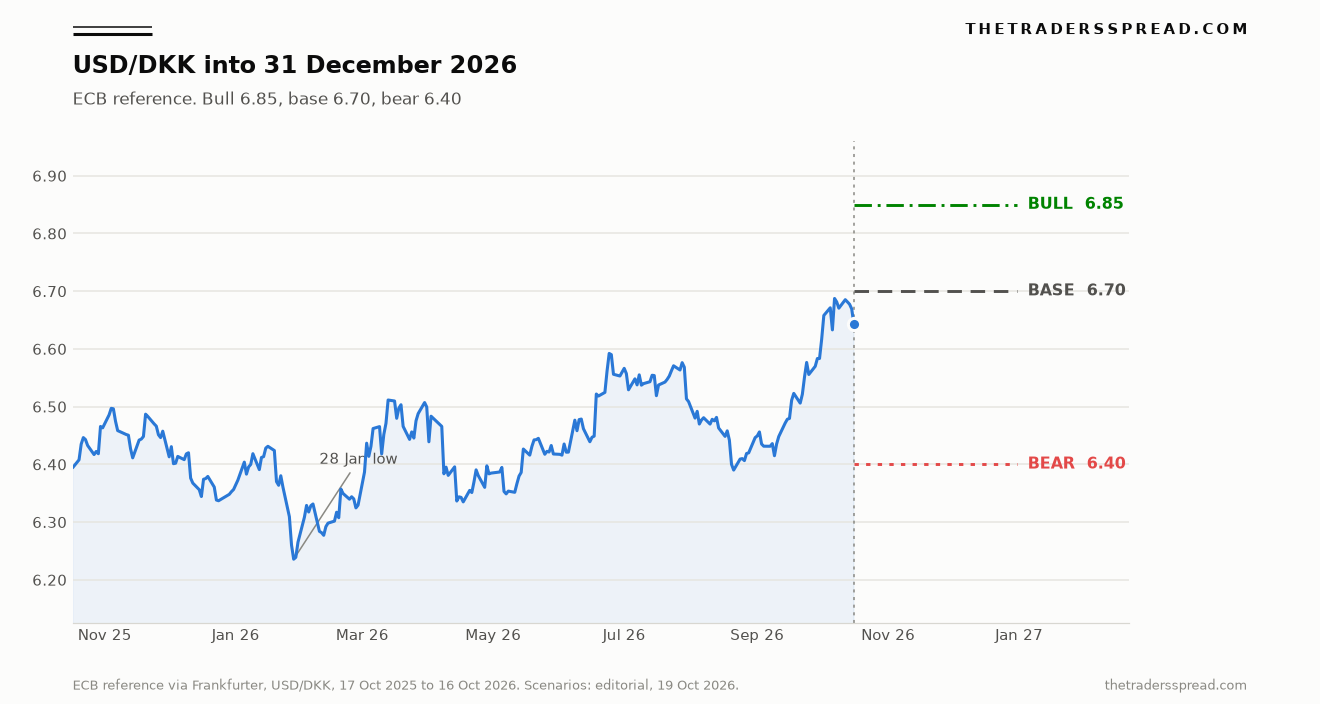
Read the path as the euro, inverted. On 2 January, USD/DKK was 6.3727 and EUR/USD was 1.1721. By 16 October the dollar cross was 6.6425, up 4.2 percent, while the euro was 1.1253, down 4.0 percent. EUR/DKK had moved from 7.4694 to 7.4748, a change of 0.07 percent. The dollar-cross low, 6.2357 on 28 January, is the day EUR/USD printed 1.1974. The high, 6.6874 on 7 October, is the day EUR/USD printed 1.1177. From 7 October to 16 October the dollar cross fell 0.7 percent as the euro rose from 1.1177 to 1.1253. Same ratio, smaller size.
| ECB reference | USD/DKK | EUR/USD | EUR/DKK |
|---|---|---|---|
| 17 Oct 2025 | 6.3941 | 1.1681 | 7.4690 |
| 2 Jan 2026 | 6.3727 | 1.1721 | 7.4694 |
| 28 Jan 2026, dollar-cross low | 6.2357 | 1.1974 | 7.4666 |
| 18 Aug 2026, euro-krone high | 6.4581 | 1.1576 | 7.4759 |
| 7 Oct 2026, dollar-cross high | 6.6874 | 1.1177 | 7.4745 |
| 16 Oct 2026, latest fix | 6.6425 | 1.1253 | 7.4748 |
Source for every cell: ECB reference rates via Frankfurter, retrieved 19 October 2026. The August row is there for a reason. The strongest euro-krone fix in the sample, 7.4759 on 18 August, did not produce the strongest dollar cross. USD/DKK that day was 6.4581, well below the October high, because EUR/USD was still 1.1576. Krone weakness against the euro and krone weakness against the dollar are not the same trade.
The floating neighbours show the contrast. Sweden and Norway do not run this peg, so USD/SEK and USD/NOK can move on their own monetary policy as well as on the dollar. Our USD/SEK forecast is a different instrument for that reason. A move in the Swedish krona does not drag EUR/DKK with it, and it should not be used as a proxy for the Danish cross. The Danish residual against the euro, over twelve months of ECB fixes, was 0.0103 kroner per euro. That is the part a USD/DKK position actually has at risk if the euro-dollar rate is already hedged.
Where the shadow would break
The forecast only works while two things stay true. EUR/DKK remains glued to the centre, and EUR/USD does the moving. Both can fail, and they fail in different places.
A peg break is the less likely failure and the one that would matter more. The bank has the reserve, the intervention line and a rate it can move without waiting for Frankfurt. Year-to-date intervention of 6.3 billion kroner, on the side that supports the krone, has not exhausted a 693 billion reserve. The formal band still has about two percentage points of room on the weak side. Nothing in the September release, the 23 September analysis or the governor's speech describes a plan to stop following the ECB. A break would look like EUR/DKK leaving 7.466 to 7.476 and staying there. Until that print exists, treating USD/DKK as a free Scandinavian currency is the wrong model. The USD/NOK forecast is the notebook for a krone that actually floats.
The dollar leg can fail without any of that. Ten weeks remain to 31 December. The October dip already took 0.0449 kroner off the high, from 6.6874 to 6.6425, in seven ECB fixes. Warsh's median of 4.1 percent is a committee projection, not a promise, and the ECB has said it will not pre-commit. An energy shock that the September staff scenarios already flag as uncertain can move the euro by more than the gap between 1.1253 and 1.1156, which is the whole of the base case below. The identity is mechanical. The forecast for the euro is not.
Base 6.70, with 6.85 above it and 6.40 below
The base case for 31 December 2026 is 6.70. That is 0.0575 above Friday's 6.6425, about 0.9 percent, and a little through the 7 October high of 6.6874. Hold EUR/DKK at 7.4748 and 6.70 implies EUR/USD near 1.1156, a cent under 1.1253 and almost on the 7 October low of 1.1177. About half the weight sits here. The window runs only to year-end, the Fed's median still points to a slightly higher funds rate, and the peg removes the Danish variable.
The bull case is 6.85. It has to sit above the live reference. On this pair, up is a weaker krone against the dollar. Divide 7.4748 by 6.85 and EUR/USD comes out near 1.0912, about 3 percent below Friday's euro. It needs a funds rate the median puts at 4.1 percent, inflation Warsh still calls too high, and an ECB deposit rate at 2.50 percent unless the Council takes a step it has refused to promise. About 30 percent of the weight sits on 6.85.
RelatedNZD/CAD Forecast: 0.8320 Bull Case vs 0.7680 Bear Case
The bear case is 6.40, below Friday's fix. The same division implies EUR/USD near 1.1679, close to the 1.1721 fix of 2 January and still under the 1.1974 high of 28 January, when USD/DKK printed 6.2357. Reaching 6.40 means giving back most of the dollar's 2026 rally against the krone, not repeating a 0.7 percent dip. About 20 percent of the weight sits here. The weights are editorial judgements, not traded probabilities and not a market price.
What changes the call is a break in one assumption, not a noisy week. If EUR/USD trades back through 1.17 before year-end, 6.40 stops being the tail and the bull leaning is wrong. That 6.40 level is the invalidation. If EUR/DKK leaves 7.4656 to 7.4759, the shadow has failed and none of the three dollar levels is the map. The bias is bull. Conviction is moderate, because the mechanism is clear and the euro's next ten weeks are not. The reference is Friday's 6.6425. The horizon is 31 December 2026.
Questions that change the level
What does a higher USD/DKK number mean?
It means one dollar is worth more kroner. USD/DKK is quoted as Danish kroner per one US dollar, so 6.85 is a weaker krone than 6.6425, and 6.40 is a stronger one. The bull case in this piece is the higher number. Readers used to euro-dollar, where up means a stronger euro, invert the story if they skip this. The ECB reference on 16 October 2026 was 6.6425.
Why does the krone track the euro so tightly?
Because that is the policy. Danmarks Nationalbank keeps the krone near a central rate of 746.038 per 100 euro, inside an agreed ERM II band of +/- 2.25 percent. In the ECB fixes from 17 October 2025 to 16 October 2026, EUR/DKK stayed between 7.4656 and 7.4759. The dollar cross moved because EUR/USD moved. The peg transmits the euro. It does not invent a separate dollar price.
Is the krone weak against the euro in a way that threatens the band?
It is slightly weak, and it is not close to the band. Friday's fix of 7.4748 is 747.48 kroner per 100 euro, against a centre of 746.038. The gap is 0.19 percent. The weak limit of the narrower band is 762.824 per 100 euro. The bank's 23 September analysis calls the move since February gradual, and the fixes agree: from 7.4691 on 2 February to 7.4748 on 16 October.
How do the Fed and the ECB enter a Danish cross?
Through the euro. The Fed's target range is 3.75 to 4 percent after the 16 September rise, and the median projection Warsh relayed puts the appropriate rate at 4.1 percent at year-end. The ECB deposit rate is 2.50 percent from 16 September. Denmark's current-account rate is 2.1 percent, a 40-basis-point discount the bank says is unchanged. That discount defends the euro peg. It is not a separate bet on the dollar.
What would make 6.85 or 6.40 the number that matters?
6.85 matters if the euro extends its decline, toward about 1.09 per dollar, while EUR/DKK stays near 7.47. 6.40 matters if EUR/USD returns to the January area near 1.17 and the dollar's rally against the krone is given back. Either case still assumes the peg holds. If the euro-krone fix leaves the narrow range of the past year, the dollar arithmetic in this piece stops being the map.
Are these tradable quotes?
No. The spot figures are ECB reference rates, agreed at the 14:10 concertation and redistributed by Frankfurter, not a bank's dealing price and not a signal to transact. The 6.85, 6.70 and 6.40 levels are editorial scenarios for 31 December 2026. A live screen on a Monday can differ from Friday's 6.6425 without either number being wrong.
This is analysis, not advice and not a recommendation to take a position. Foreign exchange moves against the people who hold it, and capital is at risk. Scenarios can be wrong even when the peg holds. The sources are the ECB reference rates via Frankfurter, retrieved 19 October 2026 with a reference date of 16 October 2026, Danmarks Nationalbank's pages on the peg, the reserve and the September analysis, the ECB's decision of 10 September 2026, and the Federal Reserve transcript of 16 September 2026.