

USD/COP did not settle into a stronger peso when Banco de la República held the policy rate at 12.25 percent on 30 October 2026. A pause that far above inflation is often treated as a lock on peso carry, and the minutes of that meeting, published on 5 November, record a director who said the tightening already delivered through 2026 had widened the gap against rates abroad and reinforced appreciation pressure, yet the official fixing rose.
We read those minutes and computed the move in the official price. That price is the TRM, the tasa representativa del mercado, which the Superintendencia Financiera de Colombia describes as the weighted average of spot purchases and sales of US dollars against Colombian legal tender. We took the row whose vigenciadesde is 30 October 2026, valor 3,166.91 pesos per dollar, and the latest row in the same download, vigenciadesde 20 November 2026, valor 3,415.10. The change is the later valor minus the earlier one, 248.19 pesos, equal to 7.84 percent of the 30 October valor. A higher TRM means more pesos per dollar, so on this measure the peso depreciated over the three weeks after the hold.
Data as of 20 November 2026, from Superintendencia Financiera dataset 32sa-8pi3 on datos.gov.co, retrieved at 08:35 UTC, using the columns valor, unidad, vigenciadesde and vigenciahasta.
Key facts
- Latest TRM: 3,415.10 pesos per dollar, vigencia 20 November 2026, dataset 32sa-8pi3.
- Decision-day TRM: 3,166.91 on 30 October 2026. Change to the latest row: 248.19 pesos, 7.84 percent.
- Policy rate: held at 12.25 percent, four directors against three who wanted 25 basis points more. Minutes published 5 November 2026. The rate applies from 3 November 2026.
- September inflation 6.3 percent. Core inflation excluding food and regulated items 6.0 percent, from 6.1 percent in August. Analyst expectations for December 2026: 6.9 percent. Two-year expectations around 4.0 percent. Target 3 percent.
- Levels from those rows: bull 3,575, base 3,371, bear 3,236.
Hold and hike on the same axes
Four directors voted to leave the rate at 12.25 percent. They wanted policy to stay restrictive while inflation and expectations remained away from the 3 percent target, and they treated September as a reason to wait. Annual inflation was 6.3 percent, slightly below the market's expectation: food rose on perishables, services were slightly higher on rents and meals away from home, and goods and regulated prices were lower. Core inflation excluding food and regulated items eased from 6.1 percent in August to 6.0 percent. In their account that evidence was still thin, so a pause limited the risk of a costly over-adjustment while they watched whether the core slowdown would stick and how El Niño would hit food and regulated prices, including second-round effects.
Two of those directors added that a sizable fiscal consolidation in 2027, and a moderate minimum-wage adjustment, would help inflation converge. A director who had first argued for a 50 basis point cut joined the hold to produce a majority. He called the upward pressure mostly supply, naming El Niño, scarce gas, and higher fuel and farm inputs tied to conflicts abroad, and he said the 2026 tightening had widened the external rate gap, fed carry trades, and reinforced peso appreciation. Another director in the group said the costs of restrictive policy still had to be set against the results, with a complex fiscal reform in front of Congress.
Three directors voted for 25 basis points more. A long miss had weakened credibility in the 3 percent target, they argued, and 2027 inflation should stay inside the technical staff forecast of 4.8 percent, which they already called elevated. The current stance would let inflation start falling in 2027, and they still wanted a further increase while excess demand lasted, because delaying it would raise later costs once the output gap closed around mid-2027 and turned negative. They treated a strong El Niño as a larger food and energy shock than earlier episodes, given short domestic gas and a reliance on imports, and they said the earthquake's drag on third-quarter activity had been cushioned by the terms of trade and household income. On the peso they ranked a wider rate differential as a smaller factor than the others they listed, with energy and food costs and high rates abroad making a quick easing less plausible.
Public finances are called first-order, with a rigorous reading asked of the Economic Rescue Bill, and later moves are left to new information. September inflation subtracted from 12.25 percent leaves 5.95 percentage points. The 6.9 percent December expectation leaves 5.35. Both gaps use only the minutes, and both were in place when the TRM started to climb.
| Axis | Hold case | Hike case | Base path |
|---|---|---|---|
| Vote on 30 October | Four directors, one of whom had preferred a 50 basis point cut and joined to make the majority | Three directors | Follows that four-director majority |
| Policy rate | Unchanged at 12.25 percent, in force from 3 November | 25 basis points higher | Stays at 12.25 percent unless new information moves the board |
| Inflation anchor | September inflation 6.3 percent, core 6.0 percent from 6.1 percent | Staff forecast of 4.8 percent for 2027, against a 3 percent target | Both sets of figures stand |
| Peso channel, in their words | The 2026 tightening had already reinforced appreciation through carry | The rate gap ranks behind the other exchange-rate factors they listed | The fixing rose 248.19 pesos while the rate was held |
| TRM reading | 3,236 if that carry channel reasserts and the fixing returns to the 4 November row | A further 25 basis points, on the hold camp's account, would add peso strength and also point lower | 3,371, below the latest print and above the decision-day print |
Bull stays off the hold column because the 248.19 peso climb happened while the rate was held. Bear at 3,236 is the unwind if the carry channel in that camp reasserts. Bull at 3,575 is a repeat of the pre-jump climb. A further hike, on the hold camp's wording, would add appreciation pressure and point toward the lower print.
The same question on the next Andean official dollar rate, a hold and the fixing that followed, is the USD/CLP piece on copper and the Chilean peso. The opposite policy move, a cut that narrowed a carry gap, is the EUR/MXN piece on the Banxico reduction.
What the fixing did after the vote
The chart plots every certified row from 1 October through 20 November 2026, one point per vigenciadesde, and the level lines run to 31 March 2027 so the dashes have length. Bull is 3,575, base is 3,371 and bear is 3,236.
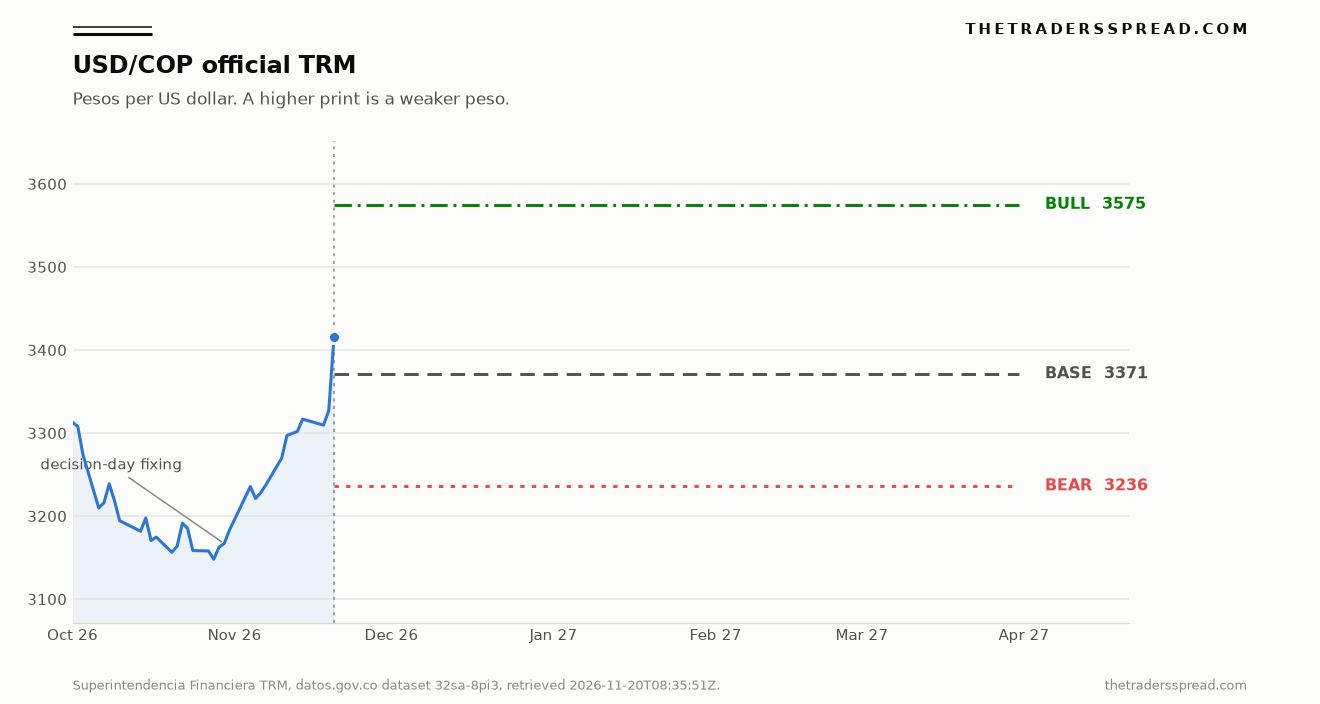
Bear rounds the 4 November valor of 3,235.59 to 3,236. The rate applies from 3 November, and the 31 October row of 3,182.99 runs through that date, so 4 November is the first fixing after the window. It is 68.68 pesos above the decision-day valor. Bull adds the climb to 19 November, 3,326.96 minus 3,166.91, or 160.05 pesos and 5.05 percent, onto the latest print: 3,415.10 plus 160.05 is 3,575.15, rounded to 3,575. Base averages the last two rows to 3,371.03, rounded to 3,371, which is 44.10 pesos under the latest fixing and 204.09 above the decision-day fixing. The last session alone was 88.14 pesos, or 2.65 percent.
| Row | Vigencia desde | Valor, pesos per dollar | Change from 30 October |
|---|---|---|---|
| Decision day | 30 October 2026 | 3,166.91 | 0 |
| In force across the effective date | 31 October 2026, through 3 November | 3,182.99 | +16.08 |
| First row after that window | 4 November 2026 | 3,235.59 | +68.68 |
| Session before the jump | 19 November 2026 | 3,326.96 | +160.05 |
| Latest row | 20 November 2026 | 3,415.10 | +248.19 |
The board's communications list records two reserve operations in this window: an authorization on 30 October for a direct purchase of USD 2 billion from the national government, and a 6 November entry recording that the bank bought those dollars. The TRM on 6 November is 3,228.26, and the latest row is 186.84 pesos higher, so the purchase sits inside the rise and the fixing kept climbing afterward. That gap is the latest valor minus the 6 November valor. The vote, the inflation figures and the effective date are in the 5 November minutes, and the rows are series 32sa-8pi3.
An earlier USD/COP call, filed at The Industry Spread on 17 October, put a stronger peso on the table into the October decision date, and that date has now passed. The official fixing on the decision date was 3,166.91, and the latest row is 3,415.10. The level from that call stays on that page.
The base path
The base path is 3,371, between the bull and bear levels and below the latest fixing, so the bias against the live TRM is toward fewer pesos per dollar, while the peso would still be 204.09 pesos weaker than on the day of the hold. The weight on that path is the October vote, four directors to three. That count is a reading of the last vote, not a probability taken from a futures market. The reference beside the levels is 3,415.10.
What would change our mind
A certified TRM at or above 3,575 would repeat the 160.05 peso climb on top of the latest print and would retire 3,371 as the central path. A certified TRM at 3,236 would mean the bear case had arrived, with the peso still 68.68 pesos softer than on the decision date and firmer than the latest print. A hike at the next rate decision would revive the appreciation pressure the hold camp described and pull the reading toward 3,236.
Banco de la República's post on 19 November says the board decides the rate at eight of twelve monthly meetings, and that the next decision is Friday 18 December 2026. The minutes page lists an ordinary meeting on 30 November 2026. The December date is the post, and the November date is the meeting named beside the minutes, after the public calendar returned a bot wall on retrieval. Core inflation turning up from the September 6.0 percent, or December expectations moving above 6.9 percent, would strengthen the hike camp's credibility case, as would a new fact that pushed 2027 inflation above the 4.8 percent staff forecast. The minutes already leave El Niño and the Economic Rescue Bill open.
Related6 USD/EGP facts from the fixing and the market print
Questions readers still ask
Is the TRM the official USD/COP price?
Yes, the TRM is the Superintendencia Financiera series used here, a weighted average of spot dollar operations against the peso, and every peso figure above is a valor from dataset 32sa-8pi3 with the vigencia date on that row.
Why does the bear case sit above the decision-day fixing?
Because 3,236 rounds the 4 November row of 3,235.59, already 68.68 pesos above the decision-day valor of 3,166.91, so that case gives back the climb after the rate took effect and still leaves the peso softer than it was on 30 October.
Does the 4-3 vote lock in another hold?
The count, including a director who joined the hold after preferring a cut, is the October vote, the minutes leave later decisions to new information, and the bank's 19 November post places the next rate decision on 18 December 2026.
What has to print for the bull case of 3,575?
The latest fixing plus the 160.05 peso rise from 30 October to 19 November sums to 3,575.15, which rounds to 3,575, a repeat of the climb that preceded the 20 November jump, stacked on the latest row.
What does a higher TRM mean for the peso?
A higher TRM is more pesos per dollar, so 3,575 is a weaker peso than the 20 November fixing of 3,415.10, while 3,236 is a stronger peso than that fixing and still a weaker peso than the 30 October fixing of 3,166.91.
This is analysis, not advice, and capital is at risk.