

| Path | Taka per USD | Gap versus the 19 November sheet |
|---|---|---|
| Sheet, 19 November 2026 | 124.75 | 0.00 |
| Base, into 28 February 2027 | 125.50 | +0.75 |
| Bull case | 128.00 | +3.25 |
| Bear case | 122.00 | -2.75 |
I read USD/BDT off Bangladesh Bank's own foreign-exchange rate sheet before I looked at a dealer screen. The sheet dated 19 November 2026, printed at 10:41 Bangladesh time by the Reserve Management and Investment Section, puts the weighted average at 124.7500 taka per dollar, and the bid and the ask sit on that same figure. The bull case of 128 is 3.25 taka above the fixing. The bear case of 122 is 2.75 taka below it. The base of 125.50 is a three-quarter-taka step off a level later sheets have already held.
A higher number in this convention is a cheaper taka, because more taka buy one dollar. The USD/BDT forecast below stays in that unit through 28 February 2027. The sample is ten rate-sheet PDFs opened on 19 November 2026, plus the wage-remittance table and the CPI page on the same site.
What the sheet is measuring
Bangladesh Bank's exchange-rate page says the bid and ask are the highest and lowest interbank rates at the previous Dhaka close, and that the bank applies the sheet to deals with the government and international organisations. The file used here is the 19 November 2026 PDF from FRTMD, retrieved that morning. The USD/KES fixing on this desk is the same kind of object: one official print, with the bull case above it and the bear case below it.
Because the page dates the bid and ask to the previous close, the 19 November sheet can be the 18 November range. The 18 November, 17 November and 12 November sheets also print 124.7500, so either clock still reads 124.75. The same PDF prints gold at 464,872.1425 taka and the SDR at 167.6141. Those lines stay out of the path. The dollar line is the numeraire for the crosses under it.
The New York euro bid on the sheet is 1.0973, and 124.7500 times 1.0973 equals 136.8882, the euro bid in taka printed beside it. Sterling's 1.3147 times 124.7500 equals 164.0088, the sterling bid. On the ask, 124.7500 times 1.0976 is 136.9256 and 124.7500 times 1.3150 is 164.0463, against a printed sterling ask of 164.0462. The crosses move with the dollar-taka print unless the New York leg offsets it. The USD/CNY parity note describes a rate an authority sets. This sheet is a weighted average of transactions, then reused for official deals.
A separate reference-rate page, for deals of 100,000 dollars and above, listed 18 November as 124.9831 and 124.8171. Column headers failed to render in that retrieval, so the pair stays unlabeled. Both figures sit a little above 124.7500. The forecast uses the labeled weighted average, the number that carries a bid, an ask, a print time and a section name.
Ten sheets, then a shelf
The history is the weighted-average line from each opened PDF. The bank's archive lists more dates between these samples. Only the ten files below were opened.
| Sheet date | Weighted average, taka per USD | Change from the prior opened sheet |
|---|---|---|
| 1 October 2026 | 123.1000 | |
| 8 October 2026 | 123.1000 | 0.0000 |
| 15 October 2026 | 123.4500 | +0.3500 |
| 26 October 2026 | 123.7500 | +0.3000 |
| 29 October 2026 | 123.9900 | +0.2400 |
| 5 November 2026 | 124.3400 | +0.3500 |
| 12 November 2026 | 124.7500 | +0.4100 |
| 17 November 2026 | 124.7500 | 0.0000 |
| 18 November 2026 | 124.7500 | 0.0000 |
| 19 November 2026 | 124.7500 | 0.0000 |
From 1 October to 19 November the weighted average rose 1.6500 taka, 1.34 percent. The 1 October and 8 October prints match. Five steps then run 0.35, 0.30, 0.24, 0.35 and 0.41 taka, and the last of those, from 124.3400 on 5 November to 124.7500 on 12 November, is the largest. The 17, 18 and 19 November sheets repeat 12 November. Four opened files sit on one number.
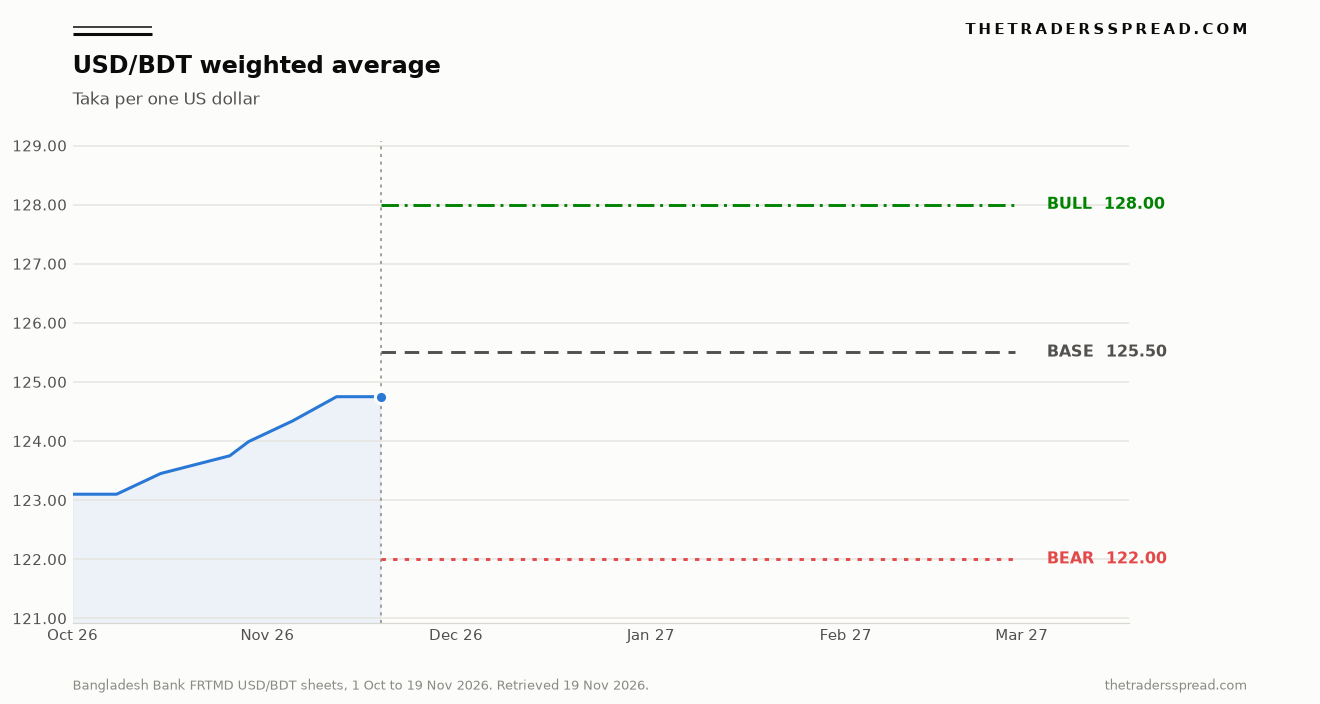
The stop at 124.75 is the shape of the path. The base treats it as a pause of less than two large steps. The bull case needs almost two full copies of the October-to-November rise. The bear case treats the shelf as a ceiling and a trip back through every print in the sample.
Remittances in the bank's own two columns
The wage-earner remittance table, sourced to the Statistics Department from July 2016, prints each month in million US dollars and in billion taka. Dividing the taka column by the dollar column, with the units scaled, gives the conversion rate inside that month's inflow. It is an accounting rate. It is a different series from the daily weighted average.
| Month | Million US dollars | Billion taka | Implied taka per USD |
|---|---|---|---|
| July 2026 | 2,858.76 | 352.46 | 123.29 |
| August 2026 | 2,967.53 | 365.30 | 123.10 |
| September 2026 | 2,766.02 | 340.08 | 122.95 |
| October 2026 | 2,873.63 | 354.73 | 123.44 |
August's implied 123.10 matches the 1 October and 8 October sheets to the hundredth. October's 123.44 matches the 15 October sheet of 123.4500 within a hundredth. September's 122.95 sits under every sheet in this sample. The November weighted average of 124.75 is 1.31 taka above the rate embedded in October's remittance total. The dollar became more expensive on the daily sheets after a month whose taka conversion still looks like mid-October.
A year earlier those four months were 2,477.87, 2,421.89, 2,685.56 and 2,562.44 million dollars, summing to 10,147.76 million. July through October of fiscal 2026-27 sums to 11,465.94 million, up 1,318.18 million, or 12.99 percent. October's 2,873.63 million is 878.58 million under March 2026's 3,752.21 million, a 23.4 percent gap. The USD/PHP remittance case treats this kind of inflow as supply. Here supply grew 12.99 percent while the sheet rose 1.34 percent.
A bear case needs the extra remittance dollars to cover the bid, so 124.75 becomes a top. A bull case reads that same inflow as already present while the weighted average climbed, so the bid for dollars outran it. The import bill sat outside the tables that returned figures in this session, and the claim stops at the sheets and the remittance columns.
Inflation is still printed above 8 percent
The inflation page, citing the Bangladesh Bureau of Statistics on a CPI with base 2021-22, puts point-to-point inflation at 8.27 percent in October 2026, from 8.34 percent in September and 8.17 percent in October 2025. The twelve-month average is 8.66 percent, against 9.22 percent a year earlier, an easing of 0.56 points. The point-to-point rate has barely moved.
A current policy-rate document sat outside the files opened for this reading, so the CPI prints stand alone. Prices are still rising above 8 percent a year, while the sheets rose 1.34 percent over the autumn window. The currency move is the smaller of the two, which keeps 128, at 2.61 percent above the fixing, inside a familiar scale, and keeps a quick slide to 122 from being the default while the CPI page still shows prices rising.
Bull case: 128 taka per dollar
128.00 is 3.25 taka above 124.75, or 2.61 percent. Twice the printed rise of 1.65 taka is 3.30, so 128 is just under two copies of that climb on top of the shelf, about eight of the 0.41 taka steps. It needs the shelf to behave like the flat week of 1 to 8 October, which was followed by the whole climb, while the bid for dollars keeps outrunning a remittance flow already 12.99 percent above the year before.
128 sits above every opened sheet and above both unlabeled 18 November reference figures. Getting there means new highs, with monthly remittances still near 2,800 to 3,000 million dollars and still failing to cap the print. A month back at March's 3,752 million dollars would weaken the case. That supply print is already in the table.
Bear case: 122 taka per dollar
122.00 is 2.75 taka under the fixing, or 2.20 percent, and 1.10 taka under the lowest sheet in the sample, the 123.1000 of 1 and 8 October. Every opened print from October and November sits above 122. The case gives back the whole 1.65 taka rise and then another 1.10 taka, about three of the mid-sized steps of 0.30 to 0.35 running in reverse after the shelf breaks downward.
Four identical sheets fit a ceiling and they also fit a pause, which is why 122 stays the downside and the base stays above the fixing. The supply side for a ceiling is remittances holding the October pace while the print slips through 123.44, the rate inside October's taka total, and then through 123.10. September's implied 122.95 already sits next to that zone. 122 is about a taka beyond it.
Base case: 125.50, and what would change it
125.50 is 0.75 taka above the shelf, or 0.60 percent, a little under two of the 0.41 steps and well under the full 1.65 taka rise. The shelf gives way by a small amount and then settles: four prints are already unchanged, and remittances are larger than a year ago while still off the March peak. The bias is neutral. The base is above the fixing, a tilt toward a slightly cheaper taka that still fits inside two ordinary steps. Conviction is 2 out of 5, on a fresh shelf and a seven-week sample.
Related6 USD/EGP facts from the fixing and the market print
A sheet back at 123.10, the 1 October weighted average, retires the base. That print is the invalidation. A sheet above 125.50 moves the path toward 128, and a sheet under 123.10 makes 122 the fit. A remittance month above 3,700 million dollars, near March 2026, would favour the bear side. Months near October's 2,874 million, with the weighted average leaving 124.75 upward, would favour the bull side.
The three levels are distances from a fixing, built from steps the sheets already printed. Another fortnight of PDFs stuck at 124.7500 would pull the base back onto the fixing itself. A single sheet that jumps by more than the 0.41 taka largest step in this sample would make the map look slow.
Key facts
- The 19 November 2026 foreign-exchange rate sheet prints a weighted-average USD/BDT of 124.7500 taka per dollar, with bid and ask at 124.7500, time-stamped 10:41 Bangladesh time. Source: Bangladesh Bank FRTMD, retrieved 19 November 2026.
- Sheets dated 12, 17, 18 and 19 November 2026 all print 124.7500, after 123.1000 on 1 October, a rise of 1.6500 taka or 1.34 percent. Source: Bangladesh Bank rate-sheet PDFs, retrieved 19 November 2026.
- The largest step between opened sheets is 0.4100 taka, from 124.3400 on 5 November to 124.7500 on 12 November. Source: Bangladesh Bank rate-sheet PDFs, retrieved 19 November 2026.
- Wage-earner remittances were 2,873.63 million dollars in October 2026, and July-October of fiscal 2026-27 summed to 11,465.94 million against 10,147.76 million a year earlier, up 12.99 percent. Source: Bangladesh Bank Statistics Department, retrieved 19 November 2026.
- The remittance table's two columns put October 2026 at an implied 123.44 taka per dollar, against a November sheet of 124.75. Source: Bangladesh Bank remittance table, retrieved 19 November 2026.
- Point-to-point CPI inflation was 8.27 percent in October 2026, from 8.34 percent in September and 8.17 percent in October 2025, and the twelve-month average was 8.66 percent. Source: Bangladesh Bureau of Statistics via Bangladesh Bank, retrieved 19 November 2026.
Frequently asked questions
What is the USD/BDT rate in this reading?
The rate is the weighted average on Bangladesh Bank's foreign-exchange rate sheet dated 19 November 2026, which prints 124.7500 taka per dollar for the bid, the ask and the average. FRTMD's Reserve Management and Investment Section generated the PDF at 10:41 Bangladesh time. The bank's page says the bid and ask reflect the previous Dhaka close, and the 18 November sheet prints the same 124.7500. The figure comes from those PDFs, opened on 19 November 2026.
Why is the bull case above the fixing and the bear case below it?
The pair is quoted as taka per dollar, so a bull case for the USD/BDT price is a higher number and a bear case is a lower one. 128 sits 3.25 taka above the 124.75 sheet and 122 sits 2.75 taka below it. A stronger taka is the bear case in the sheet's own unit. The base of 125.50 stays 0.75 taka above the fixing, a small step beside the full bull case.
How far is 128 from the move already on the sheets?
Opened sheets rose 1.65 taka from 123.10 on 1 October to 124.75 on 19 November. A second copy of that rise, placed on the shelf, lands at 128.05. The bull case at 128 is just under two copies of the recorded climb. The largest single step in the sample was 0.41 taka, so 128 also sits about eight of those steps away from the 19 November fixing.
Do remittances already explain the shelf at 124.75?
July through October remittances were 11,465.94 million dollars, 12.99 percent above a year earlier, and October alone was 2,873.63 million. That inflow can sit under a cap, and four sheets at 124.75 fit one. The same inflow was arriving while the sheets climbed from 123.10, so the remittance column did not stop the rise through 12 November. In the opened set the shelf is four prints old, a candidate for a cap and still short of proof.
What print would change the base case?
A later weighted-average sheet back at 123.10, the 1 October level, retires the base of 125.50, because the rise that base expects to keep would be gone. A sheet above 125.50 shifts the working path toward 128. Another fortnight stuck at 124.7500 would pull the base back onto the fixing. A remittance month near the March 2026 print of 3,752.21 million dollars would add supply and favour 122.
The call
The base is 125.50 taka per dollar into 28 February 2027, 0.75 above the 124.75 weighted average. The bull case is 128 if the shelf breaks upward while remittances stay near 2,800 to 3,000 million dollars a month. The bear case is 122 if the shelf is a ceiling and the file falls through 123.10. A later print above 125.50 moves the reading toward 128. A print at 123.10 drops the base and leaves 122 as the path that matches the file.
Rates come from Bangladesh Bank documents opened on 19 November 2026, and the source can revise a print. The paths are a reading of those files. They are not a recommendation to enter a currency trade.