

Lesetja Kganyago's statement of 23 September 2026, on the South African Reserve Bank's own page, says the committee decided to raise the policy rate by 25 basis points, to 7.25%, effective from 25 September. That page is one meeting in a longer run. The eight statements below, from 31 July 2025 through 23 September 2026, are the meetings for which a full 20-business-day window now exists on AUD/ZAR, quoted as rand per Australian dollar.
Data as of 27 November 2026.
The 19 November 2026 statement kept the policy rate unchanged at 7.25%. Four members preferred an unchanged rate, while three favoured an increase of 25 basis points, and the page printed inflation at 5.2%. That meeting stays out of the table. Six weekday prints have followed it, and the window used here is twenty.
Each cross is the frankfurter.dev daily rate for rand per Australian dollar on the statement date, and AUD/USD and USD/ZAR are pulled from the same source. Twenty business days later means the twentieth later Monday-to-Friday print, with Saturday and Sunday rates left out of the count, and the percent change is that later print divided by the decision-day print, minus one.
A tidy pairing would put a higher AUD/ZAR after a cut and a lower AUD/ZAR after a hike. Both cuts in this run were followed by a lower cross, and the largest decline, 2.48 percent, followed a hold on 18 September 2025. The rows below are the record of what those eight statements and the rate file printed.
| Decision date | Repo rate | AUD/ZAR on the day | AUD/ZAR 20 business days later | Percent change |
|---|---|---|---|---|
| 31 July 2025 | 7% | 11.6278 | 11.4891 on 28 August 2025 | −1.19% |
| 18 September 2025 | 7% | 11.5396 | 11.2530 on 16 October 2025 | −2.48% |
| 20 November 2025 | 6.75% | 11.1349 | 11.0651 on 18 December 2025 | −0.63% |
| 29 January 2026 | 6.75% | 11.0696 | 11.2795 on 26 February 2026 | +1.90% |
| 26 March 2026 | 6.75% | 11.7912 | 11.7862 on 23 April 2026 | −0.04% |
| 28 May 2026 | 7% | 11.6585 | 11.4071 on 25 June 2026 | −2.16% |
| 23 July 2026 | 7% | 11.5247 | 11.4645 on 20 August 2026 | −0.52% |
| 23 September 2026 | 7.25% | 11.5318 | 11.4843 on 21 October 2026 | −0.41% |
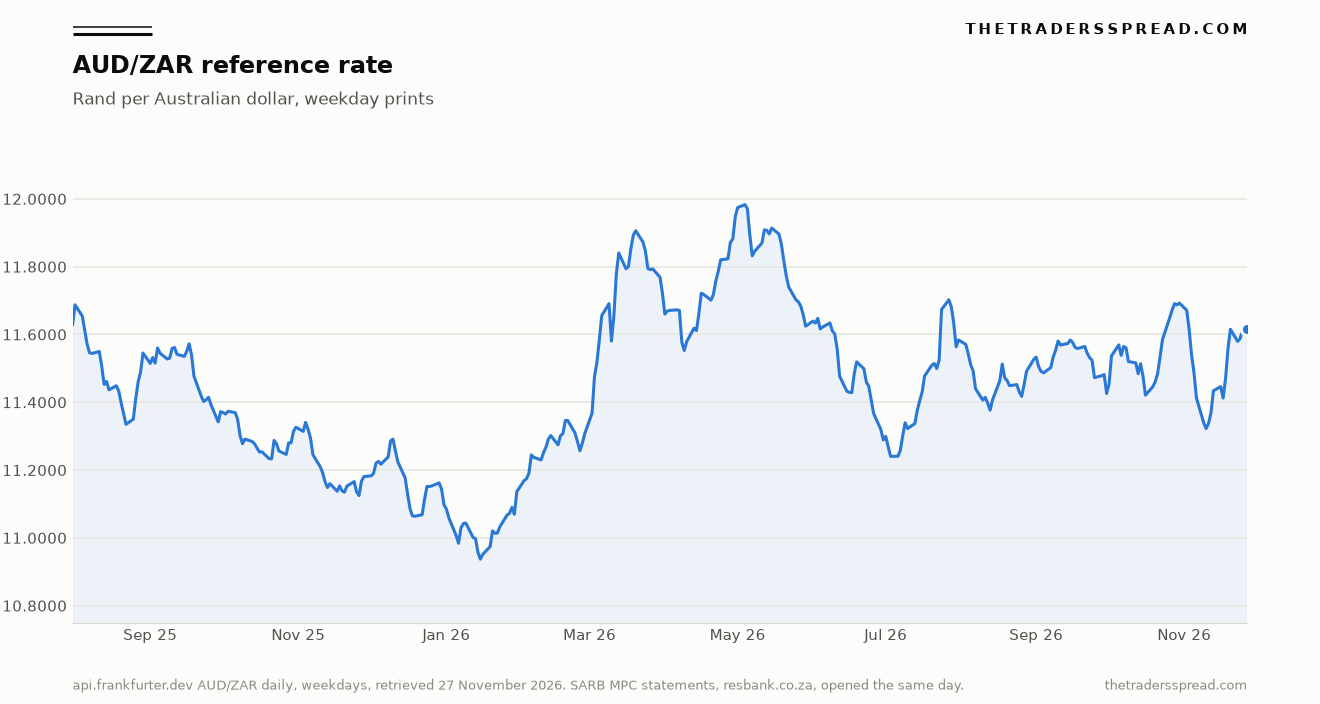
The chart is the same weekday series, from the 31 July 2025 print through 27 November 2026, and it shows the reference rate, with the decision dates kept in the table and the line itself left as the cross.
1. 31 July 2025, reduced to 7%
The 31 July 2025 statement carries that date on the embargo line and says it was published on 31 July 2025. Kganyago's text says the committee decided to reduce the policy rate by 25 basis points, to 7%, with effect from 1 August, and the decision was unanimous. The page printed headline inflation at 3% for June and core inflation at 2.9%, with the target still the 3 to 6 percent range and a preferred rate of 3%. AUD/ZAR on the statement date was 11.6278, and the twentieth later weekday print, on 28 August 2025, was 11.4891, a fall of 1.19 percent.
2. 18 September 2025, kept at 7%
The 18 September 2025 statement says the committee decided to keep the policy rate unchanged, at 7%. Four members preferred to keep rates on hold, while two favoured a cut of 25 basis points. The page printed inflation at 3.3%. The statement also says that since the previous September the committee had reduced rates by 125 basis points, and that it wanted to see how that easing was affecting the economy, how expectations were evolving, and how inflation risks were being resolved. AUD/ZAR was 11.5396 on the statement date and 11.2530 on 16 October 2025, a fall of 2.48 percent. That is the largest decline in the eight windows, and the decision that day was a hold.
3. 20 November 2025, reduced to 6.75%
The 20 November 2025 statement says the committee decided to reduce the policy rate by 25 basis points, to 6.75%, with effect from 21 November, and the decision was unanimous. The same page records the revised target, 3% plus or minus 1 percentage point, agreed between the Minister of Finance and the Governor, and it says the tolerance band is there so inflation can miss an exact point when shocks hit, while policy is still set so inflation goes back to 3%. October inflation on the page is 3.6%. AUD/ZAR was 11.1349 on 20 November and 11.0651 on 18 December 2025, a fall of 0.63 percent. The second cut in the run was also followed by a lower cross.
4. 29 January 2026, kept at 6.75%
The 29 January 2026 statement says the committee decided to keep the policy rate unchanged, at 6.75%. Two members favoured a cut of 25 basis points, while four preferred a hold. The page printed December inflation at 3.6% and the average for 2025 at 3.2%, close to the 3% objective. It also says services inflation was still over 4%, against goods inflation at 3% and core goods at 1.2%. AUD/ZAR was 11.0696 on 29 January and 11.2795 on 26 February 2026, a rise of 1.90 percent. This is the only one of the eight windows in which the cross was higher twenty weekday prints later, and the decision that day was a hold.
5. 26 March 2026, kept at 6.75%
The 26 March 2026 statement says the committee decided to keep the policy rate unchanged, at 6.75%, and the decision was unanimous. February inflation on the page is 3.0% for the headline rate and 3.0% for core, which the statement calls in line with the target. The text says the Middle East conflict had lifted oil, gas and fertiliser prices, and that the committee saw inflation risks to the upside, with headline inflation soon expected around 4% and fuel inflation over 18% for the second quarter. AUD/ZAR was 11.7912 on 26 March and 11.7862 on 23 April 2026, a fall of 0.04 percent. Over those twenty weekday prints the cross was nearly flat.
6. 28 May 2026, increased to 7%
The 28 May 2026 statement says the committee decided to increase the policy rate by 25 basis points, to 7%, effective from 29 May. Four members preferred the increase, while two favoured an unchanged rate. The page printed April inflation at 4%, up from 3.1%, and said fuel prices had increased by 11.4% after falling by 8.7% in March, one of the largest jumps in fuel inflation on record. The forecast on the page has headline inflation averaging 4.4% in 2026 and 3.7% in 2027, before a return to the 3% target in 2028. AUD/ZAR was 11.6585 on 28 May and 11.4071 on 25 June 2026, a fall of 2.16 percent. The cross was lower after the increase. The September 2025 hold, at 2.48 percent lower, was a larger decline than this one.
7. 23 July 2026, kept at 7%
The 23 July 2026 statement says the committee decided to keep the policy rate unchanged, at 7%. Four members preferred a hold, while two favoured an increase of 25 basis points. The page printed inflation at 5.0% and said the committee expected headline inflation to stay above 4% until early the following year. It also said the rand was close to where it had started the year against the dollar, and stronger against the euro. AUD/ZAR was 11.5247 on 23 July and 11.4645 on 20 August 2026, a fall of 0.52 percent. The hold came after the May increase, and the cross was slightly lower twenty weekday prints later.
Related7 Steps From the Policy-Rate Gap to the EUR/NOK Cross
8. 23 September 2026, raised to 7.25%
The 23 September 2026 statement, the page named at the start, says the committee decided to raise the policy rate by 25 basis points, to 7.25%, effective from 25 September, and the decision was unanimous. The page printed inflation at 4.4% and said headline inflation would likely sit above 5% later in 2026 and early in 2027, before slowing as the fuel shock receded, with a return to around 3% towards the end of 2027. Annual growth on the page is projected at 1.2%. AUD/ZAR was 11.5318 on 23 September and 11.4843 on 21 October 2026, a fall of 0.41 percent. The cross was lower after the raise, by less than the decline after the May increase and by less than the decline after the September 2025 hold.
Across the eight windows the cross was lower seven times and higher once. The two cuts, on 31 July 2025 and 20 November 2025, were both followed by a lower cross. The two increases, on 28 May 2026 and 23 September 2026, were also followed by a lower cross. The four holds printed changes of 2.48 percent lower, 1.90 percent higher, 0.04 percent lower and 0.52 percent lower. The repo rate on the statement and the sign of the next twenty weekday prints sit side by side in the table.
The latest print, split into two legs
On 27 November 2026 frankfurter.dev printed AUD/ZAR at 11.6154. AUD/USD on that date was 0.66231. USD/ZAR, requested with the US dollar as the base, was 17.5377. Dividing 11.6154 by 0.66231 returns 17.5377, the same direct print, so the cross equals the Australian-dollar leg times the rand leg. From 26 November the cross moved from 11.6025 to 11.6154, a rise of 0.111 percent. AUD/USD moved from 0.66139 to 0.66231, a rise of 0.139 percent. USD/ZAR moved from 17.5426 to 17.5377, a fall of 0.028 percent. The day's rise in the cross lines up with the Australian-dollar leg, and the rand leg went the other way. The log share is the natural log of each leg's ratio divided by the natural log of the cross ratio: about 125 percent for AUD/USD and about minus 25 percent for USD/ZAR, which is what an offsetting leg looks like when the two moves are added in logs.
Readers who want the dollar-rand rate on its own can use the September USD/ZAR forecast. A separate Australian cross, built from a reference rate in the same family, is the AUD/SEK split. Dealing spreads at the Johannesburg open are a different question from this 20-day count, and they are covered in why GBP/ZAR spreads change at the Johannesburg open.
A checklist for the eight rows
- Take the decision date from the embargo line on the Reserve Bank statement, and match it to the frankfurter.dev print for that calendar date.
- Count twenty later Monday-to-Friday prints, and leave Saturday and Sunday rates out of the count.
- Record the repo rate the statement prints after the decision, together with the verb on the page: reduce, keep unchanged, increase, or raise.
- Compute the percent change as the later print divided by the decision-day print, minus one.
- Read AUD/USD and USD/ZAR for the same dates before treating the cross as a rand move. On 27 November the Australian-dollar leg accounted for the day's rise.
- Keep a meeting out of the table until twenty weekday prints exist after it. The 19 November 2026 hold is in that position, with six weekday prints so far.
This is analysis, not advice, and capital is at risk.