

On the Central Bank of Iceland's official exchange-rate page, the 13 November 2026 fixing put USD/ISK at 123.60 kronur per dollar.
The Frankfurter series for one dollar against the krona printed the same 123.60 that day, and 123.27 on 12 November. The rise of 0.33 kronur is 0.27%, the daily change shown beside the fixing on the Bank's exchange-rate page. The window behind that print runs from 1 August 2025 to 13 November 2026 and holds 330 business days.
| Reading | Figure | Source and date |
|---|---|---|
| Frankfurter USD/ISK, kronur per dollar | 123.60 | Frankfurter, 13 November 2026 |
| Prior Frankfurter print | 123.27 | Frankfurter, 12 November 2026 |
| High in this window | 128.13 | Frankfurter, 28 November 2025 |
| Low in this window | 119.79 | Frankfurter, 25 September 2026 |
| Change since 13 November 2025, when the print was 126.52 | down 2.92 kronur, or 2.31% | Frankfurter |
| Key rate, seven-day term deposits | 8.00% | Central Bank of Iceland rate card, effective 7 October 2026 |
| Federal funds target range | 3.75% to 4.00% | FOMC statement, 28 October 2026 |
| Gap, key rate minus the top of the Fed range | 4.00 percentage points | 8.00 minus 4.00 |
| Gap, key rate minus the floor of the Fed range | 4.25 percentage points | 8.00 minus 3.75 |
| Twelve-month inflation | 5.9% | MPC minutes, September CPI |
| Bull, base and bear for USD/ISK | 128.0, 122.5 and 119.0 | Scenarios to 31 March 2027 |
Read the table from the print outward. At 123.60 the dollar buys 2.92 fewer kronur than on 13 November 2025, when the series stood at 126.52, so the krona is 2.31% stronger over that year. The print sits 4.53 kronur under the 28 November 2025 high of 128.13 and 3.81 kronur over the 25 September 2026 low of 119.79. The 8.00% key rate stands 4.00 percentage points above the top of the Fed's 3.75% to 4.00% range and 4.25 points above the floor. For 31 March 2027, a bull print of 128.0 stands above 123.60, a bear print of 119.0 stands below it, and 122.5 sits between them.
How the krona quote works
The krona, spelled króna and plural krónur, is the currency Iceland issues. USD/ISK tells you how many krónur one US dollar buys. When that number rises, the krona is weaker, because the same dollar stretches across more of them. When the number falls, the krona is stronger. A trader used to euro quotes, where a rise means a stronger euro, has to turn that habit around before the levels below will make sense.
A small sum makes the scale obvious. At 123.60, one thousand dollars converts to 123,600 kronur. At the bull number, 128.0, the same thousand dollars converts to 128,000 kronur. At the bear number, 119.0, it converts to 119,000 kronur. The distance from the bull number to the bear number is 9,000 kronur on every thousand dollars, about 7.3% of today's krona amount.
The policy rate is the rate on seven-day term deposits at the Central Bank of Iceland. The Monetary Policy Committee left that rate at 8.00% on 7 October 2026. The minutes of the meeting held on 5 and 6 October say the same Committee had raised it by 0.25 percentage points, to 8.00%, in August. When people in Reykjavík say the key rate, this is the rate they mean, and the forecast below is built on it.
The fixing is the Bank's once-a-day official reference rate for the krona. On the Bank's own account of the listing, the rate is recorded at 14:15 Central European Time on days when regulated foreign-exchange markets are open, and it is published around 16:00 Iceland time. Agreements, court cases and other contracts use that figure when they leave the rate unnamed, under Article 29 of Act 92/2019 on the Central Bank of Iceland. The fixing is a reference for those agreements, not a price a bank must trade. A peg is a different machine. The page on the USD/HKD convertibility band describes a standing dealing range, while Iceland's fixing is a snapshot of where the market stood at 14:15.
It also helps to see USD/ISK as one leg of a dollar cross. The walk-through of how two dollar rates build NOK/SEK is the same arithmetic in the other direction. Here the dollar is already the base and the krona is the price, so you are counting kronur, and a higher count is a cheaper krona.
The corridor around an 8.00% key rate
| Facility | Rate | Where it was set |
|---|---|---|
| Overnight loans | 9.75% | Rate card, effective 7 October 2026 |
| Seven-day collateralised loans | 8.75% | Same card |
| Seven-day term deposits, the key rate | 8.00% | Same card, and the minutes |
| Current accounts | 7.75% | Same card |
| Federal funds target range | 3.75% to 4.00% | FOMC, held 28 October 2026 |
The rate card is the instrument that puts the numbers into effect. Dated in Reykjavík on 7 October 2026, it lists overnight loans at 9.75%, seven-day collateralised loans at 8.75%, seven-day term deposits at 8.00% and current accounts at 7.75%. The comparison below stays on those quoted rates, 8.00% against a range of 3.75% to 4.00%.
The minutes of that same meeting, the 136th, published on 21 October, record a proposal from Ásgeir Jónsson, Governor and Chair. He proposed that the key rate be held at 8.0%, with the current-account rate, the seven-day collateralised rate and the overnight lending rate each a quarter of a point lower than the figures on the card. Every member voted for the proposal, and the minutes list five members in attendance. The forecast uses 8.00%, the key rate both documents share, and takes the rest of the corridor from the card, because that is the announcement the Bank issued to set what banks earn and pay.
On the dollar side the range is the one the Federal Open Market Committee published. The statement of 16 September 2026 raised the target range by a quarter of a percentage point, to 3.75% to 4%, on a 12 to 0 vote, and said inflation remained elevated. The statement of 28 October 2026 kept that range, on a 10 to 2 vote. Lisa Cook and Beth Hammack preferred another quarter-point rise. The Icelandic minutes describe the September Fed move as the first hike in three years. The gap that drives USD/ISK is the one against that range.
Those minutes also say the three-month interbank differential against the US dollar was unchanged between the August meeting and the October meeting, which fits a quarter-point hike on each side and leaves the distance between 8.00% and the top of the Fed range at 4.00 points. The Bank's own real-rate measure, an average of inflation gauges and one-year expectations, stood at 3.4% at the October meeting, 0.1 percentage point lower than just after the August decision. Subtracting the 5.9% headline from 8.00% gives a different sum, about 2.1 points, and that sum is left aside here. The 3.4% is the figure the Committee was looking at.
Inflation is why the Committee is holding a rate that high. The minutes say the consumer price index rose 0.39% in September and that twelve-month inflation reached 5.9%, the highest in two years, with inflation excluding housing at 5.7% and underlying inflation, the average of the Bank's measures, at 4.4%. The Committee's view is that inflation and expectations are still too high, that most indicators point to a fairly rapid decline in 2027, and that the uncertainty around that decline sits on the side of a slower fall.
A currency can follow its own rate rather than a simple dollar story. That is the point of the page on why GBP/SEK follows its own rate path, and it is the right frame for the krona. The Icelandic key rate is several points above the Fed range. Through 31 March 2027 the live question is whether that gap stays wide, narrows because one of the two central banks moves, or gets leaned against by the Bank's own buying of foreign currency.
What the fixing did when both banks moved
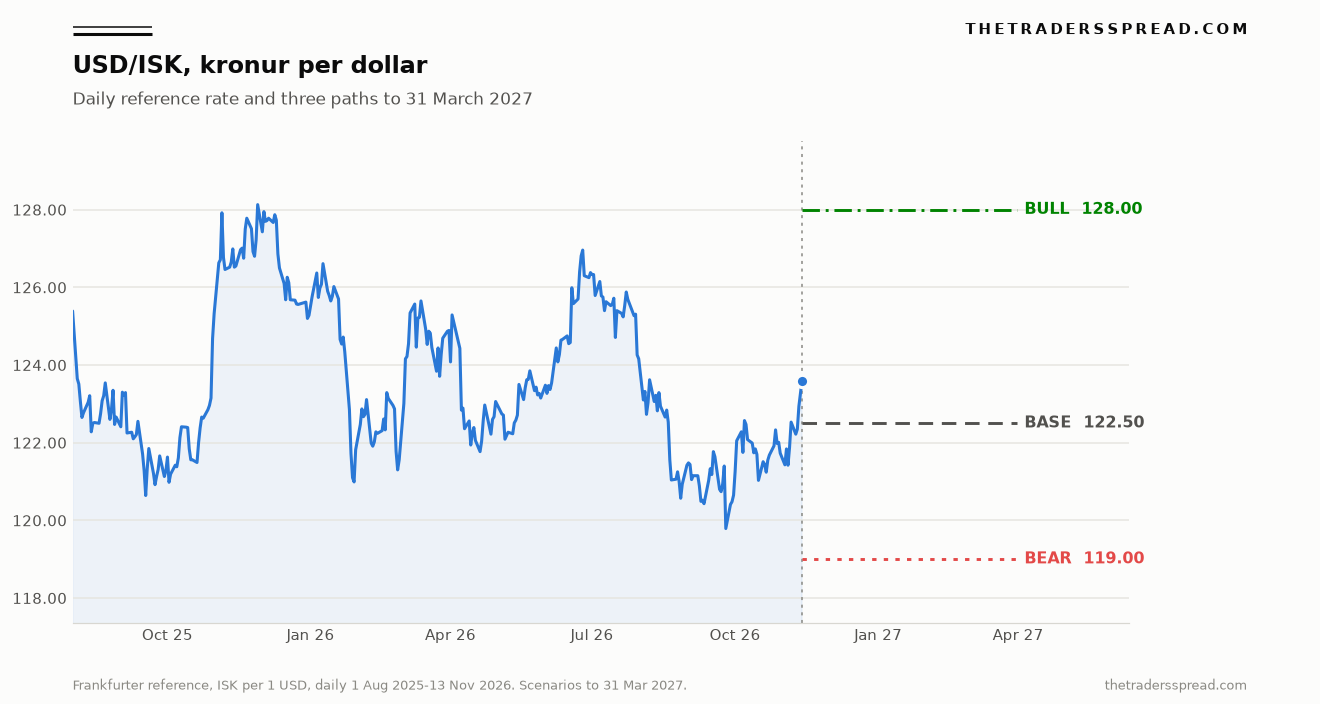
The chart is that Frankfurter series, in kronur per dollar. The last dot is 13 November at 123.60. The bull line at 128.00 sits above it, the base at 122.50 sits a little under it, and the bear at 119.00 sits under the September low, each with its own dash pattern out to 31 March 2027. History is to the left of the dotted line. The lines to the right are scenarios.
Three dates make the path easier to read than a smooth trend would. On 19 August 2026, the day the Committee raised the key rate to 8.00%, Frankfurter printed 122.53, and by 25 September the series was at the window low of 119.79, so the krona firmed after the hike. The Fed's quarter-point rise came in the middle of that slide. The 17 September print, the session after the 16 September statement, was 121.77. The quarter-point rise in the Fed's range on 16 September did not lift USD/ISK over the following sessions, and eight days later the pair printed the low.
The hold on 7 October landed at 122.57, already 2.78 kronur above the September low, and by 13 November the print was 123.60, another 1.03 kronur higher, or 0.84%. Since 1 October the series has held between 121.03, on 16 October, and 123.60, on 13 November, across 32 business days. The base number, 122.5, sits inside that band. The bull number and the bear number sit outside it.
The minutes describe a slightly earlier window, the one the Committee could see by early October. Since the August meeting the krona had appreciated by 2.8% in trade-weighted terms, by 3.6% against the euro and by roughly 0.9% against the US dollar. Over that stretch the Bank was buying foreign currency. In September it raised regular purchases from 6 million euros a week to 12 million euros a week, and between the meetings it bought 60 million euros, about 8.8 billion kronur, on that programme, plus another 17 million euros, about 2.4 billion kronur, to lean against short-term swings. Those transactions were 27% of interbank turnover and 1.7% of turnover in the wider domestic foreign-exchange market.
Buying euros means the Bank is supplying kronur. It was leaning against the appreciation, and the krona appreciated anyway, so the interest gap was large enough to firm the currency while the central bank stood on the other side of the flow. Preliminary figures from Statistics Iceland, cited in the minutes, put foreign-currency prices of marine products just over a fifth higher in the first eight months of 2026. Brent rose 10.5% between the meetings, to nearly 101 dollars a barrel, which is part of why headline inflation is 5.9%. Unit labour costs still rose by nearly 4% in the first half, faster than the inflation target will tolerate over time.
The bull case at 128.0
128.0 is 4.40 kronur above 123.60, about 3.6%, and it sits 0.13 under the 28 November 2025 high of 128.13. The bull case is a return to that winter high by 31 March 2027, inside a range the pair has already traded. On the way there the series would have to clear 126.96, the highest print of 2026, set on 25 June and 3.36 kronur above the latest fixing.
The economic version of that climb is a narrower gap. If the Fed raises the range, as Cook and Hammack already preferred on 28 October, and Reykjavík holds 8.00%, the gap against the top of the range shrinks from 4.00 points to 3.75. A quarter-point Fed rise in September coincided with a lower USD/ISK, so a repeat of that size is a thin reason, on its own, to expect 128.0. The cleaner trigger is a statement that treats the 2027 inflation decline, which the minutes already call the likely path, as a reason to ease. A cut from 8.00% narrows the spread even if the Fed stays on hold. A larger weekly euro bid, beside either of those, is what would make 128.0 a return to last winter rather than a line on a chart.
Related0.35% USD/IDR Rise Meets a Bank Indonesia Currency Pact
The bear case at 119.0
119.0 is 4.60 kronur under 123.60, about 3.7%, and 0.79 under the 25 September low of 119.79. It is the scenario that steps outside the range of this window. Krona deposits at the key rate pay 8.00%, while dollar cash inside the Fed's target range pays 3.75% to 4.00%, a gap of 4.00 to 4.25 percentage points before anyone reaches the Bank's 3.4% real-rate measure. For a small currency that spread is the load-bearing fact, and the pair has already travelled from 128.13 to 119.79 while the gap was this wide.
The next statement can make the spread wider. Headline inflation at 5.9% and underlying inflation at 4.4% keep a hike on the table, and the minutes say the Committee will respond if inflation, expectations or wages show that the stance still has work to do. A move to 8.25% would put 4.25 points between the key rate and the current top of the Fed range. The bear case survives a later matched Fed hike, which would leave the gap near today's 4.00 points, and it gets more room if Reykjavík hikes while the Fed holds.
The euro purchases belong inside the bear case. The krona appreciated, on the minutes' own measures, while the Bank was buying them, so private demand was larger than the official offer. A path back through 119.79 toward 119.0 is what that demand looks like if the stance stays tight and the weekly purchases stay at 12 million. The bounce to 123.60 is why 119.0 is a path rather than a description of the last print: since the October hold the dollar has regained 1.03 kronur, and the bear case says that hand-back stalls if the gap and the export bid both remain.
A base at 122.5 if the gap just sits
122.5 is 1.10 kronur under the 13 November print, about 0.9%, inside the band from 121.03 on 16 October to 123.60 on 13 November. It is the path if both banks leave rates where they are, the Bank keeps buying about 12 million euros a week, and the fixing drifts under 123.60 while staying above 119.79. That is a firmer krona than today's print and a weaker one than the September low, the row for a quiet pair of meetings, when the carry and the official euro bid roughly cancel.
What would move either case
The minutes, published on 21 October, set the next statement for Wednesday 18 November 2026. The paths above are anchored to the 13 November fixing and to the rates in force when those documents were read on 16 November. A hold would leave the 4.00-point gap where it is, so both 128.0 and 119.0 would stay on the map. A hike would move the bear case forward, because the krona would pay still more. A cut, or language that points toward easier policy once the 2027 inflation path arrives, would move the bull case forward, because the 8.00% side of the gap would be the side that changed.
The fixing can move the cases even if the statement is a hold. A run of prints above 126.96, the 25 June high, would put 128.0 within about one krona. Clearing that ledge would matter more than another Fed dissent, because Cook and Hammack's preference for a hike on 28 October was a vote, while the September hike was an actual decision and coincided with a lower USD/ISK.
The bear case would move if the fixing slipped under 119.79 while the Bank was still buying 12 million euros a week, a larger official bid than the 6 million euro programme in place before September. That would also mean the bounce from 119.79 to 123.60 had been given back in full. Export prices would have to keep doing the work the minutes described, or the carry would have to do it alone.
Either case would be exhausted if the fixing left the band from 119.0 to 128.0 before 31 March 2027. The bull number is the winter high, give or take 0.13 kronur, and the bear number is a small step through the September low. A print outside those two edges would mean the gap, the euro purchases or the export bid had changed scale, and the three lines would have to be drawn again from the new fixing and the new key rate.
This article is general information, not a recommendation to buy or sell any currency, and it leaves personal finances out of the account.