

USD/CNY is the pair I open twice on a fixing morning, once for the number a client wants and once for the rule that will be allowed to print it. CFETS publishes a central parity before the onshore market deals, and the interbank price lives inside a band around that parity. A client who typed usd cny exchange rate usually wants one of those prints and calls all of them "the yuan". I split the blotter lines after a junior averaged a morning parity with an afternoon European cross and sent the blend out, which failed both markets.
Five forces do the work on a fixing day. The central parity is the centre of the session and the trading band is the room around it. The ECB reference is the outside benchmark, with a date on the file. The interest-rate gap compares US and Chinese policy rates, and the offshore CNH print is the yuan beyond the onshore rule, usable only after a board has been opened. A foreign-exchange reserve requirement sits beside those five when the People's Bank of China has changed it.
Updated 15 November 2026, with every print below kept as reference data from the source named on its line.
Key facts for a USD/CNY fixing day, each one closed with its source.
- CFETS publishes the yuan-dollar central parity at 9:15 a.m. on each business day, under PBOC authority. Source: People's Bank of China, Yinfa No. 188 [2014], page opened 15 November 2026.
- Onshore USD/CNY may trade up to 2% either side of that day's parity. Source: People's Bank of China, Yinfa No. 188 [2014], page opened 15 November 2026.
- The ECB reference cross was 6.6719 yuan per dollar on 13 November 2026, from euro rates of 1.1052 dollars and 7.3738 yuan. Source: ECB daily reference file and the Frankfurter ECB provider, retrieved 15 November 2026.
- Across 255 observations from 14 November 2025 to 13 November 2026, that cross moved from 7.0961 to 6.6719, a fall of 0.4242, or 5.98%. The window high was 7.1138 on 20 November 2025 and the low was 6.6483 on 2 November 2026. Source: Frankfurter history matched to the ECB provider, retrieved 15 November 2026.
- The federal funds target range is 3.75% to 4%, and the PBOC overnight reverse-repo rate is 1.25%, a gap of 2.50 to 2.75 percentage points. Source: FOMC statement, 28 October 2026; PBOC open-market announcement effective 2 November 2026.
- The one-year loan prime rate is 3.0% and the over-five-year loan prime rate is 3.5%. Source: National Interbank Funding Center announcement, 20 October 2026, opened 15 November 2026.
- The foreign-exchange reserve requirement ratio rises from 4% to 6%, effective 15 November 2026. Source: People's Bank of China statement, 3 November 2026, opened 15 November 2026.
What is the USD/CNY daily fix?
The daily fix, in the notice that still describes it, is the central parity of the renminbi against the US dollar. Renminbi is the currency's name and yuan is the unit you count. USD/CNY is yuan per one dollar, and CNY is the onshore code. On the English page for Yinfa No. 188 [2014], opened on 15 November 2026, the People's Bank of China authorises CFETS to publish that parity at 9:15 a.m. on each business day, and it applies until the next one replaces it.
The same morning also sets parities for the euro, the yen, the Hong Kong dollar, sterling, the ringgit, the rouble, and the Australian, Canadian and New Zealand dollars. The dollar parity is the centre for onshore USD/CNY, and several of the others are built from it. The parity is the centre the session is measured from, while deals print at bids and offers inside the band, so a ticket at 6.68 and a parity at 6.70 can both be right.
Beijing is eight hours ahead of UTC all year. In November, London is on UTC and New York is five hours behind, after the US ends daylight saving on the first Sunday, so 9:15 a.m. in Beijing is 01:15 in London and 20:15 the previous evening in New York.
How do quoting banks build the central parity?
Before the interbank market opens, CFETS asks market makers for yuan-dollar quotations. The Yinfa No. 188 [2014] notice removes the highest quotation and the lowest, and the day's central parity is the weighted average of what remains. Weights come from interbank volumes, from the quotations, and from other indicators the page leaves inside the trading system. I stopped asking juniors for an equation they can paste into a sheet. The page gives the procedure, and the weights stay with CFETS.
The trim is worth doing by hand on a classroom sketch, kept separate from any parity CFETS published. Take 6.70, 6.71, 6.72, 6.73 and 6.90, then drop the low and the high. What remains is 6.71, 6.72 and 6.73, and the equal-weight average is 6.72, so the 6.90 quote has lost its seat. Live weights match that sketch only by coincidence, because CFETS weights by volume and by other indicators, and a bank that wants to tug the parity has to move a quote still inside the pack.
Each bank still sends its own figure. The parity is that trimmed, weighted result: market-maker quotations and a CFETS calculation under PBOC authority. Yuan against the euro, the Hong Kong dollar and the Canadian dollar is then worked from the day's yuan-dollar parity and from those currencies against the dollar at 9:00 a.m. Sterling, the yen, the Australian and New Zealand dollars, the ringgit and the rouble come from direct quotations before the open, and the derived crosses move with the dollar parity by construction.
How wide is the onshore trading band?
The same notice sets the float. Onshore yuan-dollar may sit up to 2% above the day's central parity or up to 2% below it. The euro, the yen, the Hong Kong dollar, sterling and the Australian, Canadian and New Zealand dollars may float 3% either side of their own parities, and the ringgit and the rouble may float 5%. The dollar band is the narrow one, on the pair several of the others are calculated from.
A round centre makes the width easy to feel. Take 7.0000 as a sketch of the rule, chosen so the percentages are clean and kept separate from any morning CFETS published. Two percent of 7.0000 is 0.1400, so the edges are 7.1400 and 6.8600. Counting a pip as 0.0001 yuan puts each edge 1,400 pips from the centre. An hour of 80 pips uses a small slice of that range, and fresh edges arrive only with the next parity.
| Force | What it is | Where the rule lives |
|---|---|---|
| Central parity | Trimmed, weighted average of market-maker quotes | CFETS at 9:15 a.m., Yinfa No. 188 [2014] |
| Onshore band | 2% above or below that day's dollar parity | Same notice, interbank spot |
| ECB reference cross | Yuan per dollar from two euro reference rates | ECB daily file, date on the payload |
| Policy-rate gap | Federal funds target minus the PBOC overnight reverse repo | FOMC 28 October 2026; PBOC from 2 November 2026 |
| Offshore CNH | Yuan dealt outside the onshore band | Open a board before printing a level |
A band that moves with the parity is a different object from a peg that defends fixed edges. The Hong Kong dollar's convertibility zone is that second arrangement, and the way the zone behaves is on our page about the USD/HKD peg. On USD/CNY the centre is new each business morning, so yesterday's 2% edges describe yesterday. Read the new parity, multiply by 1.02 and by 0.98, and write both edges beside the dealing price.
Why keep the ECB reference on its own line?
The European Central Bank publishes euro reference rates on its business days. I opened the daily file for 13 November 2026: the euro stood at 1.1052 dollars and at 7.3738 yuan. Divide yuan by dollars and the cross is 6.671915, which rounds to 6.6719 yuan per dollar. Frankfurter's v1 USD-into-CNY route, the one the history below comes from, returned 6.6719 with payload date 13 November 2026. The ECB provider on Frankfurter matched the history file on 14 November 2025, 20 November 2025, 30 June 2026 and 2 November 2026, at 7.0961, 7.1138, 6.7855 and 6.6483. That cross is the chart, named as the ECB reference and kept off the line where the onshore dealing price, a trade inside the band, belongs.
The series holds 255 ECB business days, from 14 November 2025 through 13 November 2026. The request began on 15 November 2025, a Saturday, so the file opens on the previous business day. The cross went from 7.0961 to 6.6719, a fall of 0.4242 yuan per dollar, or 5.98% against the start. Fewer yuan per dollar is a stronger yuan on this quotation. The high is 7.1138 on 20 November 2025, the low is 6.6483 on 2 November 2026, and high to low is 0.4655 yuan.
| ECB reference date | CNY per USD | What the print marks |
|---|---|---|
| 14 November 2025 | 7.0961 | First observation in the window |
| 20 November 2025 | 7.1138 | High of the window |
| 31 December 2025 | 7.0010 | Last 2025 observation |
| 30 June 2026 | 6.7855 | Last observation of June |
| 2 November 2026 | 6.6483 | Low of the window |
| 13 November 2026 | 6.6719 | Latest payload; 7.3738 over 1.1052 |
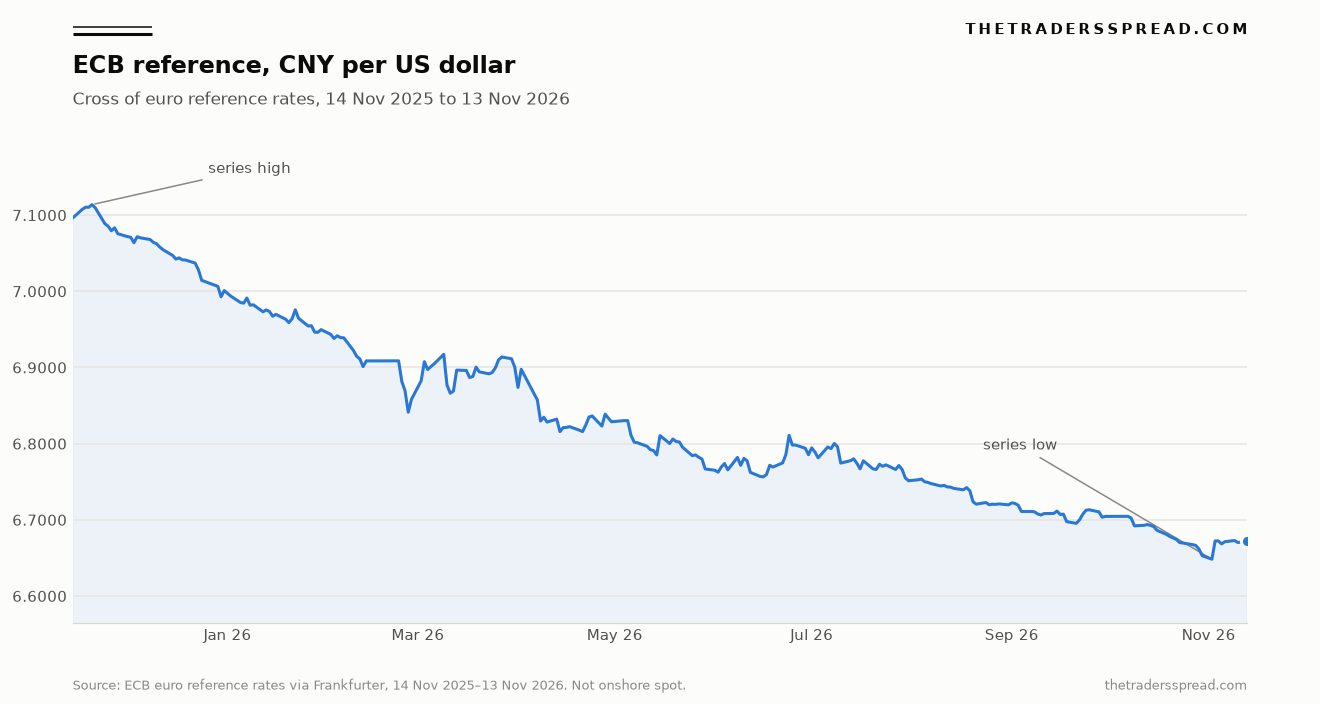
Marking a hedge on the ECB cross and dealing onshore mixes two clocks, a European reference against a China morning print. The distance between 6.6719 and the same-day CFETS parity is a measurement for the CFETS page on the day you care about, so that morning's centre stays out of this table. The chart comes from the ECB daily file and the Frankfurter history. At 6.6719 one dollar is referenced at 6.6719 yuan, and a fall means fewer yuan per dollar, the yuan gaining, which is the opposite of the EUR/USD habit.
The cross exists because the ECB publishes the euro against each currency and the ratio does the rest, so holidays and rounding live in the legs. A missing European leg means a missing dollar cross, which is why 255 points cover a year of calendar days and still skip weekends. The same two-leg problem, on a different pair, is in our explainer on GBP/SGD as two dollar rates.
What does the interest-rate gap do on this pair?
Two committees set the policy rates behind USD/CNY, on different days and for domestic reasons of their own. The gap is a slow input into how banks think about holding dollars against yuan. It explains a single morning's parity poorly on its own, and the forward market is built on it, so the blotter still needs the line.
On 28 October 2026 the Federal Open Market Committee maintained the federal funds target range at 3.75% to 4%. I opened the statement on 15 November 2026. The vote was 10 to 2, with Lisa Cook and Beth Hammack preferring a quarter-point rise. The maintained range is the policy object, and the effective funds rate can print inside it.
A PBOC open-market announcement dated 30 October 2026 changes the short-term tools from 2 November 2026. Overnight reverse repos run each working day, by quantity bidding, at a fixed 1.25%. The 7-day reverse repo moves to a variable-rate tender with a fixed quantity, used mainly around tax dates and month-ends, and tools that had been a spread off the 7-day rate are repriced off the overnight rate, old spread unchanged. I opened that announcement on 15 November 2026. The 1.25% rate is the operational rate the page lets me cite.
RelatedUSD/TWD: Myths About the Close, the Bank and the Fix
Subtract 1.25 from each end of the Fed range and the gap is 2.50 percentage points at the bottom and 2.75 at the top. Under covered-interest parity the higher-rate currency trades at a forward discount, and the dollar is the higher-rate currency here, so forward yuan-per-dollar sits below spot when that relationship holds. Live forward points stay off the blotter until a curve is opened in the same session, and the gap can sit still while morning quotes also carry customer flow, the offshore dollar and the band that starts at 9:15.
The loan prime rate is a lending price, easy to drop into the wrong gap. On 20 October 2026 the National Interbank Funding Center, under PBOC authority, set the one-year LPR at 3.0% and the over-five-year LPR at 3.5% until the next release. I opened that announcement on 15 November 2026. Against the one-year LPR the Fed range leaves a gap of 0.75 to 1.00 percentage points, smaller than the gap against 1.25%, because 3.0 sits closer to 3.75 than the overnight rate does.
| Rate | Figure | Date on the source |
|---|---|---|
| Federal funds target range | 3.75% to 4% | FOMC statement, 28 October 2026 |
| PBOC overnight reverse repo | 1.25% | Effective 2 November 2026 |
| Gap, overnight repo to the Fed range | 2.50 to 2.75 percentage points | Difference of the two rows above |
| One-year LPR | 3.0% | 20 October 2026 |
| Over-five-year LPR | 3.5% | 20 October 2026 |
| FX reserve requirement | 6%, raised from 4% | Effective 15 November 2026 |
On 3 November 2026 the PBOC raised the foreign-exchange reserve requirement ratio for financial institutions by 2 percentage points, from 4% to 6%, effective 15 November 2026, to strengthen management of foreign-exchange liquidity. I opened that statement on 15 November 2026. Banks set aside a larger share of foreign-currency deposits, so the dollars they can lend or sell shrink by that slice. The ratio is a stock rule and the parity is a daily price, and they meet in the quotes submitted at the open, beside an unchanged quoting procedure.
Where does the offshore CNH print sit?
CNY is the onshore yuan inside the interbank band. CNH is the offshore yuan dealt in Hong Kong and in other centres outside that band. The 2% limit in Yinfa No. 188 binds onshore interbank spot. An offshore price has different participants and can sit away from the onshore range, and the distance is itself a price. Desks watch it for the pressure the band is absorbing, and because a hedge written as onshore sometimes gets filled offshore.
The offshore pair has its own page, where USD/CNH is handled as a forecast with scenario levels that stay on that page. The job here is how the daily fix is built, and which other prints get mistaken for it. A neighbouring close with its own official-print myths is the USD/TWD fixing piece. Take from it the habit of asking which clock and which institution publish the number.
The Hong Kong Association of Banks exchange-rate page, opened on 15 November 2026, returned a non-working-day notice and an empty table. Ask whether the client means CNY, inside the 2% band, or CNH, which needs its own quote. An onshore receivable wants CNY and an offshore channel often wants CNH, so the wrong fill can leave the parity, the band and the ECB reference correct while the ticket is the wrong yuan.
What do you check on a USD/CNY fixing day?
Run the list before any single figure is treated as the rate. Each line needs a source, and the list ends when the lines do.
- Read the CFETS dollar parity, the 9:15 a.m. print, and its business day. In November that is 01:15 in London and 20:15 the previous evening in New York.
- Recompute the 2% edges, parity times 1.02 and parity times 0.98, and retire the previous session's edges.
- Place the onshore dealing price you were shown between those edges.
- Keep the ECB reference on its own line with the file date. Here that date is 13 November 2026 and the cross is 6.6719, from 1.1052 and 7.3738.
- Write the rates in force: federal funds at 3.75% to 4%, and the PBOC overnight reverse repo at 1.25%. For loans, add the 3.0% one-year LPR and the 3.5% over-five-year LPR, apart from the overnight gap.
- If a reserve-requirement change is in force, note it. From 15 November 2026 the ratio is 6%, raised from 4%.
- Ask which unit the client means. CNH needs a board you have opened. A Sunday blank from the Hong Kong Association of Banks is a reason to wait.
Those five forces, plus the reserve ratio when the PBOC has changed the dollars banks must hold, are the whole conversation. Name the print and name the date.
This article is general information for traders studying USD/CNY, and it is not a recommendation to take a position in the pair or in any other market.