

The USD/TWD close is a Taipei interbank print that the central bank republishes, and the habit of reading that print as a number the bank types in each afternoon is the myth that still muddles the fixing. A non-deliverable forward settles on a morning rate. Customs uses a commercial-bank quote from an earlier ten-day date. An intraday tape can pass through a level the official close never records.
On 9 November 2026 the open file and a Central News Agency dispatch agree on the same close, 32.882 New Taiwan dollars per US dollar. Foreign holdings of Taiwan-listed stocks, bonds and local-currency deposits were US$1.743 trillion at the end of October, equal to 292 percent of reserves. Requests to an ECB-based feed for dollars against the Taiwan dollar, a latest quote and a history range, came back "not found". The history below is the central bank file retrieved on 13 November 2026, and its last row is the 12 November close, 32.889.
Updated 13 November 2026, using the interbank file through 12 November.
The close is someone else's print
Dataset 7232 is the closing rate of the New Taiwan dollar against the US dollar in the interbank market. The catalogue says the daily figure is each business day's close and names the source, Taipei Forex Inc. Monthly and annual figures in that description are geometric means of the daily closes. The Central Bank of the Republic of China (Taiwan) releases the file. Taipei Forex Inc. is the market whose close is released.
The bank's English closing-rate page matches the file on the recent prints, including 32.882 on 9 November and 32.889 on 12 November. A bank writing the close would publish a decree that named a level. This file is a market series with a commercial source, and its last row stops on 12 November because 13 November had yet to be added.
Four numbers that share a nickname
People say "the fixing" and point at whichever screen is open. Two rows below have a level opened this session. Two have a method, and no same-day board rate, because a guessed board rate would be a fake print.
| Who stands behind it | What the number is | Level opened on 13 November 2026 | |
|---|---|---|---|
| Interbank close | Taipei Forex Inc., republished by the central bank | Each business day's interbank close, New Taiwan dollars per US dollar | 32.889 on 12 November 2026 |
| TWD TAIFX1 (TWD03) | SFEMC and EMTA template for a non-deliverable forward, 17 May 2006 | Settlement-rate option, published at about 11:00 Taipei time on the valuation date | Method only. No same-day level opened |
| Customs declaration rate | Customs Administration, using a Bank of Taiwan quote | Selling rate for imports, buying rate for exports, from the 5th, 15th or 25th of the previous ten-day period | Method only. No board level opened |
| Intraday tape on 6 November | Focus Taiwan, 7 November 2026 | A morning print on a day whose official close was different | 33.04 in the morning, close 32.768 |
The morning figure of 33.04 is Focus Taiwan's report of the tape, and 32.768 is both their report and the central bank file. A contract that says "the close" and a conversation that says the rate traded through 33 are describing different facts from the same session.
What the central bank says it is doing
The bank's English page on foreign exchange says the NT dollar rate is determined by market forces, and that the bank steps in when seasonal or irregular factors disrupt the market, to keep the market orderly.
Governor Yang Chin-long put a name on the operating rule in remarks Focus Taiwan reported from the Legislative Yuan's Finance Committee on 28 October 2026. He would keep managing the market under the bank's "willow tree theory", allowing the Taiwan dollar to fluctuate while intervening only to prevent excessive volatility rather than defend a specific exchange rate. The quoted phrase is the news agency's. As they recorded the rule, it is a smoothing instruction with a trigger and with no published parity.
A parity is a different object. Hong Kong runs inside a convertibility band with a stated undertaking, set out in the USD/HKD peg and the convertibility band. Denmark's arrangement against the euro is another band, and the myths around it are a separate argument in GBP/DKK and the myths against the euro band. Yang's account to the legislature names no line of that kind.
On 10 November 2026 Yang told reporters, via Focus Taiwan, that foreign institutional investors had moved about US$10 billion out since the beginning of November, including profits and dividends he called normal business. Before Monday, the dispatch says, the Taiwan dollar had depreciated 1.20 percent against the US dollar since the start of November, the greenback had briefly risen above NT$33, and the move prompted intervention. October saw the Taiwan dollar fall 1.93 percent, with foreign institutional net outflows of about US$28 billion. Reserves ended October at US$596.44 billion, down US$4.31 billion, which the dispatch attributes to that intervention.
A trade story next to a stock of foreign holdings
The stock-flow myth says an export surplus ought to make the currency firm, so a soft patch must be a mystery or a hidden peg. The scale in the weeks the governor described is the stock of foreign holdings, and the flow leaving that stock.
Lin Chi-chao, chief economist at Cathay United Bank, said it in a sentence the Taipei Times on 9 November and Focus Taiwan on 7 November both quote: "With their holdings of local assets increasing, even if they were to trim their positions by just 1 percent and moved the proceeds overseas, it would be harder than ever for the central bank to maintain the NT dollar's stability." Both papers report the central-bank figure behind that sentence: US$1.743 trillion at the end of October, down from US$1.927 trillion at the end of September, equal to 292 percent of reserves. The statistical table itself stays with the central bank. The figure is used here as those two newsrooms reported it.
One percent of US$1.743 trillion is about US$17 billion. October's outflow of about US$28 billion, and Yang's early-November figure of about US$10 billion, are already slices of that stock large enough to swamp a typical goods-balance argument. Lin added that the bank needs exporters to convert dollar holdings when they have no immediate need for foreign currency, because sustained intervention is expensive, and he contrasted Taiwanese technology firms sending funds overseas with Korean firms bringing earnings home.
Focus Taiwan on 10 November reported foreign institutional net sales of NT$90.06 billion on 9 November, an eighth session in a row, with the eight-session total near NT$800 billion. The Taiex rose 1,960.06 points that Monday, and the close was still the weaker 32.882.
A year of the interbank close
The chart is the Taipei Forex close, one point per business day from 13 November 2025 through 12 November 2026, 243 points in all. Scenario lines are absent, because this page carries no price target and a forward line would invent one.
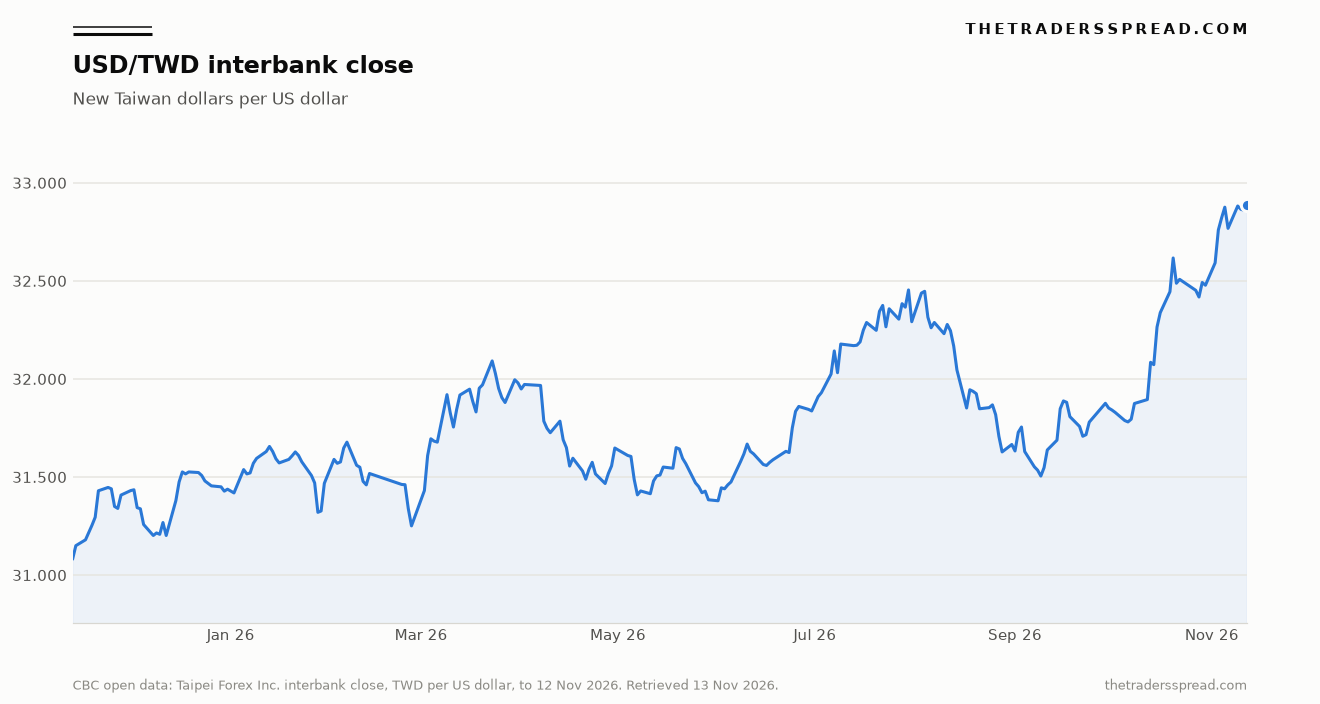
Across those 243 closes the file runs from 31.081 on 13 November 2025 to 32.889 on 12 November 2026. The session before the window, 12 November 2025, printed 31.069, so the left-hand value is simply where the plotted year starts. Inside the fourth quarter of 2025 the lowest close in the file is 30.415, on 2 October 2025.
| Business day | Interbank close, TWD per USD |
|---|---|
| 31 December 2025 | 31.438 |
| 2 January 2026 | 31.419 |
| 30 October 2026 | 32.478 |
| 6 November 2026 | 32.768 |
| 9 November 2026 | 32.882 |
| 12 November 2026 | 32.889 |
Every figure in that table is a daily-file row. There is no row for 31 October 2026, so the last October close is 30 October at 32.478. From 31.438 on 31 December 2025 to that print, the quote is higher by about 3.3 percent, beside the Taipei Times account of a 3.2 percent NT-dollar depreciation through the end of October. The catalogue's own monthly and annual averages are geometric means of the daily closes.
On 6 November the tape and the close parted. Focus Taiwan reported a morning print of NT$33.04 and a finish at NT$32.768, which the Taipei Times called the NT dollar closing up 0.33 percent. The file's previous close, 32.876 on 5 November, makes that a smaller quote. Dealers in the Focus Taiwan story, left unnamed, tied the rebound to intervention and to exporter conversion, and only 32.768 enters the central bank file.
The 11:00 rate and the customs rate
The SFEMC and EMTA template for TWD/USD non-deliverable forwards, dated 17 May 2006, settles in US dollars. The settlement-rate option is TWD TAIFX1, code TWD03, which endnote 3 says is published at about 11:00 a.m. Taipei time, with the SFEMC TWD Indicative Survey Rate, TWD04, as the fallback. Valuation uses a Taipei date and settlement uses a New York date. No same-day TAIFX1 level was opened here. The template names the forward's definition, and the central bank file names the archived close.
The Customs Administration note of 3 August 2026 compiles declaration rates three times a month from the Bank of Taiwan quote on the 5th, 15th or 25th of the previous ten-day period, or the previous business day if that date is a holiday. Imports take the selling rate and exports take the buying rate. A mid-November declaration can therefore use a 5 November or 25 October board and still follow the note, even with the 12 November interbank close at 32.889. A cross built from two dollar legs has the same split, as the NOK/JPY pricing explainer sets out.
What the cleared offshore market measures
BIS Working Paper 1383, October 2026, follows offshore non-deliverable order flow into onshore spot. Gerardo Ferrara of the Bank of England, Andreas Schrimpf, head of financial markets in the Monetary and Economic Department at the Bank for International Settlements and a CEPR research affiliate, and Ganesh Viswanath-Natraj and Zijie Wang of Warwick Business School study cleared NDFs in ten emerging-market currencies from 2013 to 2025. The New Taiwan dollar is one of the ten. The paper assigns the views to the authors and withholds them from the BIS, the Bank of England and member central banks.
LCH, on their count, clears roughly 5,500 NDF trades a day across the ten currencies, about US$30 billion of notional, and the most active group, which includes the New Taiwan dollar, runs about US$5 billion to US$7 billion a day in each contract. That figure belongs to the offshore forward. Volume in the Taipei interbank close is absent from the sources opened here, and it stays absent.
RelatedCould CAD/NOK Reach 7.05 Before the 6.40 Bear Case?
Their panel finds that US$1 billion of long-dollar order flow depreciates domestic spot by about 10 basis points and the offshore NDF by about 18. The currency-level note says the TWD estimates are positive but imprecise, so the panel average is a weak constant for this pair alone. Offshore flow can move both prices, with the forward also pricing dealer inventory, and the 11:00 contract remains a different print from the Taipei close.
What would make a myth true
The typed-close myth would describe the market once a decree named a level and the Taipei Forex close matched it on the days the decree covered. October's US$4.31 billion reserve drop, which Focus Taiwan tied to intervention, still fits a smoothing rule until that decree and that match both exist.
The trade-surplus myth would become the month's account if the goods balance settling in spot dwarfed the capital outflow and the foreign-holding stock were small beside that flow. The end-October stock of US$1.743 trillion, 292 percent of reserves, is the hurdle, and a large surplus can still be the smaller number.
The one-print myth would become true if TAIFX1, the Bank of Taiwan customs quote, and the interbank close were defined as one observation at one time. The documents opened here keep three clocks: about 11:00 in Taipei, a prior ten-day midpoint for customs, and the business-day close. A morning tape at 33.04 beside a file close of 32.768 is that split on one day.
A new document that collapsed those clocks, or a decree that named a level and a file that followed it, would change the reading. Until either appears, USD/TWD remains a set of prints with different jobs, and the interbank close remains the series the central bank chooses to archive.
FAQ
What is the USD/TWD fixing?
Several prints share the name. The central bank's closing-rate page carries the Taipei Forex Inc. interbank close, in New Taiwan dollars per US dollar, while a 2006 EMTA and SFEMC non-deliverable forward settles in US dollars on TWD TAIFX1 at about 11:00 Taipei time. Customs takes a Bank of Taiwan buying or selling rate from an earlier ten-day date, so the contract has to name its print.
Does the central bank set the daily close?
The bank's English page says market forces determine the NT dollar rate, with the bank stepping in when seasonal or irregular factors disrupt an orderly market. On 28 October 2026 Governor Yang Chin-long described, in Focus Taiwan's account, a "willow tree theory" that lets the currency move and saves intervention for excessive volatility. The daily file names Taipei Forex Inc. as the source of the close the bank then publishes.
Why can an offshore price differ from the Taipei close?
A non-deliverable forward pays the gap in US dollars. Its EMTA option is the 11:00 TAIFX1 rate, and the archived close is the later interbank print. Across ten emerging-market dollar NDFs, Ferrara, Schrimpf, Viswanath-Natraj and Wang find a US$1 billion long-dollar order flow moving the offshore forward by more than domestic spot, while the Taiwan-dollar spot estimate itself is positive but imprecise.
Which rate do customs use on a declaration?
Since the Customs Administration note of 3 August 2026, declaration rates are set three times a month from the Bank of Taiwan quote on the 5th, 15th or 25th of the previous period, or the previous business day if that date is a holiday. Imports take the selling rate and exports take the buying rate, a commercial-bank board from an earlier date that can differ from the interbank close on declaration day.
Where does the history of the close come from?
The series here is the central bank's open-data file of the interbank close, catalogue 7232 on data.gov.tw, retrieved on 13 November 2026. The catalogue says each daily figure is a business day's close and names Taipei Forex Inc. as the source. Monthly and annual figures in that catalogue are geometric means, so a percentage between two days is a different statistic. The last row on retrieval was 12 November 2026, at 32.889.
This article is analysis, and it is not a recommendation to buy or sell any currency. Exchange rates move, and capital is at risk.