

EUR/SGD dropped 5.09% from the 2 January 2026 ECB reference rate of 1.5077 Singapore dollars per euro to the 6 November 2026 rate of 1.4309, almost lockstep with a 4.74% fall in EUR/USD, yet the same cross fell 2.01% between 28 April and 27 May 2025 while EUR/USD moved 0.02%. The year looks like a euro story. A quiet euro against the dollar still left the cross free to travel about two percent in twenty ECB business days.
The accounting identity is intact, and it is the wrong place to stop. On 6 November 2026 the ECB printed EUR/USD at 1.1165 and USD/SGD at 1.2816, and 1.1165 times 1.2816 equals 1.4309. This desk already walked that multiplication through for GBP/SGD, for NOK/SEK and for EUR/RON. Singapore is the case where the policy behind the dollar leg aims somewhere else. The Monetary Authority of Singapore manages the currency against a trade-weighted currency basket, the S$NEER, inside a band. USD/SGD is the liquid pair MAS uses to intervene, and the basket is the target.
Seven forces can move EUR/SGD by more than a quiet euro: the band's slope, its width, its centre, the euro's weight, the other basket currencies, the ECB deposit rate, and the import channel. Daily changes from 3 January 2025 to 6 November 2026 correlate 0.837 with EUR/USD and minus 0.418 with USD/SGD, on the ECB series retrieved 9 November 2026. Ordinary days still track the euro against the dollar, while a quiet euro leaves the move to those seven forces.
Updated 9 November 2026
Key facts
- The ECB reference rate for EUR/SGD was 1.4309 Singapore dollars per euro on 6 November 2026, down 5.09% from 1.5077 on 2 January 2026. Source: ECB via Frankfurter, retrieved 9 November 2026.
- Over that span EUR/USD fell 4.74% to 1.1165 and USD/SGD fell 0.37% to 1.2816, so most of the year's cross move was the euro's dollar rate. Source: ECB via Frankfurter, retrieved 9 November 2026.
- From 28 April 2025 to 27 May 2025, EUR/USD moved from 1.1358 to 1.1356, a 0.02% change, while EUR/SGD fell from 1.4923 to 1.4623, a 2.01% change. Source: ECB via Frankfurter, retrieved 9 November 2026.
- On 14 October 2026 MAS maintained the S$NEER appreciation rate and left the width and the centre where they were, after a very slight slope increase on 27 July 2026. Source: MAS Monetary Policy Statements, 14 October 2026 and 27 July 2026.
- MAS Core Inflation was 2.1% year on year in July-August 2026, up from 1.5% in the second quarter, with a 2026 forecast of 1.5-2.0%. Source: MAS Monetary Policy Statement, 14 October 2026.
- The ECB kept the deposit facility at 2.50%, main refinancing at 2.65% and marginal lending at 2.90% on 29 October 2026. Source: ECB monetary policy decision, 29 October 2026.
Where the reference rate has travelled
The chart is the ECB daily reference rate from 2 January 2025 through 6 November 2026, retrieved on 9 November 2026 through Frankfurter. The sample low is 1.3966 on 20 February 2025 and the high is 1.5176 on 16 December 2025. The latest print, 1.4309, sits 2.46% above that low and 5.71% below that high. From 6 November 2025, when the rate was 1.5041, the cross is down 4.87%. From 6 August 2026, when it was 1.4798, it is down 3.30%.
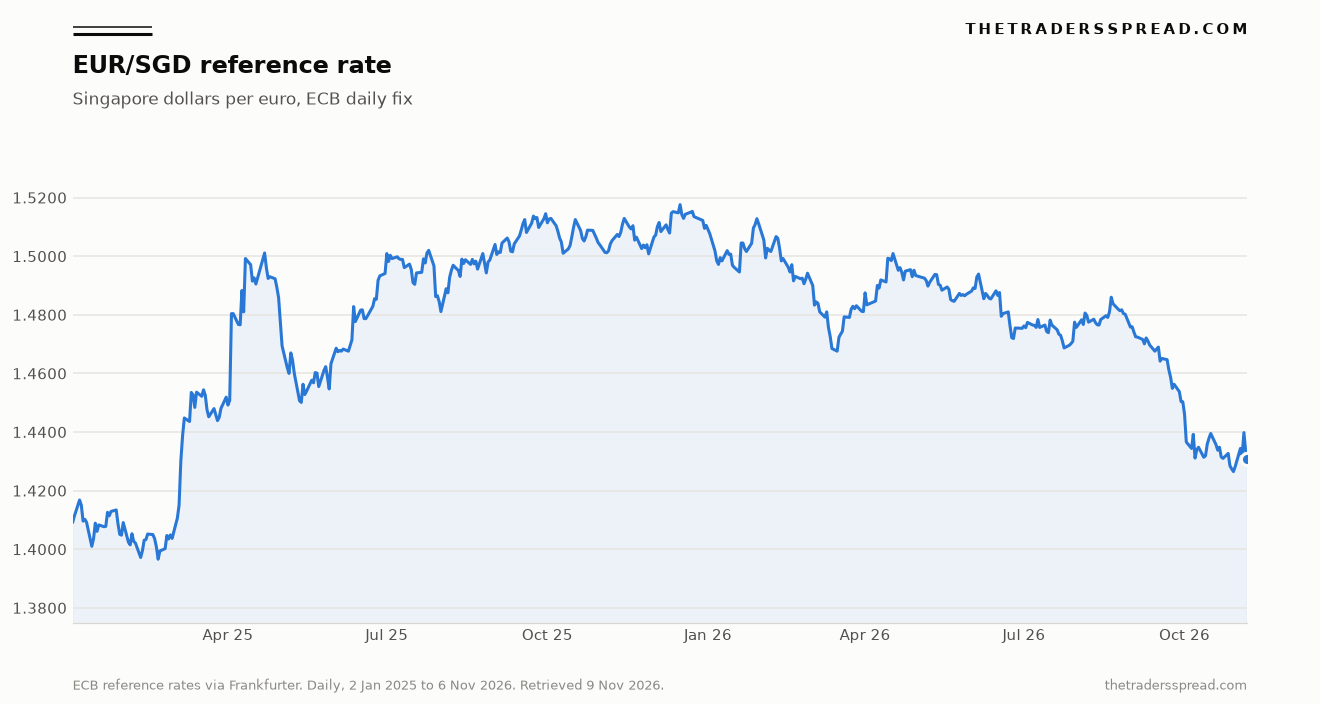
From 6 November 2025 the daily standard deviation was 0.19%, about 3.1% at a 252-day scale. The cross rose 8.66% from the February 2025 low to the December high, then in 2026 USD/SGD only moved from 1.2863 to 1.2816. After 27 July, EUR/SGD fell another 2.63% by 6 November.
Slope, width and centre
MAS calls the framework a basket, a band and a crawl. The intermediate target is the S$NEER, and each review sets the crawl, which is the slope, to the inflation path the Authority wants. Width and centre change less often. Section 2 of the FAQ, retrieved 9 November 2026, says decisions are typically slope shifts, and only occasionally a new midpoint or a new width.
The 14 October 2026 statement is the current one. July had increased the rate of appreciation very slightly, leaving width and centre alone, and the S$NEER had then firmed modestly in the upper half of the band. October maintained the appreciation rate, the width and the centre. The at-a-glance page says a gradually strengthening Singapore dollar leans against import costs. The 27 July statement says that July step was smaller than April's.
| Setting | 27 July 2026 | 14 October 2026 |
|---|---|---|
| Slope, the rate of appreciation | Raised very slightly, by less than the April step | Maintained |
| Width of the band | Left where it was | Left where it was |
| Centre of the band | Left where it was | Left where it was |
| Where the S$NEER had been trading | Upper half of the appreciating band | Upper half, after a modest further firming |
Those three rows are the first three forces, and both statements leave the percentages off the page. A steeper crawl guides the basket, euro included, firmer over time. A wider band tolerates more noise. A recentring reprices the basket in one step. Any of the three can move EUR/SGD while EUR/USD is unchanged, because each is defined on the basket.
MAS Core Inflation, excluding accommodation and private transport, rose to 2.1% year on year in July-August from 1.5% in the second quarter. Forecasts are 1.5-2.0% for 2026 core and around 2.0% for CPI-All Items, then 1.5-2.5% for both in 2027. Ministry of Energy, Trade and Industry advance estimates cited by MAS put third-quarter GDP at 5.4% year on year, and the output gap is forecast to narrow as the AI boom cools.
The euro's weight when the dollar rate is quiet
Force four is the euro's weight. A note linked from the framework page says the Singapore dollar is managed against major trading partners and competitors, with weights set by trade importance and revised as trade changes. Section 2 says the same of the S$NEER basket. The October statement decides slope, width and centre, and a euro share is absent from it, so any precise weight in a market note is an estimate the Authority has left off the page.
From 28 April to 27 May 2025 the Singapore dollar's 1.99% rise against the US dollar became a 2.01% rise against the euro, because EUR/USD only moved from 1.1358 to 1.1356. Over those days the euro also fell 1.43% against the yuan, 2.86% against the ringgit and 2.43% against the baht. The basket was in a regional move. The dollar rate of the euro was flat.
| ECB pair | 28 Apr 2025 to 27 May 2025 | 2 Jan 2026 to 6 Nov 2026 |
|---|---|---|
| EUR/USD | 1.1358 to 1.1356, minus 0.02% | 1.1721 to 1.1165, minus 4.74% |
| USD/SGD | 1.3139 to 1.2877, minus 1.99% | 1.2863 to 1.2816, minus 0.37% |
| EUR/SGD | 1.4923 to 1.4623, minus 2.01% | 1.5077 to 1.4309, minus 5.09% |
| EUR/CNY | minus 1.43% | minus 9.13% |
| EUR/MYR | minus 2.86% | minus 4.63% |
| EUR/JPY | plus 0.57% | minus 3.90% |
In 2026 to 6 November the euro fell 4.74% against the dollar and 5.09% against the Singapore dollar, while USD/SGD eased 0.37%, which is why a 0.837 correlation can sit beside a headline about other forces. When the euro sleeps, the residue is the basket. AUD/SGD carries that same basket on this desk.
Partner currencies and the import channel
Force five is the rest of the basket. MAS deals in USD/SGD because that pair is liquid, and the target remains the trade-weighted index, so a euro that is steady against the dollar and weak against Asian partners can still shift the band. EUR/SGD absorbs the shift one for one. Official weights stay off the statement.
Force seven is the import channel. Section 2 says trade exceeds 300% of GDP and almost 40 cents of each domestic dollar is spent on imports, so the floating rate inside the band reaches consumer prices directly. A framework note puts inflation at 1.9% a year from 1981 to 2023 and says domestic rates follow foreign rates. Energy, food and the AI spillover in the October statement travel that channel into EUR/SGD.
The deposit rate, in the words of the people who set it
Force six is the price of euro liquidity. The key-rate table, retrieved 9 November 2026, shows the deposit facility at 2.50% from 16 September 2026, main refinancing at 2.65% and marginal lending at 2.90%. Earlier steps were 2.25% from 17 June 2026 and 2.00% from 11 June 2025. The 29 October decision kept all three. Energy prices were still rising, the release said, with upside risks to inflation and downside risks to growth.
Christine Lagarde, President of the European Central Bank, told the Frankfurt press conference, alongside Vice-President Boris Vujčić, that the Council had looked at a hike and then "unanimously decided that we were well positioned enough at this stage to hold, and that a measured approach, at this point in time, remained appropriate." September inflation was 3.8%, from 3.2% in August, with energy at 18.9% and unemployment at 6.4%.
In a Yomiuri Shimbun interview published on 7 November, Lagarde said October headline inflation "was at 4%, which was higher than we had expected a few months ago but in line with market expectations." Energy inflation was 20.8% and core inflation was 2.5%. She said the longer those numbers stay high, the greater the risk to the medium-term target.
Isabel Schnabel, Member of the Executive Board, said on 5 November in Navigating stormy waters that central banks "should prioritise instruments that allow them to adjust monetary policy quickly as conditions change." MAS lists energy, food and the AI cycle as the shocks that could change the crawl, so her rate and Singapore's basket meet in this cross.
RelatedUSD/ILS Jumps 1.6% as the Shekel Hits a Seven-Month Low
Philip R. Lane, Member of the Executive Board, said in his 30 October San Francisco speech that AI adoption "will be a key determinant of European productivity growth in the coming years, while expenditure on AI adoption also currently constitutes a significant stimulus to the euro area economy." Digital investment on the ECB proxy is up 73% in real terms since 2014, from 2.3% of GDP to 3.3%, the same spend MAS expects to cool in the second half of 2027.
Boris Vujčić, Vice-President, told a Central Bank of Ireland conference on 2 November that Ireland "has one of the most open economies in the world" and that a US trade shift or a turn in capital flows "can spill over to the Irish economy particularly quickly," a point he scaled up to the EU, "the world's largest trading bloc." The Dublin speech is the European twin of Singapore's trade ratio above 300% of GDP.
A checklist before the next quarterly review
Statements land in January, April, July and October, and the next one will again speak to the slope, the width and the centre. Use the list to compare those words with fixings that already carry a date, and leave any price target off the page.
- Read whether the crawl was steepened, eased or maintained, whether the width moved, and whether the centre was recentred, and treat a missing percentage as the document's normal state.
- Split the latest EUR/SGD change into EUR/USD and USD/SGD on the same ECB rates, and look for a window where the euro's dollar move is near zero, as from 28 April to 27 May 2025.
- In that window, check the euro against the yuan, the ringgit and the yen, the partner moves a trade-weighted basket has to absorb.
- Set the deposit rate beside figures Lagarde has given, which on 7 November 2026 were a 4% October headline, 20.8% energy inflation and a 2.5% core rate.
- Keep 1.3966 on 20 February 2025, 1.5176 on 16 December 2025 and 1.4309 on 6 November 2026, and replace them from the next ECB fixing.
- Re-read the weight paragraph when trade patterns shift, because the basket is revised and the statement leaves the euro's share off the page.
Questions readers ask
What does MAS target when the Singapore dollar is discussed as a policy rate?
MAS targets the trade-weighted S$NEER inside a band that has a slope, a width and a centre. Intervention runs through USD/SGD because that pair is the most liquid, so the dollar rate is the tool and the basket is the target. The 14 October 2026 statement kept the appreciating crawl and left width and centre unchanged. The framework treats domestic interest rates as the variable that follows foreign rates and the expected currency path.
Why did EUR/SGD fall in spring 2025 while EUR/USD was almost flat?
From 28 April to 27 May 2025, EUR/USD went from 1.1358 to 1.1356, a 0.02% move, while EUR/SGD fell from 1.4923 to 1.4623, or 2.01%. USD/SGD fell 1.99%, and the euro also fell against the yuan, the ringgit and the baht. The cross followed the Singapore dollar's rise against the US dollar, which is what a basket target produces when the euro is quiet against the dollar and busy against other partners.
Did the October 2026 review publish a slope or a band width?
The 14 October statement maintained the rate of appreciation and left width and centre where they were. All three settings are in words. A yearly slope percentage is absent, and a bandwidth percentage is absent. On 27 July the slope had been raised very slightly, by less than the April step, with width and centre left alone. MAS said the S$NEER was trading in the upper half of the band.
How does the ECB deposit rate reach this cross?
The deposit facility is 2.50%, held on 29 October 2026, with main refinancing at 2.65% and marginal lending at 2.90%. With the exchange rate as the target and capital markets open, Singapore rates largely follow foreign rates and currency expectations. A different euro deposit rate changes the euro's yield against that backdrop, and EUR/SGD absorbs the bilateral move the basket then requires. That is why a 4% euro-area headline sits beside the crawl.
Which print should a reader treat as the reference rate?
Use the ECB daily reference rate, via Frankfurter, in Singapore dollars per euro. On 6 November 2026 it was 1.4309, equal to 1.1165 times 1.2816. Read it next to the latest MAS wording on slope, width and centre, and next to the latest deposit-rate decision. The dated comparisons already on the tape are the 16 December 2025 high of 1.5176 and the 20 February 2025 low of 1.3966.
This article is general information for readers of currency markets, and any decision on a currency position stays with the reader and the reader's own adviser.