

CAD/NOK is pinned near a two-year low in krone per Canadian dollar, while the oil spot prices that usually carry the blame for a strong krone have eased since September. Those two facts sit badly together. A barrel-only story would have lifted the cross once Norges Bank itself reported cheaper spot crude. The cross stayed heavy, and the residual is a policy-rate gap that is still two percentage points wide.
On the Frankfurter fix for 9 November 2026, one US dollar bought 1.4103 Canadian dollars and 9.4099 Norwegian kroner. NOK per CAD equals NOK-per-USD divided by CAD-per-USD, so 9.4099 divided by 1.4103 is 6.6723. The retrieval was 10 November 2026 at 06:59 UTC. The 6.6723 figure is a reference cross built from two dollar fixes, not a screened CAD/NOK quote from a broker. A platform ticker labelled CADNOK is a different series, and mixing the two will invent a move that the fixes did not print.
The same division on 8 November 2024 produced 7.8580, and the high in the window since then was 7.9675 on 14 November 2024. By the fix on 2 January 2026 the cross was 7.3299. The 9 November print of 6.6723 is a 15.1% decline from that November 2024 fix and a 9.0% decline from the first fix of 2026. The low was 6.6049 on 3 November 2026, so the latest print sits about 1.0% off the floor. Alongside that slide, Norges Bank's policy rate is 4.50% and the Bank of Canada's overnight target is 2.50%. A cad nok forecast that starts from oil and ignores those two rates is describing a different market.
Key facts
- Reference cross 6.6723 krone per Canadian dollar on the 9 November 2026 fix, from 9.4099 divided by 1.4103. Source: Frankfurter, retrieved 10 November 2026, 06:59 UTC.
- Bank of Canada overnight target 2.50%, Bank Rate 2.75%, deposit rate 2.45%, after a 25 basis point increase. Source: Bank of Canada, 28 October 2026.
- Norges Bank policy rate 4.50%, overnight lending rate 5.50%, reserve rate 3.50%, effective 6 November 2026. Source: Norges Bank, published 5 November 2026.
- Canada CPI 3.1% year over year in September, 2.2% excluding gasoline, with gasoline up 27.8%. Source: Statistics Canada, 19 October 2026.
- Canada unemployment rate 6.7% in October, up 0.2 percentage points, with employment little changed at minus 4,700. Source: Statistics Canada, 6 November 2026.
- Norway CPI 3.4% and CPI-ATE 3.0% in September. Registered unemployment 2.0% in October. Source: Norges Bank, citing Statistics Norway, 5 November 2026.
- WTI crude $94.37 a barrel and Brent $97.83, wholesale spot close of 6 November 2026. Source: U.S. Energy Information Administration daily prices page, 9 November 2026.
1. Two dollar fixes, divided
CAD/NOK rarely has the deep screen that USD/CAD or USD/NOK has. The workable public series is the ratio above: the krone's dollar price divided by the loonie's dollar price. When the krone cheapens faster than the loonie, one Canadian dollar buys fewer kroner and the cross falls. When the loonie cheapens and the krone holds, the cross rises.
Over 2026 the path has been a grind lower, with a spring interruption. Month-end prints stepped down from the 2 January high of 7.3299 through 6.9451 on 27 February, 6.8227 on 30 April and 6.7022 on 29 May, bounced to 6.9730 on 30 June, and faded to 6.6076 on 30 October. The 3 November low of 6.6049 is the bottom of the series back to 8 November 2024.
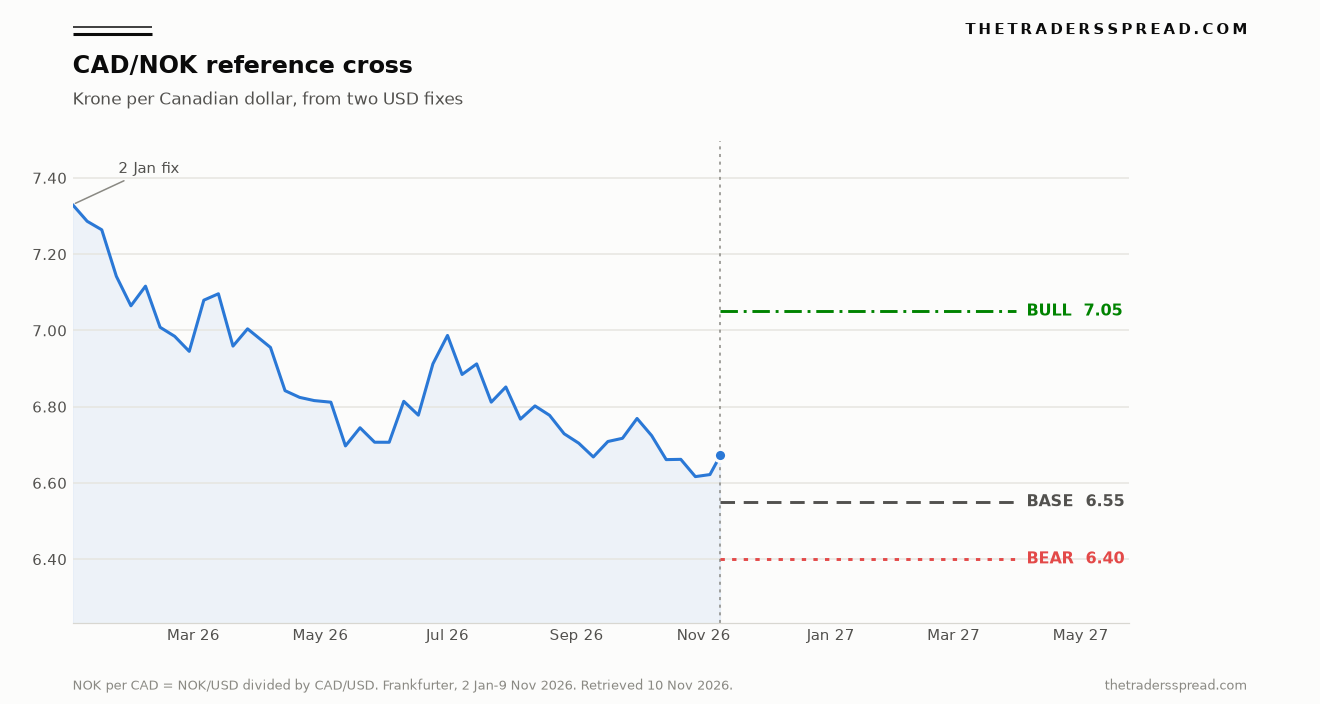
Weekly points run from that January fix through 9 November, and three levels then extend across the empty space out to 31 March 2027. Bull at 7.05 sits above the latest print. Base at 6.55 and bear at 6.40 sit below it. The January mark shows where this year's slide began, near 7.33 on the rounded scale.
NOK/SEK is built the same way, from two separate dollar rates. The interesting number is the ratio, because each leg can move for a reason of its own, and on CAD/NOK both legs have been busy enough that a single oil headline keeps mis-explaining the print.
2. The gap oil keeps being asked to explain
Norges Bank stands at 4.50% and the Bank of Canada stands at 2.50%, 200 basis points in favour of the krone. Both banks are telling the public they might still move higher, and only one of them sounds reluctant.
On 28 October 2026 the Bank of Canada raised the overnight target by 25 basis points to 2.50%, with the Bank Rate at 2.75% and the deposit rate at 2.45%, the first increase since it had been holding at 2.25%. CPI inflation had been around 3% since April and was expected to rise to about 3.5% by the end of the year. Governing Council said a further increase could be needed and that it would proceed carefully, to limit the spread of high energy prices. The next overnight announcement is 9 December 2026, and the next Monetary Policy Report is 27 January 2027. The bank put the Canadian dollar at around 71 US cents, in line with its July assumption. The 9 November fix implies about 70.9 US cents.
The Bank of Canada posted the decision in its own words the same morning, which is the cleanest record of how the bank wanted the 2.50% print understood.
We have increased our interest rate to 2.50%. https://t.co/BjYoo4p2vY#MonetaryPolicy #InterestRates #cdnecon #economy pic.twitter.com/g1nb1GIohu
— Bank of Canada (@bankofcanada) October 28, 2026
The market-participants survey published on 9 November 2026 was taken from 23 September to 1 October, from about 25 respondents. Its median for October was 2.25% and its median for December was 2.50%, cells that describe a hike already delivered by the day the survey came out. The usable forward cell is the median of 2.75% from March 2027, and the later published medians through 2028 stay at 2.75%. One more quarter point in Canada, with Norway still at 4.50%, leaves a 175 basis point gap, narrower than today and still wide for a 5.7% rally back to 7.05.
| Item | Bank of Canada | Norges Bank |
|---|---|---|
| Policy rate | 2.50% overnight target, set 28 October 2026 | 4.50%, effective 6 November 2026 |
| Latest inflation | CPI 3.1% in September. 2.2% excluding gasoline | CPI 3.4% and CPI-ATE 3.0% in September |
| Labour | Unemployment 6.7% in October | Registered unemployment 2.0% in October |
| What the bank said about the next move | There could be a further increase. Proceed carefully | Prepared to raise the policy rate if the inflation outlook warrants it |
| Next scheduled decision | 9 December 2026 | 17 December 2026, with new forecasts |
Strip out gasoline and Canada's inflation sits near 2%, while Norway's CPI-ATE is 3.0% with domestic prices hotter than the September forecast. Unemployment is 6.7% against a registered 2.0%. Slack and the higher policy rate are in different countries.
3. Canada can hike, and the labour print argues for a short cycle
The October Labour Force Survey, released 6 November 2026, makes a long Canadian tightening cycle look like a wish. Employment was little changed, down 4,700, and the employment rate fell 0.1 percentage point to 60.5%. Unemployment rose 0.2 percentage points to 6.7% because 33,000 more people searched for work. That rate sits below the April 2026 peak of 6.9% and above the "around 6.5%" the Bank of Canada used on 28 October. The statement predates this 6.7% print by nine days.
Employment had already fallen by about 68,000 in September and about 42,000 in August. Private-sector employment dropped 53,000 in October, the first decline since February, while public-sector employment rose 50,000. Average hourly wages rose 2.2% on the year, to $37.89, slower than September's 2.3%. Youth unemployment rose 0.7 percentage points to 13.7%. Core-aged unemployment was unchanged, at 5.8% for men and 5.3% for women. A wage print near 2% can absorb one hike more easily than a string of them.
Statistics Canada said the CPI rose 3.1% year over year in September, after 3.0% in August, in the release dated 19 October 2026. Gasoline rose 27.8% on the year, faster than August's 22.8%, while CPI excluding gasoline rose 2.2% after 2.4%. The 28 October statement used that same 2.2% figure, said core inflation remained close to 2%, and still lifted whole-CPI inflation to about 3.5% by year-end and an average of 3% in 2027. Growth in the statement was 3.3% in the second quarter, about 2% in the third, 1% for 2026, and 2% in both 2027 and 2028, with the expansion exposed to Canada-US trade uncertainty.
Three soft employment months, with a headline stuffed with gasoline, give the council a reason to pause on 9 December even though the September survey had pencilled 2.50% for that month. CAD/CHF ran into the same Bank of Canada gap from the other side of the loonie. The overnight rate can move, and the labour market limits how far.
4. Norway's 4.50% is a floor the committee is willing to raise
Norges Bank's Monetary Policy and Financial Stability Committee met on 4 November 2026, held the policy rate at 4.50%, and published the decision on 5 November. The rate took effect on 6 November, with the overnight lending rate at 5.50% and the reserve rate at 3.50%. Governor Ida Wolden Bache's line is the constraint on any bull case for CAD/NOK:
"Inflation is too high. It will likely be necessary to keep the policy rate elevated for a time, and we are prepared to raise the policy rate if needed to bring inflation down to target within a reasonable time horizon," said Ida Wolden Bache, Governor of Norges Bank, in the 5 November 2026 rate decision.
Twelve-month CPI was 3.4% in September and CPI-ATE, the tax-adjusted index excluding energy, was 3.0%. Inflation had evolved broadly as projected, while prices of domestically produced goods and services were higher than in the September Monetary Policy Report. Registered unemployment was 2.0% in October, a bit lower than projected, and employment had increased a little more than expected. Capacity use is slightly below normal. In the press-conference introduction the committee said unemployment is neither especially high nor unusually low, and that inflation is the problem. November brought no new projections, so the September forecast remains the latest published path until 17 December 2026, when Monetary Policy Report 4/26 arrives.
Oil spots have fallen since September while futures have risen somewhat, and the krone is stronger than assumed. That appreciation, the committee says, will dampen inflation in isolation, a reason to hesitate even while a further hike stays on the table. The September path still has the rate close to 4.5% for a period, then somewhat lower, with inflation at 2% only in 2029. Market pricing has eased a little and still includes an increase by the end of the first half of 2027. That mix is why 6.40 is a grind rather than a collapse.
If both hikes happen, Canada goes from 2.50% to 2.75% and Norway from 4.50% to 4.75%, and the gap is still 200 basis points. Reaching 7.05 needs the gap to shrink in a way neither published path offers. GBP/NOK shares the krone leg and a different policy rate on the other side, so sterling can move that cross without any change in Oslo. CAD/NOK has no such spare leg. The bank at 4.50% is the one that sounds prepared to go again.
5. The barrel is high, and both countries sell it
Oil still matters, and it is a bad sole explanation. The EIA daily prices page dated 9 November 2026 shows the 6 November wholesale spot close at $94.37 for WTI, up 0.3%, and $97.83 for Brent, down 0.1%. Expensive barrels are why both inflation forecasts are full of energy. A lower spot from a high level, with futures a bit higher, is a cooling rather than a crash.
RelatedEUR/MXN Price Prediction: 21.80 Bull Case vs 20.20 Bear Case
The 28 October Bank of Canada statement treats Canada as an oil and gas producer. Business investment had rebounded on oil and gas and on machinery, exports had help from higher energy production, and the Middle East conflict was in its eighth month. A higher barrel lifts Norwegian income and Canadian income together, and it feeds the CPI behind Ottawa's hike and the CPI that keeps Oslo restrictive. Treating CAD/NOK as a geared short on the barrel double-counts a shock that hits both notes.
Employment in Alberta fell by 24,000 in October, down 0.9%, and the province's unemployment rate rose 0.9 percentage points to 7.3%. One month in one province is a thin reed, and it is still an oil-producing region shedding jobs while WTI sat in the mid-$90s. From 7.8580 in November 2024 to 6.6723, the barrel's story is already in the price. The krone-yen cross on this site has already used oil as an input. Here the second petrocurrency sits on the other side of the ratio, so the rate gap outranks the barrel.
6. The call: 6.40 is the cleaner of the two title levels
Getting to 7.05 asks for a 5.7% rise from 6.6723, which needs a narrower gap and a weaker krone than Norges Bank is describing. Getting to 6.40 asks for a 4.1% decline through the 6.6049 low, which follows if Oslo hikes or holds 4.50% while Ottawa pauses at 2.50% and the krone keeps its gain. The second list sits closer to the words both banks published in the last fortnight.
The base between them is 6.55, about 1.8% under the 9 November fix and still above the early-November low. December, on that path, produces no surprise: Canada holds or adds a single quarter point, Norway holds 4.50% and repeats that the rate stays elevated, oil spots chop around the mid-$90s, and the cross leaks lower without a disorderly break. The base sits on the chart beside the bull and bear lines as the dull path between them.
| Case | Level, krone per CAD | Versus 6.6723 | What has to happen |
|---|---|---|---|
| Bull | 7.05 | About 5.7% higher | The rate gap narrows and the krone gives back strength the committee already flags |
| Base | 6.55 | About 1.8% lower | December decisions keep the gap near two points and oil stays a shared shock |
| Bear | 6.40 | About 4.1% lower | Oslo hikes or holds a restrictive line while Ottawa pauses, and the 6.60 low gives way |
Conviction is 2 on a five-point scale, because direction and distance disagree. Direction favours 6.40: 200 basis points is a lot of carry to set against a 5.7% rally, and the survey leaves most of that gap in place. Distance pulls against a confident call: the cross is already down 9.0% this year and 15.1% from the November 2024 fix, the krone is stronger than Norges Bank assumed, and oil spots are off their earlier highs, so further leakage is plausible without making 6.40 a high-confidence destination. The horizon runs to 31 March 2027, through both December decisions, Ottawa's January Monetary Policy Report, and the March survey cell.
Entry on that map is the reference fix of 6.6723, with 6.40 as the bear target and 7.05 as the level that kills the bear case. If December is dull, 6.55 is the base. Anyone treating 7.05 as the likelier print has to say which bank blinks. On the documents opened on 10 November, neither bank has.
What would confirm or kill the call
- Fixes under 6.60 into the December decisions would show the 6.6049 low has broken, putting 6.40 in play.
- An Oslo hike on 17 December, or a forecast keeping the rate near 4.50% into the first quarter, beside a Canadian hold at 2.50% on 9 December, would show the gap staying wide.
- A Canadian rise to 2.75% on 9 December, with Oslo guiding the next move down, would kill the bear case and reopen 7.05.
- A fix above 6.90 held across several sessions would kill the bear case early, and a fix at 7.05 would invalidate it.
- Oil spots falling by more than the decline since September, with the krone giving back strength Norges Bank already flags, would also kill a lower CAD/NOK.
- October CPI on 16 November and the November labour survey on 4 December come first. A gasoline jump with higher unemployment would leave the council short of room.
Oslo's December forecast matters more than a single oil headline. The rate gap is the driver that still separates this cross from a story the price has already told.
FAQ
How is CAD/NOK calculated when screens disagree?
NOK per CAD is the krone's dollar price divided by the loonie's dollar price. The 9 November 2026 Frankfurter fix was 9.4099 divided by 1.4103, or 6.6723, retrieved at 06:59 UTC on 10 November 2026. That print is a reference cross from two fixes. A broker series labelled CADNOK is a separate price, so a forecast should name which series it means.
What is the Canada-Norway policy-rate gap?
The Bank of Canada overnight target is 2.50% after the 28 October 2026 increase. Norges Bank's policy rate is 4.50%, held on 4 November and effective 6 November, so the gap is 2.00 percentage points. A Canadian move to the survey's 2.75% median by March 2027 would leave 1.75 points if Norway stayed at 4.50%, still a wide rate advantage for the krone.
Does a higher oil price always lift the krone against the Canadian dollar?
Both economies export energy, and both central banks face the same expensive barrel. The EIA recorded WTI at $94.37 and Brent at $97.83 on the 6 November 2026 close, while Norges Bank says spots have fallen since September. On CAD/NOK the barrel hits both legs, and the 4.50% to 2.50% gap is what still points to a heavier cross.
This analysis is for information only. It is not a recommendation to buy, sell or hold any currency, contract or other instrument, and capital put at risk in foreign exchange can be lost.