

Is USD/PHP pricing a peso that stays cheap while October inflation is 7.8 percent, or a late-year remittance bid that pulls the pair back toward 60? The 10 November ECB reference of 62.904 already sits 1.090 pesos under the 27 October high of 63.994 in the same series, and the Bangko Sentral ng Pilipinas published a separate reference of 63.040 pesos per dollar on 11 November 2026, against 58.934 a year earlier. Both fixings leave a bull case at 65.40 above the market and a bear case at 60.20 below it.
The split that decides the path is the real policy rate, set beside the nominal gap and the dollars still to arrive. The target reverse repurchase rate is 5.50 percent. Headline inflation for October was 7.8 percent, so the policy rate sits 2.3 percentage points under the latest consumer-price print. That same 5.50 percent stands 162 basis points above the effective federal funds rate of 3.88 percent, a nominal premium to hold pesos beside a real gap that still compensates the dollar for purchasing power lost since January.
Holiday inflows are the third term, and the published record still stops in August. Cash remittances from overseas Filipinos reached $23.424 billion in January to August 2026, against $22.909 billion in the same months of 2025, a rise of 2.2 percent on the Bangko Sentral table. The last four months of 2025 carried $12.725 billion, equal to 35.7 percent of that year's $35.634 billion. August 2026 itself was $3.035 billion, down from $3.240 billion in July.
From those three inputs the central path into 31 March 2027 is 63.70, above both current references and under the late-October ECB high, with 65.40 and 60.20 as the bounds around the 31 March 2026 close of 60.689.
Key facts
- USD/PHP on the ECB reference was 62.904 on 10 November 2026, and 63.994 on 27 October 2026. Source: Frankfurter, 11 November 2026.
- The Bangko Sentral reference was 63.040 on 11 November 2026, from 63.255, 63.491 a week earlier, 62.766 a month earlier, and 58.934 a year earlier. Source: Bangko Sentral key statistical indicators, 11 November 2026.
- The target reverse repurchase rate is 5.50 percent, with the deposit facility at 5.00 percent, the lending facility at 6.00 percent, and the interbank call rate at 5.5625 percent on 10 November 2026. Source: Bangko Sentral key statistical indicators, 11 November 2026.
- October 2026 headline inflation was 7.8 percent, from 7.2 percent, with core at 5.4 percent, transport at 20.1 percent, and a January-to-October average of 5.6 percent. Source: Philippine Statistics Authority via BusinessWorld, 5 November 2026.
- Overseas Filipino cash remittances were $23.424 billion in January to August 2026, against $22.909 billion a year earlier. Source: Bangko Sentral remittances table, 11 November 2026.
- The Federal Reserve held the funds range at 3.75 to 4 percent on 28 October 2026, and the effective rate was 3.88 percent from 3 to 9 November. Source: FOMC statement, 28 October 2026, and H.15, 10 November 2026.
- The Monetary Board meets on 17 December 2026, and the next Monetary Policy Report is dated 23 December. Source: Bangko Sentral 2026 meeting calendar, 11 November 2026.
1. Two reference prints, one climb
USD/PHP in the ECB series opened 2026 at 58.847 on 2 January and printed 62.904 on 10 November, a rise of 6.9 percent, after a 27 February low of 57.683 and a 27 October high of 63.994. That high was 10.9 percent above the February low. The Bangko Sentral reference of 63.040 is 7.0 percent above 58.934 a year earlier.
A few tenths of a peso between 62.904 and 63.040 is a measurement difference between two fixing conventions. The levels below use the ECB print, the continuous history on the chart. After the February low the reference was 60.689 on 31 March and 63.680 on 30 October, before the early-November ease.
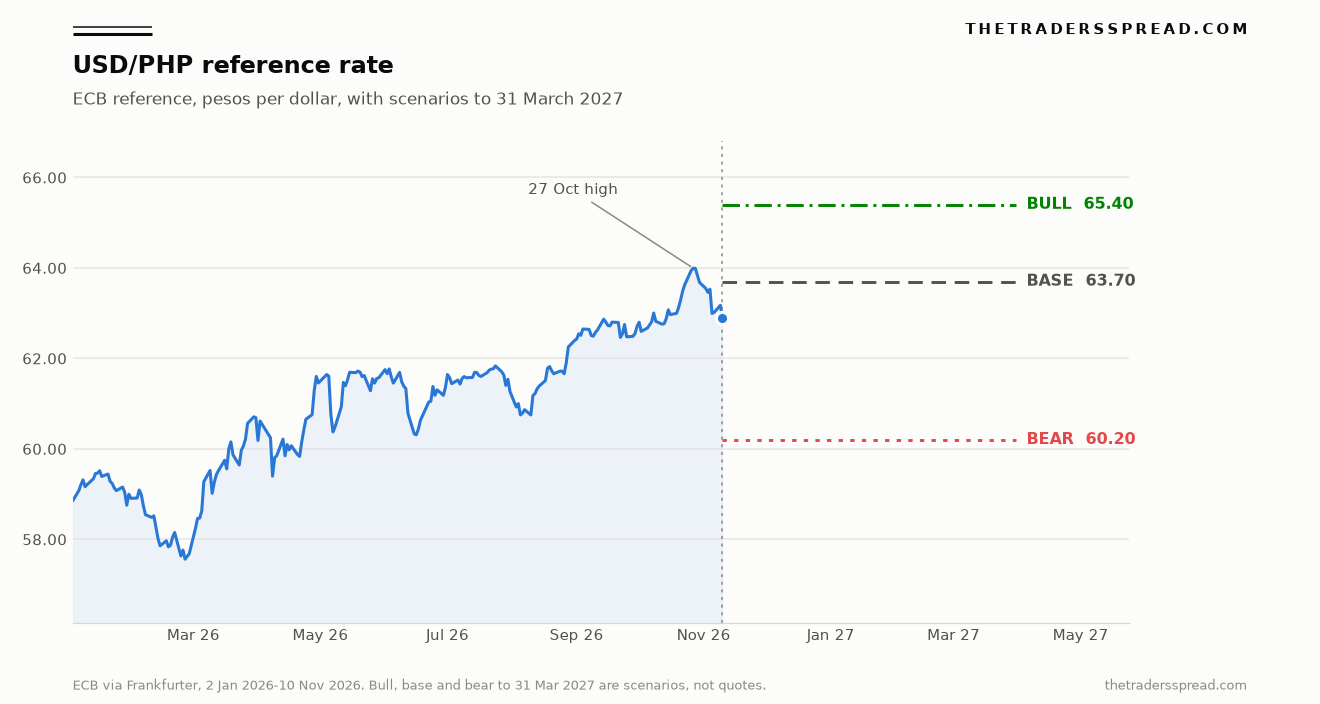
From 62.904, the bull case adds 2.50 pesos to a dollar-invoiced import bill and the bear case hands back 2.70. The base at 63.70 is an extra 0.80 pesos, beside a 4.06 peso rise since the 2 January reference of 58.847.
USD/PHP has the dollar inside the quote, which makes it a different object from a Nordic cross built out of two dollar rates, the construction in the NOK/SEK dollar-legs explainer. The peso floats, and the Hong Kong dollar sits inside the convertibility band described in the USD/HKD peg note. The August report treats the exchange rate as a channel into inflation, expectations, financial stability, and activity, with the inflation target as the board's objective.
| ECB reference date | USD/PHP |
|---|---|
| 2 January 2026 | 58.847 |
| 27 February 2026 | 57.683 |
| 31 March 2026 | 60.689 |
| 27 October 2026 | 63.994 |
| 30 October 2026 | 63.680 |
| 10 November 2026 | 62.904 |
Selected ECB reference closes from Frankfurter. 27 February is the 2026 low in that series, and 27 October is the high.
2. A 5.50 percent rate under a 7.8 percent price print
The target reverse repurchase rate is the midpoint of a corridor. On the Bangko Sentral daily key statistical indicators for 11 November the deposit facility was 5.00 percent and the lending facility was 6.00 percent. The interbank call rate of 5.5625 percent on 10 November sat 6.25 basis points over the policy rate. A month earlier that policy rate was 5.00 percent, and a year earlier it was 4.75 percent.
The August Monetary Policy Report, approved on 27 August 2026, records the 25-basis-point step to 5.00 percent and a central forecast of 6.1 percent average inflation in 2026, 5.4 percent in 2027 and 3.3 percent in 2028, against a 3.0 percent target with a 1-point band. Those projections included the August rise and a possible October rise, and they pre-date the later 50-basis-point decision and the 7.8 percent print.
On 22 October the Monetary Board raised the target reverse repurchase rate by 50 basis points to 5.50 percent. BusinessWorld, reporting Philippine Statistics Authority figures on 5 November, put October headline inflation at 7.8 percent, the fastest clip since 8.6 percent in February 2023 and above the 3 percent target for an eighth straight month. Core inflation was 5.4 percent, from a revised 4.8 percent. Transport was 20.1 percent, from 14.6 percent, and rice was 20.7 percent.
National Statistician Claire Dennis Mapa told BusinessWorld that a late-September public-transport fare hike showed up in the October basket, and that exchange-rate pass-through was visible in gasoline, diesel, liquefied petroleum gas, and rice. The same report said the Philippines relies on Middle East crude for at least 90 percent of oil imports and imports about 30 to 35 percent of rice consumption.
The Bangko Sentral posted the 22 October decision in its own words, a 50-basis-point rise in the target reverse repurchase rate to 5.50 percent.
BSP raises target RRP rate by 50 basis points to 5.50%https://t.co/u9ev1WX48t pic.twitter.com/cuxgByPLPB
— Bangko Sentral (@BangkoSentral) October 22, 2026
3. Remittance season is still in front of the data
Cash remittances are the structural dollar inflow that usually leans against a weak peso into the holidays. The Bangko Sentral overseas Filipino cash remittances table puts the full-year totals at $33.491 billion in 2023, $34.493 billion in 2024, and $35.634 billion in 2025, with 35.7 percent of 2025 packed into September through December. A usd php forecast that stops at the August run-rate misses that compression.
July 2026, at $3.240 billion, is the high of the eight published months, and August at $3.035 billion is 6.3 percent below it. Repeating the 2025 September-to-December total on top of the $23.424 billion already booked would put 2026 near $36.1 billion by addition on that table. The Bangko Sentral page carries the monthly series through August.
The United States accounted for $9.327 billion of the January-to-August 2026 total, 39.8 percent. Selling those dollars for pesos can pull USD/PHP down, and that flow has to clear an import bill inflated by transport inflation of 20.1 percent.
| Cash remittances | Billion US dollars |
|---|---|
| Full year 2023 | 33.491 |
| Full year 2024 | 34.493 |
| Full year 2025 | 35.634 |
| January to August 2025 | 22.909 |
| January to August 2026 | 23.424 |
| September to December 2025, residual | 12.725 |
| July 2026 | 3.240 |
| August 2026 | 3.035 |
Bangko Sentral overseas Filipino cash remittances, shown in billions. The September-to-December 2025 figure is the full-year total minus January to August.
4. The dollar leg after a hold
The Federal Open Market Committee on 28 October 2026 held the target range for the federal funds rate at 3.75 to 4 percent, by a 10-to-2 vote, in the FOMC statement. Lisa Cook and Beth Hammack preferred a quarter-point rise. The effective federal funds rate on the H.15 release of 10 November was 3.88 percent on 3, 4, 5, 6, and 9 November.
The Bureau of Labor Statistics reported that the US consumer price index rose 0.4 percent in October, after 0.6 percent in September, with the index less food and energy up 0.3 percent and energy up 0.7 percent after 5.2 percent. The bureau withheld an October 2026 twelve-month all-items change because October 2025 survey data are missing after a lapse in appropriations.
The August report had assumed US federal funds futures were pointing to quarter-point rises in October 2026 and June 2027. The October meeting produced a hold, so that assumption is already behind the decision. A December rise of 25 basis points, the step the two dissenters wanted, would lift the top of the US range to 4.25 percent and narrow the nominal gap versus the 5.50 percent Philippine rate from 150 basis points, measured off the top of the current range, toward 125. The same building blocks, hours and the two policy rates, are set out for another dollar-linked cross in the GBP/SGD rates-and-hours explainer.
5. Base 63.70, bull 65.40, bear 60.20
The base case is 63.70 by 31 March 2027, 0.796 pesos or 1.3 percent above the 10 November ECB reference and under the 27 October high of 63.994. Holiday conversions lean against a new high, and a real policy rate 2.3 points under the price print leans the other way.
The bull case is 65.40, 4.0 percent above 62.904 and 1.406 pesos above that October high. It needs inflation near the October pace, the quarter-point Federal Reserve rise the October vote passed over, and remittances that only extend the 2.2 percent year-to-date pace. Then the early-November pullback fails, and 65.40 extends a move already 6.9 percent since 2 January.
RelatedHow Does NOK/JPY Get Its Price Out of Oil and Yen?
The bear case is 60.20, 4.3 percent under 62.904 and 0.49 pesos under the 31 March 2026 close of 60.689. It needs a late-year inflow near $12.725 billion, a further 17 December tightening while the Fed stays on hold, and cooler transport and oil inflation, with El Niño fading ahead of the August report's first-half-of-2027 risk. The post-February climb then retraces toward the area before the spring jump through 60.689.
| Case | USD/PHP | Versus 62.904 | What has to hold through 31 March 2027 |
|---|---|---|---|
| Bull | 65.40 | +4.0 percent | Inflation stays elevated, the Fed lifts the funds rate, and remittances only extend the 2.2 percent pace |
| Base | 63.70 | +1.3 percent | A quarter-point December step or a hold, partial remittance support, and a retest of the October area that stops short of a lasting break |
| Bear | 60.20 | minus 4.3 percent | A wider nominal premium versus a Fed on hold, a full late-year inflow near $12.7 billion, and cooler transport inflation |
Distances use the 10 November ECB reference of 62.904. The Bangko Sentral print of 63.040 sits under 65.40 and over 60.20.
On 30 October the Bangko Sentral posted its statement on the inflation forecast for October, the marker for whether that month's price print was already inside the path the board had sketched in August.
BSP Statement on the Inflation Forecast for October 2026#BSP #BSPupdates #Inflation pic.twitter.com/ziZ9Md4JC3
— Bangko Sentral (@BangkoSentral) October 30, 2026
6. What would change the reading
The Monetary Board meets on 17 December, on the 2026 calendar of monetary policy meetings. Alyssa Nuñez, lead economist at BDO Unibank's Wealth Research Office, told BusinessWorld on 5 November that hotter core inflation made a quarter-point December rise likely. Deepali Bhargava, regional head of research for Asia-Pacific at ING Bank N.V., kept a further 25-basis-point rise as her base case and treated a second 50-basis-point step as limited if oil eased and third-quarter growth was weak.
A quarter-point Philippine rise fits the base case. A second 50-basis-point rise with the Fed on hold fits the bear case. A pause near 7.8 percent inflation fits the bull case, as does a Fed quarter-point rise unless the Philippine step is larger. A late-year remittance total near $12.725 billion is the bear-case inflow, and one that only extends the 2.2 percent pace is the bull-case shortfall, beside transport at 20.1 percent and core at 5.4 percent. On the Frankfurter ECB series the reference gained 6.9 percent from 2 January to 10 November, then gave back 1.090 pesos after the high.
FAQ
Why is the bull case above the October high while the base case is below it?
The October high of 63.994 in the ECB series is a price already printed, and the three cases start from 62.904. The base at 63.70 asks for a return toward that high, capped under a lasting break, because holiday conversions and a possible December tightening can lean against a new extreme. The bull case at 65.40 asks for the break itself, which needs sticky inflation, a firmer dollar, and a thin remittance season together.
Does a higher Bangko Sentral rate line up with a stronger peso?
A higher target reverse repurchase rate widens the nominal gap versus the federal funds rate, and the peso still has to clear inflation plus the dollar conversion of remittances. At 5.50 percent against October inflation of 7.8 percent, the real rate sits 2.3 percentage points below the price print, so the nominal premium and the real gap point in opposite directions.
How much of a usd php forecast hangs on remittances beside the policy rate?
Remittances are large enough to matter beside the policy rate, on a seasonal clock the rate decision follows with a lag. January to August 2026 brought in $23.424 billion, and September to December 2025 alone was $12.725 billion, or 35.7 percent of that year. The policy rate sets the funding gap, 162 basis points over the 3.88 percent effective federal funds rate. The remittance flow sets how many dollars are sold for pesos into the holidays.
If the dollars that arrived in the last four months of 2025 repeat near $12.725 billion, and the 17 December meeting adds only a quarter point while inflation is still several points above the 5.50 percent policy rate, which of those forces shows up in USD/PHP by 31 March 2027?
This analysis is for information only and is not a solicitation to buy or sell any currency or contract, and past reference rates do not determine later rates.