

Traders treat USD/CLP as a copper quote with a peso sign on it, and the 2026 tape has already broken that habit. The Chilean observed dollar printed 999.10 on the value date of 16 November 2026, the high of the year in Banco Central de Chile series F073.TCO.PRE.Z.D, read from the bank's statistical database on 14 November 2026. On 2 January the same series stood at 907.13, so the peso has cheapened by 10.1 percent against the dollar while copper's annual average sits far above last year. A USD/CLP forecast that copies the metal onto the currency starts from the wrong object.
The observed dollar was 969.80 on 10 November, 992.48 on 13 November, and 999.10 for 16 November, a rise of 3.0 percent from the month's low to the year's high. The bull case below is a higher number, and the bear case is a lower number, because a higher print is a cheaper peso and the pair is pesos per one US dollar.
Copper stayed expensive through that rise. Cochilco, the Chilean Copper Commission, said in its weekly note for 9 to 13 November that the metal closed at US$6.17 a pound, down 2.47 percent on the week, with an annual average of US$6.16 a pound, 39.5 percent above the same stretch of 2025. The central bank's dealing survey still sat at 970 pesos on 11 November, about 29 pesos under the latest official print.
1) What the observed dollar actually measures
Banco Central de Chile describes the observed dollar as the amount-weighted average of spot purchases and sales of pesos against US dollars by banks and other members of the formal exchange market, taken on the banking day before publication in the Diario Oficial. The bank also posts the figure on its statistics site, on a reference basis, ahead of the morning it takes effect, which is how the 16 November value date was already on the database when the series was read on 14 November.
That timing is why 999.10 and 992.48 can both be the dollar in the same conversation. The 13 November value date summarises the prior banking day, and the 16 November value date carries Friday's formal-market spot across the weekend as Monday's official reference. A broker screen on Friday afternoon, set beside the observed dollar then in force, was looking at Thursday's weighted average.
Across 2026 the series is a climb with one deep dip. January averaged 883.97, February averaged 862.02 and set the year's low at 854.25 on 10 February, 17.0 percent under the latest print, and March jumped to an average of 909.89. April and May settled near 898, June averaged 903.38, July 930.97, August 917.66, September 947.27, and October averaged 982.28. The eleven value dates from 2 November through 16 November average 981.80.
August is the shelf under the lower path. The series printed 911.58 on 6 August, 911.77 on 10 August, and 911.43 on 26 August. A path back to 910 returns to that area, about 8.9 percent under 999.10, inside a range the pair has already traded in 2026.
2) The rate gap is a thin cushion
Copper is the story people reach for first. The interest-rate gap has been doing more of the work, and it is thinner than a carry trade usually wants.
The Council of the Banco Central de Chile said on 27 October 2026 that it was keeping the monetary-policy rate at 4.5 percent. The bank's own post is the account of that decision.
El Consejo del Banco Central de Chile acordó mantener la Tasa de interés de Política Monetaria (TPM) en 4,5%.
— Banco Central de Chile (@bcentralchile) October 27, 2026
Conoce más detalles en https://t.co/AfEJOCwIKP pic.twitter.com/T6paDw3yfZ
On 28 October the Federal Reserve held the funds range at 3.75 to 4 percent. The statement passed on a 10 to 2 vote, and dissenters Cook and Hammack preferred a quarter-point rise. The FOMC calendar, updated 12 November 2026, puts the next meeting on 8 and 9 December, with a Summary of Economic Projections.
Chile's 4.5 percent sits 50 basis points above the top of the Fed range and 75 basis points above the bottom. The quarter-point rise those two voters preferred would leave 4.5 percent only 25 basis points above the new top. The gap would stay positive and small for a currency that absorbs copper swings, a fuel import bill, and a dollar bid on its own account.
INE said in bulletin 336, dated 6 November 2026, that consumer prices rose 0.5 percent in October and 4.5 percent in the year to October, with the index at 114.13 on a 2023 base. The CPI excluding food and energy was unchanged on the month, while energy rose 2.7 percent. Headline inflation and the policy rate sit on the same 4.5 percent figure, so the simple real policy rate against headline CPI is about zero, with fuel doing the lifting.
Other crosses on this desk separate the same two forces. The CAD/NOK forecast has to decide whether the commodity or the rate gap is in charge, and the EUR/ZAR paths turn on a real policy rate rather than on a single export price. USD/CLP sits with them, because Chile exports copper and imports fuel beside a US range now close to its own policy rate.
3) Copper is high, and the week still softened
The rate gap puts the metal in a smaller role. It leaves the metal in the story.
Cochilco's weekly note tied that soft week to a stronger dollar, higher-rate expectations, doubts about technology investment, and weak Chinese industrial orders. Scarce copper in China and production problems lent some support, and that support fell short of offsetting the pressure.
The commission's post on Friday 13 November carried the same close and a slightly different average. Place the post next to the note, because a tenth of a dollar is the only disagreement and the level is the news.
#PreciodelCobre 💰Bolsa Metales de Londres - Viernes 13 de noviembre de 2026: US$ 6,17 la libra (US$ 13.610 la tonelada). - Variación diaria: -0,74%. Promedio 2026: US$ 6,15 la libra.@MinMineria_cl
— Cochilco (@CochilcoChile) November 13, 2026
The post puts the 2026 average at US$6.15 a pound, Friday's daily change at minus 0.74 percent, and the tonne price at US$13,610. The weekly note puts the annual average at US$6.16, and both use the same close. The market sits a little above six dollars a pound, softer on the week, and still far above the comparable stretch of 2025.
The copper price paths stay on the metal's page, in dollars per pound, separate from this pesos-per-dollar call. If the annual average holds near the zone just printed, the peso keeps a terms-of-trade cushion the 2026 climb has left unspent. If the weekly loss becomes a sequence and the average drifts toward the mid-fives, that cushion thins and the bull case for a higher USD/CLP gets its commodity excuse.
4) What the dealing survey said on 11 November
The central bank asks financial operators where they think the exchange rate will be, and it publishes the median. The 2026 table shows a community that chased the peso's weakness higher and then, on the latest row, stepped back.
The seven-day median was 900 on 7 January and 855 on 11 February, beside the 854.25 low, then clustered between 890 and 945 through September before printing 980 on 22 October. On 11 November the seven-day median and the 28-day median were both 970. Operators marked both views down by 10 pesos, and the official series then printed 992.48 and 999.10.
On the latest filled factor date, 22 October, the global-dollar factor was marked 8, local and foreign flows 7, copper 6, and country risk 3.5. Copper outranked country risk, and the global dollar outranked copper. The people who deal the pair still score the metal as relevant and the dollar as more relevant.
The 970 figure is the anchor for the base case. Three days before the latest official high, the dealing community thought a number near 970 was the fair one-week and one-month level. A base of 950 by 30 June 2027 steps a little through that anchor, because seven months is longer than 28 days and the year's trend still deserves respect. The bull case at 1080 sits on the other side of 999.10.
5) Three paths to 30 June 2027
The horizon is 30 June 2027. From the February low of 854.25 to the latest print is 17.0 percent, so an 8.1 percent rise to 1080, or an 8.9 percent fall to 910, stays inside a move the pair has already made.
The chart uses the daily observed dollar from 2 January through the 16 November value date. The three lines to the right of the last print are scenarios, drawn forward so the levels stay visible.
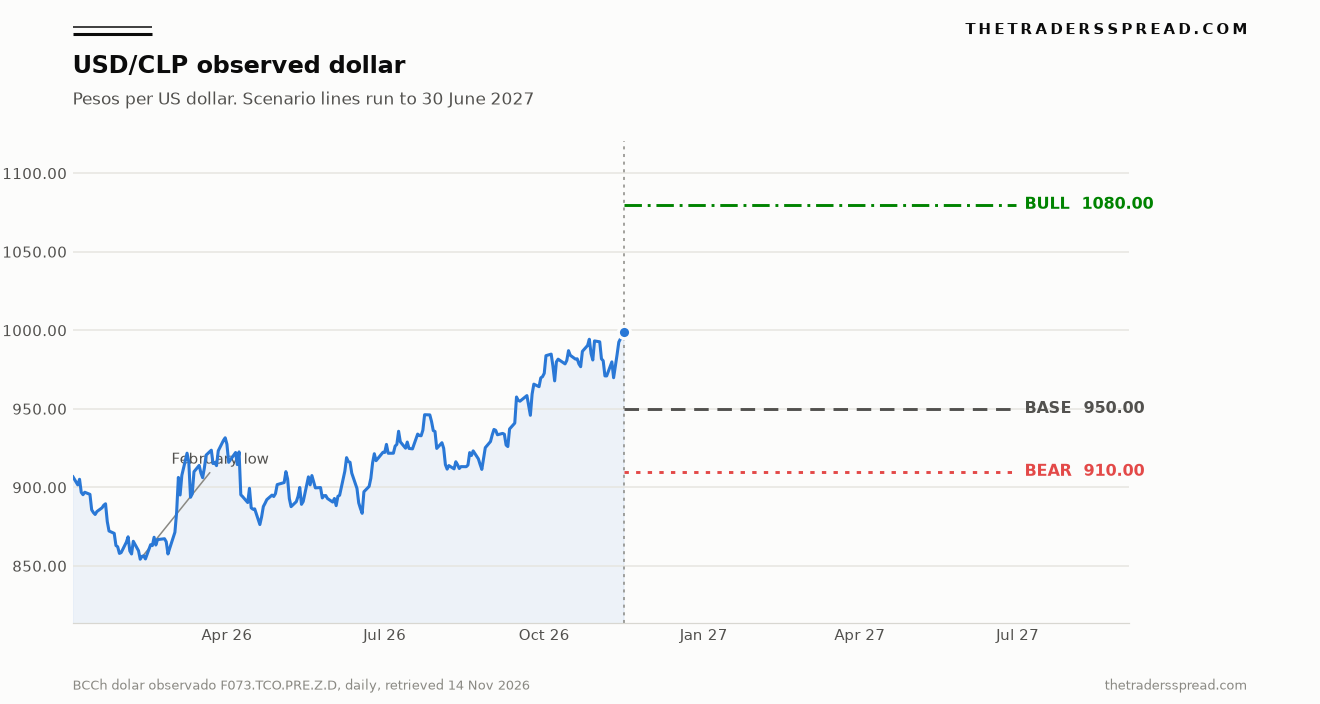
| Path | Pesos per dollar | Versus 999.10 | Desk weight | What has to show up |
|---|---|---|---|---|
| Bear | 910 | 8.9 percent lower | 28 percent | Copper's average holds near the zone just printed, the Fed leaves the funds range where it is, and the peso retraces toward the August prints around 911. |
| Base | 950 | 4.9 percent lower | 50 percent | The jump from 969.80 to 999.10 fades, copper stays elevated, and the 970 survey median acts as a waypoint on the way toward 950. |
| Bull | 1080 | 8.1 percent higher | 22 percent | The weekly copper loss becomes a trend, the US funds range rises, and the Chilean policy rate stays at 4.5 percent. |
The base path is 950, 4.9 percent under the latest value date, between October's average of 982.28 and September's average of 947.27, and 20 pesos under the 11 November survey median. Copper near a six-dollar average leaves a full extension toward 1080 short of a commodity reason.
RelatedUSD/TWD: Myths About the Close, the Bank and the Fix
The bear path at 910 means a stronger peso, 8.9 percent under 999.10 and a short distance through the August prints near 911. It needs the copper average to hold, the Fed to leave the 3.75 to 4 percent range alone, and the survey to keep stepping down from 970. The weight is 28 percent because those conditions can line up, in a year that has disappointed anyone who faded the dollar too early.
The bull path is 1080, 8.1 percent above the latest print. It needs the soft copper week to become a lower average, the funds range to rise in line with the two dissents of 28 October, and the Chilean policy rate to stay at 4.5 percent so the carry shrinks from the US side. The weight is 22 percent because 1080 would clear a series that has only just touched 999, while the operator survey still points the other way.
The weights sum to 100, stand apart from option prices and from the survey median, and pick 950.
6) The call, and what would change it
The call is a base of 950 pesos per dollar by 30 June 2027, a bear case of 910 if copper holds near the average just printed and the Fed leaves the funds range unchanged, and a bull case of 1080 if copper's weekly loss lengthens while the US range rises and the Chilean policy rate stays at 4.5 percent. The lean follows the survey at 970, the copper average still 39.5 percent above 2025, and a real policy rate against headline CPI of about zero, and it leaves the August shelf as the tail.
Two developments would change the call. A later value date in F073.TCO.PRE.Z.D above 1040, 4.1 percent above 999.10, would retire 950 and make 1080 the working path, provided copper was also losing its average and the December projections lined up with a higher funds range. If instead the 28-day median steps down from 970 toward 940, Cochilco's average is still near US$6.15 to US$6.16, and the Fed has left the range at 3.75 to 4 percent, then 910 replaces 950 as the central case.
Questions readers actually ask
What is the USD/CLP forecast from here?
The USD/CLP forecast is a three-path call on Chile's observed dollar through 30 June 2027. The latest official print is 999.10 pesos per dollar on the 16 November 2026 value date. The base path is 950, the bull path for a weaker peso is 1080, and the bear path for a stronger peso is 910. Those levels refer to the official series, which averages the previous banking day's formal-market deals.
Why can the peso weaken while copper is this expensive?
Cochilco's note for 9 to 13 November put copper at US$6.17 a pound, with an annual average of US$6.16, up 39.5 percent on the same stretch of 2025, and the observed dollar still rose from 907.13 to 999.10. The copper leg was supportive on the level and soft on the week. On 22 October the operator survey marked the global-dollar factor at 8 and copper at 6, so the dollar leg outranked the metal.
How should a newer trader read 999.10?
Read 999.10 as pesos per one US dollar, for one value date, from the central bank's weighted average of formal-market spot. The figure belongs to 16 November 2026 and was on the database by 14 November, because the bank publishes the reference ahead of the morning it applies. The prior value date was 992.48. A higher reading is a cheaper peso.
How does the Fed decision feed into the peso?
The Fed held the funds range at 3.75 to 4 percent on 28 October 2026, and two voters preferred a quarter-point increase. Chile's policy rate is 4.5 percent, so the nominal gap is 50 to 75 basis points. A quarter-point US increase would shrink the gap to the top of the range from 50 basis points to 25. The 8 and 9 December meeting includes new projections, and that gap is the US channel into USD/CLP.
What would make 910 more likely than 950?
The bear path at 910 becomes the central case if three things line up. Cochilco's copper average needs to hold near the US$6.15 to US$6.16 zone just reported. The Fed needs to leave the funds range at 3.75 to 4 percent. And the 28-day survey median, 970 on 11 November, needs to keep stepping down toward something nearer 940.
Where do the percentage weights come from?
The 50 percent weight sits on 950, the 28 percent on 910, and the 22 percent on 1080. They are scenario weights for 30 June 2027, and they sum to 100. They rank which mix of copper, the US funds range, and the Chilean policy rate looks most plausible. The 11 November survey median of 970 is an input to the base case, separate from these weights.
This is research for general information. Currency levels move, the three paths can all miss, and any decision about a position sits with the reader.