

GBP/PLN printed a twelve-month high of 5.3012 on 3 November 2026, two days before the Bank of England raised Bank Rate, and the cross was already back at 5.2666 on the 11 November ECB reference.
That give-back is only 0.65% from the high. The year underneath it is a different size of move. On 12 November 2025 the same ECB reference, carried by Frankfurter, stood at 4.792, so the rise to 5.2666 is 9.9%. The twelve-month low was 4.785 on 14 November 2025, and the 3 November high sat 10.8% above that floor. On this quote a higher GBP/PLN print is a stronger pound, because the series is zlotys per one pound, which puts the bull case above the spot and the bear case below it.
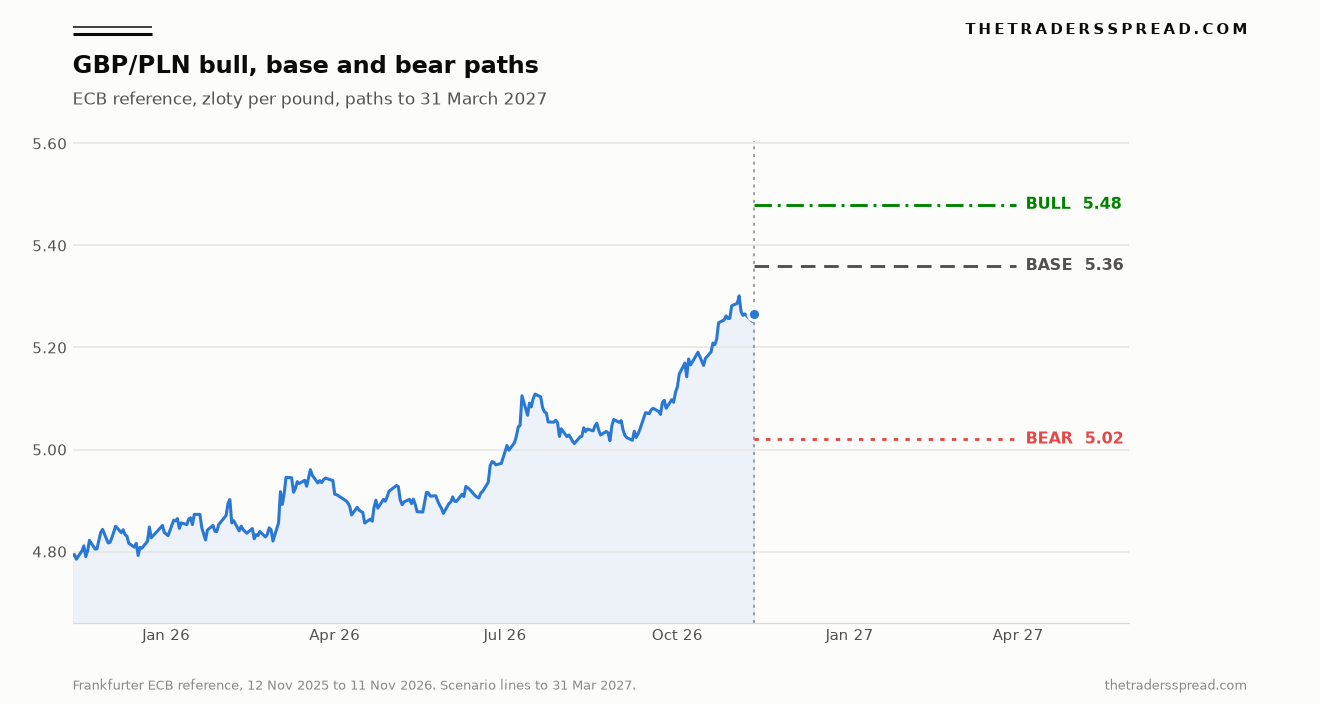
The policy gap after the hike is 0.25 percentage points. Bank Rate is 4%, after a quarter-point rise published on 5 November 2026, and the NBP reference rate is still 3.75% after the Council meeting of 3-4 November. A 9.9% climb against a quarter-point gap that opened at the end of the climb is the tension in this GBP/PLN forecast. Our bias on the cross is bull into 31 March 2027, with a bull case at 5.48, a base path at 5.36 and a bear case at 5.02. We anchor the bull reading at 5.27, a rounding of the 11 November print, and conviction is three on a five-point scale.
Key facts
- GBP/PLN on the ECB reference was 5.2666 on 11 November 2026, up from 4.792 on 12 November 2025, a rise of 9.9%. Source: Frankfurter, retrieved 12 November 2026.
- The twelve-month high was 5.3012 on 3 November 2026 and the low was 4.785 on 14 November 2025. Source: Frankfurter, retrieved 12 November 2026.
- The 20-session average of that series is 5.2443 and the 60-session average is 5.137. Source: Frankfurter, retrieved 12 November 2026.
- Bank Rate is 4% after a 0.25 percentage point rise at the meeting ending 4 November 2026, and the next date on the Bank's page is 17 December 2026. Source: Bank of England, 5 November 2026.
- The Committee voted 8 to 1 for that quarter-point rise, and Catherine L Mann preferred 0.5 percentage points, to 4.25%. Source: Bank of England minutes, 5 November 2026.
- The NBP reference rate stayed at 3.75%, with the lombard rate at 4.25% and the deposit rate at 3.25%. Source: NBP communique, 4 November 2026.
- The November projection, on unchanged NBP rates and data to 15 October 2026, puts 2027 CPI in a 50% band of 3.1% to 5.3%, against 1.5% to 4.0% in July. Source: NBP communique, 4 November 2026.
1 The cross had already done the year's work
From the 2 January 2026 reference of 4.8312, the year-to-date rise to 5.2666 is 9.0%, so almost all of the twelve-month gain is a 2026 gain. Spring was quieter than the autumn. On 12 May the reference was 4.8938, which is 7.6% under the latest print, and the cross spent the early summer chopping under 5.00 before the second half did the heavy lifting.
On 12 August 2026 the ECB reference was 5.0426. The move from there to 5.2666 on 11 November is 4.4% in about three months, and the last of those months was the slow one: 5.1907 on 12 October, then only 1.5% up to the latest print. The high of 5.3012 arrived on 3 November and the six sessions after it sat between 5.2511 and 5.2708.
Our spot is the ECB reference via Frankfurter, 5.2666 on 11 November 2026, retrieved on 12 November. The NBP table A mid is a separate fixing: 5.3037 on 3 November in table 214/A/NBP/2026, and 5.2490 on 10 November in table 219/A/NBP/2026. Every scenario below stays on the ECB scale. The print is about 0.4% above its 20-session average of 5.2443 and 2.5% above the 60-session average of 5.137, which is why a further 4.1% to 5.48 is the bull case rather than the base.
2 London hiked, and left the next step open
The Bank Rate page, updated 5 November 2026, shows Bank Rate at 4%, inflation at 3.5% and a 2% target. The same page records holds at 3.75% in July 2026 and September 2026, so the November move is a quarter-point rise from that plateau, with the next decision dated 17 December 2026. The page says inflation is expected to reach about 5% by mid-2027, with energy prices kept high by the Middle East conflict and with activity stronger than the Bank had expected.
The minutes of the meeting ending 4 November 2026, published the next day, record an 8 to 1 vote. Eight members, Governor Andrew Bailey among them, preferred a rise of 0.25 percentage points, to 4%. Catherine L Mann preferred 0.5 percentage points, to 4.25%. The minutes say UK CPI increased to 3.5% in September and is expected around 5% by the middle of next year, with limited evidence of knock-on effects into other prices and wages, enough pipeline pressure to justify the rise, and a stance free of a pre-set path.
Andrew Bailey, Governor of the Bank of England, said on the Bank Rate page: "There is now enough inflationary pressure in the pipeline caused by the rise in energy prices that an increase in Bank Rate is warranted." He framed the step as something other than the start of an automatic sequence, and he said a further increase was plausible while the conflict, which the minutes put in its ninth month, stayed unresolved. If CPI is about 5% by mid-2027 and Bank Rate is still 4%, the crude gap of Bank Rate over September's 3.5% turns around, so 5.48 needs that door to stay open. One extra quarter point, with Warsaw on hold, can clear the 5.3012 high.
3 Warsaw held, and widened the 2027 fan
The NBP communique dated Warsaw, 4 November 2026, says the Council kept rates unchanged at the meeting of 3-4 November. The reference rate stays at 3.75%, the lombard rate at 4.25%, the deposit rate at 3.25%, the rediscount rate at 3.80% and the discount rate at 3.85%. Further decisions depend on incoming information about the outlook. The document is the Council's information note, the Komunikat RPP of 4 November 2026.
The inflation news in front of that meeting was a fuel-driven dip. The communique says that, on the GUS flash, CPI in October fell to 3.5% year on year, from 4.1% in September, mainly because fuel prices were lower than in September. The GUS flash of 30 October 2026 reports prices up 3.5% on October 2025 and down 0.4% on the month. Food was 99.9 versus a year earlier. Electricity, gas and other fuels were 106.0. Transport fuels were 121.7 versus a year earlier and 90.3 versus September, a 9.7% monthly drop inside a 21.7% yearly rise. The flash is preliminary and can still be revised. The chart on that release prints an inflation target of 2.5%.
A fuel drop of that size can move a headline from 4.1% to 3.5% and still leave the yearly fuel rate above 20%. On unchanged rates, and on data to 15 October 2026, the November projection puts CPI in a 50% band of 3.1% to 3.2% for 2026, 3.1% to 5.3% for 2027 and 1.4% to 4.4% for 2028, against July bands of 2.4% to 3.3%, 1.5% to 4.0% and 0.8% to 3.9%. The 2027 floor sits above the 2.5% target and the ceiling sits above 3.75%. GDP bands in the same round are 3.2% to 4.1% for 2026, 1.9% to 3.8% for 2027 and 1.7% to 3.9% for 2028. The hold supports sterling today, and a later reference-rate rise toward Bank Rate is the fundamental version of 5.02.
4 Where a quarter point meets a cross near its high
The latest inflation headlines match by coincidence of the prints, and the months differ. UK CPI was 3.5% in September on the Bank of England minutes. Polish CPI was 3.5% in the October flash. The policy rates sit apart, at 4% after a rise and at 3.75% after a hold. A crude policy-minus-CPI gap is about half a point in Britain and about a quarter point in Poland. The gap the cross can actually trade is the nominal one, 0.25 points in sterling's favour.
From here the paths diverge, even though both institutions face a year in which inflation can sit near 5%. London has already moved, and the vote still contains a half-point dissent. Warsaw has held, with a 2027 band that runs from 3.1% to 5.3% if rates stay put. The bank that has moved can extend the sterling bid. The bank that held can take it back. Neighbouring gaps are separate pages: the euro against the zloty is EUR/PLN, sterling against the forint is GBP/HUF, and the dollar leg of the zloty is USD/PLN. GBP/PLN is the sterling-zloty cross only, and it should be read off these two rate paths.
From 12 August at 5.0426 to 11 November at 5.2666 was 4.4%. A further 4.1% to 5.48, about 3.4% above the 5.3012 high, is why 5.48 is the bull case rather than the base. The bear case at 5.02 is 4.7% under the spot, near the 12 August print, and it would break the 60-session average at 5.137. The base at 5.36 is 1.8% above the spot: through the old high, then a stall, inside the window to 31 March 2027.
5 Bull 5.48, base 5.36, bear 5.02
The three paths are scenarios for the ECB reference, on the same scale as the 5.2666 print of 11 November 2026, and they run to 31 March 2027. The bull case is the target we attach to the bull bias. The bear case is the level that invalidates it. The reference for the bull reading is 5.27.
| Path | GBP/PLN | Versus 5.2666 | What has to be true |
|---|---|---|---|
| Bull | 5.48 | +4.1% | Bank Rate rises again, or the 17 December message keeps a further rise plausible, and the NBP reference rate is still 3.75% |
| Base | 5.36 | +1.8% | The 0.25 point gap survives the next Bank of England decision and the next NBP decision |
| Bear | 5.02 | -4.7% | The NBP lifts the reference rate, or the Bank of England treats 4% as the last rise of this phase |
Asking for another 4% from a point near the high, after the cross already rose 4.4% between 12 August and 11 November, requires the gap to widen or to look likely to widen. A December hold in London that still sounds open, beside another hold in Warsaw, belongs on the base row, with the price through 5.3012 and then stalling around 5.36.
The bear row is the worse outcome for the pound on this cross, and it sits below the spot on purpose. A Warsaw reference rate at 4% would erase the quarter-point gap, and a rate above 4% would reverse it. Either outcome, or a Bank of England message that closes the door, hands back the move since early August. The 5.02 mark is near 5.0426 on 12 August and far above the 4.785 low, so it is a setback inside the existing range.
Related7 Forces Move the EUR/SGD Cross More Than the Euro
6 The print that would flip the call
Three prints would retire the bull case, and any one of them would do it alone. The first is an NBP communique that lifts the reference rate to 4% or higher, matching or passing Bank Rate. The second is the 17 December Bank of England decision, if it holds Bank Rate at 4% and drops the language that a further increase is plausible while the Middle East conflict continues. The third is an ECB reference for GBP/PLN under 5.02, the bear case on the chart, even with the communiques left as they stand. A settlement under that level would mean the rate-gap story had failed in the price.
A quieter reason to redraw the levels would be a new NBP projection with a 2027 ceiling back under 4%, which would make 5.02 look too aggressive while the direction survived if Bank Rate were still above the reference rate. The hard flip is a Polish policy rate at or above Bank Rate, or a sterling reference under 5.02. A December pair of holds, with London still describing another rise as plausible, would leave 5.48 in place and would fit 5.36 if the price stayed between 5.27 and the base.
FAQ
What is the GBP/PLN forecast in this desk view?
The forecast is a bull case at 5.48, a base path at 5.36 and a bear case at 5.02, set against the 11 November 2026 ECB reference of 5.2666. The bull reading is anchored at 5.27 and the levels run to 31 March 2027. It depends on Bank Rate staying above the NBP reference rate, with room left for a further rise in London. Conviction is three out of five.
Why use the ECB reference rather than the NBP fixing?
Frankfurter publishes the ECB euro foreign-exchange reference rates, and GBP/PLN here is that series with sterling as the base, dated 11 November 2026 at 5.2666. The NBP table A mid is a separate Polish fixing. On 10 November 2026 it was 5.2490 in table 219/A/NBP/2026, about two hundredths under the next ECB reference. The bull case, the base path and the bear case share that one ECB scale.
What did the NBP change at the November meeting?
The Council left the corridor where it stood. The communique of 4 November 2026 keeps the reference rate at 3.75%, the lombard rate at 4.25%, the deposit rate at 3.25%, the rediscount rate at 3.80% and the discount rate at 3.85%. The new information was the projection. On unchanged rates, and on data to 15 October, the 50% band for 2027 CPI moved to 3.1% to 5.3%, from 1.5% to 4.0% in July.
How can both inflation rates be 3.5% and still move the cross?
The headlines match on the latest prints, and the months differ. UK CPI was 3.5% in September 2026 in the Bank of England minutes. Polish CPI was 3.5% in the GUS flash for October, down from 4.1% in September on the NBP's reading, mainly because fuel prices fell on the month. The policy rates differ, at 4% in London and 3.75% in Warsaw, and the cross follows that gap.
What would make 5.48 the wrong bull case?
An NBP reference rate at or above Bank Rate would make 5.48 the wrong bull case, as would a 17 December message from the Bank of England that treats 4% as the last rise while the Middle East conflict continues. An ECB reference under 5.02 would do the same job in the price alone. A new NBP band with a 2027 ceiling under 4% would be a reason to redraw the levels.
The levels above are a scenario for GBP/PLN from this desk. The text is general information, and it is not a solicitation to transact in the cross or in any other market.