

Traders who treat GBP/DKK as a free float between Britain and Denmark are watching the wrong policy. Denmark keeps the krone inside a narrow band against the euro, so the cross is mostly the pound's move against that peg, and a year of reference rates left a krone residual of a few hundredths of a krone.
On the European Central Bank reference for 23 October 2026, one pound bought 1.1943 euro and one euro bought 7.4748 kroner. The product is 8.92715 kroner per pound, against a direct GBP/DKK fix of 8.9275, a gap of 0.00035 kroner. Dividing Nationalbank's same-day prices, 892.75 kroner per 100 pounds and 747.48 per 100 euro, by 100 reproduces those ECB fixes. Over the same dates EUR/NOK spanned 13.5 per cent of its midpoint and EUR/DKK spanned 0.14 per cent.
Those variance shares are a calculation on the downloaded series, not a statistic the ECB prints ready-made. A request for 26 October 2025 through 26 October 2026 returned 255 business-day fixes, 24 October 2025 to 23 October 2026, the latest ECB reference available that Monday. Frankfurter's v1 series matched the ECB provider feed on both GBP/DKK and GBP/EUR at every date. The correlation of the 254 daily percentage changes was 0.9992. On the daily log changes, the variance of GBP/EUR was 99.3 per cent of the variance of GBP/DKK, and the variance of EUR/DKK was 0.14 per cent of it, with about half a percentage point left over as covariance between the legs.
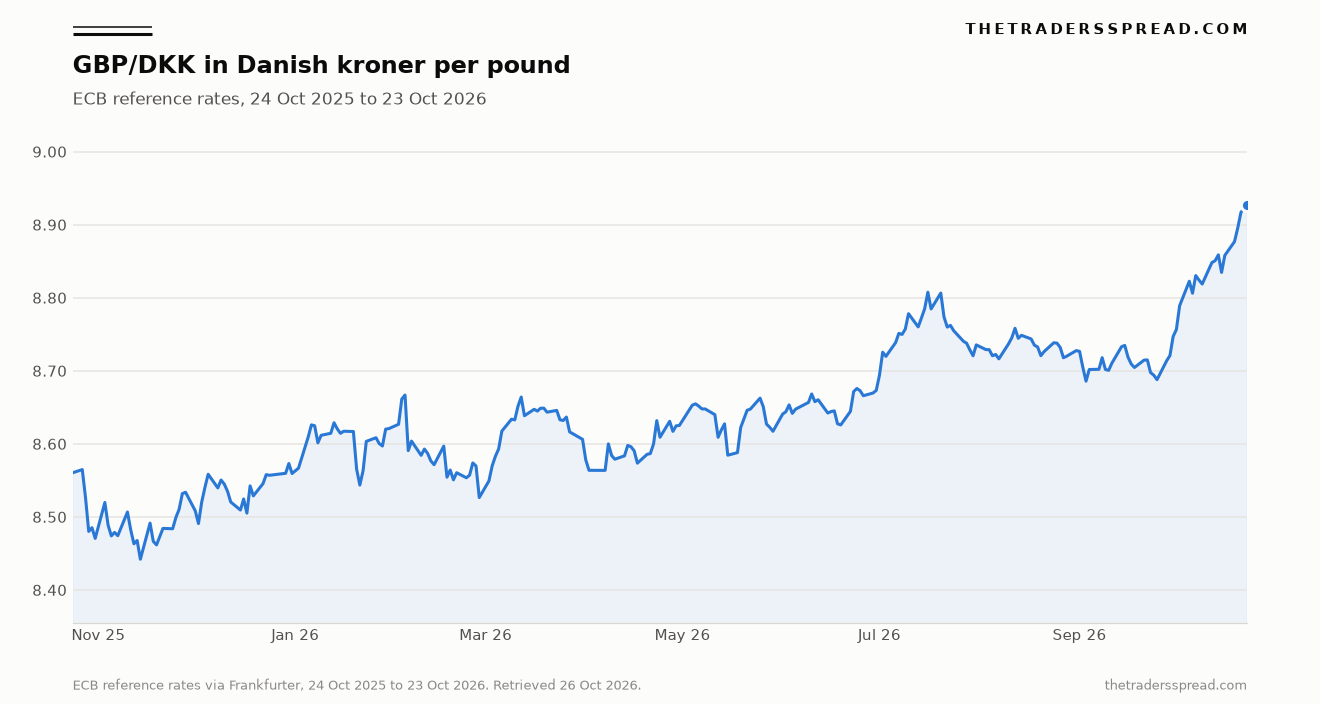
EUR/DKK ran from 7.4656 on 5 November 2025 to 7.4759 on 18 August 2026, a range of 0.0103 kroner. GBP/DKK ran from 8.4421 on 14 November 2025 to 8.9275 on 23 October 2026. From the window's first print, 8.5604 on 24 October 2025, the cross rose 4.29 per cent, while GBP/EUR rose 4.21 per cent, from 1.146 to 1.1943. The euro against sterling is the other leg, and this desk follows it on its own in the EUR/GBP forecast. GBP/DKK is that leg multiplied by a krone that stays near 7.46 per euro.
Updated 26 October 2026.
GBP/DKK is a free float, the way sterling floats against the dollar.
A retail platform draws GBP/DKK with the same candles it uses for cable, which is why the free-float sentence sounds plausible. The policy behind the quote is different. Danmarks Nationalbank's FAQ says the krone floats against every currency except the euro, and it names the Swedish krona and the US dollar as rates with neither a ceiling nor a floor. Sterling sits in that open group. The euro is the currency the band is written for.
Both legs of a genuine free float would show up in the variance, and this cross fails that test on the shares above. The low day makes the split concrete. On 14 November 2025, GBP/DKK and GBP/EUR both printed their lows for the 255-day window, at 8.4421 and 1.1305, while EUR/DKK was 7.4679. EUR/DKK at 7.4679 was about 10.1 basis points above the central rate of 7.46038. The product of 1.1305 and 7.4679 is 8.44246, against the direct fix of 8.4421. The soft day in GBP/DKK was a sterling day against the euro, and the peg was where it had been all autumn.
| Leg on 23 October 2026 | Fix | Unit |
|---|---|---|
| GBP/EUR | 1.1943 | euro per pound |
| EUR/DKK | 7.4748 | kroner per euro |
| Product of the two legs | 8.92715 | kroner per pound |
| GBP/DKK, direct reference | 8.9275 | kroner per pound |
| Direct fix minus the product | 0.00035 | kroner |
The fixes are ECB references via Frankfurter on 26 October 2026, and the product is arithmetic on the first two. The third currency in that identity is the euro.
How the central-bank quote and the screen quote name one rate.
The unit is where screens diverge. Danmarks Nationalbank publishes kroner per 100 units of foreign currency, and the ECB reference, which Frankfurter stores, publishes the price of one unit. On 23 October 2026 the bank's sterling line was 892.75 and its euro line was 747.48. Moving the decimal point two places produces 8.9275 and 7.4748. A platform showing "GBP/DKK 8.9275" and a central-bank page showing "892.75" are describing one fix, and averaging the two numbers mixes a per-one quote with a per-hundred quote.
The exchange-rate page sets the clock. The ECB concertation moved from 14:15 to 14:10 on 3 April 2023. The rates are interbank mid-prices at that concertation. The ECB publishes at 16:00, and Danmarks Nationalbank follows with kroner prices derived from the euro-krone reference. The page calls the prices indicative figures for information, separate from transaction prices. The RSS channel text still says 14:15, the pre-2023 wording, so a legal timestamp should follow the explanatory page.
Frankfurter's documentation says ECB figures should be read from the provider route, which is the check behind the 255 matching dates above. Other currencies on the blended route need their own check.
The krone is said to have 15 per cent of room against the euro.
ERM II's standard band really is plus or minus 15 per cent around a central rate, and that half of the paragraph is where the wide-band claim starts. The Nationalbank FAQ then sets Denmark's central rate at 746.038 kroner per 100 euro, or 7.46038 per euro, under an agreement with the ECB on a narrower band of plus or minus 2.25 per cent. Since the late 1990s, the same page says, the bank has held the krone much closer to the central rate than those edges require, and the parity against the D-mark, later the euro, has been unchanged since January 1987.
The explainer on inflation, rates and the peg ties the choice to the ECB's aim of inflation close to 2 per cent over the medium term, and to Denmark's trade with the euro area. The FAQ describes ERM II as the framework for the existing peg, and Denmark's participation is that framework rather than a path into the euro.
| Marker | Kroner per 100 euro | Kroner per euro | Versus the central rate |
|---|---|---|---|
| Narrow floor, minus 2.25 per cent | 729.252 | 7.29252 | minus 2.25 per cent |
| Central rate | 746.038 | 7.46038 | parity |
| Narrow ceiling, plus 2.25 per cent | 762.824 | 7.62824 | plus 2.25 per cent |
| Lowest ECB fix, 5 November 2025 | 746.56 | 7.4656 | plus 7.0 basis points |
| Highest ECB fix, 18 August 2026 | 747.59 | 7.4759 | plus 20.8 basis points |
| ECB fix, 23 October 2026 | 747.48 | 7.4748 | plus 19.3 basis points |
The floor, ceiling and central rate are Nationalbank's marks, and the basis points are the percentage gap from 7.46038. All 255 euro-krone fixes sat above parity, so one euro cost more kroner than 7.46038 all year. The softest print, 7.4759, was still about 2.0 percentage points short of the ceiling at 7.62824, and the year's range of 0.0103 kroner is 3.1 per cent of the narrow band's width of 0.33572. The reference rates used a thin slice of the 2.25 per cent agreement, on the soft side of parity.
Norway is the central bank traders reach for when GBP/DKK moves.
Norway and Denmark get filed together on a sterling desk, and the mandates on the two sites diverge. Norges Bank's strategy targets annual consumer-price inflation close to 2 per cent over time, uses the policy rate on banks' deposits up to a quota as its main instrument, and sets a very high threshold for intervening to influence the krone. The policy-rate page showed 4.5 per cent, published on 24 September 2026.
Denmark's FAQ says monetary policy exists to keep the krone stable against the euro, so the rate is unavailable as a separate lever for the domestic cycle. From 11 September 2026 the current-account, certificate and discount rates were 2.10 per cent and the lending rate was 2.25 per cent, after a 0.25 percentage-point rise the 10 September press release tied to the ECB's deposit facility. Oslo's quota rate and Copenhagen's current-account rate are different facilities, and the 2.40 percentage-point gap between 4.5 and 2.10 is a comparison of two jobs.
EUR/NOK fell 9.92 per cent over the window, from 11.6185 to 10.4665, and spanned 13.5 per cent of its midpoint, while EUR/DKK changed 0.07 per cent. The desk's EUR/NOK forecast follows the Norwegian cross on its own, and reading that path back onto GBP/DKK imports a float into a peg. Sweden is the currency Nationalbank cites as having neither a ceiling nor a floor against the krone. EUR/SEK spanned 7.42 per cent of its midpoint here, about fifty times EUR/DKK's 0.14 per cent, and the GBP/SEK note treats sterling against that krona as its own cross.
| ECB cross | 24 Oct 2025 | 23 Oct 2026 | Low | High | High to low, share of midpoint |
|---|---|---|---|---|---|
| EUR/DKK | 7.4698 | 7.4748 | 7.4656 on 5 Nov 2025 | 7.4759 on 18 Aug 2026 | 0.14 per cent |
| EUR/NOK | 11.6185 | 10.4665 | 10.4665 on 23 Oct 2026 | 11.9858 on 17 Dec 2025 | 13.5 per cent |
| EUR/SEK | 10.904 | 11.131 | 10.5205 on 30 Jan 2026 | 11.331 on 30 Sep 2026 | 7.42 per cent |
| GBP/EUR | 1.146 | 1.1943 | 1.1305 on 14 Nov 2025 | 1.1943 on 23 Oct 2026 | 5.49 per cent |
| GBP/DKK | 8.5604 | 8.9275 | 8.4421 on 14 Nov 2025 | 8.9275 on 23 Oct 2026 | 5.59 per cent |
The midpoint share is the high minus the low, divided by their average, on ECB references retrieved 26 October 2026. GBP/EUR and GBP/DKK share almost the same span.
A jump in sterling is treated as something Copenhagen must answer.
The intervention rule is written for one pair. If the krone moves away from the central rate against the euro, Danmarks Nationalbank can buy kroner and sell euro, or do the reverse, and it can move interest rates to pull the krone back. The FAQ is specific: buy kroner and sell euro when the krone is depreciating away from the central rate, and sell kroner when the krone is appreciating. Sterling is absent from that job description. A GBP/DKK move that arrives entirely through GBP/EUR leaves EUR/DKK, and therefore the peg, untouched, so the peg's trigger stays idle.
The cross in the chart rose from the 8.44s in November 2025 to the 8.92s by 23 October 2026, which is the pound's gain against the euro, scaled into kroner.
Two public figures show the scale. The explainer recalls intervention of 275 billion kroner in January and February 2015, the episode it calls the great krone pressure. The release dated 2 October 2026 is the quiet year: the reserve fell 0.4 billion kroner in September, to 693.2 billion, on a net sale of 0.5 billion of foreign exchange and 0.1 billion of government foreign borrowing, with September's intervention line blank. January through September, intervention purchases of foreign exchange were a net minus 6.3 billion kroner, a net sale of foreign exchange for kroner, which supports the krone. Beside 275 billion, those sums are small, and they point at the euro.
Danish policy rates are described as a tool for the Danish cycle.
The domestic-cycle story is the one the framework was built to retire. Since the early 1980s the bank has used rates to hold the peg, and it assigns domestic stabilisation to fiscal policy. The FAQ's division of labour puts the exchange-rate regime with the government, in consultation with the central bank, and puts monetary policy inside that regime with the central bank alone. Parliament and the government stand outside the rate decision. The result the bank describes is that the rate has one job.
The 2026 increases are that job in public. In Interest rate increases and high risk appetite, dated 23 September 2026, the bank said the krone had weakened gradually against the euro after war broke out in the Middle East in February, that it intervened in a small way in June and August, and that it matched ECB rises of 25 basis points in June and September, leaving the monetary policy spread at minus 40 basis points. The 10 September press release sets the levels from 11 September at 2.10 per cent for the current account, certificates of deposit and the discount rate, and 2.25 per cent for lending, after the ECB's deposit-facility increase. The minus 40 is the analysis. The levels are the press release.
The FAQ's sequence, when the spread does move, is intervention first and a rate gap to the euro area second, which is still a peg tool. Reading 2.10 per cent as a Danish growth setting, detached from Frankfurt, skips the sentence the regime opens with. Sterling's 4.29 per cent rise passed into GBP/DKK while the euro gap stayed inside 21 basis points.
The central rate is assumed to shift when growth needs a weaker krone.
Devaluation was the old habit, and the explainer treats 1982 as the break with it, after the high inflation and repeated parity changes of the 1970s. From January 1987 the central rate against the D-mark, later converted to 7.46038 against the euro, stayed put. A trader who still prices a Copenhagen nudge to the peg is pricing an instrument the bank says it retired, and that the FAQ says has been untouched since 1987.
RelatedGBP/NOK Price Prediction: 13.20 Bull Case vs 12.10 Bear
What replaced parity changes is intervention, including the 275 billion kroner of early 2015, and rate gaps to the euro area. A drift of 21 basis points sits inside the plus or minus 2.25 per cent band with room to spare, so the operating style since the late 1990s can lean on intervention and the ECB spread while 746.038 stays in the agreement.
Danmarks Nationalbank marked four decades of that regime in a Danish-language post on 27 October 2022. Chief adviser Morten Spange is named there as the author of an analysis on how economic policy is arranged in a country that runs a fixed exchange rate. The post matters because the bank dates the regime in public and treats it as the frame for the other policy choices, which is the opposite of a central rate edited when growth disappoints.
40 år med fastkurspolitik i Danmark.
— Danmarks Nationalbank (@nationalbanken) October 27, 2022
Chefrådgiver @MortenSpange sætter i ny analyse fokus på, hvordan den økonomiske politik bedst tilrettelægges i et land som Danmark, hvor der føres fastkurspolitik.https://t.co/jXbEMEYfqd#dkøko #dkpol #dkfinans pic.twitter.com/EUr0Vv3eKs
GBP/EUR rose 4.21 per cent from the first fix in the window to the last, and GBP/DKK rose 4.29 per cent alongside it.
Questions that keep coming back on GBP/DKK and the peg.
Is GBP/DKK a free-floating exchange rate in the way cable is?
Sterling floats against the dollar and against the krone, while the krone is managed against the euro, so GBP/DKK inherits GBP/EUR. Across 254 daily percentage changes from 24 October 2025 to 23 October 2026, the correlation with GBP/EUR was 0.9992, and EUR/DKK spanned only 0.0103 kroner. EUR/NOK's high-to-low span in that window was 13.5 per cent of its midpoint. The candles move because the pound moves, and the Danish half of the pair is a band around the euro.
What central rate does Denmark actually defend against the euro?
The ERM II central rate is 746.038 kroner per 100 euro, or 7.46038 per euro, unchanged on Danmarks Nationalbank's account since January 1987. The agreed band is plus or minus 2.25 per cent, from 7.29252 to 7.62824, inside the ordinary ERM II width of plus or minus 15 per cent. Every ECB fix in the window used here sat between 7.0 and 20.8 basis points above 7.46038, on the soft side of parity and far inside those edges.
Does a sharp move in sterling force Danmarks Nationalbank to act?
Intervention is defined against the euro. The bank buys kroner when the krone depreciates from the central rate and sells kroner when it appreciates, so a GBP/DKK move that comes through GBP/EUR leaves EUR/DKK alone. On 14 November 2025 the cross and GBP/EUR both printed their lows for the year, at 8.4421 and 1.1305, while EUR/DKK was 7.4679, about 10.1 basis points from parity.
Why is the Norwegian krone the wrong comparison for this cross?
Norges Bank targets consumer-price inflation close to 2 per cent over time, and its policy rate was 4.5 per cent in the figure published on 24 September 2026. Denmark's current-account rate was 2.10 per cent from 11 September 2026 and is used for the euro peg. The facilities differ, so the 2.40 percentage-point gap illustrates two mandates. Over the same ECB dates EUR/NOK spanned 13.5 per cent of its midpoint and EUR/DKK spanned 0.14 per cent.
Why do some screens show about 8.93 while others show about 893?
Danmarks Nationalbank quotes kroner per 100 foreign units. On 23 October 2026 that was 892.75 per 100 pounds, the same price as the ECB's 8.9275 per pound, and 747.48 per 100 euro, the same price as 7.4748. The exchange-rate page calls these indicative information prices after the 14:10 concertation and the 16:00 publication. The per-hundred habit is a quoting convention, not a second market.
Has the central rate been adjusted when the Danish economy needed it?
The central rate against the D-mark, later the euro, has been unchanged since January 1987, after parity changes dropped out of economic policy in 1982. The tools the bank describes are intervention and the rate gap to the euro area. The explainer cites 275 billion kroner of intervention in January and February 2015, against net intervention purchases of foreign exchange of minus 6.3 billion kroner from January to September 2026. The parity stayed at 746.038 per 100 euro.
The rate that actually carries a move in GBP/DKK.
GBP/DKK is a sterling-euro rate with Denmark's narrow euro band wrapped around the krone, so the leg that carries the move is GBP/EUR.
This article is general information drawn from public reference rates and central-bank pages. It is not a forecast, a recommendation, or an instruction to take a position in GBP/DKK or any other market.