

The Riksbank's press release of 24 September 2026, Policy rate unchanged at 1.75 per cent, records a weaker krona beside an unchanged policy rate, and that document is the Swedish half of GBP/SEK.
The shortcut says the cross is nothing more than GBP/USD multiplied by USD/SEK. Over the 255 ECB reference days from 22 October 2025 to 21 October 2026, the cross rose from 12.563 to 13.2389, a gain of 5.4 per cent. Cable rose from 1.3335 to 1.3402, half a per cent. Dollar-krona rose from 9.4209 to 9.8785, 4.9 per cent. About nine-tenths of the cross's log change lines up with USD/SEK. Stop on that split and GBP/SEK had no path of its own.
The arithmetic is real, and it is the wrong conclusion. At one timestamp the dollar cancels: GBP/USD times USD/SEK is GBP/SEK by algebra. On 21 October 2026 Frankfurter's ECB feed returned 13.2389, the same figure as kronor per euro divided by pounds per euro. A perfect triangle is how the fixing is built, not a finding that the Riksbank's path has nothing to say.
Updated 22 October 2026
Key facts
- GBP/SEK at the ECB reference rate was 13.2389 kronor per pound as of 21 October 2026, up from 12.563 on 22 October 2025. Source: European Central Bank via Frankfurter, retrieved 22 October 2026.
- That day's euro rates were 0.83825 pounds, 1.1234 dollars and 11.0975 kronor per euro, and the dollar cancels out of the cross before rounding. Source: ECB euro foreign exchange reference rates, 21 October 2026.
- Across those 255 days the gap between published GBP/SEK and the product of the published dollar legs averaged under 0.2 basis points, and peaked at 0.43 basis points on 3 February 2026. Source: ECB reference rates via Frankfurter, retrieved 22 October 2026.
- The Riksbank left the policy rate at 1.75 per cent from 30 September 2026 and lifted its 2027 policy-rate forecast to 2.3 per cent, from 1.9 per cent in June. Source: Riksbank press release, 24 September 2026.
- The Bank of England held Bank Rate at 3.75 per cent on 17 September 2026 by a 6-3 vote. The next decision is due on 5 November 2026. Source: Bank of England Monetary Policy Summary, 17 September 2026.
- UK CPI rose 3.5 per cent in the twelve months to September 2026, up from 3.1 per cent in August. Source: Office for National Statistics, released 21 October 2026.
The dollar cancels, which is why the myth looks proved
The identity is algebra. The files look like a discovery because the administrator forces them to close.
Every currency on the euro reference-rate page is quoted per euro. Sterling-krona is the ratio of two of those lines. On 21 October 2026 the lines, and the ratios built from them, were these.
| Rate | 21 October 2026 | Where it comes from |
|---|---|---|
| EUR/GBP | 0.83825 | ECB euro reference rate |
| EUR/USD | 1.1234 | ECB euro reference rate |
| EUR/SEK | 11.0975 | ECB euro reference rate |
| GBP/USD | 1.3402 | EUR/USD divided by EUR/GBP, four decimals |
| USD/SEK | 9.8785 | EUR/SEK divided by EUR/USD, four decimals |
| GBP/SEK | 13.2389 | EUR/SEK divided by EUR/GBP |
| Product of the rounded dollar legs | 13.2392 | 1.3402 times 9.8785 |
Before rounding, the product matches 13.2389. The 0.0003 gap in the last row is four-decimal dollar legs, not a market residual. The widest gap in the year was 0.43 basis points on 3 February 2026, when the cross was 12.233 and the product of the published dollar legs was 12.2325. The average was under 0.2 basis points.
The framework dated 23 June 2026 says the rates are set daily around 14:10 CET and published around 16:00 CET, for information, not for dealing. Frankfurter, which redistributes the ECB series used here, says the feed is not built for live trading. A reference rate that is not a transaction price cannot prove that the transaction price has no life of its own.
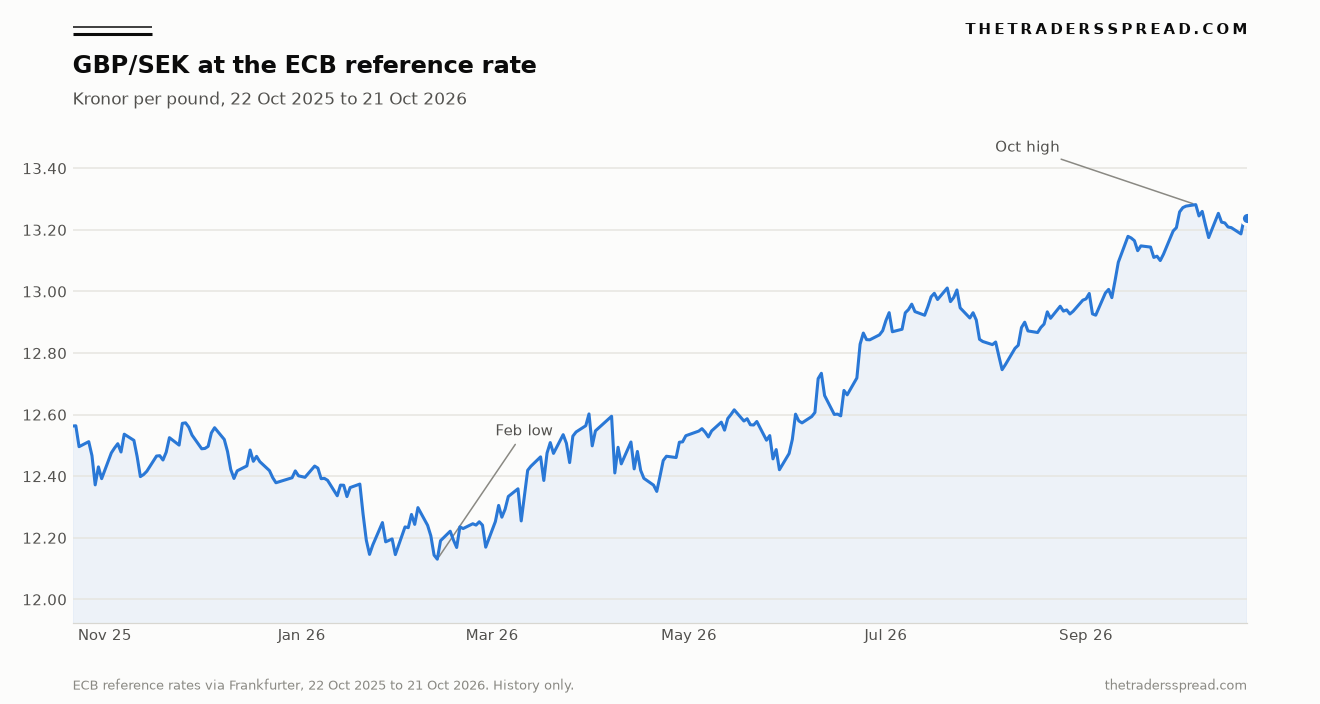
The low on the file is 12.1306 on 12 February 2026. The high is 13.282 on 5 October 2026. From that low to that high the reference rate rose about 9.5 per cent, then eased to 13.2389 by 21 October. No line on the chart runs past the last fixing.
Thirty seconds is the framework's own line
The claim that fails is not the algebra. The claim that fails is that the algebra describes the day.
The June 2026 framework says a contributed price has to sit inside the bid-ask at the concertation. If the latest quote is more than 30 seconds old, it should not count as an active trade unless the rate is barely moving. A morning GBP/SEK quote and cable carried overnight from New York are earlier objects from different clocks. Multiply a live dollar-krona by a stale cable and the two dollars are not the same dollar. The residual collapses at 14:10 CET because the snapshot is built as a triangle.
The myth also borrows the framework's dollar-cross rule and drops the condition. A large gap between the direct euro rate and the dollar cross is settled in favour of the dollar cross only when the currency's own hours miss the concertation. Sterling and the krona are European, and 14:10 CET is their afternoon. The fallback was written for a different case.
The identity is about mids. A dealing price is a bid and an ask, and the synthetic cross carries two spreads while the outright carries one. This page does not invent a pip width. A zero residual in the mid-rate fixing does not measure the outright book.
September rewrote the Swedish path
The Riksbank's September release is a path, not a product of dollar pairs. The policy rate stayed at 1.75 per cent from 30 September 2026. The Board said it should rise by more than the June forecast, with the first increase expected this year if the outlook held. The 2027 forecast went to 2.3 per cent from 1.9. By quarter, the path is 1.85 per cent in the fourth quarter of 2026, against 1.82 in June, and 2.38 per cent in the third quarter of 2027, against 1.97. CPIF for 2026 was marked at 1.5 per cent, from 1.1.
Erik Thedéen, Governor of Sveriges Riksbank, put a date on that path at the Ruter Dam event in Stockholm on 8 October 2026. He said there were "strong reasons to raise the policy rate in the near term", and that it "may be reasonable to raise the policy rate as early as in November." He tied the risk to "high energy and commodity prices, persisting supply disruptions and a weaker krona." The speech is on the Riksbank's account of the presentation.
LiveSquawk carried those remarks the same afternoon, which is the version that reached rates screens before the November meeting. The post reports the governor. It is not a target for the cross.
Riksbank’s Thedéen Sees Grounds For Interest Rate Increase
— LiveSquawk (@LiveSquawk) October 8, 2026
- Strong Growth And Inflation Risk
- Swedish Economy Has Performed Better Than Expected, Whilst Risks Of Inflation Overshooting Target Have Increasedhttps://t.co/iV8Jqy8Yw9
If the Riksbank raises the policy rate and the Bank of England does not, GBP/SEK can move while cable does not. USD/SEK may move too, if the Fed does not match, and the product story will call the cross "just dollar-krona." The accounting can be true after the fact. It still does not name the bank that moved.
A 6-3 hold is not a krona event
Andrew Bailey, Governor of the Bank of England, said on the decision page published 17 September 2026: "Today, we've held Bank Rate at 3.75%." He added that the longer the energy volatility persists, the more likely a rise will be needed to get inflation back to the 2 per cent target. The page is Interest rates and Bank Rate, and the next decision listed there is 5 November 2026.
The Monetary Policy Summary records a 6-3 vote to hold Bank Rate at 3.75 per cent, Andrew Bailey among the six. Megan Greene, Catherine L Mann and Huw Pill preferred 4 per cent. The CPI figure in front of them was 3.1 per cent in August. The minutes also describe a market curve peaking near 4.9 per cent by the end of 2027. That is a market price, not a Bank of England forecast, and not a GBP/SEK target.
The Bank of England posted the vote on the morning of the decision. The post is the sterling half of the gap, in the Bank's words, not a call on the cross.
The Monetary Policy Committee voted 6-3 to keep the interest rate at 3.75%.
— Bank of England (@bankofengland) September 17, 2026
Find out more:https://t.co/GHHt7QdrbF pic.twitter.com/9tlJ8aqmM9
The print the committee had not yet seen came later. The Office for National Statistics said, in its 21 October 2026 bulletin, that CPI rose 3.5 per cent in the twelve months to September, from 3.1 per cent in August. Motor fuels led the rise. The decision page still narrates August's 3.1 per cent and shows 3.5 per cent as the current tile. One figure is what the committee voted on. The other was published a month later.
After those decisions the gap was two percentage points, Bank Rate at 3.75 against the Riksbank at 1.75, and the documents do not even use the same units. Stockholm publishes a path for its own rate. The London minutes describe a market curve and a split vote. A dollar-product model skips both pages, multiplies the legs, and calls that an explanation.
The shock in front of both banks was the same and the sentences were not. The September minutes put Brent at 106 dollars a barrel at the 14 September close, up 36 per cent from the run-up to the July Report, with UK wholesale gas up 78 per cent. Thedéen treated that, plus a weaker krona, as a reason a November rise could be reasonable. Bailey treated it as a reason the hold might not last. GBP/SEK is where those two reactions meet.
A year of reference rates, read twice
The same three columns support a dollar story and a krona story. Only one of them survives the cancellation.
| Pair | 22 October 2025 | 21 October 2026 | Change |
|---|---|---|---|
| GBP/SEK | 12.563 | 13.2389 | +5.4 per cent |
| GBP/USD | 1.3335 | 1.3402 | +0.5 per cent |
| USD/SEK | 9.4209 | 9.8785 | +4.9 per cent |
Read it the myth's way and the cross was a passenger. Sterling barely moved against the dollar, the krona weakened against the dollar, and the product is a higher GBP/SEK. The published GBP/USD forecast and the published USD/SEK forecast are the two ingredients that shortcut invites a reader to multiply. The EUR/SEK forecast sits closer to the rate the ECB actually prints.
RelatedUSD/DKK Forecast: 6.85 Bull Case vs 6.40 Bear Case
Read it the other way and the accounting was the passenger. A weaker krona, which the Riksbank's September text names, raises both USD/SEK and GBP/SEK. Cable stays quiet when the Bank of England and the Fed are not the banks that moved. The large dollar-krona share then means the Swedish leg dominated the year.
Flip the year, let Bank Rate move while the Riksbank stands still, and the same myth would say the cross was "just cable." It cannot be wrong if every outturn is renamed after the larger dollar leg. A real test is a day when one committee moves and the dollar leg that is supposed to carry the cross does not.
What moves GBP/SEK, and what the forecast query is asking
What moves GBP/SEK, once the dollar has cancelled out of the identity, is the gap between Swedish and British policy, the krona's path against the euro, and the hours when the outright book is not the fixing.
After September 2026 the gap was 3.75 per cent against 1.75 per cent. Thedéen pointed at November. The Bank of England's next announcement is 5 November 2026. One committee moving, on a day the other does not, is a GBP/SEK event even if the dollar is unchanged against one currency. That evening's fixing will still be a perfect triangle.
The two euro lines already are the cross. The dollar version is a translation for desks that hedge in dollars. Between publications a morning outright and that translation are allowed to differ, and the next fixing irons the difference out.
People who search for a GBP/SEK forecast are usually asking which committee moves next, and whether a weaker krona is still the Riksbank's description. Search volume and keyword difficulty for that phrase were not measured for this page. A forecast that only multiplies a cable view by a dollar-krona view is right on the days the identity is an accounting fact, which is every fixing, and silent on the day only one central bank changes its path.
FAQ
Is GBP/SEK just GBP/USD multiplied by USD/SEK?
At the ECB reference fixing, yes, before rounding. The dollar cancels, so the product of the two dollar legs equals sterling against the krona. On 21 October 2026 that cross was 13.2389. Across the year to that date the gap after rounding stayed inside 0.43 basis points. The identity describes the fixing. It does not describe two quotes taken at different times, and it does not name which central bank moved.
What moves GBP/SEK if the dollar pairs already match the fixing?
The gap between the Riksbank's policy rate and Bank Rate, and the outright book between fixings. After the September 2026 decisions the Swedish rate was 1.75 per cent, with a higher forecast path, and Bank Rate was 3.75 per cent on a 6-3 hold. A change in that gap can reprice GBP/SEK on a day cable does not move. Krona flow in the European morning can do the same before the next concertation forces the triangle shut.
Why do people search for a GBP/SEK forecast?
The search usually wants the next policy step, not a multiplied price. Volume and keyword difficulty were not measured for this page. The documents show a Swedish path revised up in September 2026, a governor who said a November rise could be reasonable, and a British committee split on a Bank Rate rise. Multiplying the dollar legs misses a day when only one committee moves.
Does the Stockholm session give the cross its own price?
The ECB prints one reference rate a day and says it is not for dealing. Its framework treats a quote older than 30 seconds as something other than an active trade, unless the rate is barely moving. Between publications, a morning GBP/SEK quote and a synthetic from cable and dollar-krona are different books. They meet again at the next concertation, around 14:10 CET. That meeting is the fixing at work.
What would show that the cross really has no path of its own?
A dealt GBP/SEK price that stayed inside the synthetic cross through a Riksbank announcement on a day GBP/USD did not move. Reference-rate files cannot show that test. They are forced onto a triangle once a day. Prices from the same minute, outright against the two dollar legs, could. If a policy day moves the cross while cable is quiet, the pair had its own path.
What would make the myth true
The myth would be true if a dealt GBP/SEK price, outside the 14:10 CET concertation, stayed inside the synthetic dollar cross through a Riksbank decision that left GBP/USD unchanged. The pages opened for this piece do not contain that test. They contain a triangle that is exact because the dollar cancels, a Swedish rate path revised up on 24 September 2026, and a British committee that held Bank Rate at 3.75 per cent by 6-3 on 17 September.
In April 2027 the same check still works. Divide the euro rates. Multiply the rounded dollar legs. A gap of a few ten-thousandths is rounding, not a discovery. Then ask whether the Riksbank's latest path moved the cross on a day sterling did not move against the dollar. If no such day is in the prices, the myth describes the market and not only the fixing. If one is, the cross had its own path, and the product was only how the administrator closes the file.