

We have been marking Helium against its own paperwork for months, and the token is the page that breaks from the network. Helium (HNT) printed at $0.354008 on CoinGecko at 07:42 UTC on 2 November 2026, market cap $70,692,765, down 85.3% from a close near $2.42 on 3 November 2025. Over a similar stretch Helium's chart shows carrier data rising from about 24 terabytes a day to about 128. Usage rose while the coin fell because Noble Mobile took the consumer carrier on 2 June 2026, the $0.50-per-gigabyte target reset toward $0.10, and holders approved a supplement of about 141 million HNT.
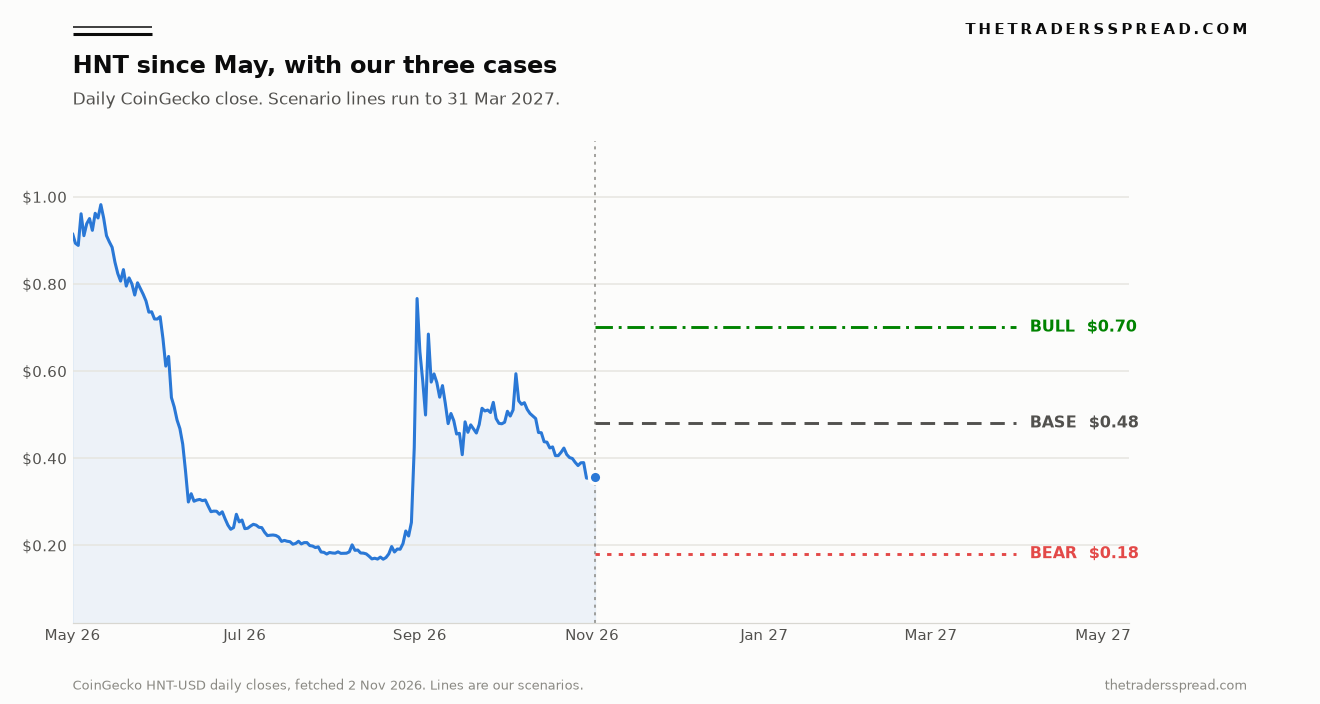
Our bull case is $0.70, our base is $0.48, and our bear case is $0.18, a retest of the $0.168 low on 19 August 2026. The bull sits above the live print and the bear sits under it. Conviction is 2 on a 1-to-5 scale, because the burn tile and the traffic tiles cash out to different dollars, and an approved mint can swamp either reading.
Key facts
- CoinGecko printed HNT at $0.354008 at 07:42:58 UTC on 2 November 2026, market cap $70,692,765, circulating supply 199,692,765, listed maximum 223,000,000, per the coin endpoint fetched that morning.
- Helium's snapshot still leads with 1 million-plus daily users, 49 TB-plus a day and 40,000-plus access points, while its chart runs to 3.4 million users in early 2026 and about 128 TB a day in May 2026, per helium.com/snapshot opened 2 November 2026.
- Docs set emissions at 7,500,000 HNT a year from 1 August 2025 through the following two-year window, with the next cut to 3,750,000 on 1 August 2027, and cap the daily re-mint at 1,643.84 HNT, per docs.helium.com opened 2 November 2026.
- Approved HIP 149 authorizes about 141 million HNT over 36 months, about 196,000 a day in the flat first year, and HIP 150 passed on 31 August 2026 with 96.25% of veHNT cast, per GitHub and heliumvote.com opened 2 November 2026.
- The HNT page prints a burn of about $50,000 "in the last day" and still describes a 223 million hard cap, per helium.com/hnt opened 2 November 2026.
1) The year CoinGecko actually printed
All-time high on the coin record is $54.88 on 12 November 2021, and the all-time low is $0.113 on 17 April 2020. The bear case stops at the 2026 low and stays clear of that older floor.
| Level | What it marks | |
|---|---|---|
| 8 Nov 2025 | $2.456 | High of the trailing daily series |
| 3 Nov 2025 | $2.416 | Close near the start of the measured year |
| 7 May 2026 | $0.950 | Spring close, above every case we set |
| 19 Aug 2026 | $0.168 | Series low, the area of the bear case |
| 31 Aug 2026 | $0.766 | Spike inside the late-August repair |
| 4 Oct 2026 | $0.511 | Close the base case tries to revisit |
| 2 Nov 2026 | $0.354 | Coin-endpoint print at 07:42 UTC |
Daily closes are from the CoinGecko chart fetched 2 November 2026, and the last row is the coin endpoint that morning. Turnover of $1.33 million is about 1.9% of the $70.7 million market, so a mint near $70,000 of HNT a day is large next to the book that has to absorb it.
Helium has lived on Solana since 18 April 2023, mint hntyVP6YFm1Hg25TN9WGLqM12b8TQmcknKrdu1oxWux, with the first emission dated 29 July 2019 from a zero pre-mine. We covered the chain's own tape when Solana jumped with the ETF complex. HNT's year looks more like the issuance question in our VeChain prediction.
2) Helium's snapshot argues with itself
The snapshot, opened 2 November and stamped 30 October, leads with 1 million-plus daily users, 49 TB-plus and 40,000-plus access points, the United States and Mexico live, Brazil named next. The chart on that URL is the fivefold path in the opening, through about 128 TB and 3.4 million users by early 2026. The proposal page still prints about 128 TB, 130,000-plus hotspots and a line that wireless spends over $300 billion a year. We read it as the campaign page for a vote that has passed, left up after the council election closed on 20 July 2026.
On 27 October 2026 the Helium account put a fresher figure in public: about 1.5 million phones a day on Wi-Fi, between the 1 million tile and the 3.4 million bar. The three counts stay side by side rather than being folded into one false user number.
Billions in capex every year, and signal still struggles to get through concrete and glass.
— Helium🎈 (@helium) October 27, 2026
Meanwhile ~1.5M phones a day already ride Wi-Fi that’s sitting right there, with real-time quality checks.
Guess which one scales.
3) Ten cents a gigabyte versus the burn tile
Data Credits are how the docs say the network gets paid. One credit equals $0.00001, and mobile data is priced at $0.10 per gigabyte, or 10,000 credits. HNT is burned to mint those credits off a Pyth price, so a fixed dollar of usage destroys fewer tokens when HNT is expensive.
The HNT page puts about $50,000 next to "value of HNT burned in the last day," and it still describes supply falling under a 223 million hard cap, with deployers targeting at least 80% of carrier pay, which matches HIP 150, while the 223 million cap still follows old HIP 20. At $0.354008 a literal $50,000 is about 141,240 HNT, or about 500 terabytes if it were only mobile data at $0.10 a gigabyte. The traffic tiles, at 1,000 gigabytes to the terabyte, cash out near $4,900 and $12,800 a day, so the columns stay separate.
From 1 August 2025, and again from 1 August 2026, the docs target 7,500,000 HNT a year, or 20,548 a day, about $7,270 now, plus a re-mint capped at 1,643.84 HNT. On that path a genuine $50,000 burn destroys far more HNT than the schedule creates. The supplement was written to sit on top of that squeeze. The next cut, on 1 August 2027, is 3,750,000 HNT.
4) HIP 149's mint, then HIP 150's floor
HIP 149 was Approved when we opened the raw file on 2 November. The price sits on the mint: about 141 million HNT over 36 months into a Nova Labs vault, about 196,000 a day in the flat first year, then a two-year taper. The text calls that rate about 9.5 times HIP 20 emissions and lifts the effective maximum from about 206 million to about 347 million. It cited 182.5 million on chain at drafting, a different reading from CoinGecko's 199.7 million on 2 November, so the gap is a poor measure of tokens already minted.
The proposal page holds the mint until two weeks after council diligence. Community seats elected by 20 July 2026 are James Fayal, Samuel Andrews, MD, Jacob Brady, Eric Eife and Chris Ferebee. We have yet to read a daily 196,000 HNT credit off a chain page, which keeps conviction at 2. A readable liability that the market still has to absorb is also the core of our Synthetix debt-pool prediction, and a higher HNT price makes this mint heavier in dollars.
At $0.354 the flat window is about $69,400 a day, about $25.0 million in year one if sold, against roughly $18.3 million from a $50,000 daily burn and $2.7 million of HIP 20 issuance. The generous tile leaves a gap near $10 million. The $4,900 to $12,800 traffic conversion leaves the supplement in charge, and August's low comes back into the set. Nova is asked to sell over the counter. Curtailment needs a simple majority at a 100 million veHNT quorum, looser than the 66.67% that authorized the mint.
Heliumvote dates HIP 150 to 31 August 2026: 594,800,135 veHNT in favor, 96.25%, against 23,154,195. The 4 September post says multipliers went live, capped at 5, and that service-provider rewards move into the deployer pool, from 70% to 94%. The floor rises from 50% to 80% of the payer rate for one year, so at $0.10 a gigabyte it moves from $0.05 to $0.08, while a 5-times site earns $0.50 if the carrier pays $0.50. After a sharp drop, HIP 149 says delivery can miss for a week or two while smoothed burns catch up.
Mario Di Dio, incoming chief executive of Helium, wrote on 4 June 2026 on the company blog: "On Tuesday, we shared that Andrew Yang's Noble Mobile is acquiring the Helium Mobile Carrier, our consumer wireless carrier business." Amir Haleem moved to chairman. The snapshot dates the deal to 2 June 2026. BusinessWire returned an access denial, so we cite Helium's pages. Carrier traffic, Noble included, still burns HNT on Helium's telling, while the phone-plan revenue left with Noble. Di Dio's same post puts the subsidy at a $0.50-per-gigabyte target that "has compressed to roughly $0.10/GB as traffic grew 4x."
On 31 October the Helium account posted an Avis counter in Hebron, Kentucky, rank 69 by data, 111.5 GB and 3,737 users. That slice is about 0.23% of a 49 TB day and under 0.1% of the May chart's 128 TB, which is why a terabyte headline can hide a long tail of rooms.
Venue of the day: Avis Car Rental, a car rental agency in Hebron, KY. Yesterday it ranked #69 on the network by data, moving 111.5 GB for 3,737 daily active users.
— Helium🎈 (@helium) October 31, 2026
Avis was the first car rental business at an airport, and now 3,737 travelers stayed connected on Helium at its…
5) Building 0.70, 0.48 and 0.18
The cases share the $0.354 print and a horizon into early 2027. They split on whether daily burn is closer to $50,000 or to the $5,000-to-$13,000 traffic conversion, and on whether 196,000 new HNT a day stays off the public book.
| Flow | HNT a day | Dollars at $0.354 | Source of the row |
|---|---|---|---|
| HIP 20 schedule | 20,548 | about $7,270 | 7.5 million a year in the docs, divided by 365 |
| Net-emissions cap | 1,644 | about $582 | Docs cap, fixed through the halvings |
| HIP 149 flat window | 196,000 | about $69,400 | Approved HIP, first year, if the mint is posting |
| Burn tile, implied | about 141,240 | about $50,000 | HNT page, converted at the 2 November print |
| 49 TB at $0.10/GB | moves with price | about $4,900 | Snapshot glance, 1,000 GB per TB |
| 128 TB at $0.10/GB | moves with price | about $12,800 | May 2026 chart on the same snapshot |
Dollar columns are our multiplication of the pages named, and the mint row counts only while the flat window is emitting.
Bull at $0.70 is about double spot, still under the 7 May close of $0.95 and well under November 2025 near $2.40. It needs the burn tile to be the truer meter and vault sales to clear off-exchange. At that price 196,000 HNT is about $137,000 a day, while a dollar-pegged burn stays flat if traffic stays flat, so $0.70 is the top of the range we will defend, a market near $140 million on the current float.
RelatedSynthetix (SNX) Price Prediction: $0.25 Bull vs $0.13 Bear
Base at $0.48 sits by the 4 October close of $0.51, with burn between the two meters and part of the vault sold off-exchange, so the fade from $0.51 to $0.36 stops short of a new low. Bear at $0.18 rounds the 19 August low of $0.168, the path if exchange sales meet a 49 TB reality or if public supply steps up by about 196,000 HNT a day and price loses the area around $0.30. HIP 149's old worked example put a $0.05 floor near $0.33. HIP 150 moved the floor to $0.08, so that illustration stays as vintage.
Questions on the Helium price
Where do the 0.70 and 0.18 dollar cases come from?
The bull case of $0.70 is about double the 2 November print of $0.354 and still under the 7 May 2026 close near $0.95. The bear case of $0.18 rounds the 19 August low of $0.168, and the base of $0.48 sits near the 4 October close of $0.51. Each case runs into early 2027 and turns on whether burn or the HIP 149 mint is the larger daily flow.
Why did the token fall while the traffic chart rose?
Helium's chart shows daily data rising from about 24 TB in June 2025 to about 128 TB in May 2026, while HNT fell about 85% on CoinGecko. Noble Mobile took the consumer carrier in June 2026, the gigabyte target reset from $0.50 toward $0.10, and HIP 149 authorized a large mint. Traffic and the coin moved apart because they measure different flows.
Does the 223 million cap still bind?
The HNT page and the CoinGecko maximum both still print 223 million. Approved HIP 149 says that named ceiling gives way and puts the effective maximum near 347 million once the supplement is included. Screens will keep showing 223 million until vendors adopt the governance figure. We treat 223 million as the label on the feed and 347 million as the figure in the passed proposal.
What changed when Noble Mobile bought Helium Mobile?
The snapshot dates the deal to 2 June 2026. Mario Di Dio, writing on 4 June as incoming chief executive, said Noble would acquire the consumer carrier and that its subscribers could connect through Helium, with Amir Haleem moving to chairman. Phone-plan revenue now sits with Noble. Carrier offload, including Noble traffic, still burns HNT on the account Helium gives in that post.
How does HIP 150 change deployer pay?
HIP 150 closed on 31 August 2026 with 96.25% of veHNT cast. The 4 September post says the deployer floor rose from 50% to 80% of the payer rate for one year, from $0.05 to $0.08 per gigabyte at $0.10, with service-provider rewards joining the deployer pool and site multipliers up to 5. A sharp price drop can leave that floor short for a week or two.
6) Where we land
We are bullish on Helium, conviction 2, from the $0.354 print into early 2027. Base is $0.48, bull is $0.70, and bear is $0.18, marked at the live print. The case looks for a partial repair of the autumn fade if burn stays meaningful and the supplement stays off a thin book, and it gives up if the mint hits that book while the smaller traffic tiles were the true ones.
Three prints would change the view. Burn that stays near $50,000 while supply grows slower than 196,000 HNT a day pulls toward $0.70. Supply stepping up near that rate, with burn revised toward $4,900 to $12,800, makes $0.18 the working case and retires the bull. A curtailment, or a payer rate above $0.10 in the docs and in the burn, lifts the base and leaves the bear in place.
Helium levels here are desk scenarios based on sources dated in the text. They are not a solicitation to buy or sell HNT or any other asset, and they can be wrong.