

Rain rose 13.8 percent in the 24 hours to 06:49 UTC on 3 November 2026 while Bitcoin fell 2.1 percent, and the same Rain token is still down 50.5 percent over 30 days.
I pulled both prints from CoinGecko before writing. Rain, coin id rain, last updated 2026-11-03T06:49:50.000Z, was $0.00632956, and the 24-hour field on that document was 13.83907 percent, which is the 13.8 in the headline. Bitcoin, last updated a minute earlier at 06:48:52 UTC, was $76,466, down 2.12334 percent. On the markets pull timestamped 06:49:50 UTC, Ether was $2,242.78 and down 1.74 percent, BNB was $692.61 and down 2.18 percent, and Solana was $91.34 and down 3.13 percent, while XRP at $1.25 was off 0.07 percent. A token CoinGecko ranked 24th had its sharpest-looking session in weeks on a tape where the majors I checked were red or flat.
The percentage and the path are different facts. CoinGecko's 24-hour dollar change was $0.00076947, so subtracting that from $0.00632956 puts the level a day earlier at $0.00556009, against a session low of $0.00556118 and a session high of $0.00692151. At the morning print, Rain was 13.8 percent above that low and 8.6 percent under its own high of the same window. The daily series I pulled for 365 days marked $0.006089 at 00:00 UTC on 2 November, and from that mark to the morning print is a rise of 3.9 percent. The headline is a recovery from the bottom of the window, and the close-to-close step is much smaller.
Reported size is the part worth keeping. Market cap was $4,499,235,283, fully diluted value was $7,230,921,352, and 24-hour volume was $14,927,096, so volume divided by market cap is 0.33 percent. Bitcoin's volume on its own coin document was 1.75 percent of market cap. Rain can print a double-digit day on about $15 million of reported turnover because the book is thin beside the valuation CoinGecko is carrying, and a rank of 24 with that turnover is a figure a modest order can shove.
| Asset | Price (USD) | 24h | 7d |
|---|---|---|---|
| Rain | 0.006330 | +13.84% | -12.36% |
| Bitcoin | 76,466 | -2.12% | -4.26% |
| Ether | 2,242.78 | -1.74% | -2.76% |
| BNB | 692.61 | -2.18% | -5.67% |
| XRP | 1.25 | -0.07% | -3.56% |
| Solana | 91.34 | -3.13% | -8.32% |
The same Rain document carries the longer changes: seven days minus 12.36 percent, fourteen days minus 25.76 percent, thirty days minus 50.50 percent, and one year plus 88.40 percent. The day is green inside a month that cut the price in half, inside a year that is still up. Those four fields sit on one page, and they are the contradiction the headline compresses.
3 November, measured from the low
The low and the price a day earlier are the same number for any desk purpose, $0.005560 against $0.005561. I read the window as opening at the low, pushing to $0.006922, then giving back to $0.006330. CoinGecko's high and low are the extremes inside the 24 hours, and a trade-level path between them was outside this pull. The headline gain sits between the low and the print. A sale at the high of this window would have stood 8.6 percent above the 06:49 UTC price.
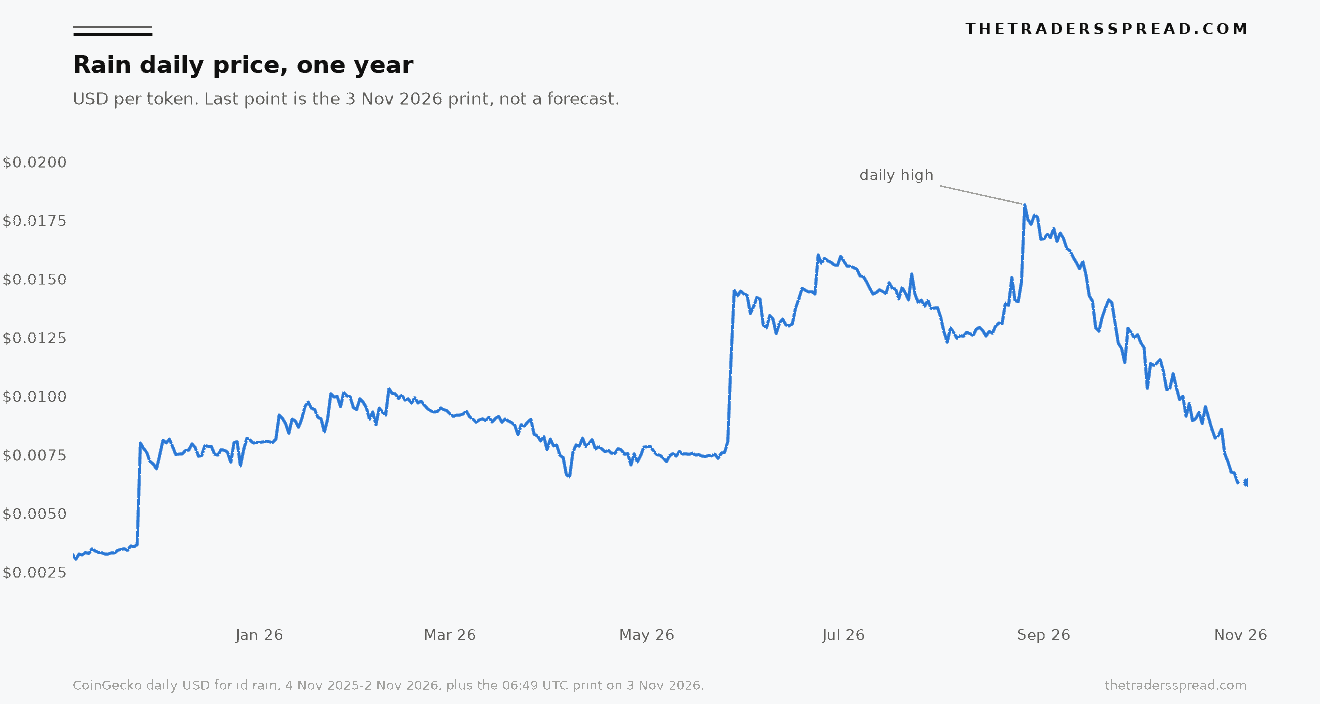
The chart is one daily point from 4 November 2025 through 2 November 2026, and the last point is this morning's coin print. I dropped a second 3 November mark, $0.006788 at 00:00 UTC, so the line ends on that print. From the 26 August daily high the token is down 65.1 percent.
25 August back to the treasury dates
The all-time high on the coin page is $0.01946402, timestamped 2026-08-25T19:53:00.000Z. The daily series peaks a date later, at $0.018158 on 26 August, because a midnight mark falls short of the intraday extreme. From $0.01946402 to $0.00632956 is a drawdown of 67.5 percent. The line on the chart uses the daily marks, and the coin-page high is the intraday extreme.
On 1 October the daily mark was $0.012265, and from there to this morning is minus 48.4 percent. On 6 October it was $0.011409. On 27 October it was $0.007522, the date Enlivex said a 1-for-16 reverse split of its ordinary shares would become effective and the date it announced a Nasdaq delisting notice. The daily mark that morning was already far under the August high, and the series kept falling afterward. On 2 November the mark was $0.006089. This morning's print is 3.9 percent above that mark, and 13.8 percent above the level 24 hours before the pull.
The climb into August was uneven. The daily file opens on 4 November 2025 at $0.003239. On 24 November 2025 the mark was $0.003653, and on 25 November it was $0.007991, a rise of 118.7 percent in one daily step. That step lands on the calendar date after Enlivex Therapeutics Ltd. announced, on 24 November 2025, a private placement of about $212,000,000 to start what the release called the first RAIN prediction-markets treasury. The company said it intended to use the net proceeds for that treasury and to keep the Allocetra clinical work going. The dates touch, so the mark and the company's plan sit on one timeline.
The same release appoints Matteo Renzi, former prime minister of Italy, to the Enlivex board, and quotes him on "real potential in blockchain technologies and in the emergence of prediction-driven models." From the 26 May 2026 daily mark of $0.008046 to the 28 May mark of $0.014506 the series rose 80.3 percent, and a cause for those two days was absent from the pages I opened. On 22 June 2026 the treasury update says that as of 20 June the company held 79,568,550,005 RAIN, worth about $1.14 billion, while a bullet dates that count to 18 June and the footnote uses a CoinMarketCap close. Dividing $1.14 billion by the count implies about $0.0143, beside CoinGecko marks of $0.01375 on 16 June and $0.01596 on 30 June.
If that June count were still the holding this morning, 79,568,550,005 tokens at $0.00632956 would be worth about $504 million, about 11.2 percent of the 710.83 billion tokens CoinGecko lists as circulating. That is arithmetic on an old count and a new price. A later token count was absent from the Enlivex releases I opened, so the June figure stays a June figure.
Where the volume sat at 06:51 UTC
The coin page's $14.93 million and the ticker list are close. Fifteen tickers came back, last fetched 2026-11-03T06:51:50+00:00, and their converted USD volumes sum to $14,908,897. BingX's RAINPROTOCOL/USDT book was $5,301,477, or 35.6 percent of that sum. HTX's RAIN/USDT book was $5,029,154, or 33.7 percent. BloFin was $1,281,757, or 8.6 percent. Those three are 77.9 percent of the ticker volume in the response, with KuCoin at $439,912 and MEXC at $59,517 further down the list. A RAIN/WETH pool on Uniswap v3 on Arbitrum carried $1,161,496 of converted volume. The raw last on that pool is about 0.00000282 WETH, which at Ether's $2,242.78 lines up with the USDT books near $0.00633, so I am using the converted volume and leaving that raw last out of the dollar quotes.
The March 2026 white paper lists Kraken, KuCoin, MEXC, BingX, BitMart, WhiteBIT, LBank, XT, Bitrue, BloFin and Gems Trade. Kraken is absent from the 15 tickers in this pull. Absence from a 15-row response is a gap in the feed, and it stops short of a delisting notice. HTX, the second-largest book this morning, is outside that white-paper sentence. The venue list and the live book have drifted since the document's publication date of 26 March 2026.
A Panama foundation, an Arbitrum contract
Rain's site titles the project a decentralized predictions market protocol. The application bundle on that host points the social link at x.com/Rain__Protocol, the white paper at whitepaper.rain.one, and hard-codes Arbitrum contract 0x25118290e6A5f4139381D072181157035864099d, the same contract CoinGecko returns for coin id rain and the contract on Arbiscan.
The white paper is version 2.0, marked March 2026, notification date 24 February 2026, publication date 26 March 2026, filed under Regulation (EU) 2023/1114. The offeror and issuer are the Rain Foundation, registered 14 July 2025 in Panama City at Betania, Via Ricardo J. Alfaro, PH The Century Tower, office 307, registry number 25062124. The management body is Lorena Del Carmen Diaz Moreira as founder, Ana Gabriela De Leon Macias as president, and Rebeca Isabel Munoz Arosemena as secretary, and the contact email is solutions@rain.one. Applicable law is the law of Panama.
The token section names RAIN as an ERC-20 on Arbitrum with a total supply of 1,150,000,000,000, and it describes the contract as non-upgradeable. Field F.9 dates admission to trading at 24 March 2025, earlier than the July 2025 registration in the same file. Field F.1 calls RAIN a governance token. Field F.2 says it is for governance after a DAO is activated, that trading, deposits and market creation proceed on their own, and that ownership and redemption rights are absent from what the token confers. On the issuer's description, a market on the protocol can run apart from the token CoinGecko values at $4.50 billion.
Governance timing inside the paper pulls in two directions. Section 08 says activation is a future phase and the timing remains open. Part G says the rights were unexercised at publication, with voting only after activation. The risk section still schedules DAO governance for the fourth quarter of 2025, a quarter that had already ended when version 2.0 shipped in March 2026. CoinGecko's blurb treats the DAO as already at work. A later vote was outside the pages I opened.
Field G.5 says the issuer retained 157,000,000,000 tokens, 13.7 percent of the maximum, a foundation figure distinct from Enlivex's June treasury count. Circulating supply on CoinGecko was 710,828,818,925, or 61.8 percent of the maximum, and total supply was 1,142,404,644,443, about 7.60 billion under the white-paper maximum. That gap is the difference between two published supply figures, and it stays a gap.
The paper says the token contract passed a Hacken audit, reports an absence of critical or high-severity findings, and points to the auditor's Rain page. I opened hacken.io/audits/rain/, which describes Rain as a decentralized options protocol on Arbitrum. The page schema refers to two audits and 56 total findings, and the rendered text I could read left the severity split out. The clean bill on critical and high findings is the issuer's summary. The auditor's page confirms the audits and states a findings count.
The 27 October 2026 release says Nasdaq sent a notice dated 26 October under Listing Rule 5550(a)(2): the closing bid had been under $1.00 for 30 consecutive business days before 22 October. A reverse split inside the prior 12 months meant the company lacked the usual 180-day cure. Enlivex said a hearing request would stay any suspension while the shares continue on the Nasdaq Capital Market, that a 1-for-16 reverse split would take effect that day, and that it withheld any assurance the appeal would succeed. The homepage still calls the protocol backed by Nasdaq-listed Enlivex. A post explaining the 3 November bounce was missing: the blog returned 2025 placeholder headlines, and the latest @Rain__Protocol posts in the search were from 5 October, on market structure and fees.
2.5 percent on the homepage, 5 percent on X
The live rain.one bundle says: "From every market's trading volume, 2.5% is used to buy back and burn $RAIN tokens, directly linking the token's scarcity to platform activity." Another line says market creators pay a flat $1 oracle fee, regardless of final volume. On 30 September 2026 @Rain__Protocol posted that traders pay a 5 percent fee on every trade, split among liquidity providers, the market creator and the resolver. The post is silent on a burn. Publish.twitter.com timed out on the oEmbed request, so the blockquote stays out and the link is the record.
The white paper says a share of trading fees buys and destroys tokens, and the risk section calls the mechanism discretionary, open to being modified, suspended or discontinued, and silent on any promise of price support. Those three wordings can be one design, a later rewrite, or two cuts on the same trade, and the pages leave it open. A fee you can read off a single trade is a different standard, which is the comparison in the piece on how GMX funding fees hit that token.
RelatedVeChain (VET) Price Prediction: $0.012 Bull vs $0.004 Bear
The white paper says users define outcomes, provide liquidity and trade against an automated market maker, with public markets resolved by an oracle it calls Olympus AI and a dispute path toward human oracles. On 1 October 2026 @Rain__Protocol posted that each market is a pool and each answer is a sub-pool with its own price. The oEmbed timed out, so the post is cited. It describes the product and leaves the morning move unexplained.
What this changes
The day changes the 24-hour column. Rain is up while Bitcoin, Ether, BNB and Solana are down, on a bounce off the window low after a month that halved the price. Turnover near $15 million can reverse on an ordinary session. Enlivex's RAIN count was last printed on 20 June, and the March paper still dates the DAO to a quarter that had ended. From $0.007522 on 27 October the daily series fell to $0.006089 on 2 November, then to this morning. The token and the Nasdaq appeal meet in the treasury the company described.
A session like this is easy to misread from one coin. The Bitcoin Cash piece on a large-cap drop had to set one coin against that kind of tape. Rain is the mirror: the majors down, this coin up, the up-move smaller than the drawdown behind it. The dYdX vote piece was a reminder that a governance process and a price can run on different clocks. Rain's white paper still has the governance clock unwound.
FAQ
What is the Rain token?
Rain (RAIN) is the token of the prediction-markets protocol at rain.one. The March 2026 white paper names the Rain Foundation in Panama as issuer and describes an ERC-20 on Arbitrum, contract 0x25118290e6A5f4139381D072181157035864099d, with a maximum of 1.15 trillion tokens. CoinGecko, at 06:49 UTC on 3 November 2026, priced it at $0.00632956, market cap $4.50 billion, rank 24. The paper calls it a governance token and dates admission to trading at 24 March 2025.
Why did Rain rise while Bitcoin fell on 3 November 2026?
CoinGecko showed Rain up 13.839 percent and Bitcoin down 2.123 percent around 06:49 UTC. Ether, BNB and Solana were down on the same pull, and XRP was off 0.07 percent. Rain's gain matches a bounce from a low of $0.005561 to $0.006330, after a high of $0.006922. A project post naming a catalyst for this session was absent from the blog and from recent posts on the project account. The 30-day change was still minus 50.50 percent.
How does the white paper describe holder rights?
The March 2026 paper says RAIN is for governance after a DAO activates, and that trading, deposits and creating a market proceed on their own. Part G says those rights were unexercised on the 26 March 2026 publication date. A risk line still schedules the DAO for the fourth quarter of 2025, already past when version 2.0 shipped. CoinGecko's blurb treats DAO governance as current. The texts diverge, and a later vote was outside the pages opened here.
What RAIN holding has Enlivex disclosed?
The 22 June 2026 Enlivex release says the company held 79,568,550,005 RAIN as of 20 June, worth about $1.14 billion on a CoinMarketCap close. A bullet on the same page dates that count to 18 June. At the 3 November CoinGecko price the old count would be worth about $504 million, near 11.2 percent of circulating supply. That is multiplication on the June figure, and the June release is the last holding update opened for this record.
Where did RAIN volume trade on 3 November 2026?
CoinGecko's ticker list at 06:51 UTC summed to $14.91 million of converted volume across 15 books. BingX was $5.30 million, HTX $5.03 million and BloFin $1.28 million, together 77.9 percent, with KuCoin and MEXC smaller. An Arbitrum Uniswap v3 pool showed about $1.16 million converted. The March white paper names Kraken among venues, and Kraken was absent from these 15 rows. USDT books clustered near $0.00633.
Will the next Enlivex release still show 79,568,550,005 RAIN, or has the treasury count changed since 20 June 2026?
This desk record uses CoinGecko, the Rain white paper, rain.one and Enlivex releases opened on 3 November 2026. Prices move after a pull. Nothing here is a solicitation to buy or sell Rain or any other asset, and nothing here sets a price target.