

Filecoin's FIL token rose 23.8% in the 24 hours to 07:24 UTC on Monday 14 September, reaching $1.0071 on Binance's spot book and its highest level on CoinGecko's daily series since 28 May. Over the past year, the raw disk capacity committed to the Filecoin network fell 55%, from 3.01 exbibytes on 29 September 2025 to 1.35 exbibytes today, according to the Filfox block explorer. Both figures are accurate. They point in opposite directions. The token is pricing a supply event while the network it pays for keeps shrinking. That supply event is real and dated: on 15 October the vesting schedule for Protocol Labs and the Filecoin Foundation ends, and gross issuance of new FIL falls by roughly 75%. The date was published on 4 September, nine days before the rally, and nothing about it changed on Sunday. What changed was positioning, and the evidence for that sits in the futures market rather than in any announcement.
Here is what the rally coverage has missed. On Binance, the largest FIL venue, the perpetual contract turned over $515.3 million in the 24 hours to 07:24 UTC, against $53.8 million on the spot FIL/USDT book: about $9.60 of leveraged turnover for every dollar of spot. Binance open interest climbed from 49.1 million FIL at 00:00 UTC on Sunday to 69.8 million FIL, a 42% build in 31 hours, and its biggest single hour began at 14:00 UTC, the hour the price broke out. Korean won markets, the usual suspect in sudden altcoin spikes, carried about 6% of the day's volume. And the paid demand the 15 October story leans on is still small. Filecoin Pay, the network's onchain payment rail, had an annualised run-rate of $59,327 at the end of August. FIL's market capitalisation is roughly 13,900 times that.
Key facts
- FIL rose 24.5% from the 13 September 00:00 UTC print of $0.8010 to $0.9972 at 07:11 UTC on 14 September — CoinGecko market_chart API, 14 Sep 2026
- Reported 24-hour volume of $386.1 million equalled 46.8% of the $825.4 million market capitalisation — CoinGecko coin endpoint, 07:09 UTC 14 Sep 2026
- Binance FIL perpetual open interest rose 42%, from 49.1 million to 69.8 million FIL, between 00:00 UTC 13 September and 07:24 UTC 14 September — Binance futures data API, 14 Sep 2026
- Binance perpetual turnover of $515.3 million against $53.8 million on spot over the same 24 hours — Binance spot and futures ticker APIs, 07:24 UTC 14 Sep 2026
- Protocol Labs and Filecoin Foundation vesting of about 66.7 million FIL a year ends on 15 October, cutting gross issuance by roughly 75% to about 22 million FIL a year — FilecoinTLDR network update, 4 Sep 2026
- Raw byte power of 1.35 EiB, down 55% from 3.01 EiB on 29 September 2025 — Filfox power statistics, 14 Sep 2026
- Filecoin Pay annualised run-rate of $59,327 at the end of August, up from $663 in January — FilecoinTLDR network update, 4 Sep 2026
Sunday, 14:00 UTC: what the tape shows
Start with the clock. Through Sunday morning FIL drifted between $0.80 and $0.84, and between 12:00 and 14:00 UTC no 15-minute window on Binance's perpetual contract traded more than $2.1 million. The 14:00 UTC bar broke that pattern. Price ran from $0.854 to $0.891 and quarter-hour turnover jumped to $9.3 million. By 17:15 UTC the contract had printed $1.0347, the high of the move, before the 17:30 bar knocked it back to $0.964 on $33.9 million of volume, the heaviest 15 minutes of the day.
Open interest shows who arrived. Between 14:00 and 15:00 UTC, Binance's FIL perpetual added 5.8 million FIL of open contracts, taking the total from 51.7 million to 57.4 million. The build carried on through the evening, paused around midnight at 63.8 million, and peaked at 70.2 million at 03:00 UTC on Monday. Price rising alongside open interest means fresh positions were being opened rather than old shorts simply closing. Binance's account-level long/short ratio moved the same way, from 1.67 at 08:00 UTC on Saturday to 1.99 at 04:00 UTC on Monday, when two in every three accounts holding an FIL position were net long.
Funding did not overheat. Bybit and OKX both showed FIL perpetual funding at 0.01% per eight hours on Monday morning, the baseline rate, so longs were not yet paying a premium to hold. That is the one derivatives reading that argues against a crowded trade.
What the tape does not show is a trigger. Upbit's notice board lists no Filecoin item between 7 and 14 September. A full-text search of EDGAR covering 1 August to 14 September finds no Grayscale Filecoin Trust filing since three small Form 144 resale notices dated 3 to 6 August. We could not load Binance's announcement feed from our systems, but FIL spot and perpetual markets were already trading there, so a new listing does not explain the move. The official Filecoin account did publish a post at 14:00:11 UTC, eleven seconds into the breakout bar. It was a comparison of cloud egress costs, one of a run of near-identical infrastructure posts the account had published every day since at least 9 September. It is hard to read it as news.
The explanation that spread fastest came later. At 17:49 UTC, three and a half hours after the breakout, an account with 484,561 followers attributed the surge to talks with Nvidia. We found no primary source for any such talks. The closest first-party item is a 10 September post about a Filecoin Foundation speaker addressing civic-tech leaders at an Nvidia event, which is a conference slot, not a negotiation.
Korea followed rather than led. Upbit's KRW-FIL book turned over ₩29.1 billion in 24 hours and Bithumb's ₩2.6 billion, about $23.6 million combined at the European Central Bank reference rate of 1,342.79 won per dollar for 11 September, or roughly 6% of the $386 million CoinGecko counted. Upbit's own 24-hour change read just 5.3% at 07:15 UTC, because its daily reference resets at midnight Seoul time, 15:00 UTC, by which point FIL had already cleared $0.91.
For FIL, as for many mid-cap tokens, the perpetual contract is where the marginal price gets set. Perpetual venues are also the business behind Hyperliquid's 52% climb in August, and Sunday's FIL tape is a small case study in why that business keeps growing.
The 75% figure, checked against the chain
Filecoin's hard cap is 2 billion FIL. The protocol specification assigns 15% of that to Protocol Labs and 5% to the Filecoin Foundation, 400 million FIL between them, with 70% reserved for miners and 10% for fundraising. The FilecoinTLDR update, written by Pietrek Chan and published on 4 September, puts current vesting at about 66.7 million FIL a year against roughly 21.7 million from block rewards, and says the vesting stream stops on 15 October. The official Filecoin account amplified the same numbers the same day, and reposted them at 05:30 UTC on Monday, well after the rally.
We checked the block-reward half independently. Filfox's network overview shows 59,089 FIL mined in the latest 24 hours, which annualises to 21.6 million. Add 66.7 million of vesting and gross issuance comes to about 88.3 million FIL a year. Strip the vesting out and 75.5% of it disappears. The figure holds.
Three details get lost in the headline number. First, the cut applies to gross issuance, meaning what enters circulation each day, not to tokens already out there. On-chain circulating supply is 911 million FIL on Filfox's count, and the remaining 21.6 million a year works out to about 2.4% of it. Second, roughly 5.7 million FIL is still due to vest between now and 15 October at the current rate, less than a third of the 20.8 million FIL of open interest Binance's perpetual added in 31 hours. Third, the supply base itself is disputed: CoinGecko reports circulating supply of 827.8 million FIL, 83 million below the on-chain figure, which is why market-cap numbers for Filecoin differ by about $80 million across data sites.
Vesting is not selling. Tokens that vest become transferable, and whether they ever reach an exchange is a separate decision. Neither organisation has published sale data we could verify.
A second supply change is queued behind the first. FIP-0118, nicknamed Solstice, is marked Accepted in the Filecoin Improvement Proposals repository, where it was created on 14 July. It would retire the Filecoin Plus verification layer, give every new sector the 10x quality-adjusted power multiplier automatically, and divert a share of block rewards to service operators that bring in paid usage. Where paid settlement misses its quarterly targets, that share is burned instead. The FilecoinTLDR update projects Solstice for the nv29 network upgrade and notes that it still awaits scheduling, so there is no activation date yet. Supply schedules cut both ways, too: our Arbitrum price analysis tracked 648 million ARB still to vest, the opposite problem to the one FIL holders are pricing.
A year of FIL in one chart
The chart puts Sunday in proportion. FIL printed $3.44 at 00:00 UTC on 8 November 2025 and $0.6315 on 19 August 2026, its lowest daily print of the year. CoinGecko's intraday all-time low of $0.6124 came at 03:52 UTC on 18 August, less than four weeks ago. Monday morning's $0.997 sits 58% above the August print and 71% below November.
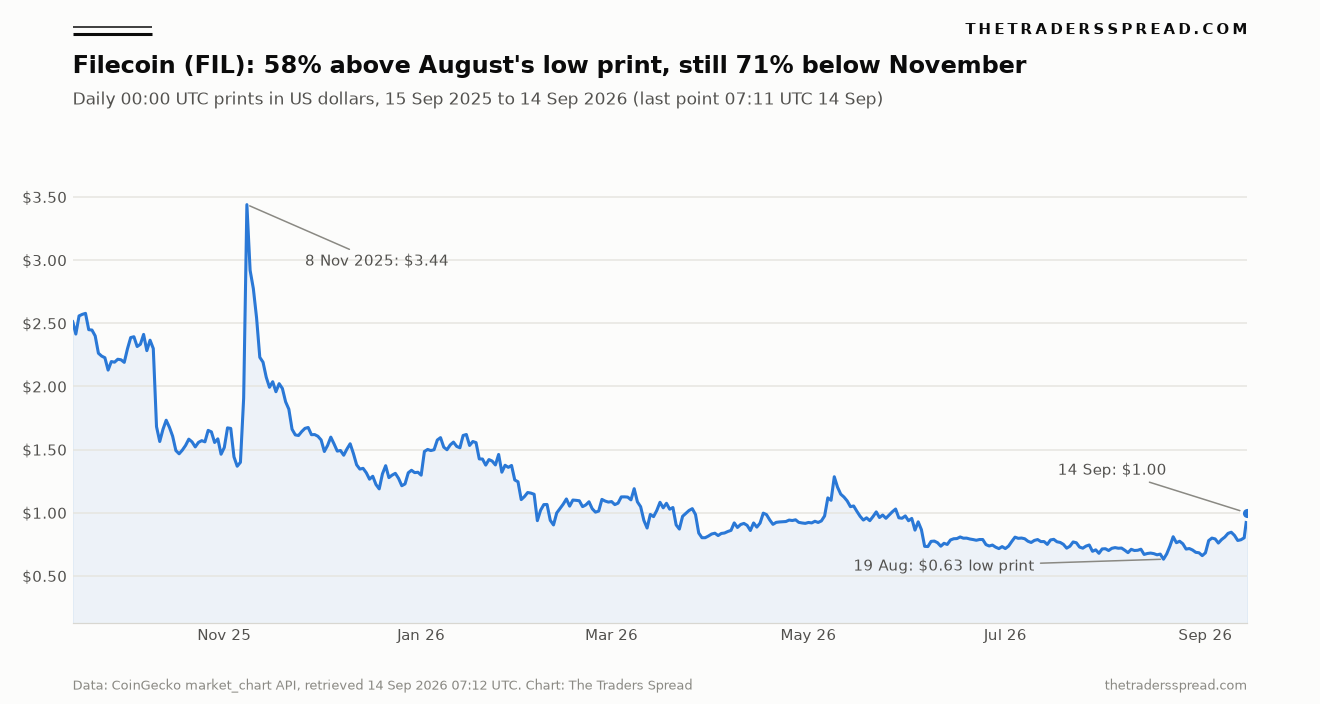
Every window below is computed from CoinGecko's own daily 00:00 UTC prints, with the start date shown. We do not use CoinGecko's percentage fields: its 30-day field read 44.4% on Monday morning, which does not reconcile with its own prices.
| Window | Start print (00:00 UTC) | Start price | Change to $0.9972 at 07:11 UTC 14 Sep |
|---|---|---|---|
| 1 day | 13 Sep 2026 | $0.8010 | +24.5% |
| 7 days | 7 Sep 2026 | $0.8070 | +23.6% |
| 30 days | 15 Aug 2026 | $0.6802 | +46.6% |
| From the lowest daily print | 19 Aug 2026 | $0.6315 | +57.9% |
| Year to date | 1 Jan 2026 | $1.2968 | −23.1% |
| From the 12-month high print | 8 Nov 2025 | $3.4385 | −71.0% |
| 1 year | 15 Sep 2025 | $2.5164 | −60.4% |
The one-day and seven-day numbers are almost identical because FIL went nowhere from 7 to 12 September. The whole week's gain arrived on Sunday afternoon. It also arrived alone. Over the 24 hours to 07:21 UTC, Binance's bitcoin book was up 0.7% and ether 0.2%, so the scenario levels in our BTC price outlook were not in play. This was a Filecoin-specific trade.
What the storage side says
A storage network earns its token's value by storing things people pay for. On that measure the record is weak. Raw byte power, the physical disk capacity storage providers commit, has fallen in every one of the 23 half-month intervals Filfox publishes since late September 2025, from 3.01 EiB to 1.35 EiB. Quality-adjusted power, which weights verified deals ten times, fell 48% over the same span to 12.19 EiB. Filfox counts 508 active storage providers.
On-chain fee demand is thin.
Filecoin's base fee, the per-gas charge that is burned, sat at its 100 attoFIL floor in 14 of the 24 readings Filfox logged over the past 30 days. Cumulative burnt supply stands at 42.9 million FIL, and 64.9 million FIL is locked as pledge collateral.
The paid-demand products exist, and they are young. Filecoin Onchain Cloud went live on mainnet in the first quarter of 2026. Fil One, launched in June, sells S3-compatible storage at $4.99 per terabyte-month with no egress fees and re-verifies stored objects roughly every 24 hours. Filecoin Pay's run-rate grew about 90-fold between January and August, from $663 to $59,327, and active payers rose from 73 to 119, per the same FilecoinTLDR update. Growth from a tiny base is still a tiny base: $59,327 a year is less than Binance's FIL perpetual turned over in an average ten seconds during the 24 hours to 07:24 UTC on Monday.
There is a second-order effect the vesting story leaves out, and this is our reading rather than the update's. The update names collateral locking as one of the two forces that take FIL out of circulation. A network whose committed capacity keeps shrinking locks less new collateral, while expiring sectors hand their pledge back to providers. If raw capacity keeps falling after 15 October, part of the issuance cut could be offset by collateral returning to circulation, and the net supply picture would look less tight than the 75% headline suggests.
Would a fade prove anything?
FIL has already staged this move once this quarter and given it back. From the 19 August print of $0.6315 it rallied 28% to $0.8096 by 22 August, then slid 18.5% to $0.6599 by 31 August. A second leg began on 1 September, the same week the vesting date started circulating, and it stalled at a $0.8451 print on 9 September. Our coverage of Uniswap's 128% run and 18% retreat traced a similar shape: a real fundamental story, a leveraged run, then a give-back once the positioning cleared.
Two readings would show the market absorbing Sunday's move rather than renting it. The first is open interest drifting back toward 50 million FIL on Binance while price holds near $1, which would mean spot holders took the other side of closing futures. The second is funding staying near 0.01% rather than climbing. A rising Korean share of volume from today's 6% would add weight, since it would mean demand broadening beyond the derivatives desks.
RelatedEigenLayer (EIGEN) vs Native Staking: Where the Yield Splits
The opposite combination matters more for risk. Open interest steady or rising while price slips back under $0.85, where Sunday's breakout started, would leave the latest longs holding positions the spot market never endorsed. That is the setup in which a cascade of liquidations does the price discovery.
What this changes
For supply, the change is fixed and dated. From 15 October about 182,600 FIL a day of vesting stops, and new FIL comes only from block rewards, currently near 59,000 FIL a day. Against today's on-chain circulating supply, that takes gross issuance from roughly 9.7% a year to about 2.4%. Nothing that happened on Sunday moves that date or that number.
For positioning, the change is large. Binance alone now carries 69.8 million FIL of perpetual open interest, about 7.7% of on-chain circulating supply and more than twelve times the 5.7 million FIL still to vest before the cut. The market has positioned for an event a month away, mostly with borrowed exposure. That can persist, but it is refinanced every eight hours through funding and it unwinds faster than spot holdings do.
For the fundamental case, nothing has changed yet. Raw storage is still falling, the base fee is still mostly at its floor, and paid usage is measured in tens of thousands of dollars a year. The optimistic version of the story needs those lines to turn: Filecoin Pay's run-rate moving into the millions, raw byte power stabilising, Solstice receiving an activation epoch. The pessimistic version needs nothing new at all, only for leverage built in 31 hours to leave the way it came.
What would change our read is either a sustained fall in open interest with FIL holding above $0.95, or a first-party disclosure that explains why Sunday afternoon, rather than 4 September, was the moment the market chose to reprice a date it already knew.
FAQ
Why did Filecoin rise on 13 September?
No first-party announcement explains the timing. The move began at 14:00 UTC on Sunday and was carried by Binance perpetual futures, where open interest rose 42% in 31 hours and turnover ran about 9.6 times spot. The background story is the 15 October end of Protocol Labs and Filecoin Foundation vesting, published on 4 September, which cuts gross FIL issuance by roughly 75%.
When does Filecoin vesting end?
On 15 October 2026, according to the FilecoinTLDR network update of 4 September. The Protocol Labs and Filecoin Foundation allocations, 20% of the 2 billion FIL cap under the protocol specification, have been vesting since the network launched and currently release about 66.7 million FIL a year. After that date, block rewards of roughly 21.6 million FIL a year become the only new supply.
Does the end of vesting make FIL deflationary?
Not by itself. It cuts what enters circulation, while burns and collateral locking decide whether net supply shrinks. The FilecoinTLDR update cites simulator runs in which daily net supply growth falls 86% to 119% by the end of 2027, the upper end being net deflation, and labels them modelled scenarios rather than forecasts. With the base fee mostly at its floor, burns are small today.
Is the Filecoin storage network growing?
Not in raw capacity. Filfox data show raw byte power of 1.35 EiB on 14 September, down 55% from 3.01 EiB on 29 September 2025, with a decline in every half-month interval in between. Paid usage is growing from a small base: Filecoin Pay's annualised run-rate reached $59,327 at the end of August, up from $663 in January.
How much FIL is in circulation?
It depends on the source. Filfox's on-chain figure is 911 million FIL. CoinGecko uses 827.8 million, which put market capitalisation at $825.4 million on Monday morning, against roughly $908 million on the on-chain count at the same price. The protocol caps supply at 2 billion FIL, and CoinGecko lists total supply at 1.96 billion.
This article is news and analysis, not investment advice. Crypto assets and leveraged derivatives are highly volatile, and you can lose all of the capital you commit. Figures are as of the times stated and will change.