

GMX token markets on GMX v2 still print a position fee of 0.04% or 0.06% of size, while the Arbitrum pool that pairs the token with USDC was charging longs 14.89% a year in funding and 21.16% a year in borrow, a net 36.05%, on open interest only $1,117 apart.
Those two prints describe one trade: the percentage on the open ticket, and what the heavier side was accruing, annualised, on a book a quick glance would call square. We took the schedule from GMX's fees page and the rates from the Oracle API snapshot for GMX/USD [GMX-USDC] at 07:00 UTC on 30 October 2026, when long open interest was $122,615, short open interest was $121,498, and the whole imbalance was $1,117, smaller than a $10,000 position.
That gap decides which position fee applies. The docs charge 0.04% when a trade shrinks the absolute difference between long and short open interest, and 0.06% when the trade widens it. A short of ordinary size on this pool widens the difference, because the difference itself is only $1,117, so the cheaper open belongs to a clip smaller than the gap. Every larger order pays 0.06% to get in, and the holding cost has already started.
The hourly print is what makes the miss feel small. At 06:59 UTC the pairs feed showed 0.00170% per hour on this market, the sign that means longs pay. Times 24 and times 365, that is 14.89%, the snapshot's annualised figure a minute later, beside a 0.06% open that looks like dust. This GMX token pool's skew is $1,117, and long funding still sits just under the 15% floor of the Arbitrum ceiling.
Updated 30 October 2026 with the morning's CoinGecko and GMX Oracle prints.
Key facts from the morning reads on 30 October 2026
- GMX token last printed $8.01, inside a 24-hour range of $7.68 to $8.60, with a 24-hour change of -5.08%, a market value of $85.6 million and 24-hour turnover of $3.18 million. Source: CoinGecko coin endpoint for gmx, last updated 06:57 UTC on 30 October 2026.
- GMX/USD [GMX-USDC] on Arbitrum had $122,615 of long open interest and $121,498 of short open interest, a gap of $1,117. Source: GMX Oracle API markets/info, response dated 07:00 UTC on 30 October 2026.
- On that snapshot longs accrued funding at 14.89% a year and borrow at 21.16% a year, a net 36.05%, while shorts were credited funding at 15.03% a year and accrued borrow at 0%. Source: GMX Oracle API markets/info, 30 October 2026.
- The position fee on most GMX markets is 0.04% of size when a trade shrinks the long/short gap and 0.06% when it widens the gap, charged on the open and again on the close. Source: GMX docs, Fees, opened 30 October 2026.
- From 23 April 2026 the Arbitrum funding keeper floors the max-funding ceiling at 15% APR and caps it at 300% APR. Source: GMX docs, Fees, opened 30 October 2026.
- 27% of fees from perpetual trading, liquidations, borrowing and swaps buy back GMX, and distribution of bought-back GMX to stakers waits until the token reaches $90. Source: GMX docs, GMX token and Rewards, opened 30 October 2026.
- Held frozen, the long net rate of 36.05% costs $9.88 on a $10,000 position over 24 hours, against a $6.00 open at 0.06%. Source: arithmetic on the markets/info rates above, 30 October 2026.
What does the 0.04% or 0.06% position fee actually buy?
The fees page, opened on 30 October 2026, states the position fee as 0.04% or 0.06% on the open, on an increase, on a partial decrease, and on the close. A round trip is two tickets, and a sheet that keeps only the open has dropped half the toll.
On the morning snapshot longs led by $1,117, so another long is a 0.06% open and a short smaller than the gap is the 0.04% case. A short larger than the gap finishes wider than it started. The position fee is one rate for the whole trade, so a $10,000 short here is a 0.06% open on that reading, while closing the $10,000 long while longs are still ahead shrinks the gap and that close is 0.04%. The round trip is $6.00 plus $4.00 when both conditions hold.
TradFi markets on the same page carry a separate on-hours schedule, and GMX/USD is outside that list. The figures follow the published schedule rather than a direct DataStore read of this market's fee factor. A swap is a different toll, 0.05% or 0.07% of input on a standard pool according to whether the token balance improves. The same mix-up, on another venue, is how Raydium sets the fee a swap actually pays.
| Charge | What the fees page specifies | When it is taken |
|---|---|---|
| Position fee | 0.04% of size if the order shrinks the long/short gap, otherwise 0.06%. TradFi markets use their own schedule | Open, increase, partial decrease and close |
| Funding | Adaptive, per second. Since 23 April 2026 the Arbitrum keeper ceiling is floored at 15% APR and capped at 300% APR | While the position is open; settles on a modify or a close, and the flow can be a credit |
| Borrow | Larger open-interest side only. Linear full-use tiers of 45%, 50%, 55% or 65% a year, or a kink past optimal utilisation | Per second, settled on a modify or a close |
| Net price impact | Zero at entry. On a decrease, positive cap 40 bps on most markets. The negative-cap table lists GMX at 500 bps | Close or decrease. Excess over the negative cap is claimable as a rebate after five days |
| Network | Keeper gas, charged up front and refunded on the unspent part. The dollar amount waits on gas at execution | Every order. A cancelled take-profit or stop-loss returns its fee |
People who search gmx fees usually get the open percentage, because that is the line the interface prints first. A position closed inside the same minute pays the toll twice and almost nothing to carry. A position held through a day on this pool is already on a different invoice.
Why is funding still near 15% when the GMX token book is almost square?
Funding on GMX v2 moves between the two sides of one market, scaled so dollars out match dollars in. A positive saved factor means longs pay shorts. The API exposes the paying side's rate, and the receiving side is scaled by paying open interest over receiving open interest. Longs accrued 14.891% a year and shorts were credited 15.028%, a ratio of 1.0092, the same ratio as $122,615 over $121,498.
The factor updates when a transaction touches the market, and between transactions it accrues by the seconds elapsed. Above a stable-funding threshold it increases, between two thresholds it holds, and below a decrease threshold it steps down toward zero. The arbitrage note points it toward the market's minimum funding factor per second, which may sit above zero, and the snapshot leaves that stored minimum unspecified. What the snapshot shows is a book $1,117 from square and a long rate of 14.89%, a hair under the 15% APR floor of the keeper's ceiling, and a flip in who is larger changes direction at once.
Since 23 April 2026 an Arbitrum keeper sets each market's maximum, and the speed of the moves, from Hyperliquid, Coinbase, Binance, OKX, Bybit and Trade.xyz. It adds the larger of a 10 percentage-point buffer and 25% of the reference, then clamps between 15% and 300% APR, so the clamp moves the ceiling while the live rate remains a function of GMX open interest. On other chains the docs describe the settings as contract configuration alone.
GMX's own account put the design in one post on 6 October 2026. Adaptive funding is there to pull open interest back toward balance, and across longer periods the leftover is described as slight. Our morning had almost met the aim in open interest, and the hour was still priced at 14.89% a year.
As in every GMX pool, LPs take the other side of trader PnL when open interest is not fully balanced between longs and shorts.
— GMX 🫐 (@GMX_IO) October 6, 2026
Mechanisms like adaptive funding fees help pull the open interest back toward balance, so across longer periods the effect is only slight.
6/
Settlement multiplies size by the change in the funding index since the position was last touched. Accrual pauses when one side's open interest is zero. Both sides of the USDC-backed pool were open at 07:00 UTC, so the adaptive 14.89% was accruing, and that rate, rather than the single-token pool's round 15.00% on $68,134 against $61,235, is the one the worked example uses. GMX/USD [GMX-GMX] was listed on 22 November 2024.
Who pays borrow on this pool, and why did it print 21%?
Borrow stops a trader from reserving the pool with matched longs and shorts bought for two position fees. Longs, the larger side, paid 21.16% a year, the short borrow rate was 0%, and the long net of funding plus borrow was 36.05%. The amount is size times the rise in the cumulative borrowing factor since the last update. We read the API fields as fractions of a year, the reading that matches the pairs feed after multiplying the hourly funding figure by 8,760.
Many markets use one linear tier, 45%, 50%, 55% or 65% at full use, and a kink model instead steepens past an optimal utilisation, often near 75%. This pool fits the 50% line: $122,615 divided by that open interest plus $167,236 of available long liquidity is 42.30%, and 42.30% of 50% is 21.15% against a printed 21.16%. The single-token pool fits 55%, because $68,134 over that figure plus $203,681 is 25.07% and a quarter of 55% is the 13.79% print. The fit uses the API fields, and the on-chain factor keys were left unread.
Of the borrow fee collected, 63% goes to the pool and 37% to the protocol fee receiver. Funding is the payment that rebalances the book, and borrow is the payment for reserved liquidity. A borrow rate that follows everyone in the pool, which is a different design, is the subject of what Compound borrowers get wrong about the rate.
| Market | Long OI | Short OI | Funding, longs | Funding, shorts | Borrow, longs | Borrow, shorts | Net, longs |
|---|---|---|---|---|---|---|---|
| GMX/USD [GMX-USDC] | $122,615 | $121,498 | 14.89% a year | 15.03% credit | 21.16% a year | 0% | 36.05% a year |
| GMX/USD [GMX-GMX] | $68,134 | $61,235 | 15.00% a year | 16.69% credit | 13.79% a year | 0% | 28.79% a year |
Both rows are the Arbitrum Oracle API at 07:00 UTC on 30 October 2026, rounded to two decimals. The USDC-backed pool was listed on 4 June 2024. Single-token pools skip the swap fee on a position operation, because collateral, profit and backing are the same token, while the position fee, funding and borrow were all live for longs on the GMX-backed pool.
When does price impact arrive if the open ticket showed none?
Opening a position leaves price impact at zero. The entry is the oracle, the max for a long and the min for a short, and impact lands on a close or a decrease, with the sign set by whether the book ends more balanced. Positive impact on most markets caps at 40 basis points. The negative-cap table puts GMX at 500 basis points, against 50 for BTC, ETH and SOL, which is 5% of size, a $500 ceiling on a $10,000 close. A $1,117 gap gives that ceiling little reason to bind.
The markets/info payload has open interest, liquidity, funding and borrow, and it leaves the impact factor out, so the 500 basis point row is a bound from the fees table on 30 October 2026, which the risk team can still change on the monitor. Excess over that cap is claimable after five days. Wrapped-BTC-only and wrapped-ETH-only pools set impact factors at zero, and GMX/USD [GMX-GMX] is outside that pair. Slippage, default 1% and capped at 5%, covers the oracle move until the keeper runs, and keeper gas is charged up front with a refund on the unspent part.
RelatedHow Raydium (RAY) Sets the Fee a Swap Actually Pays
How fast does a $10,000 long spend the open fee again?
A $10,000 long opened into the 07:00 UTC book, with every rate held frozen, is the limit of the exercise: funding will move, borrow will move with utilisation, and $10,000 is large beside roughly $244,000 of open interest in the pool. If the morning's per-second rates had stayed put, the open at 0.06% is $6.00, because the order widens an already-long book, and a later close that shrinks the gap is 0.04%, or $4.00. The round trip in position fees is $10.00.
Funding at the unrounded 14.8913138% a year is $4.08 over 24 hours and $122.39 over 30 days of a 365-day year. Borrow at 21.1593911% is $5.80 and $173.91. The net rate of 36.0507049% is $9.88 and $296.31, and adding the $10.00 of position fees makes the 30-day bill $306.31. Each dollar figure is the unrounded annual rate times $10,000 times the day count, divided by 365, then rounded to the cent, which is why the rounded 30-day funding and borrow cents sit one cent under the rounded net.
| Line, rates frozen at 07:00 UTC | Rate used | Dollars on $10,000 |
|---|---|---|
| Open, because the order widens the gap | 0.06% of size | 6.00 |
| Close, if that close shrinks the gap | 0.04% of size | 4.00 |
| Funding over 24 hours | 14.89% a year | 4.08 |
| Borrow over 24 hours | 21.16% a year | 5.80 |
| Net carry over 24 hours | 36.05% a year | 9.88 |
| Funding over 30/365 of a year | 14.89% a year | 122.39 |
| Borrow over 30/365 of a year | 21.16% a year | 173.91 |
| Thirty-day carry plus both position fees | Frozen snapshot | 306.31 |
Hours travel better than dollars, because the open fee and the carry both scale with size. Funding at 0.00170% per hour rebuilds a 0.06% open in about 35 hours, borrow alone rebuilds it in about 25 hours, and together they rebuild it in about 14.6 hours. Over 30 frozen days the carry is about thirty times the round-trip position fee, so for a hold measured in days the open percentage is the wrong summary of gmx fees.
A short smaller than $1,117 pays 0.04% to open, receives funding, and pays borrow at zero while longs remain larger. The 15.028% credit is about $4.12 a day per $10,000, so a $10 round trip of position fees takes a bit over two days to earn back if the short stays lighter. A $10,000 short widens the gap, pays 0.06%, and becomes the heavy side, the side funding is pushed toward and the side that starts paying borrow.
Where do GMX fees go, and what does the token chart show?
On Arbitrum and Avalanche the liquidity page assigns 63% of trading, swap, borrow and liquidation fees to the pool and 37% to the protocol. The token page assigns 27% of those fee types to GMX buybacks and 10% to Chainlink, the treasury and keepers, with 1.2 points of that 10 for Chainlink. Sixty-three plus 27 plus 10 is 100, so the two pages are one split seen from each side.
Bought-back GMX reaches stakers when the token reaches $90. Until then the Earn page labels the APR "Accumulating", and staking power, accruing every second since 4 March 2026, resets if the balance falls below 80% of the wallet's peak, a rule tracked since 25 March 2026. CoinGecko at 06:57 UTC had the token at $8.01, with 10,691,419 circulating against a 13.25 million cap. The endpoint high is $91.07 on 18 April 2023 and the low is $4.81 at 06:49 UTC on 1 July 2026. The $90 condition is a little over eleven times the morning print.
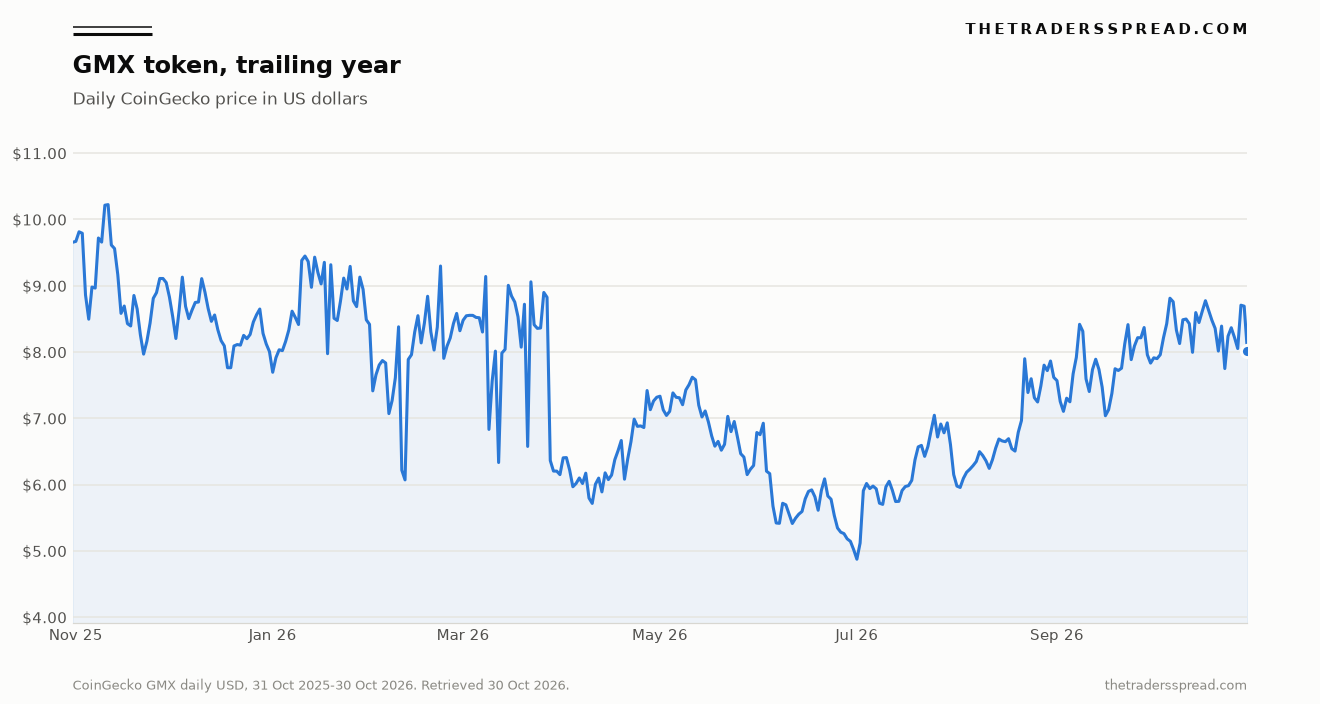
Daily prices run from $9.65 on 31 October 2025 to $8.01 on 30 October 2026, 17.0% lower. The file's high is $10.22 on 11 November 2025 and its low is $4.87 on 1 July 2026. Protocol open interest at 07:00 UTC was $238.3 million and Arbitrum open interest was $49.0 million. The USDC-backed pool at $244,113 is about 0.5% of that Arbitrum book. Aerodrome's fee, bribe and lock myths ask who keeps a fee through emissions and a lock, and the GMX token question is who the buyback is waiting on.
What comparison still works after these rates move?
The snapshot will be stale by the afternoon, because funding is built to move and one modest order can double a $1,117 gap. The reusable comparison is the open fee, the close fee, and one day of the net rate for the side in question, all in the same dollars of size. On this morning, one day of the long net rate was $9.88 per $10,000, and the open plus the close was $10.00. A hold past a day, at rates of this shape, is a funding-and-borrow position with an open ticket attached. A hold closed inside a few hours is mostly the position fee, paid twice, plus whatever impact the close then discovers.
The lighter side receives funding and pays borrow at zero only while it stays lighter, and it still pays a position fee in and out. On this book that description dies at $1,118 of new size. Past the gap, the 0.06% open sits next to one day of the heavy-side net rate, and the token page says the buyback waits for $90. The 14.89% and the 21.16% are what a 0.06% open was standing next to on the morning of 30 October 2026.
Figures are a reading of GMX's documentation and of market data retrieved on 30 October 2026. They are not a recommendation to open, close, or stake a GMX token position, and the live rate will have moved by the time this is read.