

I had VeChain's gas-token page open beside the CoinGecko print before the chart was worth reading. VeChain (VET) last changed hands at $0.005885 at 07:58 UTC on 1 November 2026, a market value of $506.1 million, rank 105, with $3.86 million traded in the rolling 24 hours. The page beside that print describes a redesign of how the network mints its fee token, and the price has spent the year walking away from the redesign.
| Scenario to 31 March 2027 | Level | Versus the $0.005885 print | Value of 85.985 billion VET | What has to be true |
|---|---|---|---|---|
| Bull | $0.012 | +103.9% | $1.03 billion | Daily price accepts a level last cleared on 15 January 2026, still 30.9% under the 11 November 2025 high |
| Base | $0.0075 | +27.4% | $645 million | The path drifts back to the median of the last 365 daily points, $0.007468 |
| Bear | $0.004 | −32.0% | $344 million | Price goes through the 1 July 2026 low of $0.004358, the floor the daily series held |
The bull level sits above the live print and the bear level sits below it, which is the whole map. Of 365 daily points from 2 November 2025 through 1 November 2026, 278 finished above $0.005885, so the print is in the bottom quarter of its own year, and CoinGecko's rolling one-year change on the same snapshot is down 62.9%. VeThor (VTHO), the fee token, was $0.00056854 at 08:00 UTC, down 48.8% over its own year. The foundation's page dated 5 January 2026 already said the chain was minting less VTHO, and both tokens are lower anyway. The supply story and the price story have pointed different ways for most of the year.
Key facts
- VET last printed $0.005885, market value $506.1 million, rank 105, rolling 24-hour volume $3.86 million, up 0.78% on the day and down 34.2% over 30 days (CoinGecko, 07:58 UTC, 1 November 2026).
- The 365-day high was $0.017356 on 11 November 2025 and the low was $0.004358 on 1 July 2026, with 76.2% of daily points above the live print (CoinGecko market_chart, 1 November 2026).
- Circulating supply is 85,985,041,177 VET against a maximum of 86,712,634,466, so 99.2% of the cap already counts as circulating (CoinGecko, 1 November 2026).
- VTHO last printed $0.00056854, market value $59.2 million, circulating supply 104.16 billion, maximum-supply field left open (CoinGecko, 08:00 UTC, 1 November 2026).
- Since Hayabusa, annual new VTHO equals 1,200 times 64 times the square root of VET staked. The docs' example is 2.525 billion VET staked and about 3.86 billion VTHO a year (VeChain docs, opened 1 November 2026).
- The manifesto dated 5 January 2026 said the chain produced 50% less VTHO in the first weeks after Hayabusa, paid only to StarGate stakers (vechain.org, opened 1 November 2026).
- VeChain's account said on 29 September 2026 that 15.5 billion VET was locked through StarGate (X post, oEmbed check, 1 November 2026). The StarGate app failed to load in this session.
Reading the daily path
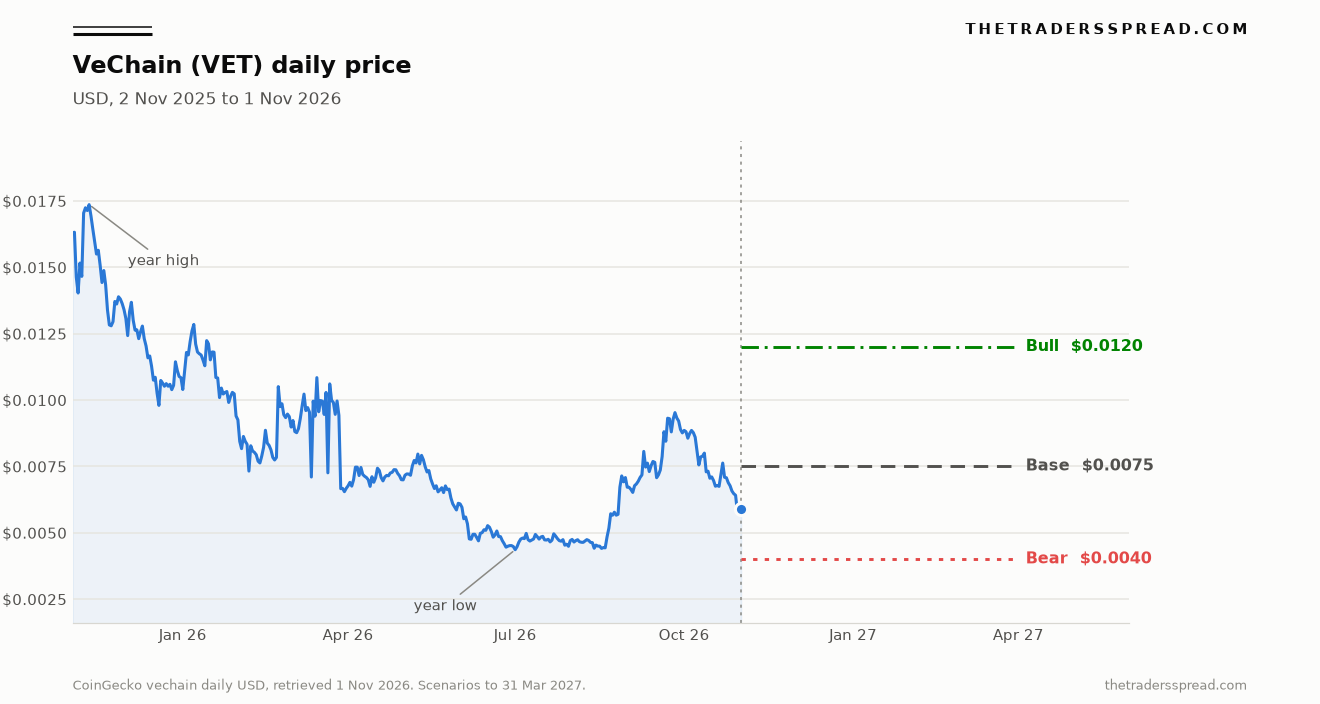
The line is CoinGecko's daily dollar series. Bull at $0.012, base at $0.0075 and bear at $0.004 are drawn out to 31 March 2027 so the marks extend past the last point. That last point, $0.005889, sits $0.000004 above the ticker of $0.00588535, and I use the ticker because it carries the 07:58 UTC timestamp.
The window opened near $0.0163 on 2 November 2025, printed $0.017356 on 11 November, and then made lower month-end marks into the summer. Price doubled off the July low by 30 September and gave the bounce back in October. The bull line sits in the upper part of that history, the bear line sits just under the summer floor, and the base line cuts the middle of the cloud.
| Date on the daily series | Point, USD | Change from 2 November 2025 |
|---|---|---|
| 30 November 2025 | 0.013399 | −17.8% |
| 31 December 2025 | 0.010837 | −33.5% |
| 31 January 2026 | 0.009249 | −43.2% |
| 28 February 2026 | 0.009371 | −42.5% |
| 31 March 2026 | 0.006670 | −59.1% |
| 30 April 2026 | 0.006996 | −57.1% |
| 31 May 2026 | 0.006107 | −62.5% |
| 30 June 2026 | 0.004475 | −72.5% |
| 31 July 2026 | 0.004703 | −71.1% |
| 31 August 2026 | 0.006712 | −58.8% |
| 30 September 2026 | 0.008758 | −46.2% |
| 31 October 2026 | 0.005975 | −63.3% |
| 1 November 2026 | 0.005889 | −63.9% |
One March daily point fell hard and reversed the next day, so the table keeps month-ends. From the 1 July low of $0.004358 to 30 September at $0.008758 is a rise of 101%, and from there to the live print is a fall of 32.8%. Forty-seven daily points closed above $0.012, all between 2 November 2025 and 15 January 2026. Sixty-nine closed under $0.005 from 6 June to 20 August, and 86 points in a row, from 2 June through 26 August, sat under $0.006. The bear level is 8.2% under the window low, and the 2021 high of $0.281 sits far enough above this sample that the scenarios stay inside the last year.
Two tokens, two jobs
VeChainThor is the chain. VET is what a holder stakes to take part in securing it. VTHO is what a user spends to have a transfer or a contract call included in a block, the job people call gas. Fees can move in one token while the staking asset trades in another, so a busy week of product scans can leave VET where it is.
An enterprise writing a product passport pays VTHO, and a large VET balance is optional for that writing. The way back to the staking token is indirect. Scarce VTHO would make the right to earn new VTHO, which now sits with staked VET, worth more. Cheap VTHO leaves that right earning less. The income is a fee token, separate from any corporate dividend.
| VET | VTHO | |
|---|---|---|
| Job in the docs | Staked for security, as a validator bond or a delegated StarGate position | Fee for a transfer or a contract call. Base fee burned, priority fee to the block's validator |
| Live print, 1 November 2026 | $0.005885 at 07:58 UTC | $0.00056854 at 08:00 UTC |
| Market value | $506.1 million, rank 105 | $59.2 million, rank 392 |
| Supply | 85.985 billion circulating, 86.713 billion maximum | 104.16 billion circulating, maximum left open |
| One-year price change | −62.9% | −48.8% |
| Rolling 24-hour volume | $3.86 million | $0.86 million |
One VET buys about 10.4 VTHO at these prints, and VTHO's market value is 11.7% of VET's. The gas token is the smaller market, which fits a coin meant to be spent, and the stock is still large beside any new-coin flow in the low billions. On VET itself, 99.2% of the stated maximum is already circulating, and fully diluted value matches market value. A re-rating has to come from use of the chain or from staking income, rather than from a lockup calendar with a large slice still locked away.
The square root that mints new VTHO
Before Hayabusa, holding VET generated VTHO, idle exchange coins included. Hayabusa ties new VTHO to VET staked by validators and delegators when a block is produced. Annual new VTHO equals 1,200 times 64 times the square root of VET staked, and those constants multiply to 76,800. Each extra staked coin adds less than the one before it, so a doubled stake lifts issuance by about 1.41 times.
Stake of 2.525 billion VET has a square root of 50,249, and 76,800 times that root is 3.859 billion VTHO a year, the figure the docs round to about 3.86 billion. The same product falls out of the same inputs here. The StarGate app at app.stargate.vechain.org refused a connection on 1 November, so a live stake total stayed out of reach.
If the 15.5 billion VET the account called locked on 29 September were all inside the formula, annual generation would be about 9.56 billion VTHO, 2.48 times the example. Undelegated coins can sit in a locked total and outside the square root, so that figure stays a sensitivity. Against 104.16 billion VTHO already circulating, the example covers about 27 years of stock and the sensitivity about 10.9. The base-fee burn shrinks the pile only when destroyed fees exceed new coins, and a running burn-versus-mint total is absent from the page.
The StarGate rewards page puts the mainnet transition on 2 December 2025 through 9 December 2025, with rewards paused in that window. After it, rewards split 30% to the validator and 70% to its delegators, by effective stake. Effective stake is VET in the position times a multiplier from 1 on the Dawn tier to 5 on Mjolnir X. The multiplier changes a delegator's share. The square root still sets the network total.
A supply cut the price has already had time to meet
The 5 January 2026 manifesto says the first weeks after Hayabusa produced 50% less VTHO, paid only to StarGate stakers, and that VTHO used as the protocol minimum is destroyed. The docs split the fee: the base fee is burned, and a priority fee can still reach the validator. Both lines are the project's account. From the 31 December 2025 point of $0.010837 to the live print is a fall of 45.7%, through a spring slide, a summer floor, a September rally to $0.008758 and an October retrace. VTHO fell 48.8% over its own year. The slower tap, as the foundation described it in January, met demand soft enough to leave both prices lower.
A supply cut changes the tap, and a bid is a separate event. Filecoin's tape into a scheduled cut in new supply moved before the cut arrived. VeChain's version was told in January, and the token is lower in November. Someone still has to want the staking asset, or want the gas token badly enough that the right to earn it turns scarce. Rolling 24-hour VET volume of $3.86 million is 0.76% of the $506.1 million market value. The median daily volume field over the year, dropping the latest partial point, is about $14.7 million, or 2.9% of today's market value. That is enough turnover for the 101% rally off the July low and for the give-back since September, with the formula left as it was.
What the foundation says the chain is for
The manifesto says VeChain has launched more than 100 enterprise applications since 2015 and hundreds of millions of business transactions. On VeBetter it claims more than 50 applications, nearly 50 million transactions and 5.2 million users, with Mugshot and Greencart past 3 million users between them, plus 14.4 million addresses and more than 924,000 contracts. Those counts stay the issuer's, because a block-explorer recount sat outside this session. The page calls Walmart a long-term user and names Lululemon China, Rekord, Franklin Templeton, BitGo, Keyrock and Meria Finance later on. Rekord, it says, has passed 100,000 on-chain transactions for European product data. A named customer meets the VET price only when the activity becomes demand for VTHO, and then for the stake that earns it.
The gap between activity and the token has run the other way on Aave, where the token climbed beside a deposits headline. Here the usage claims are large and VET is in the bottom quarter of its year, and the claims were already public in January while spring and summer prices fell. If the counts hold, the activity is paid in VTHO, and VTHO at $0.000569 leaves a buyer free to skip VET. The manifesto also says the VET and VTHO white papers were early confirmations on the EU ESMA register under MiCA. The register stayed unopened here, so that line stays attributed, and the path since the page is dated is the monthly table.
Fifteen billion locked, on a September post
The freshest stake figure from the project is a post, checked through X's oEmbed endpoint. On 29 September 2026 the account said 15.5 billion VET was locked through StarGate and named Crypto.com, Binance, Bitvavo, BitGo and Cointelegraph among those securing the chain. Name-to-address matching waited, and the live app failed to load.
15.5B VET is locked through StarGate today.
— VeChain (@vechainofficial) September 29, 2026
And if you check who’s helping secure VeChainThor, you might recognize a few names:
Crypto․com, Binance, Bitvavo, BitGo, Cointelegraph — plus a few familiar VeFam addresses and a growing validator community.
Not a bad crew to have…
Beside the 1 November circulating supply, 15.5 billion is 18.0% of 85.985 billion. The dates are five weeks apart, so the ratio is a sketch: a minority described as locked, and most of the supply free to trade. A seller can move coins already in circulation. The same question shows up in a Chainlink price framework, which has to separate coins committed to the network's job from the price the market is making. About a fifth of VET, on that September sentence, has left the bid unfinished, because both tokens are lower over the year.
RelatedBitcoin Cash (BCH) fell 6.05 percent in the large-cap tape
How a position is put together
On 5 October the account posted the ordinary plumbing. Stake VET, receive a StarGate NFT for the position, delegate it to a validator, and share the VTHO rewards. The validator bond in the docs is 25 million VET, about $147,100 at the live print, a seat size rather than a fee or a scenario.
How does staking work on VeChainThor?
— VeChain (@vechainofficial) October 5, 2026
The simple version:
Stake VET → receive a StarGate staking NFT → delegate it to a validator → help secure VeChainThor → earn VTHO rewards
You don’t need to run a validator yourself. Your staking NFT represents your position, and… pic.twitter.com/Jpl9SXHbar
Delegation starts when the validator opens a new period of 7, 15 or 30 days, and an exit waits for the next one. Rewards accrue inside the period and become claimable at the end. A validator that misses blocks leaves an empty reward. The flow is VTHO, and VTHO's rolling volume was $0.86 million that morning, so the dollar door out of a reward is small. A rate in a $59 million token is a different object from a rate in dollars.
Where $0.012 comes from
The bull case is $0.012 by 31 March 2027, up 103.9% from $0.005885, about $1.03 billion on today's circulating supply. It sits 30.9% under the 11 November 2025 high, near a 90th percentile around $0.0126, and the last close above it was 15 January. Reaching it takes buyers who bid the right to earn VTHO, or buyers who want VET because a thin book is moving with a larger market. September already travelled the second path, from $0.004358 to $0.008758 on the Hayabusa formula, and stopped short of $0.012. I weight the tail as possible and lighter than the bear. It still asks for a price last seen in January, while VTHO is down almost half over the year.
Where $0.004 comes from
The bear case is $0.004, down 32.0%, about $344 million, and 8.2% under the 1 July low of $0.004358. Twelve daily points closed under $0.0045 and the series bottomed at $0.004358, so $0.004 steps past the only floor this year has shown. From 30 September the token already fell 32.8%, almost the same distance again, and another slide of that size lands on $0.004 if stake stays a minority of supply and VTHO demand stays soft. Weeks near $0.0044, and the 86-day run under $0.006, are recent. I weight this tail a little above the bull because the print is already low in the sample and the supply story has been public since January, while the July low has held so far.
The middle of the sample
The base case is $0.0075 by 31 March 2027, 27.4% above the live print, about $645 million on today's supply. The median daily point is $0.007468, so $0.0075 is that centre in a sayable number. September stalled under $0.009, and the spring chopped near $0.007 before the summer break. A run under $0.004 retires the base case, because the median then describes a sample the price has left. A run above $0.012 means the bull case has already happened. Five months is enough for either, inside a year that already doubled off its low, and short enough to leave the 2021 high aside.
The weights are base 50, bull 20 and bear 30. Half sits on the centre the series has already lived in. The bear outweighs the bull because the issuance change is old, the float is almost the whole supply, and VTHO cheapened with VET, while the bull keeps a share because $0.012 was ordinary in January and the book is thin. The square-root mint describes VTHO's tap, and VET still needs a buyer on top of it. The reference print is $0.005885, the central level is $0.0075, and $0.004 is where that central level stops describing this sample.
Checklist
- Open CoinGecko's VET page and write the print beside $0.012, $0.0075 and $0.004.
- Keep $0.012 above that print and $0.004 below it. Once either has crossed, the map is stale.
- On a daily chart, place $0.004 under the 1 July 2026 low of $0.004358 and $0.012 under the 11 November 2025 high.
- Separate the tokens before using a usage claim. VET is staked, VTHO pays the fee, and the manifesto's user counts are claims about activity paid in VTHO.
- Read the generation formula and the square root, because doubling stake lifts new VTHO by about 1.41 times.
- Hold 15.5 billion locked VET as the 29 September 2026 post. If StarGate loads, replace it with the live locked total and the delegated slice.
- Keep the horizon on 31 March 2027. Daily points under $0.004 retire the base case, and daily points above $0.012 mean the bull case has been met.
The levels map the evidence opened on 1 November 2026: the CoinGecko print, the daily series, the VeChain docs, the StarGate rewards page and the January manifesto. They are scenarios, separate from any instruction to buy or sell VET or VTHO, and they go stale if the stake, the burn or the tape leaves the ranges above.