

The tidy explanation for Aave's 50% month is that lending demand came back and the token followed it up. The loan book says otherwise. Aave's outstanding borrowings grew 13.6% between 7 August and 6 September, on DefiLlama's numbers, while AAVE gained 50.0% on daily closes over the same stretch. Gross interest paid by borrowers grew 13.6%. Revenue routed to the DAO grew 17.5%. Not one operating series on the protocol came within 30 percentage points of what the token did.
AAVE changed hands at $134.46 on 7 September 2026, a market capitalisation of $2.07bn, against $89.64 a month earlier (CoinGecko, retrieved 7 September 2026). Total deposits across every Aave deployment reached $31.25bn, made up of $18.40bn of net liquidity and $12.85bn of active loans (DefiLlama, 6 September 2026). Both numbers are real. Neither of them grew at anything like the pace of the token.
Here is the arithmetic almost nobody has run. Value AAVE against the revenue the DAO actually banked in the trailing 30 days, annualised, and the multiple moved from 29.4x on 7 August to 37.6x on 7 September. The token did not re-rate because Aave started earning more. It re-rated because the market decided the same earnings deserved a higher price, and it made that decision inside five trading sessions in the third week of August. Working out what happened in those five sessions is the whole exercise, and two of them were not about Aave at all.
Key facts
- AAVE rose 50.0% on daily closes between 7 August and 7 September 2026, against bitcoin +24.0% and ether +31.4% — CoinGecko API, retrieved 7 September 2026
- Total Aave deposits reached $31.25bn, up 20.1% in 30 days; active loans reached $12.85bn, up 13.6% — DefiLlama, 6 September 2026
- Protocol revenue routed to the DAO was $4.54m over the trailing 30 days, against $3.86m in the preceding 30 — DefiLlama fees API, retrieved 7 September 2026
- Coinbase tokenized stocks went live on Base on 24 August 2026 under the B20 standard, with shares custodied by Alpaca — Crypto Briefing, 24 August 2026
- Aave V4 deposits across Ethereum and Avalanche passed $800m during August, per Aave Labs' own monthly update — Aave governance forum, 1 September 2026
- The US Treasury announced on 19 August that long-end buyback operations would rise from a $2bn maximum to at least $4bn each, effective 9 September — US Treasury press release, 19 August 2026
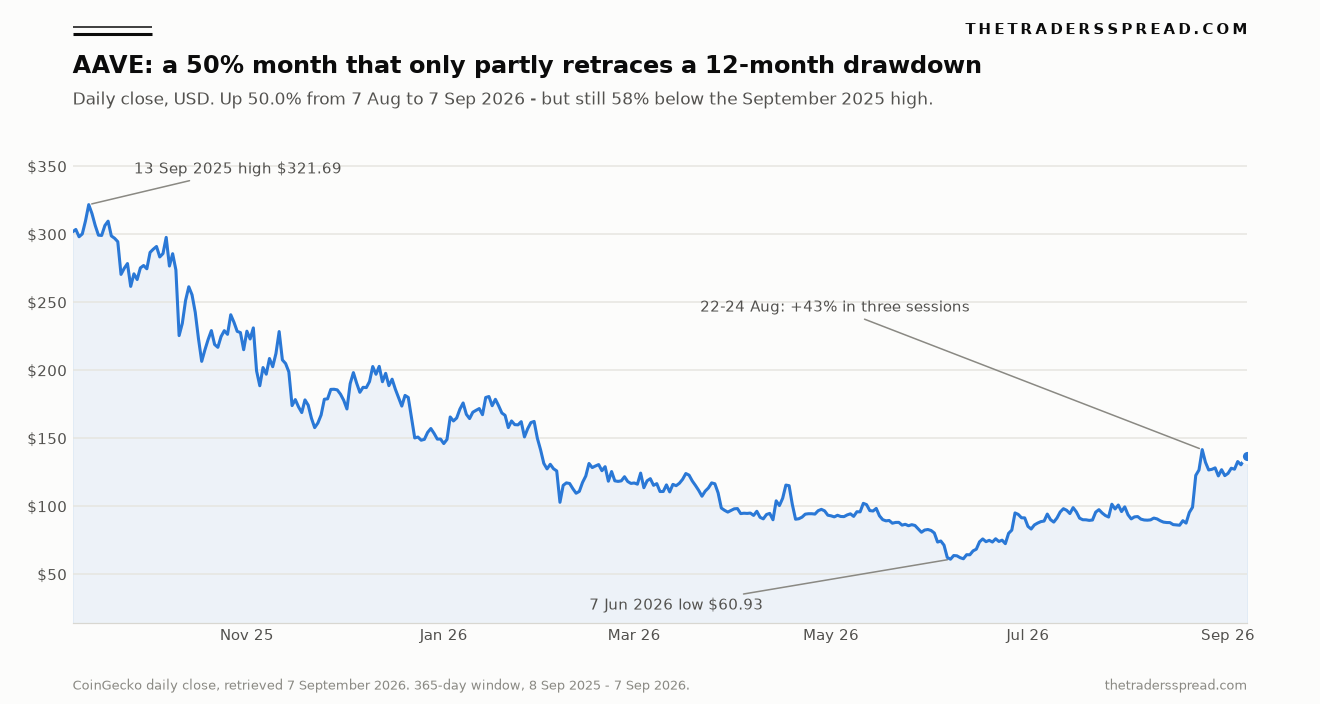
- AAVE remains 58.2% below its 13 September 2025 high of $321.69 — CoinGecko API, retrieved 7 September 2026
The five sessions that made the month
Strip the calendar back and the 30-day figure stops looking like a trend. AAVE closed 19 August at $87.49, roughly where it had sat since the start of the month. It closed 24 August at $141.53. Everything before and after is noise around a five-session repricing.
The first two of those sessions belong to the bond market, not to lending. On 19 August the US Treasury said it would at least double the size of its long-end liquidity support buybacks, from a $2bn ceiling per operation to "at least $4 billion per operation", effective 9 September. Scott Bessent, US Treasury Secretary, went further in remarks published by Euronews on 21 August: "We routinely do buybacks, and we're going to increase the size of the buyback [...] I would note that it could be more than the $4 billion per issue." Risk assets moved together. Ether added 17.5% on 20 August alone. AAVE added 8.9% that day, which is to say it lagged.
The interesting part starts on 22 August.
| Window | AAVE | Bitcoin | Ether |
|---|---|---|---|
| 30 days, 7 Aug to 7 Sep | +50.0% | +24.0% | +31.4% |
| 19 to 24 Aug (the squeeze) | +61.8% | +20.1% | +28.5% |
| 22 to 24 Aug | +15.5% | −0.8% | −2.1% |
| 24 Aug to 7 Sep | −5.0% | +2.5% | +1.5% |
Daily closing prices, CoinGecko API, retrieved 7 September 2026.
That third row is the only part of the month that Aave earned on its own. Between the 22nd and the 24th, AAVE added 15.5% while bitcoin fell 0.8% and ether fell 2.1%. Turnover confirms it: daily volume in AAVE ran at $245m on 21 August and $718m on the 24th, a near-tripling into a market that was otherwise flat. The token then gave back 5.0% over the following fortnight while both majors edged higher, which is the signature of a positioning unwind rather than a repricing that stuck.
Why the deposit headline flatters the protocol
Deposits crossing $31bn is the number doing the most work in the coverage, and it is the number most in need of a caveat. Aave's deposit base is denominated in dollars but composed largely of ether, staked ether derivatives, wrapped bitcoin and stablecoins. When ether rises 31.4% in a month, the dollar value of every ETH-denominated deposit rises with it, without a single new coin being supplied.
Run the two series side by side and the gap becomes obvious.
| Metric | 7 Aug 2026 | Latest | Change |
|---|---|---|---|
| AAVE price (daily close) | $89.64 | $134.42 | +50.0% |
| Total deposits | $26.01bn | $31.25bn | +20.1% |
| Active loans | $11.31bn | $12.85bn | +13.6% |
| Gross interest paid, 30d | $28.71m | $32.63m | +13.6% |
| DAO revenue, 30d | $3.86m | $4.54m | +17.5% |
| Utilisation | 43.5% | 41.1% | −2.4pp |
Price from CoinGecko; deposits, loans, fees and revenue from DefiLlama, latest column 6 September 2026 for on-chain series and 7 September for price. Utilisation calculated as active loans divided by total deposits.
Utilisation fell. That is the tell. More collateral arrived, in dollar terms, than borrowers wanted to draw against, so the share of the book actually working went down rather than up. A lending protocol whose token is being repriced on genuine credit demand does not usually show falling utilisation in the same window. The same reflexive effect showed up on Ethereum during August, and the mechanism is identical here: collateral repricing inflates the balance sheet, the inflated balance sheet gets reported as growth, and the growth narrative supports the collateral. Readers who followed the August move in ether have already seen one half of this loop.
None of which makes the deposit figure fake. It makes it a measure of the market, not a measure of Aave.
The two days Aave owned
On 24 August, Coinbase put tokenized US equities live on Base. The launch covered thirteen names including Apple, Nvidia, Meta and Alphabet, issued under a Base-native extension of ERC-20 called B20, with the underlying shares held by the regulated broker-custodian Alpaca in a bankruptcy-remote structure. Each token is a claim on a real share rather than a synthetic tracker. Holders can post them as collateral.
That last sentence is why AAVE moved.
Aave Labs put its own version on the record in its August development update, published to the Aave governance forum on 1 September: "The team announced support for Coinbase Tokenized Stocks on Base, with Aave included as the sole credit infrastructure in Coinbase's announcement." The same post commits the team to "Continue supporting the Babylon and Coinbase Tokenized Stocks integrations with Aave V4" through September. For a lending protocol, being the credit rail underneath an exchange with Coinbase's distribution is a larger prize than any single asset listing, because it converts a retail equity position into a borrowable balance without the holder ever touching a bank.
Two days earlier the mood had already turned. Stani Kulechov, Founder and CEO of Aave, marked deposits crossing $30bn with three words, "liquidity is back", as reported by Crypto Briefing on 22 August. That was the day AAVE added 23.6% against ether's 8.1%.
The claim that does not survive the launch-day record
Aave Labs' phrase "sole credit infrastructure" is doing heavy lifting, and the launch-day reporting does not support it. Coverage of the 24 August go-live consistently lists Aave alongside Morpho and Euler among the lending venues supporting B20 assets from day one, with Aerodrome providing spot liquidity and roughly fifty third-party protocols committed in total. Aave may well have been the only lender named in whatever Coinbase communication Aave Labs is referring to. It was plainly not the only lender at the table.
This matters for anyone pricing the integration. A sole-provider arrangement with Coinbase would be a durable moat. A place on a list of three lending venues is a distribution channel that competes on rates, caps and risk parameters from the first day, and Aave's nearest rival on Base has been taking share for most of the year. Our note on Morpho's own run on Base deposits sets out how quickly that competition compounds.
The second overstatement worth flagging concerns real-world assets. Two institutional collateral proposals landed in the window and both have been read as done deals. Neither is. The Securitize and Neuberger Berman high-income fund, HINC, was proposed for Aave Horizon on 18 August; the Wellington Management portfolio issued by Midas, mWIN, was proposed on 27 August. As of 7 September both sit at the request-for-final-comment stage, with no Snapshot vote and no on-chain implementation, and the HINC thread carries unresolved pushback on liquidator backstop sizing.
Carlos Domingo, Co-Founder and CEO of Securitize, framed the fund launch itself in a statement on 18 August: "This tokenized fund brings Neuberger's established fixed income capabilities to public blockchains." Read that release closely and Aave is not mentioned once. The connection to Horizon exists only in the governance proposal.
Regulation caps the collateral before Aave does
The constraint on the Coinbase integration is not Aave's risk framework. It is securities law.
Coinbase's tokenized stocks are restricted to non-US persons under Regulation S, because the SEC has not finalised the innovation exemption that would let tokenized securities trade onshore; reporting on the launch dated 25 August puts that framework at 2027. The same account has Coinbase building the issuance stack around a Financial Services Permission granted by the Abu Dhabi Global Market's regulator on 11 August 2026. The addressable pool of holders who could post AAPLc or NVDAc as Aave collateral therefore excludes the entire US retail market, which is the market that owns most of the equities in question.
Aave's own filings history is a reminder that this is not abstract. The DAO has spent years managing regulatory exposure, and Aave Labs put a framework to the forum on 12 February 2026 asking holders to "Direct 100% of Aave-branded product revenue to the Aave DAO treasury", naming an AAVE exchange-traded product among the future revenue lines. Whether an equity-collateral market ever reaches US users is a question for the SEC calendar, not for a governance vote. Traders sizing the opportunity should price the smaller pool until that changes.
RelatedMonero (XMR) Falls 2.9% Over Seven Days to 15 October
What this changes
The immediate consequence is that Aave now has a second-order dependency it did not have in July. If Coinbase's tokenized equity book grows, Aave's collateral mix diversifies away from crypto-native assets for the first time at scale, and the protocol's revenue becomes partly a function of how many people want dollar liquidity against Apple shares at two in the morning. If it stalls, the August re-rating has no fundamental follow-through, and a 37.6x multiple on trailing revenue has to be defended by something else.
Watch four things. First, utilisation: the ratio fell to 41.1% during a month of headline growth, and a genuine credit expansion would push it back toward the 43.5% it held on 7 August. Second, whether HINC or mWIN reaches a Snapshot vote and then an executed proposal, because the institutional RWA story is currently a set of forum threads rather than a set of live markets. Third, the size of the B20 collateral book on Aave specifically, measured against Morpho's and Euler's, since the distribution win is only worth what Aave's share of it turns out to be. Fourth, DAO revenue: $4.54m over 30 days annualises to roughly $55m, and every month that number fails to accelerate is a month the multiple carries more of the load.
The disconfirming case is straightforward and worth stating plainly. If active loans and utilisation both turn up sharply into October while ether goes sideways, the argument in this piece is wrong, and August was an early read on real credit demand rather than a repricing of the same book. That combination has not appeared yet. It would be visible within weeks if it did.
There is also a cleaner comparison available than bitcoin. AAVE's 50% month sits close to the 52% Hyperliquid posted on its regulatory onshoring push, and the shape of the two stories is similar: a token repriced on a distribution or licensing development rather than on trailing numbers. The difference is that Aave's revenue base is measurable and public, which makes the multiple falsifiable rather than a matter of belief. Collateral concentration is the other live risk, and holders of yield-bearing stablecoin collateral such as the assets discussed in our Ethena note carry a correlated exposure inside the same book.
Frequently asked questions
Did Aave's fundamentals actually improve in August?
Yes, modestly. Active loans rose 13.6% to $12.85bn, gross interest paid by borrowers rose 13.6% to $32.63m over 30 days, and revenue routed to the DAO rose 17.5% to $4.54m, all on DefiLlama data to 6 September 2026. The improvement is real. It is roughly a third of the token's 50.0% move, which is the point of contention rather than the direction.
Why did deposits grow faster than loans?
Because deposits are measured in dollars and held largely in ether, staked-ether derivatives and wrapped bitcoin. Ether rose 31.4% over the same 30 days, lifting the dollar value of existing collateral without any new supply arriving. Utilisation, the share of deposits actually borrowed against, fell from 43.5% to 41.1% across the month, which is what a repricing looks like rather than a demand surge.
What exactly did Coinbase launch on 24 August?
Thirteen tokenized US equities on Base, including Apple, Nvidia, Meta and Alphabet, issued under the B20 standard. Each token is a direct claim on a share held by broker-custodian Alpaca in a bankruptcy-remote structure supervised by the Abu Dhabi Global Market's regulator. The tokens trade around the clock and can be posted as collateral in on-chain lending markets, Aave among them.
Is Aave the only lending venue for Coinbase tokenized stocks?
No. Aave Labs described Aave as "the sole credit infrastructure in Coinbase's announcement" in its 1 September governance update, but launch-day coverage consistently names Morpho and Euler as lending venues alongside Aave, with around fifty third-party protocols committed to B20 support in total. Treat sole-provider framing with caution until Coinbase's own documentation says so.
Have the Wellington and Neuberger Berman funds actually launched on Aave?
Not yet. Both mWIN, the Wellington Management portfolio issued by Midas, and HINC, the Securitize and Neuberger Berman fund, were proposed as Aave Horizon collateral in August. As of 7 September 2026 both remain at the request-for-final-comment stage on the governance forum, with no Snapshot vote taken and no on-chain implementation. They are proposals, not live markets.
How far is AAVE from its previous high?
The token closed at $134.42 on 7 September 2026 against a high of $321.69 on 13 September 2025, a drawdown of 58.2%. Measured from the other direction, it is up 120.6% from the $60.93 cycle low set on 7 June 2026. Both framings are accurate and they support opposite narratives, which is why the operating metrics matter more than the chart.
Disclaimer
This article is analysis and information, not investment advice, and nothing in it is a recommendation to buy, sell or hold any asset. Digital assets are volatile and your capital is at risk. Figures were retrieved live on 7 September 2026 from the sources named against each claim and will move. Readers should conduct their own research and consider their own circumstances before acting on any market information.