

Does the unlock schedule on Immutable's own token page, and the fee rule printed beside it, still describe a live drip of IMX into the market?
The documents opened on 5 November 2026 answer with a split. The current orderbook specification fixes a protocol fee of 2% on mainnet and on testnet. The token page says 20% of the protocol fee must be paid in IMX, describes an open-market conversion when the trader pays in another currency, and reserves that 20% for staking rewards. The same page prints an unlock table whose latest end date is 31 October 2025. CoinGecko's immutable-x record, last updated at 06:49:54 UTC that morning, showed 904,472,049 IMX in circulation against a 2,000,000,000 cap. A derivatives venue can publish a funding fee in the mechanism and a separate rewards story on a token page. Whitepaper v1.2, published 26 June 2023 and linked from the token page, already held both rates, plus a lock-up table that names the large sale differently from the live unlock grid.
Updated 5 November 2026.
Key facts
- The current orderbook document sets the protocol fee at 2% on mainnet and on testnet. Source: Immutable orderbook fees, docs.immutable.com, opened 5 November 2026.
- Whitepaper v1.2 states a 2% fee on primary asset sales and on every NFT trade, in the purchase currency, and says 20% of the protocol fee must be paid in IMX. Source: Immutable X Whitepaper v1.2, published 26 June 2023, opened 5 November 2026.
- The live token page assigns 51.72% (1,034,461,000 IMX) to ecosystem development and 25% (500,000,000 IMX) to project development, with 31 October 2025 as the end date on both rows. Source: imx.community/tokenomics, opened 5 November 2026.
- That page's headings, and the whitepaper allocation section, both put 13.86% on the private sale and 5.42% on the public sale, inside a 2,000,000,000 cap. Source: imx.community/tokenomics and Whitepaper v1.2, opened 5 November 2026.
- As of 5 November 2026, 06:49 UTC, CoinGecko showed circulating supply of 904,472,049 IMX, a market cap of $111,749,344 and a fully diluted valuation of $247,104,029, per the immutable-x payload last updated at 2026-11-05T06:49:54Z.
- Immutable chain id 13371 uses IMX as the native gas token, with a 10 gwei minimum priority fee and a 30,000,000 block gas limit. Source: Immutable chain overview, docs.immutable.com, opened 5 November 2026.
1. A 2% protocol fee is what the orderbook document fixes
The fee page an integrator would code against lists four cuts: a protocol fee to Immutable, a royalty set on the NFT contract, a maker fee to the listing marketplace, and a taker fee to the marketplace that fills the order. The prose says the buyer pays every cut and the seller receives the sale price minus those fees. The worked examples already disagree about that net. A diagram splits a 1.00 IMX payment into a 0.02 protocol fee, a 0.05 royalty, a 0.01 maker fee, a 0.01 taker fee and 0.91 for the seller. A seller-facing card for the same price subtracts a 2% protocol fee, a 5% royalty and a 1% marketplace fee, and prints 0.92, stopping one line earlier than the diagram.
The protocol rate is the stable line: 2% on mainnet and 2% on testnet, called non-negotiable on orderbook trades. Fees are notional amounts in the payment currency, and a partial fill pro-rates them. Royalties come off ERC-2981, in a typical band of 2% to 5% for gaming items, with a recommended ceiling of 10%. Fulfillment data expires after three minutes, and the live protocol fee can differ from the listing query during a promotion. Section 5.4 of the June 2023 whitepaper already described that same 2% on primary asset sales and on every NFT trade, denominated in the purchase currency. Reading the fee a venue actually charges, which is what the Raydium note on how a swap fee is set does for a swap, is the standard here. The open question is which document still attaches that rate to a purchase of IMX.
2. The 20% IMX slice lives in the whitepaper and on the token page
Whitepaper section 6.1.1 is the sentence the fee claim depends on. It says 20% of Immutable's protocol fee must be paid in IMX. The trader can pay that slice in IMX, or Immutable swaps the purchase currency, with ETH given as the example, for IMX on the open market. The subsection then separates bare ownership from any revenue entitlement and points the operative design at the staking pool that follows.
Set beside section 5.4, the arithmetic is a product of two printed rates. Twenty percent of a 2% fee is 0.4% of the payment. The string 0.4% is absent from the whitepaper and from the current fee page. The whitepaper is explicit that the 2% is denominated in the purchase currency, and that a fifth of the protocol fee is the part forced through IMX. On that 2023 text a trade priced in ETH would pay most of the protocol fee in ETH and route a fifth through an IMX purchase.
The live token page keeps a shortened form of the same rule, with the IMX portion reserved for people who stake and take part in pro-network activity. The orderbook fee page opened on 5 November 2026 prints the 2% and the other three cuts in the payment currency, and uses IMX only because the worked example is priced at 1.00 IMX. A mandatory conversion and a staking reserve are absent from that page.
CoinGecko's fully diluted valuation exceeded its market cap by $135,354,685 at the 06:49 UTC print. Divide that gap by 0.004 and the quotient is $33,838,671,250 of payment volume, the point at which a 0.4% slice taken on every trade would equal the gap once. The volume that would make them meet is unpublished on those pages. GMX is a useful comparison because the fee a trader can point at there is the one the mechanism prints, the same test this 20% sentence has to pass on the current orderbook page.
3. Staking rules in the 2023 text are stricter than the live sentence
The whitepaper sends IMX from fee capture to a staking rewards pool, paid monthly in proportion to what each active staker held that month. Staking would start a couple of months after launch, once added to the protocol, and the terms may change through governance. An address counted as staked only with IMX on layer 1 or layer 2, a governance vote in the prior 30 days, and an NFT on Immutable X or a trade in those 30 days. Rewards pay on layer 2, so the wallets have to be linked.
The live token page compresses this to a shorter promise: stake, take part in pro-network activity, and the reserved 20% is the pool. The monthly interval, the 30-day vote and the NFT-or-trade alternative are absent from that shorter text. The native-token page says IMX can be staked, that staking is provided by the IMX Ecosystem Foundation, and that the place to participate is imx.community/staking. Fetched on 5 November 2026, that URL returned the title IMX Staking and an empty body. A reward rate, a cycle length and a current eligibility test were absent from the response.
The June 2023 whitepaper names the issuer as Digital Worlds Ltd. NFTS, called there the Foundation, and names Immutable Pty Ltd as the service provider. It places directors and employees of Immutable, and directors of the Foundation, outside direct token compensation. The November 2026 native-token page says the native token is issued by the IMX Ecosystem Foundation, a separate name on a later page. What staking still shows is a 2023 rule with a change clause, a shortened live sentence, and a dashboard that returned a title. Lido's daily stETH rebase is the level of mechanism detail that URL would need before a reward rate could be quoted.
4. The unlock table fights the headings and the whitepaper
Supply is where the documents stay specific after the fee sentences thin out. Read on 5 November 2026, the token-page headings are 51.72% ecosystem development, 25% project development, 13.86% private sale, 4% foundation reserve and 5.42% public sale. Whitepaper section 6.2 uses those five shares, assigns the larger sale to private investors, and calls the breakdown provisional. The unlock-table counts add to the same 2,000,000,000 cap, and the five percentages sum to 100, while the row names under the headings run the other way.
| Row as labelled in the unlock table | Share | IMX count | Cliff cell | Periods | End date printed |
|---|---|---|---|---|---|
| Ecosystem development | 51.72% | 1,034,461,000 | None | 52 | 31 October 2025 |
| Project development | 25% | 500,000,000 | 1 year | 52 | 31 October 2025 |
| Public sale | 13.86% | 277,139,000 | 1 year | 32 | 19 April 2024 |
| Private sale | 5.42% | 108,400,000 | None | 3 and 6 | 28 January 2022 |
| Foundation | 4% | 80,000,000 | None | 1 | 5 November 2021 |
Figures are as printed on imx.community/tokenomics, opened 5 November 2026. The headings above that table, and Whitepaper v1.2 section 6.2, assign 13.86% to the private sale and 5.42% to the public sale.
The swap is on one screen. The unlock table gives the public-sale row 13.86% and 277,139,000 IMX, and the private-sale row 5.42% and 108,400,000 IMX. The headings do the opposite, and the whitepaper agrees with the headings.
Whitepaper section 6.4 puts the long vest on the private sale: fully locked at launch, a one-year cliff, then a 2.5-year unlock every 28 days. The public sale splits into a discounted tranche with a six-month unlock and a cliff of none, plus a tranche unlocked at launch over three months. Project development has a one-year cliff and a four-year unlock. The foundation reserve is 0% subject to lock.
The token page's private-sale summary says two tranches, 2.94% over three months and 2.48% over six months. Those slices add to 5.42, the public-sale share in the headings and the whitepaper, and the lengths match the whitepaper's public tranches. The row carrying that language is labelled private. The row labelled public carries 13.86%, a one-year cliff and an end date of 19 April 2024, a different shape from the whitepaper's private sale of a one-year cliff plus 2.5 years.
Count the periods from the foundation row's TGE on 5 November 2021. Fifty-two intervals of 28 days, 1,456 days, land on 31 October 2025, the shared end date of the ecosystem and project rows. The ecosystem row fits: cliff none, 52 periods, and a declining split of 40%, 30%, 20% and 10% across four years. The project row prints a one-year cliff beside that same end date, so a cliff plus 52 periods would finish a year later and line up with the whitepaper's four-year unlock. Thirty-two periods land on 19 April 2024, the public row's printed end, while that cliff cell says one year. Three periods land on 28 January 2022, the private row's end, and six periods would land on 22 April 2022, a date that cell leaves off.
A status grid beside the table keeps locked balances, balances awaiting a cliff, and unlocked balances in different states for trading, paying, withdrawals, staking and voting. An end date on a row is a different claim from a circulating figure.
5. Circulating supply still covers about 45% of the cap
As of 5 November 2026, 06:49:54 UTC, the CoinGecko immutable-x payload showed a dollar price of $0.123552, circulating supply of 904,472,049 IMX on a whole-token reading of 904,472,049.12, total and max supply both at 2,000,000,000, a market cap of $111,749,344 and a fully diluted valuation of $247,104,029. Market cap divided by that valuation is 0.45, and circulating supply divided by the cap is 45.2%. Fully diluted valuation minus market cap is $135,354,685. The daily series in the chart ends at $0.12352 on 5 November 2026, with a high of $0.4708 on 11 November 2025 and a low of $0.1001 on 19 August 2026. The coin endpoint's all-time low is $0.094763 on that same August day, under the daily point, and the all-time high is $9.52 on 25 November 2021. The one-year change on the payload is -70.70%.
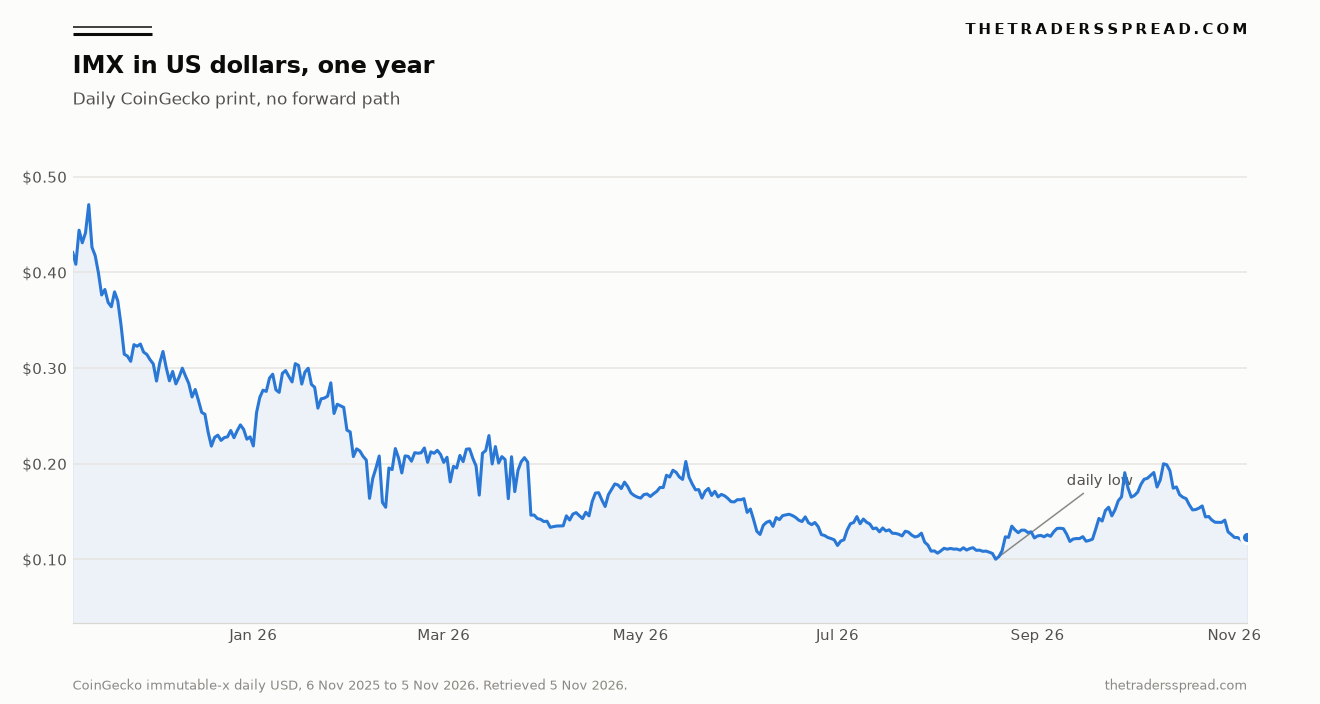
If every end date on the token-page table meant tokens were inside the reported float by 31 October 2025, the November 2026 figure would sit near 2 billion and instead sits near 904 million. About 1,095,527,951 IMX remains outside the float CoinGecko reports, a year after the latest date in that column. Whitepaper section 6.5 calls that circulating schedule a projection. The dated vendor print is what can be set beside a table whose latest end date has passed and whose rows disagree with the whitepaper.
The Ethereum contract CoinGecko prints is 0xf57e7e7c23978c3caec3c3548e3d615c346e79ff, 18 decimals, the address the native-token document shortens to 0xf57e…79ff, beside wrapped IMX at 0x3a0c…9c9d. Bridging from Ethereum credits native IMX, so one cap can be reported while balances live in more than one form. The vest-row conflict stays on the token page.
6. Games and gas are described, and the fee volume is unpublished
A 2% fee needs NFT trades on the orderbook, and the token page's line about IMX as gas needs someone paying for block space. Chain id 13371 uses IMX at 18 decimals, with blocks of about two seconds, EIP-1559, a 10 gwei minimum priority fee and a 30,000,000 gas limit. The overview card says Zero Gas for Players. The gas-sponsorship document says Immutable sponsors gas for Passport users, so those players trade, mint and transfer while a sponsor pays, and studios are told to treat that cost as an operating expense. Sponsorship is limited to Passport, a narrower line than the card.
RelatedRain (RAIN) Rises 13.8 Percent as Large-Cap Coins Fall
The June 2023 whitepaper says the minting path had already been used for more than 10 million NFTs on Immutable X, and section 7 names Gods Unchained and Guild of Guardians as projects Immutable develops. Those claims are dated, and they are stale as a November 2026 volume print. CoinGecko's live figures measure something other than an NFT fee: total value locked of $583,631, a market-cap to TVL ratio of 191.47, and exchange volume of $5,293,300. Four tenths of one percent of that exchange volume is about $21,173, the stacked slice applied to token turnover. The orderbook volume that belongs in the denominator is absent from the docs and the token page.
On 25 August 2026 the Immutable account, the handle linked from the company site, posted a game leaderboard. The post puts a 100,000 wAURE pool on an Olderfall competition inside what it calls a Polygon Hub, and it tells players to compete before September 30.
The Immutable Hunt @Olderfall Leaderboard is LIVE: 100,000 $wAURE up for grabs!
— Immutable (@Immutable) August 25, 2026
A featured title of the Immutable "Polygon Hub" with @0xPolygon
Compete, climb, and claim your share before September 30.
- 100K $wAURE Reward Pool: Top 500 players win. Rank 1 walks away with… pic.twitter.com/lHVNoFwYkH
A competition denominated in a game token is activity the account was still posting in late summer 2026. The post's figure is a prize pool for that contest. The fee check stays with the orderbook document.
FAQ
Where does Immutable's 2% fee apply?
The 2% in the current orderbook document is the protocol fee on trades that clear that orderbook, on mainnet and on testnet. The June 2023 whitepaper used the same rate for primary sales and for every NFT trade on Immutable X, in the purchase currency. A transfer of IMX on chain id 13371 is gas, and the sponsorship document puts that gas on Immutable for Passport users. Exchange turnover is the separate volume CoinGecko prints.
Which IMX unlock schedule matches the other documents?
The live token page's headings and Whitepaper v1.2 both assign 13.86% to the private sale and 5.42% to the public sale. The unlock table on that token page swaps the names and attaches 277,139,000 IMX to the row it labels public. The whitepaper's private-sale vest is a one-year cliff plus 2.5 years, while the token page stops rows on 19 April 2024 and 28 January 2022. The schedules have to stay separate.
What would make the fee switch large next to the supply gap?
Twenty percent of a 2% fee is 0.4% of payment value, and that 0.4% string is absent from both source pages. On 5 November 2026 CoinGecko's fully diluted valuation sat $135,354,685 above market cap. Dividing the gap by 0.004 gives about $33.84 billion of payment volume for the slice to match the gap once. The orderbook page bills the 2% in the payment currency, and a live NFT volume is absent from the pages opened here.
Verdict
Check the fee claim against the page an integrator would ship, and the 2% is still there, in the current orderbook specification and in the June 2023 whitepaper as a purchase-currency cut on primary sales and NFT trades. The 20% IMX conversion and the reservation of that slice for stakers sit in the whitepaper and, shortened, on the live token page. The 20% IMX rule is a sentence on the token page and in that PDF, not a line in the orderbook fee table opened on 5 November 2026.
The driver that still shows up with counts, cliffs, end dates and a live market print is supply. Staking remains the 2023 monthly pool, the 30-day vote and the NFT-or-trade test, with a clause that the terms may change, while the live page keeps the reserve sentence and the dashboard returned a title. The headings and the whitepaper agree the private sale was the 13.86% block and the public sale the 5.42% block. The unlock table swaps those names, and its end dates fight its cliff cells and the whitepaper's lengths. On the morning of 5 November 2026 CoinGecko reported 904,472,049 IMX in circulation, 45.2% of the 2 billion cap, a year after the latest end date that table prints. That gap, and the conflict among the schedules, is what the documents leave standing.
Nothing on this page is a recommendation to buy, sell or hold IMX or any other asset.