

BNB closed at $739.68 on 8 September 2026, up 23.2% from the $600.33 close on 9 August, on CoinGecko daily closes taken at 00:00 UTC. The first thing I do with a number like that is not read the news. I open the supply history, because an asset whose entire marketing story is a burn should show me the burn before it shows me anything else. BNB's circulating supply on 9 August was 133,164,487. On 8 September it was 133,161,655. Two thousand eight hundred and thirty-two coins left the float in a month, worth roughly $2.1m against a market capitalisation of $99.96bn. Whatever moved this asset, it was not scarcity. That check took ninety seconds and it killed the explanation attached to almost every BNB rally I have read this week.
The same data says something more interesting. The 30-day window contains two rallies, not one, and they have opposite causes. Between 19 and 23 August BNB gained 15.2% while bitcoin gained 19.2%, ether 26.5% and solana 21.9%; BNB lagged the entire complex, which is the signature of pure beta. Between 3 and 6 September BNB gained 11.4% while bitcoin managed 3.3%, ether 3.7% and solana 2.8%. The second leg runs at roughly three times the majors, and it lines up day for day with total fees paid on BNB Chain rising from 2,195 BNB a day on 29 August to 7,804 BNB a day on 8 September. The move being credited to a deflationary token model is, on the numbers, a move driven by memecoin launchpad throughput that began nine days ago.
Key facts
- BNB rose 23.2% in the 30 days to 8 September 2026, from $600.33 to $739.68 — CoinGecko daily closes, 00:00 UTC, retrieved 8 September 2026.
- Over twelve months BNB is down 15.85%, against bitcoin −29.4%, ether −42.2% and solana −51.6% — CoinGecko, 9 September 2025 to 8 September 2026.
- Gas fees paid on BNB Chain totalled 28,310 BNB in the 30 days to 7 September, up 51.5% in token terms from 18,688 BNB in the 30 days to 8 August — DefiLlama, retrieved 8 September 2026.
- Circulating supply fell by 2,832 BNB over the window, about 0.0021% of the float — CoinGecko supply series, retrieved 8 September 2026.
- Flap, a BNB Chain token launchpad, generated $24.08m of fees in the 30 days to 7 September against $1.16m in the 30 days to 8 July — DefiLlama, retrieved 8 September 2026.
- Binance BNBUSDT perpetual open interest rose just 4.5% in token terms, from 608,521 BNB on 10 August to 636,032 BNB on 8 September — Binance futures API, retrieved 8 September 2026.
- The 36th quarterly Auto-Burn retired 1,615,827.795 BNB, worth about $931.7m, on 15 July 2026 — BNB Chain, 15 July 2026. The next one is not due until October.
Two rallies wearing one costume
Aggregating a month into one percentage is how analysts lose the plot. A 23.2% window return sounds like one event with one cause. It was two, separated by ten days of nothing.
The August leg is the easy half. Risk came back across the whole digital asset complex in the third week of the month, and BNB went along for the ride without leading it. A token that rises 15.2% while solana rises 21.9% and ether rises 26.5% has not been repriced on anything specific to itself; it has been dragged. Our piece on ether's August covers the same window from the other side, and the pattern is consistent: the large-cap layer ones moved together and BNB moved least.
Then the complex stalled. Between 23 August and 3 September BNB gave back 1.0%, closing at $688.23 after touching $712.05 on 28 August. Nothing about the burn changed in those eleven days. Nothing about the ETF changed either.
The September leg is where the asset stopped behaving like a beta instrument. BNB added 5.35% on 4 September and 6.23% on 6 September, on daily volume of $1.18bn and $2.21bn against a late-August run rate nearer $700m. Bitcoin, ether and solana each managed less than 4% across the same three sessions. When one asset in a correlated basket triples the move of its peers over 72 hours, the cause is local, and the place to look for a local cause on a smart-contract chain is the fee meter.
The chart, and the year behind it
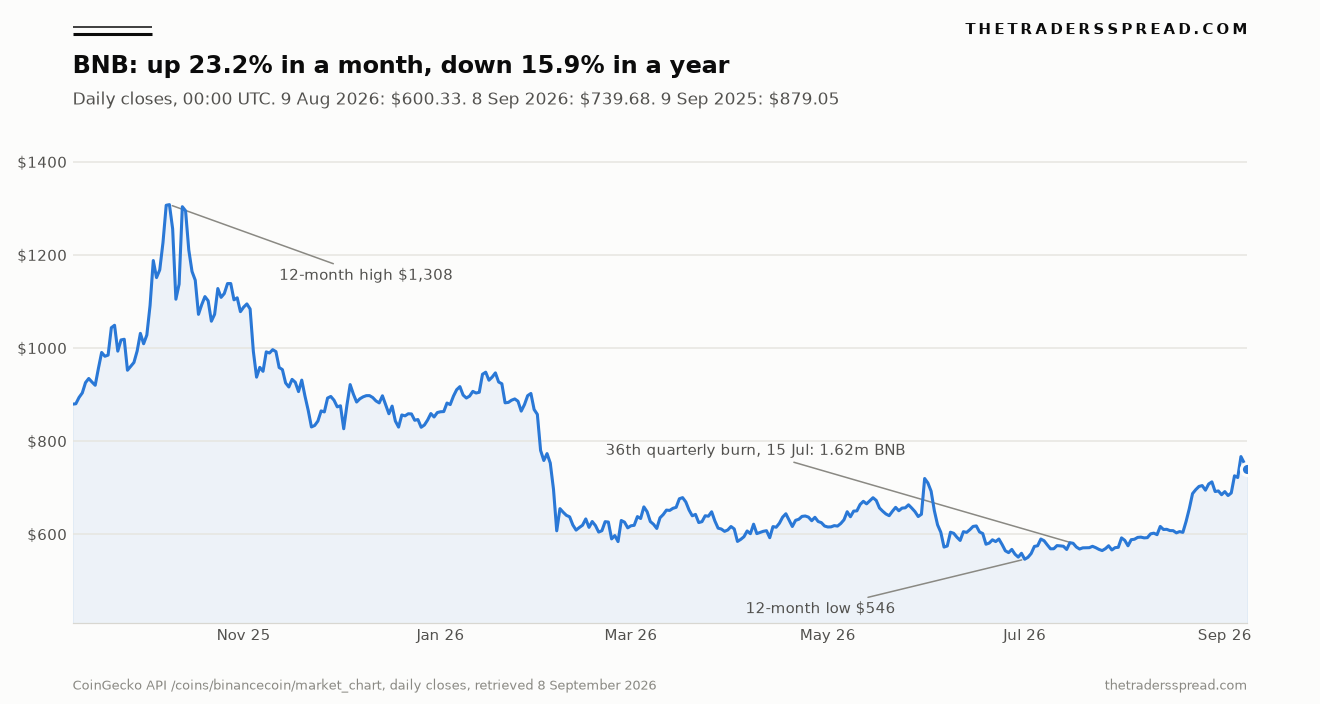
Zooming out reframes the whole story. BNB is down 15.85% over twelve months and down 43.4% from its 12-month closing high of $1,307.76 on 9 October 2025. Read alone, that is a broken asset. Read against its peers, it is the best-performing major layer one on the board.
| Asset | 19–23 Aug 2026 | 3–6 Sep 2026 | 30 days to 8 Sep | 12 months to 8 Sep |
|---|---|---|---|---|
| BNB | +15.2% | +11.4% | +23.2% | −15.9% |
| Bitcoin | +19.2% | +3.3% | +21.8% | −29.4% |
| Ether | +26.5% | +3.7% | +30.0% | −42.2% |
| Solana | +21.9% | +2.8% | +36.6% | −51.6% |
All figures computed from CoinGecko daily closes at 00:00 UTC, retrieved 8 September 2026.
Losing 15.9% in a year when ether lost 42.2% is relative outperformance of 26 percentage points. The negative twelve-month print is not a BNB story at all. It is a layer-one de-rating in which BNB de-rated least, which is what you would expect from the token with the largest captive exchange demand base. Our work on solana's ETF assets and our bitcoin scenario piece sit inside the same drawdown.
Three explanations that die on contact with the data
I tested five candidate catalysts before I found one that survived. Three of them are the ones circulating most widely.
The burn. BNB Chain's 36th quarterly Auto-Burn retired 1,615,827.795 BNB, about $931.7m, on 15 July 2026, leaving total supply at 133,166,127.91. That is three and a half weeks before the window opened, and the next event is not due until October. Inside the window the only supply reduction is the BEP-95 real-time burn, which retires a fixed ratio of each block's gas fees. My measured supply change of 2,832 BNB against measured gas consumption of 28,310 BNB implies that ratio is still the original 10%. BNB Chain's own figure for cumulative BEP-95 burns since 2021 is roughly 291,000 BNB, or 18% of what a single quarterly event removes. A rounding error is not a 23% repricing.
DeFi growth. BNB Chain's total value locked rose from $4.92bn on 9 August to $5.66bn on 8 September, a gain of 15.0%, which reads as capital arriving. Divide those dollar figures by the BNB price on the same days and TVL goes from 8.200m BNB to 7.547m BNB, a fall of 8.0%. In native terms, capital left the chain during the rally. The dollar increase is the price of the collateral, not new collateral, which is why I convert every TVL series into the chain's own token before quoting it.
Leverage. If a squeeze were running, Binance perpetual open interest and funding would both be screaming. Open interest in BNBUSDT went from 608,521 BNB on 10 August to 636,032 BNB on 8 September, up 4.5% in token terms while the dollar figure rose 28% from $367m to $471m. Funding annualised between 0% and 10% across the window and sat at 1.6% on the morning of 8 September. A single-day burst on 6 September took open interest to 703,232 BNB and two thirds of it had unwound by 8 September. This was a spot bid, not a derivatives squeeze, which also means there is little forced-seller fuel underneath it.
Where the fees actually came from
The candidate that survived is boring to say and awkward to write about, because it is not an institutional story.
Total fees paid across BNB Chain, applications and gas together, ran at 63,554 BNB in the 30 days to 8 August. In the 30 days to 7 September they ran at 118,279 BNB, up 86.1% measured in the chain's own token so that price cannot flatter it. Gas alone, the portion that feeds BEP-95, went from 18,688 BNB to 28,310 BNB, up 51.5%. Daily gas on 7 September was $1.08m against $0.48m on 2 September.
One application accounts for most of the delta. Flap, which DefiLlama classifies as a launchpad, produced $24.08m of fees in the 30 days to 7 September. The comparable figure for the 30 days to 8 August was $5.27m, and for the 30 days to 8 July it was $1.16m. On 8 September Flap alone took $2.28m in 24 hours, more than double the $1.08m the chain collected in gas, and its week-over-week fee growth was 321%. Behind it sit GMGN, a trading bot that took $13.47m on the chain over 30 days, and PancakeSwap's V3 automated market maker at $12.06m, up 157% week over week. Chain decentralised exchange volume rose 21.4%, from $27.61bn to $33.52bn.
Those are the numbers behind the second leg. A launchpad going from $1.16m to $24.08m of monthly fees in two months is a speculation cycle, and speculation cycles on token launch venues have a short, well-documented half-life.
There is a sharper irony sitting on top of it. On 1 September, three days before the gas spike began, BNB Chain extended its zero-fee campaign for USDC, USD1 and U transfers, withdrawals and bridging until 30 September 2026 at 23:59 UTC, noting that "over $4.5M in gas fees has already been covered for users". The chain is paying to suppress the fee stream from stablecoin settlement, which is the most durable and least cyclical transaction type it hosts, while its burn mechanism is being fed by memecoin launches instead. That is a deliberate growth trade. It also means the fee line that is currently repricing the token is the volatile one by construction.
Who is responding, and who is not
The two institutional channels that would normally absorb a story like this both look quieter than the price does.
The VanEck BNB ETF has been listed on Nasdaq under VBNB since late May. Its registration went effective on 27 May 2026, the exchange certification landed the same day, and the fund closed at $27.96 on 4 September, near its 52-week high of $28.14. VanEck added BitGo Bank & Trust as a second BNB custodian under a custodial services agreement disclosed in an 8-K on 7 August 2026. Nothing in that sequence is new inside the window, which is the point: the access channel opened three months before the rally. Bloomberg ETF analyst James Seyffart, writing in May as Grayscale and VanEck amended their filings, said BNB "could be the next crypto asset to get a spot ETF in the US". By the time the price moved, that question was settled.
Corporate treasuries are the second channel, and the filings are emptier still. CEA Industries Inc., which trades on Nasdaq as BNC, reported 515,544 BNB at its 30 April 2026 fiscal year end, split 487,956 unrestricted and 27,588 restricted, with digital assets carried at $319.6m and $3.1m of cash. "Fiscal 2026 was a transformative year for CEA Industries, marked by our strategic pivot in August 2025 to become the largest publicly traded digital asset treasury focused exclusively on BNB," said David Namdar, then Chief Executive Officer, in the company's results release of 22 June 2026.
Namdar is gone. An 8-K filed on 24 July 2026 records his exit no later than 31 August, Alex Odagiu appointed interim president from 23 June under a consulting agreement paying $25,000 a month for 32 hours a week, and chief financial officer William B. Miller taking the interim principal executive officer role from 22 July. The company's two filings inside the 30-day window are an 8-K on 10 August confirming it regained compliance with Nasdaq Listing Rule 5620(a), and an 8-K on 4 September withdrawing the designations for two unissued preferred series. No BNB purchase is disclosed in either. BNB Plus Corp, an OTC vehicle, filed an officer-change 8-K on 3 September and nothing else. The treasury bid that headlines keep invoking has no filed footprint in this window at all.
What would make me wrong
My case rests on the fee series being real activity rather than wash volume, and that is the assumption most likely to break. Launchpad fee revenue can be manufactured by the launchpad's own participants, and DefiLlama measures what the contracts report, not the intent behind them. If Flap's throughput is substantially self-dealing, the second leg has no economic content and my distinction between the August and September moves collapses into one beta trade.
The second thing that would change the picture is duration. Compare this with Aave's 50% move on deposit growth or Hyperliquid's run on a regulatory catalyst: those rest on balances and licences, which are sticky. Launchpad gas is not sticky. If daily chain fees fall back under 3,000 BNB, the mechanism I have described has stopped operating and the price no longer has the support I am attributing to it.
RelatedToncoin (TON) Price Prediction: $2.15 Bull vs $1.15 Bear
What this changes
The most useful consequence is a measurement one. BNB has spent five years being valued on a burn narrative, and this window is a clean natural experiment showing what that mechanism is worth at monthly frequency: 2,832 coins, about $2.1m, against a $99.96bn capitalisation. Anyone modelling BNB as a deflationary asset on the strength of the quarterly headline is modelling a variable that changes four times a year and is set by a formula referencing price and block count, not demand. The real-time burn, the part that responds to usage, is two orders of magnitude too small to matter over any horizon a trader cares about.
The second consequence is about what BNB Chain is becoming. Three of the top four fee generators on the chain are a launchpad, a trading bot and an automated market maker, and total value locked in native terms fell 8.0% while all of that was happening. That describes a venue optimised for token issuance and rapid turnover rather than for holding capital. It is a legitimate business and currently a lucrative one, but it prices differently from a settlement chain: higher beta to retail speculation, lower persistence, and a revenue line one bear week away from halving.
The third consequence is structural, and it is the one I expect to matter beyond this quarter. The zero-fee stablecoin campaign runs to 30 September. Whatever BNB Chain does at that date is a direct statement about which fee stream it wants: extend again and it keeps subsidising the boring, durable flows out of the burn calculation; let it lapse and stablecoin settlement starts feeding BEP-95 alongside the launchpads. The October quarterly burn will be the first whose Auto-Burn inputs reflect the September spike, and it arrives with the price roughly 35% above the July low, which mechanically shrinks the coin count retired for a given amount of value.
One last thing worth holding onto. An asset down 15.9% on the year and 46% below its record is not a momentum story that has run away; it is a damaged asset that has clawed back a quarter of its drawdown on a fee stream that did not exist in July. Both halves are true at once, and a reader who sees only one of them will misread whatever happens next.
FAQ
How much did BNB actually rise, and over what window?
BNB rose 23.2%, from a close of $600.33 on 9 August 2026 to $739.68 on 8 September 2026, using CoinGecko daily closes at 00:00 UTC. The live tick at 07:22 UTC on 8 September was $750.29. CoinGecko's two endpoints report different 30-day figures, so this one is recomputed from the daily close series.
Did the token burn cause the rally?
No. The last quarterly Auto-Burn was on 15 July 2026, three and a half weeks before the window opened, and it removed 1,615,827.795 BNB. Inside the window itself, circulating supply fell by 2,832 BNB, roughly $2.1m of value against a $99.96bn market capitalisation. The next quarterly burn falls due in October.
Why is BNB down over twelve months if the last month was so strong?
The whole large-cap layer-one group de-rated between October 2025 and July 2026. BNB fell 15.9% over the twelve months to 8 September, against 29.4% for bitcoin, 42.2% for ether and 51.6% for solana. BNB's negative year is the mildest of the four, and the rally has retraced about a quarter of the drawdown from its October 2025 closing high of $1,307.76.
What is driving BNB Chain's fee growth?
Token launch activity. Flap, a launchpad, generated $24.08m of fees in the 30 days to 7 September against $1.16m two months earlier, and on 8 September took more in 24 hours than the chain collected in gas. GMGN, a trading bot, and PancakeSwap's V3 pools account for most of the remainder. Total chain fees rose 86.1% measured in BNB rather than dollars, so the increase is not a price artefact.
Is there a US spot BNB ETF?
Yes. The VanEck BNB ETF trades on Nasdaq under VBNB, its registration statement having been declared effective on 27 May 2026. VanEck disclosed a second custodian, BitGo Bank & Trust, in an 8-K on 7 August 2026. The fund closed at $27.96 on 4 September 2026, near its 52-week high of $28.14.
How leveraged is the current move?
Very little, on the venue with the deepest BNB perpetual book. Binance BNBUSDT open interest rose 4.5% in token terms across the window, from 608,521 BNB to 636,032 BNB, and funding annualised between 0% and 10%. A one-day spike to 703,232 BNB on 6 September had largely unwound within 48 hours.
Disclaimer
This article is analysis and information, not investment advice, and it is not a recommendation to buy, sell or hold any asset. Digital assets are volatile and your capital is at risk. Figures are sourced and dated as shown and were correct at the time of retrieval on 8 September 2026; prices move continuously and any of them may be out of date by the time you read this. Do your own research and consider taking regulated professional advice before making any financial decision.