

Bittensor (TAO) closed on 28 September 2026 at $308.20 on Binance, seventy cents above its close of 28 September 2025. In the twelve months between those two prints, the network halved the rate at which it creates new TAO, from roughly 7,200 tokens a day to 3,600. A supply cut of that size is supposed to leave a mark on price, and after a year the mark is zero. Now the last quarter: TAO is up 52.4% since its 30 June close of $202.20, and 30.7% in the last thirty days alone. The token that did nothing for a year is also one of the summer's better large caps. This piece works out which reading the market is trading, and sets a bull case at $480 and a bear case at $190 for the end of the year, against a live Binance price of $314.30 at 09:54 UTC on 29 September.
The flat dollar line hides the real story, and the real story is in the denominator. Priced in bitcoin, TAO has not been flat at all. On 28 September 2025 one TAO bought 274,152 satoshis. On 28 September 2026 it bought 369,102, a gain of 34.6%, because bitcoin itself fell 25.6% over the same twelve months on Binance closes, from $112,164 to $83,500. The two AI tokens that trade most like TAO did far worse in dollars: Render lost 43.5% and FET, the ASI Alliance token that began life as Fetch.ai, lost 61.3%. Read that way, the halving did its job. It did not lift TAO in absolute terms, because the whole crypto tape fell away beneath it. What it did was make TAO the asset its own sector sold last. That changes how to think about the upside, because the relative strength has already been paid for. The next leg needs dollar buyers, not just a gentler rate of dilution.
Key facts
- Spot: $314.30 on Binance TAO/USDT at 09:54 UTC, 29 September 2026; coinpaprika showed $315.11 and a $3.02bn market cap, rank 43, at 09:52 UTC. (Binance, coinpaprika, 29 Sep 2026)
- One-year change: +0.2%, from a $307.50 close on 28 Sep 2025 to $308.20 on 28 Sep 2026; bitcoin fell 25.6% over the same window. (Binance daily closes, recomputed by The Traders Spread, anchor date 28 Sep 2026)
- Issuance: 0.5 TAO per 12-second block, about 3,600 TAO a day, since the first halving in December 2025; the next halving fires when total issuance reaches 15.75m TAO. (Bittensor documentation, emissions page, retrieved 29 Sep 2026)
- Dollar value of new supply: about $1.11m a day at the 28 September close, down from roughly $2.22m a day at the same price before the halving. (The Traders Spread calculation)
- Grayscale Bittensor Trust held 46,331.54 TAO with net assets of $9.39m at 30 June 2026, and had 2,994,200 shares outstanding by 28 September. (SEC Form 10-Q, 4 Aug 2026; Form 8-K, 28 Sep 2026)
- Realised volatility: 98% annualised over the past year and 108% over the past 30 days, from Binance daily log returns. (The Traders Spread calculation, 28 Sep 2026)
- All-time high: $769.13 on 11 April 2024, which leaves TAO about 59% below the peak. (coinpaprika, 29 Sep 2026)
What the halving actually removed
Bittensor's supply schedule borrows bitcoin's cap and not much else. There will only ever be 21 million TAO, and the emission rate halves at fixed points on the way there, but the trigger is not a block height. According to the protocol's own emissions documentation, a halving fires when total issuance crosses the midpoint of the remaining supply: 10.5 million TAO for the first, 15.75 million for the second. TAO that is recycled, which includes registration burns and some fees, is subtracted from that total and can be emitted again. Recycling therefore pushes each halving further out.
The first one landed on 12 December 2025. The docs page carries a mainnet snapshot, fetched on 11 August, showing total issuance of 11,222,524.60 TAO. That leaves about 4.53 million TAO to go before the second cut. At 3,600 a day, a straight line puts it around the start of 2030. Recycling would make it later.
So the next supply event is not a 2026 trade, and anyone pricing TAO off a halving countdown is pricing something more than three years away. The December cut is also the only one that matters for the fourth quarter, and it is already nine months old. What it changed is the size of the daily sell flow that miners, validators and subnet owners could put into the market if they chose to. At $308.20, 3,600 TAO is worth about $1.11m a day, or roughly $405m a year. Before December the same price would have implied $2.22m a day. Half of that overhang has gone.
The other half is still there, every twelve seconds, and it has to be absorbed by someone.
There is a second mechanism that matters more for the next three months than the halving does. Each block's TAO is split across subnets according to the moving price of each subnet's own alpha token, and the documentation describes an emission gate that is now applied to those shares. Its midpoint, theta, is by default the 32nd-highest adjusted share, recalculated every 360 blocks. A subnet sitting at theta passes half of its weight. Subnets well below it pass much less, and the curve is steep: the gate uses an exponent of three. In plain terms, emissions are being concentrated in the subnets the market already values. That is healthy if you believe the market's ranking. It also means the long tail of subnets, which a ForeverMoney post on 26 August counted at 128, now competes for a smaller slice of an already halved emission.
The tape: TAO against its own sector
Every percentage below was recomputed from Binance daily closes rather than taken from an aggregator's headline field, with 28 September 2026 as the anchor. The TAO series was cross-checked against Kraken's daily OHLC over 399 overlapping days: the mean absolute difference between the two venues' closes was 0.08%, and there were no alternating one-day spikes of the kind that have corrupted other price series we have audited this month.
| Asset (Binance USDT pair) | 1 year | 90 days | 30 days | 28 Sep 2026 close |
|---|---|---|---|---|
| Bittensor (TAO) | +0.2% | +52.4% | +30.7% | $308.20 |
| Bitcoin (BTC) | -25.6% | +42.4% | +6.7% | $83,500 |
| Render (RENDER) | -43.5% | +29.1% | +33.8% | $1.95 |
| ASI Alliance (FET) | -61.3% | +30.7% | +50.3% | $0.2246 |
Two things jump out of that table. The first is the one-year column, where TAO is the only line that is not deeply negative. The second is the 30-day column, where TAO has lagged both Render and FET. The September rally in AI tokens was a sector move, and TAO was carried by it rather than leading it.
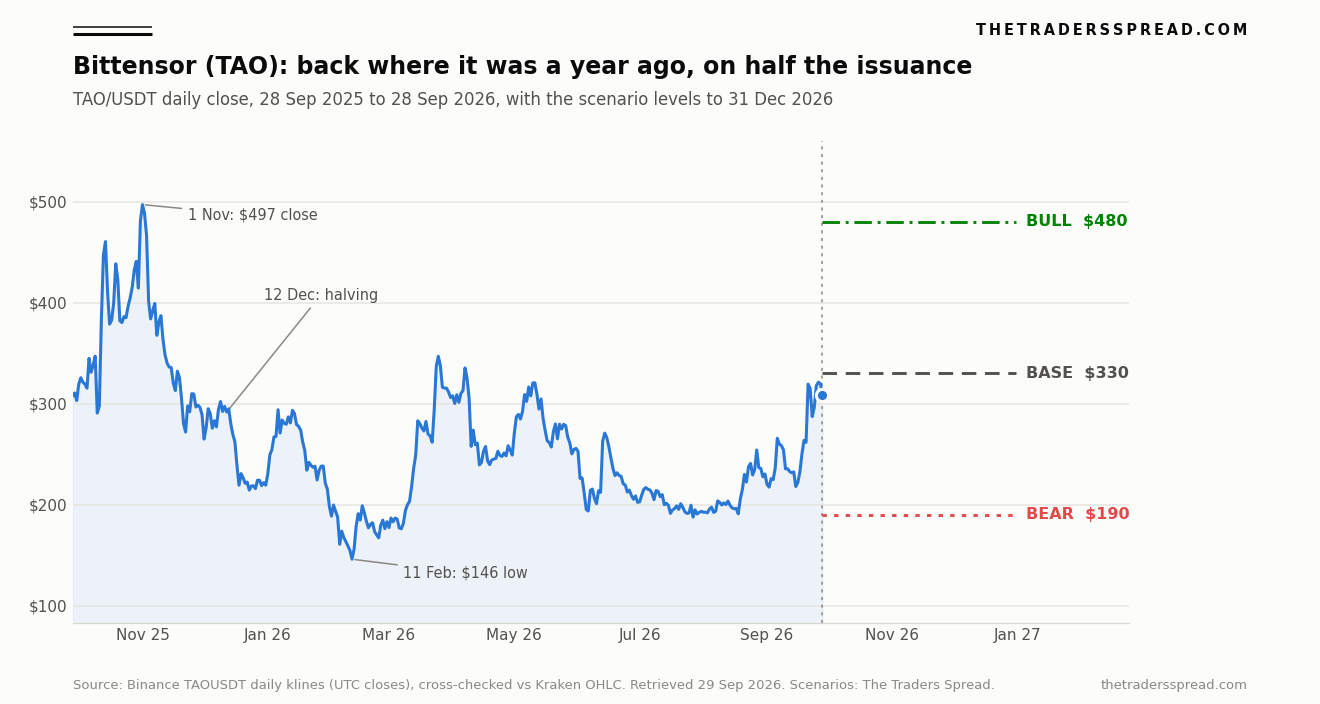
The chart shows why the year-on-year number is so misleading. TAO did not drift sideways for twelve months. It ran to a $497.20 close on 1 November 2025, sat near $292 into the halving, fell to $145.90 by 11 February 2026, rebuilt to $347.00 on 25 March, broke again in April, slid to a $187.60 close in July, and has closed between $287.20 and $321.20 in all eight sessions since 21 September. That round trip from $497 to $146 and back to $308 is the context for any target: at 98% annualised volatility, a one-standard-deviation move over the 93 days to year-end is roughly 50% either way.
The biggest single day of the current run came on Monday 21 September, when TAO closed at $319.40, 22.0% above the previous day's $261.70. CryptoTicker, reporting that day, found no Bittensor-specific trigger and tied it to the wider tape, with bitcoin at its highest level since January above $85,000 on a wave of short liquidations. We have seen the same pattern elsewhere this month: our Filecoin write-up on its 75% supply cut found a token rallying ahead of a scheduled issuance change, which is a cleaner catalyst than anything TAO had on 21 September. For the broader bitcoin frame that this move rode on, our bitcoin scenario piece sets out the levels that matter.
Who is on the other side of the trade
If 3,600 TAO a day needs a buyer, the obvious candidate is the regulated wrapper. In December 2025, days before the halving, Will Ogden Moore, a research analyst at Grayscale, set out the institutional case in comments reported by BeInCrypto via Yahoo Finance: "The early success of certain subnet-based applications and an increase in institutional capital in the Bittensor ecosystem, combined with the forthcoming TAO supply halving, could be a positive catalyst for price, in our view."
Grayscale's own filings measure how that institutional capital has turned out. The trust's 10-Q for the quarter to 30 June 2026 shows 46,331.54 TAO held against net assets of $9.39m. That is equal to about 12.9 days of network issuance. Put another way, the entire US-listed institutional wrapper for TAO, since its 2024 launch, holds less than two weeks of new supply. The trust still trades over the counter as GTAO. Grayscale filed an S-1 on 30 December 2025 to convert it into an exchange-listed ETF and an amendment on 2 April 2026, and as of 29 September EDGAR shows no effective registration and no listing.
The flow is growing, just not fast. Three 8-K filings on 27 August, 15 September and 28 September report 596,900 new shares created against 11,296 TAO in total, worth about $2.85m at the prices implied in each filing. That is about three days of issuance absorbed over roughly three months of reporting. The most recent 8-K, dated 28 September, values its 2,869.42 TAO at $891,272, an implied $310.61 per token, which tells you the latest creations were bought into the rally, not ahead of it. By our arithmetic from the trust's TAO-per-share ratio, it now holds somewhere near 56,000 TAO.
Other routes in are similarly thin. ForeverMoney's bridge, which put TAO on Coinbase's Base network on 20 August, reported $613,000 of liquidity and $731,000 of cumulative volume in its launch post. Binance alone traded an average of $35.6m of TAO a day over the last 30 sessions.
So the marginal buyer through September was not an ETF, a treasury company or a bridge. It was spot and derivatives flow on the major venues, arriving when bitcoin broke out. That buyer can leave as fast as it came, and the Solana ETF story we covered in August shows the alternative: a coin whose US spot ETFs held $1.06bn by late August. TAO's wrapper holds about half of one percent of the token's market cap.
The governance discount nobody has priced out
April is the other date on the chart that matters. Covenant AI, which ran several subnets, announced it was leaving Bittensor, and its founder Sam Dare accused co-founder Jacob Steeves of using his position to push it out: suspending emissions to its subnets, restricting moderation rights and selling tokens as pressure. On Binance, TAO fell from a $325.10 close on 8 April to $257.70 on 10 April, a 20.7% two-day drop, on the heaviest and third-heaviest volume sessions of the past year.
Steeves rejected the account. "I do not have the ability to suspend emissions," he said in a public response reported by FinanceFeeds, adding: "I don't have any privilege beyond what normal TAO holders have." His argument was that his token sales moved emissions only through ordinary market mechanics, which is precisely how the protocol is designed to work. That is the uncomfortable part. If a large holder can shift a subnet's emissions by selling its alpha token, then the design is working as intended and a well-capitalised participant can still decide who gets paid.
The emission gate sharpens this. When the 32nd-ranked subnet sets the midpoint and the curve is cubic, a fall in one subnet's alpha price does not cost it a proportionate slice of emissions; it can cost it most of them. For a trader, the relevance is simple. Governance shocks on Bittensor arrive as price gaps. Five months on, the April gap is still open on a closing basis: the best close since, $321.20 on 26 September, sits below the $325.10 that preceded the drop. Any bull case has to survive another one.
What the consensus misses
Most TAO commentary this month has argued in one of two directions. One camp says the halving is a slow-burning supply story that is only now showing up. The other says the rally is sector beta with nothing underneath. Both skip the TAO/BTC line. A token that rose 34.6% against bitcoin in a year when bitcoin fell a quarter already has something underneath it. What it lacks is a dollar bid of its own.
That distinction decides the targets. If bitcoin holds above $80,000 and AI tokens keep their bid, TAO's relative strength can turn into absolute gains quickly, because issuance is half what it was and the April overhang has cleared. If bitcoin rolls over, the one-year record says TAO will fall less than Render or FET, but falling less is still falling. Holders comparing it with other supply-schedule stories on this desk, such as our Zcash (ZEC) bull and bear levels, will notice the same thing: the scarcity argument sets the floor under relative performance, not the direction.
RelatedStellar (XLM) Falls 6.8% in the Week Chainlink Went Live
The call: $330 base, $480 bull, $190 bear
Base case, $330 by 31 December 2026 (45%). TAO holds most of the September move and ranges between roughly $260 and $380. That is 5% above spot. The halving arithmetic keeps daily sell pressure at about $1.1m, the Grayscale trust keeps creating shares at the pace of the last three 8-Ks, and bitcoin trades sideways in the low-to-mid $80,000s. The $347.00 close from 25 March, the highest of 2026, acts as a ceiling on daily closes for most of the quarter.
Bull case, $480 (25%). This needs a daily close above $347, then a push back towards the zone of the November 2025 peak. The most plausible triggers are an effective GTAO registration, which would give the token its first US exchange-listed wrapper, or bitcoin running into the $90,000s and dragging the AI basket with it. $480 is 52.7% above spot, which is just under one standard deviation at trailing volatility. It stops short of the $497.20 close because the first test of a prior high usually fails.
Bear case, $190 (30%). A 39.5% fall to $190 would put TAO back at the 18 August close of $190.90, before the Base bridge and the September rotation. The route is a bitcoin reversal below $75,000 combined with a second governance episode or a sharp drop in a top-ranked subnet's alpha price. A daily close below $287.20, the 23 September low close, would be the first sign; a close below $230 would take the whole rotation back and is where our bull tilt is invalidated.
What would change my mind. On the upside, a GTAO listing or a month in which the trust's 8-Ks show creations above 3,600 TAO a day, meaning the wrapper absorbs more than the network issues. On the downside, the TAO/BTC ratio falling back below 300,000 satoshis. That would say the relative strength that defined the past year has broken, and the halving thesis would have to be rebuilt from scratch.
FAQ
What is the Bittensor (TAO) price prediction for the end of 2026?
Our base case is $330 by 31 December 2026, with a 45% weight. The bull case is $480 (25%), which requires a daily close above $347 and a new catalyst such as an exchange-listed Grayscale product. The bear case is $190 (30%), which would follow a bitcoin reversal below $75,000 and a break of $287. All three are scenarios, not recommendations.
Did the Bittensor halving work?
In dollar terms it did not lift the price: TAO closed 28 September 2026 at $308.20, almost exactly where it was a year earlier. In relative terms it looks better. TAO gained 34.6% against bitcoin over that year while Render fell 43.5% and FET 61.3% in dollars. Issuance fell from about 7,200 to 3,600 TAO a day in December 2025.
When is the next TAO halving?
The second halving fires when total issuance reaches 15.75 million TAO, according to Bittensor's documentation. A mainnet snapshot on the docs page showed 11.22 million issued as of 11 August 2026. At 3,600 TAO a day that points to around the start of 2030, and recycled TAO pushes the date later, so it is not a factor for 2026 pricing.
Is there a Bittensor ETF?
Not yet. Grayscale Bittensor Trust trades over the counter as GTAO. Grayscale filed an S-1 on 30 December 2025 to convert it into an exchange-listed ETF and amended it on 2 April 2026. As of 29 September 2026 SEC records show no effective registration. The trust held 46,331.54 TAO at 30 June, worth $9.39m.
Why did TAO jump 22% on 21 September 2026?
TAO closed at $319.40 that day, up 22.0% from $261.70 on Binance. CryptoTicker's report the same day found no Bittensor-specific news; AI-linked tokens rose as a group while bitcoin broke above $85,000 on short liquidations. That makes the move sector beta rather than a change in the network's fundamentals.
Disclaimer
This article is analysis and information only and is not investment advice or a recommendation to buy or sell any asset. Cryptoassets are highly volatile and you can lose all of the capital you commit. Scenario levels and probabilities reflect the author's view on the date of publication and can change without notice. Figures are sourced and dated in the text, and prices will have moved since publication.